How do neuronal ensembles span seizures and the intervals between them?
A male-mouse study labels piriform-related neuronal ensembles by experience. During focal seizures, calcium rises in the seizure-related ensemble but changes nonsignificantly in the interictal-related ensemble. Broad tagging windows also permit overlap.
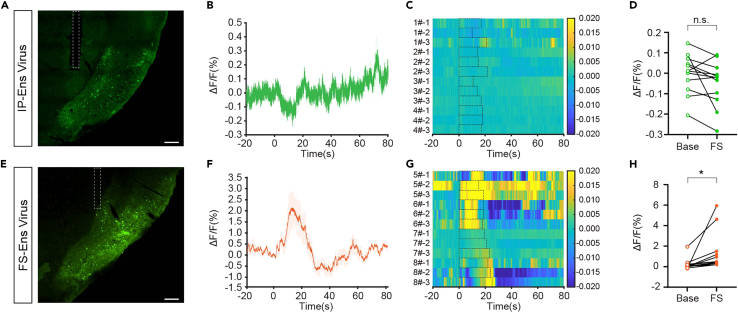
Seizures can be brief and intense, separated by much longer interictal intervals. How does the brain move between these states, and do the same cells always participate? An article published in STAR Protocols on April 25, 2023 presents experience-based ensemble identification in a mouse hippocampal-kindling model. The team focuses on the piriform-related APir region, combining activity-dependent labeling with calcium recordings to compare interictal-related and focal-seizure-related ensembles. Its central demonstration is that the tagged populations respond differently during the same type of seizure.
During focal seizures, mean calcium increases significantly in the seizure-related tagged ensemble. The interictal-related ensemble shows a downward trend that is not significant. Activity history distinguishes populations, while broad tagging windows prevent a pure separation.
Contents · 6 sections
Identifying cells by experience as well as location
A region contains many cells; increased regional activity need not mean that every member participates identically. Cells with similar molecular markers can also be recruited by different experiences. Activity-dependent labeling asks about another kind of identity: which cells were active during a particular experience.
This perspective is useful for epileptic networks. Seizures involve abnormally synchronized neuronal activity in one or more regions, while interictal intervals occupy longer periods between them. Focusing only on seizures can miss network organization at other times. Seizures and interictal intervals are phases of the same network rather than separate pieces of tissue. Identifying ensembles associated with each phase brings temporal distinctions into subsequent observations beyond region-wide averages.
Tagging an experience and following later responses
The article uses the enhanced synaptic activity-responsive element E-SARE to link cellular activity with subsequent labeling. Temporally regulated expression allows experience-related cells to express a calcium indicator. Later recordings can then follow the population recruited during the earlier experience.
Such a tag does not define an immutable cell type. It depends on experience during labeling, activity strength and expression conditions. The team defines interictal-related IP-Ens and seizure-related FS-Ens populations and follows their population calcium during focal seizures.
A hippocampal model with recordings in a piriform-related region
The study uses hippocampal kindling, while the recorded populations lie in APir. Piriform cortex is implicated in seizure generation and propagation, making it relevant to network changes. The induction site and observation site differ, extending the analysis toward another related network node.
Histology shows calcium-indicator expression in the target region under both tagging conditions. Population fluorescence is aligned with seizure activity to follow cells carrying different experience tags around seizures. The fluorescence integrates calcium dynamics across a population.
Seizure-related calcium rises while the interictal-related change is nonsignificant
During focal seizures, mean FS-Ens calcium increases significantly relative to baseline. The seizure-experience-tagged population therefore shows enhanced calcium activity during subsequent seizures, linking earlier recruitment with later responses.
The mean IP-Ens trace trends downward, but its baseline-to-seizure difference is nonsignificant. Each ensemble dataset includes four mice and repeated recordings. Increased seizure-related activity alongside a nonsignificant interictal-related change forms the main comparison in the result figure.
Source: Lai N et al. · STAR protocols · CC BY-NC-ND
Original figure and English caption ↗
A broad time window permits population overlap
A seizure unfolds over a defined interval, but tagging does not capture an instant like a camera shutter. Drug entry into and clearance from brain tissue take time, allowing seizure-related tags to include cells active during interictal intervals. FS-Ens is not a pure set with no overlap with IP-Ens.
Activity must also sufficiently drive the responsive element to produce visible labeling. The observed population reflects both the experience and the tool’s response. Distinct average calcium profiles reveal ensemble features without providing a complete cell-by-cell inventory.
From regional averages to experience-linked networks
The work offers a way to examine seizure networks by asking when cells participated as well as where they are. Preserving activity history and following later calcium dynamics allows comparisons among phase-associated ensembles rather than treating an entire region as uniform.
The findings come from adult male mice in a hippocampal-kindling model and demonstrate ensemble labeling and recording. Calcium changes do not directly establish which population initiates, prevents or terminates seizures. Better temporal resolution and subsequent functional studies can clarify how overlapping ensembles participate in state transitions.