Beyond the tether: wireless, battery-free interfaces meet the nervous system
A technology review connects free behavior, soft interfaces, wireless sensing and feedback control, alongside the challenges of power and long-term stability.

When a mouse turns, runs or approaches a companion, a tether moves with it. For scientists studying natural behavior, that connection can itself become part of the experiment. Published in Nature Biomedical Engineering on March 8, 2021, a review by Won, Cai, Gutruf and Rogers surveys wireless, battery-free neuroengineering, from reducing external constraints to combining sensing and feedback within the body. Its map brings together capabilities demonstrated across cited studies.
Wireless, battery-free interfaces have brought selected sensing and modulation capabilities to freely behaving animals. Power, tissue compatibility, data transfer and feedback detection jointly determine their reach.
Contents · 6 sections
The tether can influence the behavior being observed
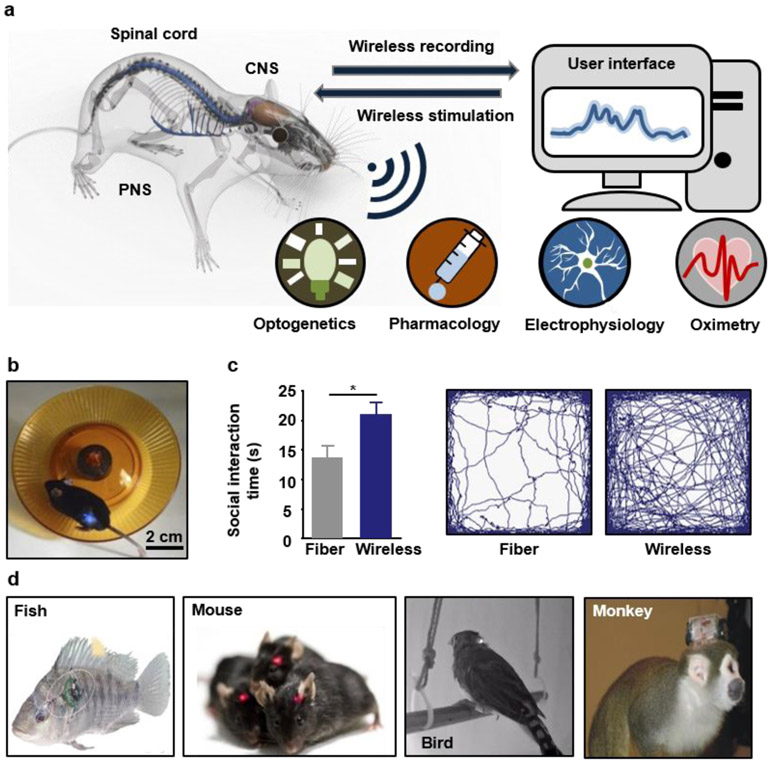
Conventional tethers provide a mature, direct route for optical, electrical or fluidic access. Pulling, tangling and attempts to remove a cable can alter movement and produce small shifts between soft tissue and rigid probes. These effects matter particularly for spinal, peripheral-nerve and social-behavior studies.
In a cited mouse comparison, social interaction and overall activity are greater under wireless recording than with fiber tethering. That wireless device still uses a battery, but illustrates the motivating point: changing the connection can change the behavior available for study.
Source: Won SM et al. · Nature biomedical engineering · TDM
Original figure and English caption ↗
After the battery is removed, where does power come from?
Batteries add mass and volume and require replacement or charging. Battery-free systems move part of that burden outside the body. Radio-frequency transfer, near-field magnetic coupling, ultrasound and light offer different routes; other systems harvest energy from bodily motion.
Each route involves trade-offs. Propagation through tissue, animal orientation and movement range affect available power, while sensing and transmitting more information raise demand. Battery-free operation redistributes the energy problem across the device, its environment and the research task.
Coverage of the intended activity space matters alongside device operation itself. A solution suited to a small-animal setting may perform differently in a larger space or at another tissue depth; power delivery must be assessed together with its environment.
A moving body calls for a compliant interface
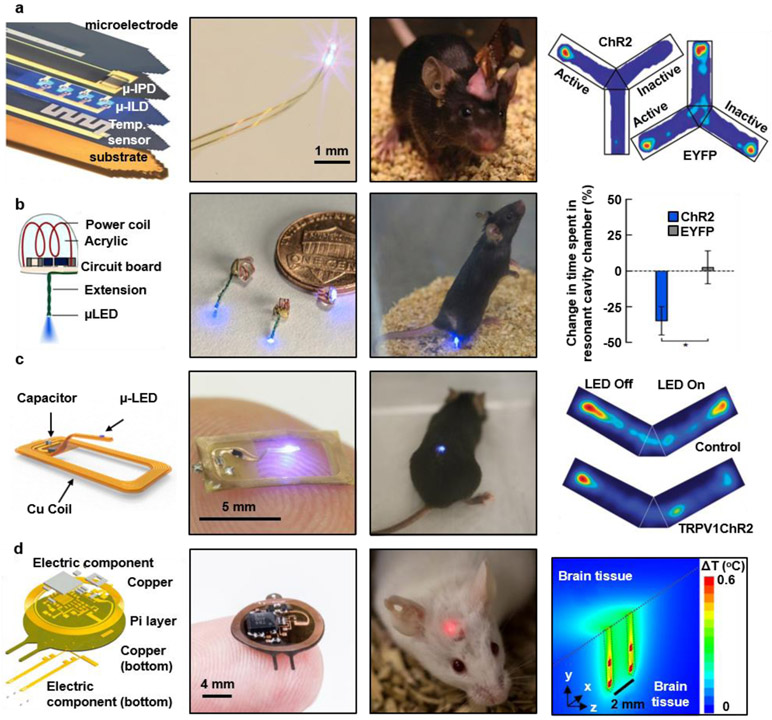
Neural tissue is soft, whereas hardware is often stiff. Removing an external tether leaves that mechanical mismatch in place. Flexible, stretchable structures can follow curved and moving anatomy, extending access from relatively stable cranial sites to the spinal cord and periphery.
The reviewed miniature optoelectronic interfaces demonstrate modulation and multimodal sensing at different sites. Compliance addresses only part of long-term integration: fluid ingress, tissue responses and device fatigue still influence how long an interface remains useful.
Source: Won SM et al. · Nature biomedical engineering · TDM
Original figure and English caption ↗
Listening to the body, as well as delivering signals
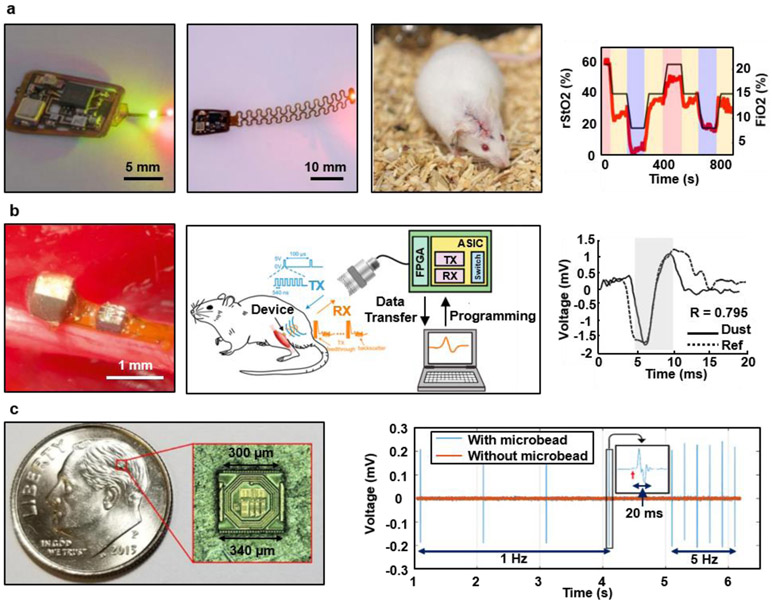
A device that only delivers stimulation leaves the current physiological state partly unknown. Sensing addresses that gap. The review presents regional tissue oxygenation, muscle electrical activity and nerve signals as distinct windows, each with different sensing and communication requirements.
Oxygenation recordings can track changes in oxygen availability, whereas electrical recordings capture nerve or muscle activity. Wireless transfer frees these observations from a data cable, making signal quality and continuous communication as consequential as miniaturization.
Source: Won SM et al. · Nature biomedical engineering · TDM
Original figure and English caption ↗
From scheduled action to a response based on state
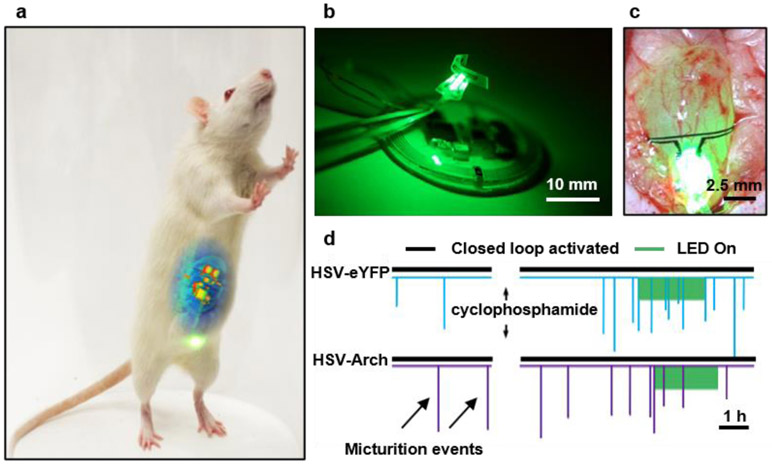
Combining sensing and modulation allows a shift from a schedule to a response based on physiological state. A closed loop must turn continuous measurements into a decision and then into timely feedback. Detection errors become a vulnerability of the whole system.
A cited rat bladder study combines sensing of organ deformation with feedback modulation. The figure shows reduced inflammation-associated frequent voiding in the functionally responsive closed-loop condition. This organ-level example demonstrates that feedback can be organized around impaired function, as well as neural signals.
Source: Won SM et al. · Nature biomedical engineering · TDM
Original figure and English caption ↗
Free behavior changes the conditions of observation
Across moving mice and dynamic organs, these studies seek interfaces that accommodate the body, rather than bodies that must continually accommodate a cable. Less constrained movement and interaction may reveal physiological relationships missed under restriction, while testing stability under more demanding conditions.
Long-term operation links competing requirements: barriers must resist fluids while following tissue deformation, and richer recordings require more bandwidth and power. Improving one feature can constrain another, so device size alone cannot rank the alternatives.
The remaining challenges are concrete: long-term sealing, continuous power, wireless bandwidth and reliable interpretation of increasingly complex signals. Successes across animals and functions have not converged into a universal clinical platform. They have changed how observations can be made, while showing how an instrument’s limits shape the brain and body we observe.