An unusual medial-habenula brake: depolarization can silence neurons
Strong nicotine stimulation briefly excites and then silences a subset of mouse medial-habenula neurons. Calcium-activated chloride channels sustain the plateau, while BK potassium channels help end it.
Neuronal inhibition often brings a lower membrane voltage to mind. In the medial habenula, however, sustained depolarization can also produce prolonged silence. A study published in Science Advances in 2025 records mouse neuronal responses to different strengths of nicotine stimulation: weaker stimulation increases firing, while stronger stimulation briefly excites and then silences a subset of cells. Following the underlying ion dynamics reveals an unusual brake organized by calcium, chloride and potassium channels.
In the medial-habenula intracellular chloride environment, calcium-activated chloride channels and high-threshold calcium channels support sustained depolarization. Sodium-channel inactivation prevents firing, while BK potassium channels help restore membrane voltage.
Contents · 7 sections
The same cells show opposing firing changes
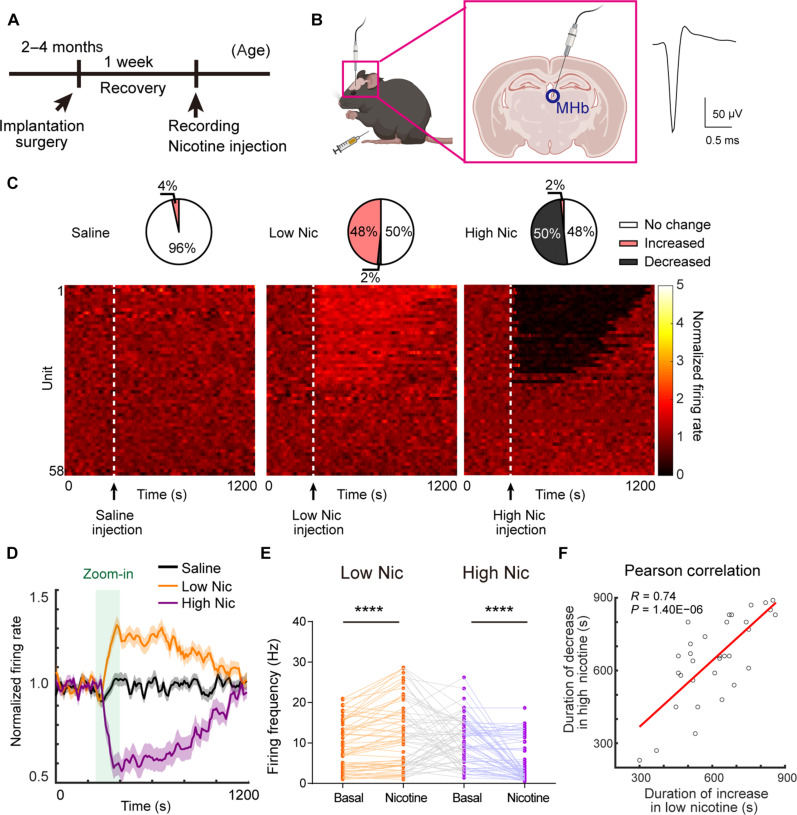
Single-unit recordings in freely moving mice show increased firing in roughly half the sampled cells after lower-dose nicotine, but decreased firing in roughly half after the higher dose, lasting minutes. Saline has little effect. Sequential comparisons in the same animals link the two response patterns.
Most cells excited by weaker stimulation become suppressed by stronger stimulation. Finer time resolution reveals a brief firing increase before suppression. The response therefore undergoes a transition from excitation to silence rather than shutting down immediately.
Source: Kawai T et al. · Science advances · CC BY-NC
Original figure and English caption ↗
Silence persists after stimulation ends
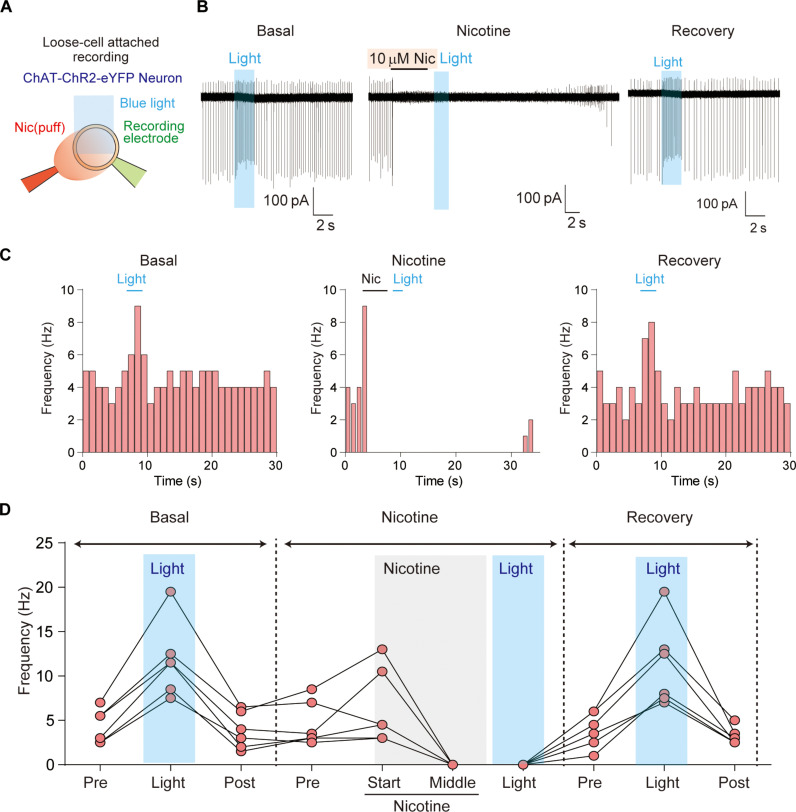
Ventral medial-habenula neurons in slices reproduce the transition. A brief weaker nicotine stimulus transiently increases firing, while a stronger stimulus is followed by prolonged silence that does not end immediately when stimulation stops.
The same optogenetic activation evokes firing at baseline and after recovery, but fails to recruit action potentials during the silent phase. This reversible state is termed a long-lasting refractory period, extending the consequences of a brief stimulus beyond its duration.
Source: Kawai T et al. · Science advances · CC BY-NC
Original figure and English caption ↗
During silence, voltage remains elevated
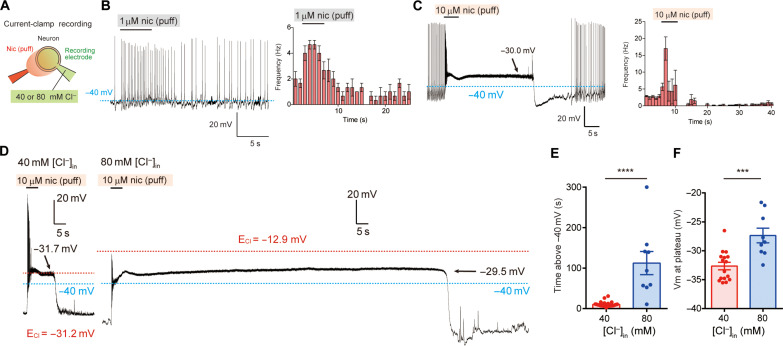
Voltage recordings reveal the apparent paradox: silent cells do not return to a strongly negative voltage, but remain near a plateau around −30 mV. Sustained voltage in this range prevents voltage-gated sodium channels from recovering from inactivation, interrupting repeated spikes.
Medial-habenula neurons have relatively high intracellular chloride and an elevated chloride equilibrium potential. Altering intracellular chloride changes both plateau voltage and duration, implicating chloride conductance in sustained depolarization.
Source: Kawai T et al. · Science advances · CC BY-NC
Original figure and English caption ↗
Calcium entry supports a persistent current
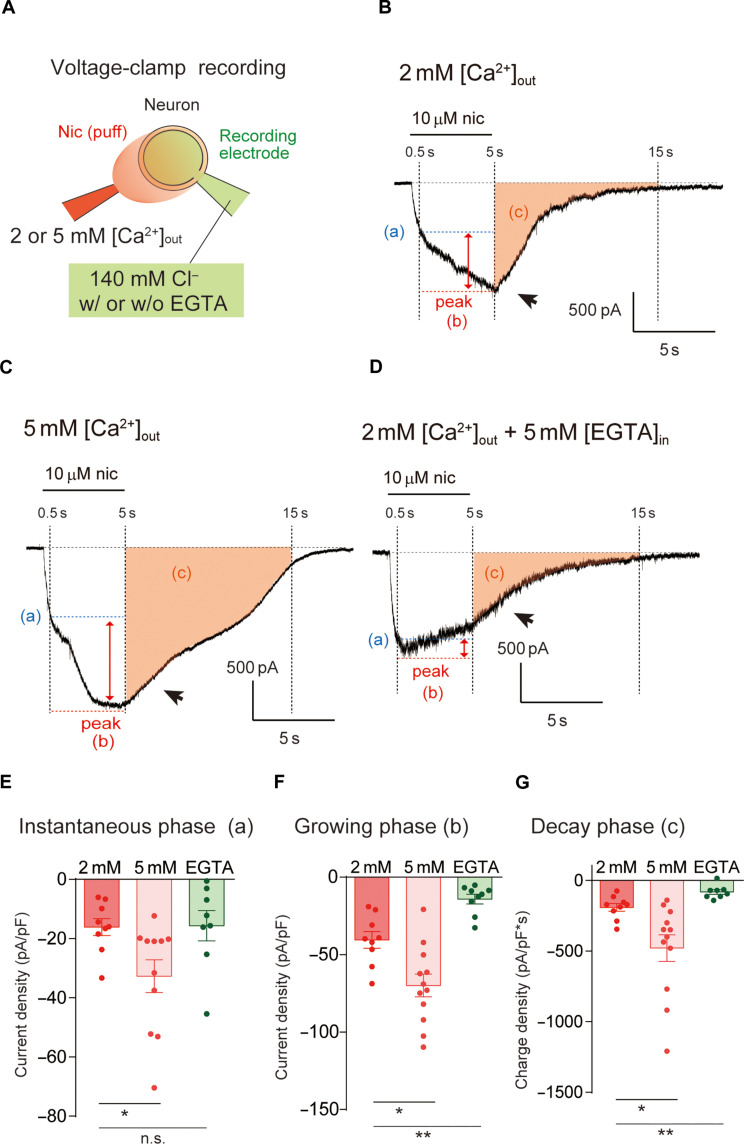
The strong-stimulus current has immediate, growing and slowly decaying phases. Higher extracellular calcium enhances the later current and prolongs decay. Intracellular calcium buffering reduces growth and the tail while largely preserving the initial rapid current.
The findings support a sequence in which nicotinic receptors initially admit cations and calcium, followed by calcium-activated chloride-channel recruitment. In this environment, chloride efflux further depolarizes the membrane, and persisting conductance helps keep the cell at a plateau unfavorable for firing.
Source: Kawai T et al. · Science advances · CC BY-NC
Original figure and English caption ↗
TMEM16A connects a molecular candidate with the refractory period
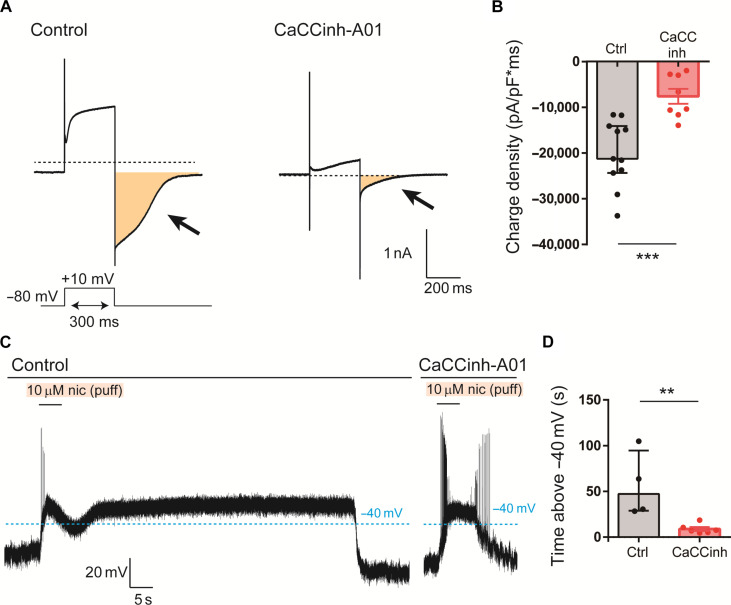
The team examines TMEM16A, a calcium-activated chloride channel abundantly expressed in the medial habenula. An inhibitor targeting it markedly reduces characteristic chloride currents and shortens the strong-nicotine plateau, linking this molecular candidate with the refractory period.
Channel properties, expression and pharmacological intervention together support the connection. They explain how calcium changes can leave a prolonged electrical response and lead to another question: how is calcium supplied to sustain the plateau after its initial entry?
Source: Kawai T et al. · Science advances · CC BY-NC
Original figure and English caption ↗
The plateau recruits additional calcium entry
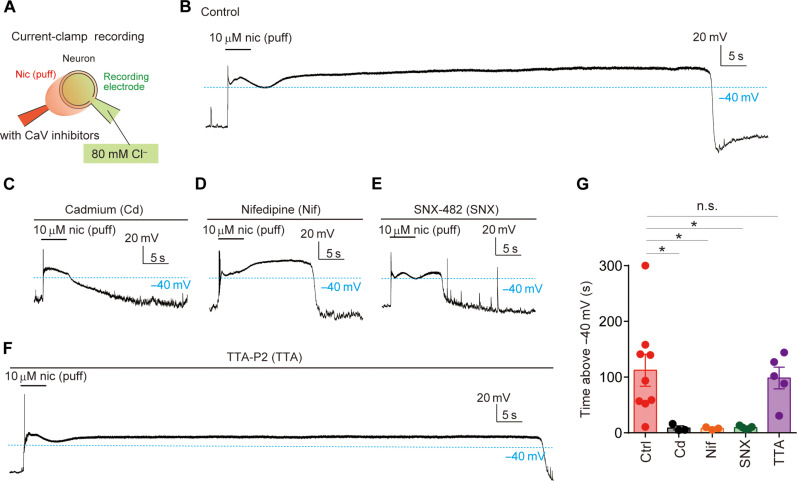
Near the plateau voltage, high-threshold voltage-gated calcium channels provide further calcium entry to sustain chloride-channel opening. Chloride-mediated depolarization and additional calcium supply form a mutually reinforcing loop, extending a brief receptor stimulus into a longer cellular state.
Broad calcium-channel blockade eliminates the prolonged plateau, and L- or R-type inhibition shortens the refractory period. T-type inhibition does not significantly change its duration, supporting a role for high-threshold calcium supply in maintaining the plateau.
Source: Kawai T et al. · Science advances · CC BY-NC
Original figure and English caption ↗
BK potassium channels help firing resume
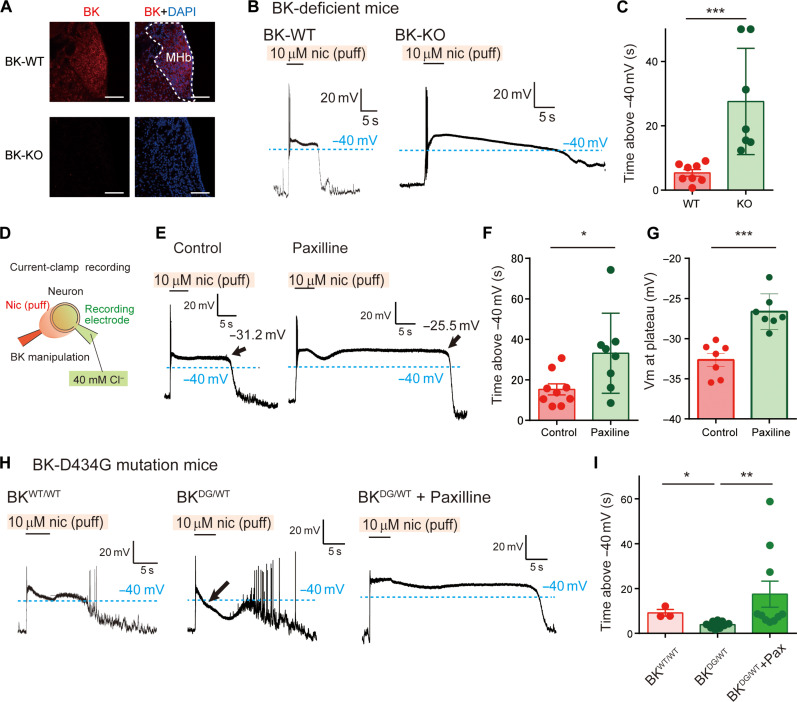
BK channels also respond to calcium and voltage, but potassium efflux drives the membrane toward more negative voltages. Cells from BK-deficient mice or treated with a BK blocker show longer plateaus. A gain-of-function variant largely prevents plateau formation and permits earlier firing recovery; BK blockade restores a longer plateau.
Experiments using male and female mice describe silence as a dynamic balance among ion channels. Chloride and calcium channels sustain depolarization, while BK helps end it. The study establishes a cellular mechanism of nicotine responses, without directly testing how it determines reward, aversion or consumption behavior.
Source: Kawai T et al. · Science advances · CC BY-NC
Original figure and English caption ↗