Why does itch drive both scratching and aversion? A pathway from anterior insula to bed nucleus
A mouse study identifies an excitatory projection from anterior insular cortex to the dorsal bed nucleus of the stria terminalis that contributes to both scratching and itch-related aversion.
Published in Current Biology on March 13, 2024, this study by Boxing Li and Lianyan Huang's group at Zhongshan School of Medicine, Sun Yat-sen University (with Jieyan Zheng, Xiao Min Zhang, and Wenting Tang as co-first authors) investigates the neural substrates linking itch sensation and negative affect. Combining in vivo fiber photometry, optogenetics, chemogenetics, trans-synaptic viral tracing, RNAscope in situ hybridization, and slice electrophysiology, the authors demonstrate that excitatory neurons in the anterior insular cortex (AICExt) are recruited during both histamine- and chloroquine-evoked scratching and itch-conditioned aversion, and drive GABAergic neurons in the dorsal bed nucleus of the stria terminalis (dBNSTGABA) via monosynaptic glutamatergic projections to mediate both scratching behavior and itch-induced aversion.
Excitatory neurons in the anterior insular cortex (AICExt) are robustly activated during histamine- and chloroquine-evoked scratching and conditioned place aversion, directly exciting Gad2+ GABAergic neurons in the dorsal bed nucleus of the stria terminalis (AICExt→dBNSTGABA); pathway-specific silencing of either presynaptic AIC or postsynaptic dBNST neurons suppresses both scratching and itch-induced aversion.
Contents · 7 sections
Histamine and Chloroquine Evoke Scratching Behavior Accompanied by Conditioned Place Aversion and Stress Facilitation
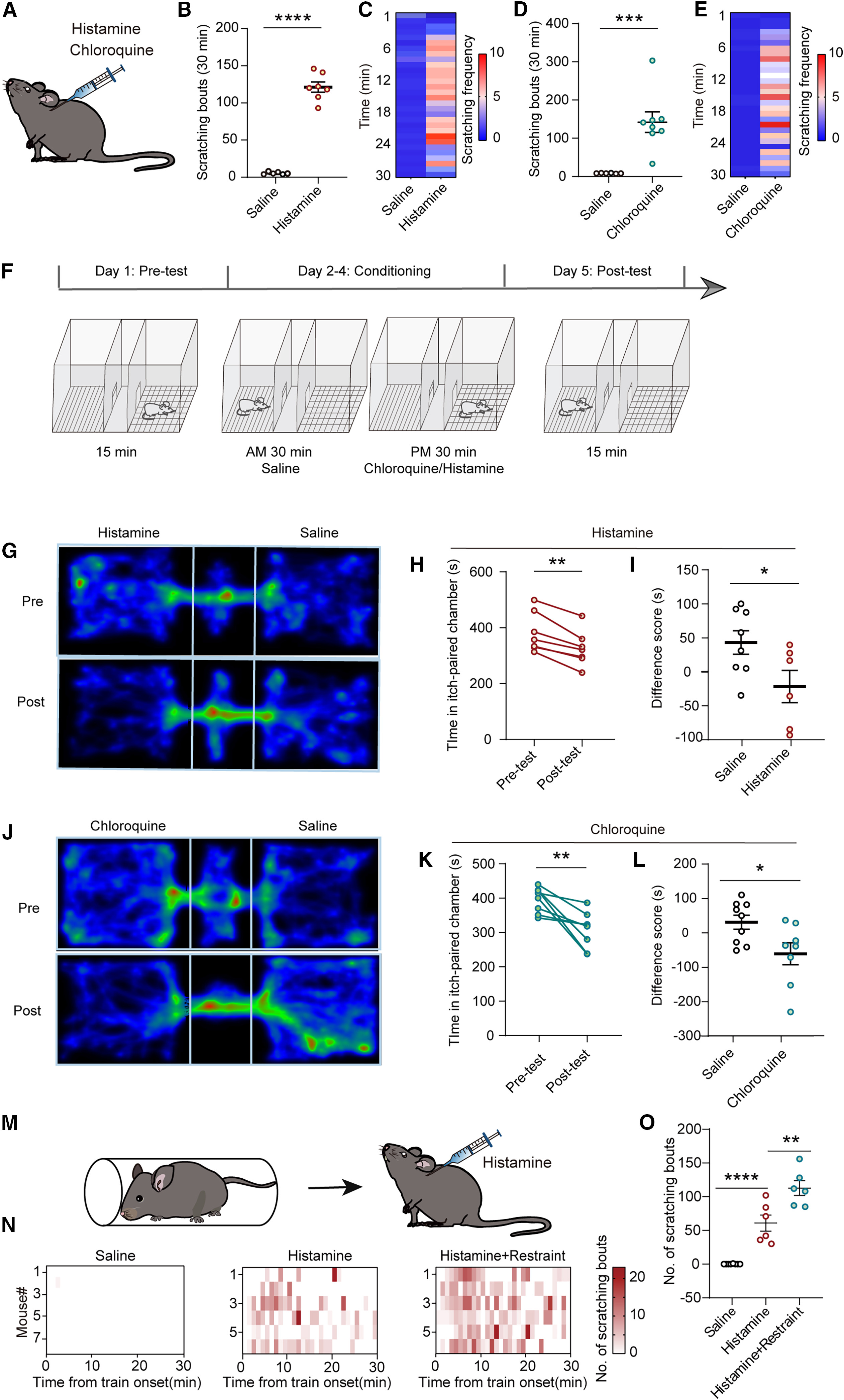
Intradermal injection of either histamine (500 μg/50 μL, histamine-dependent pruritogen) or chloroquine (200 μg/50 μL, histamine-independent pruritogen) into the nape of C57BL/6J mice evoked robust scratching bouts within 30 minutes. In a 3-day conditioned place aversion (CPA) paradigm, pairing either histamine or chloroquine with a conditioning chamber significantly reduced time spent in the itch-paired chamber during the post-test, yielding robust CPA scores.
Conversely, subjecting mice to 30 minutes of acute restraint stress prior to intradermal histamine injection significantly increased histamine-evoked scratching bouts without altering baseline scratching in saline-injected controls, demonstrating a bidirectional exacerbation between itch sensation and negative emotional state.
Source: et al. · Current Biology · Original figure reproduced for academic literature review under fair scholarly commentary; copyright remains with the authors/publisher.
Original figure and English caption ↗
Anterior Insular Cortex Excitatory Neurons Are Activated During Scratching Bouts and Entry into Itch-Paired Chambers
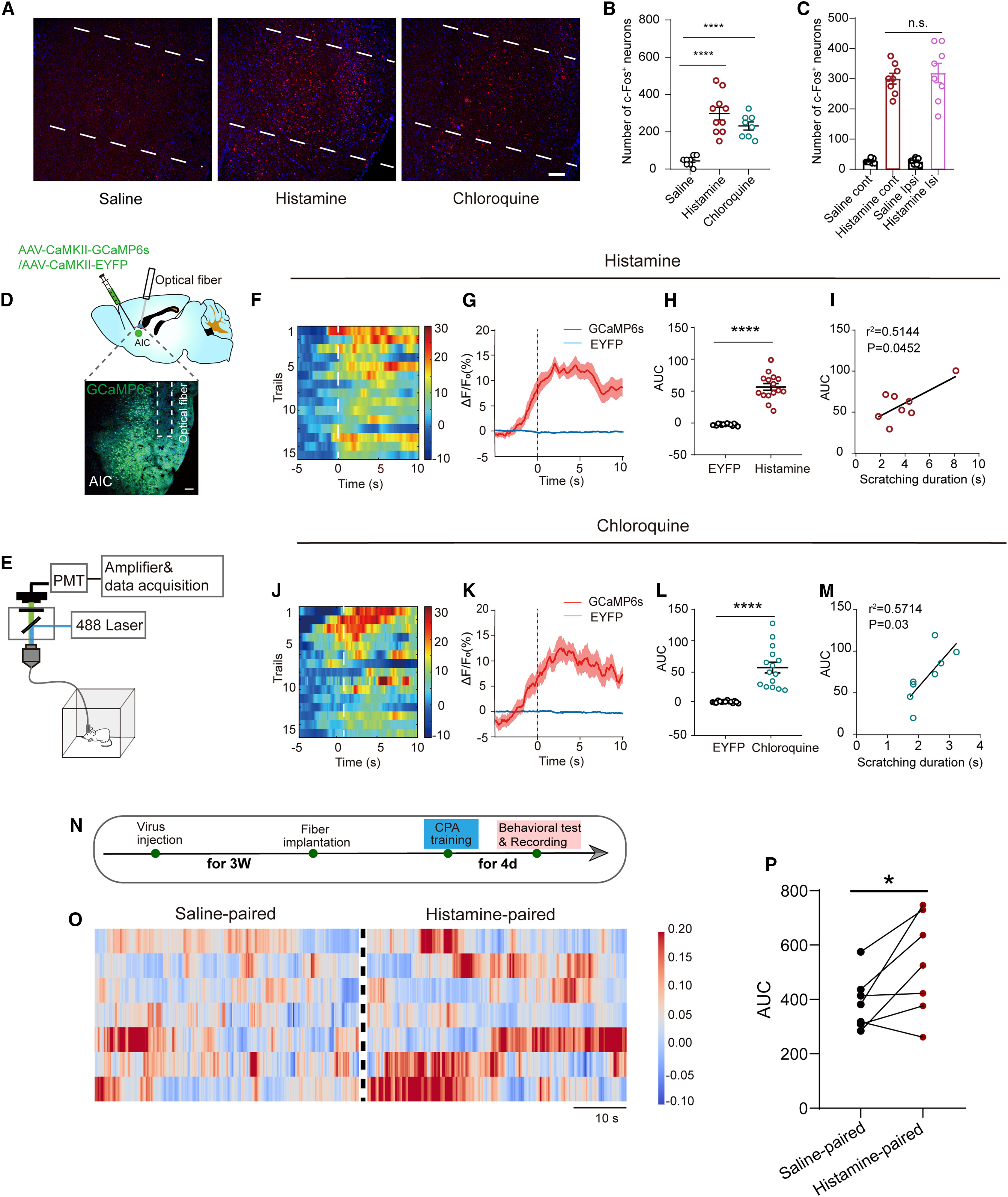
Both histamine and chloroquine significantly increased c-Fos expression bilaterally in the anterior insular cortex (AIC). In vivo fiber photometry in mice expressing AAV-CaMKII-GCaMP6s in the AIC revealed time-locked Ca2+ transients in AICExt neurons aligned to individual histamine- or chloroquine-induced scratching bouts, with the Ca2+ area under the curve (AUC) positively correlating with scratching bout duration.
Furthermore, during the drug-free CPA post-test, AICExt neurons exhibited robust Ca2+ elevations specifically when histamine-conditioned mice entered the histamine-paired chamber (but not the saline-paired chamber or during pre-conditioning), indicating that AICExt neurons encode both acute scratching behavior and itch-associated aversive memory.
Source: et al. · Current Biology · Original figure reproduced for academic literature review under fair scholarly commentary; copyright remains with the authors/publisher.
Original figure and English caption ↗
Optogenetic Activation of AIC Excitatory Neurons Exacerbates Pruritogen-Induced Scratching Whereas Chemogenetic Inhibition Suppresses It
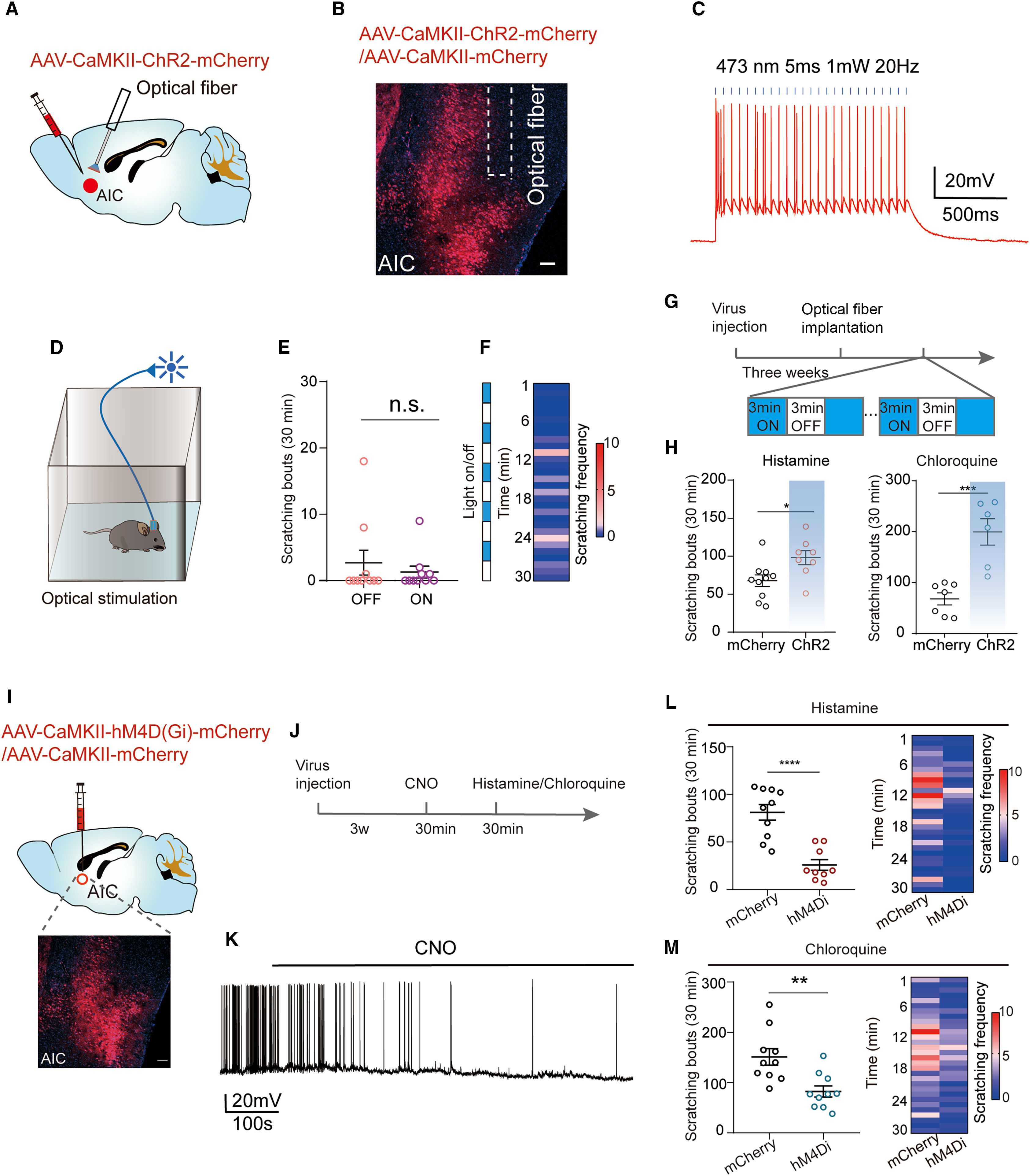
To test causality, mice were injected with AAV-CaMKII-ChR2-mCherry in the AIC and implanted with optical fibers (200 μm O.D., 0.37 NA) 0.2 mm above the injection site. While 473 nm blue-light stimulation (20 Hz) of AICExt neurons did not evoke spontaneous scratching in naive mice, it significantly increased both total scratching bouts and scratching frequency following intradermal histamine or chloroquine injection.
Conversely, bilateral chemogenetic inhibition of AICExt neurons (AAV-CaMKII-hM4Di-mCherry + CNO 3 mg/kg) markedly reduced scratching bouts and frequency evoked by both histamine and chloroquine without affecting total locomotion or center time in the open-field test.
Source: et al. · Current Biology · Original figure reproduced for academic literature review under fair scholarly commentary; copyright remains with the authors/publisher.
Original figure and English caption ↗
AIC Excitatory Neuron Activation Carries Intrinsic Aversive Valence and Is Required for Itch-Induced Conditioned Place Aversion
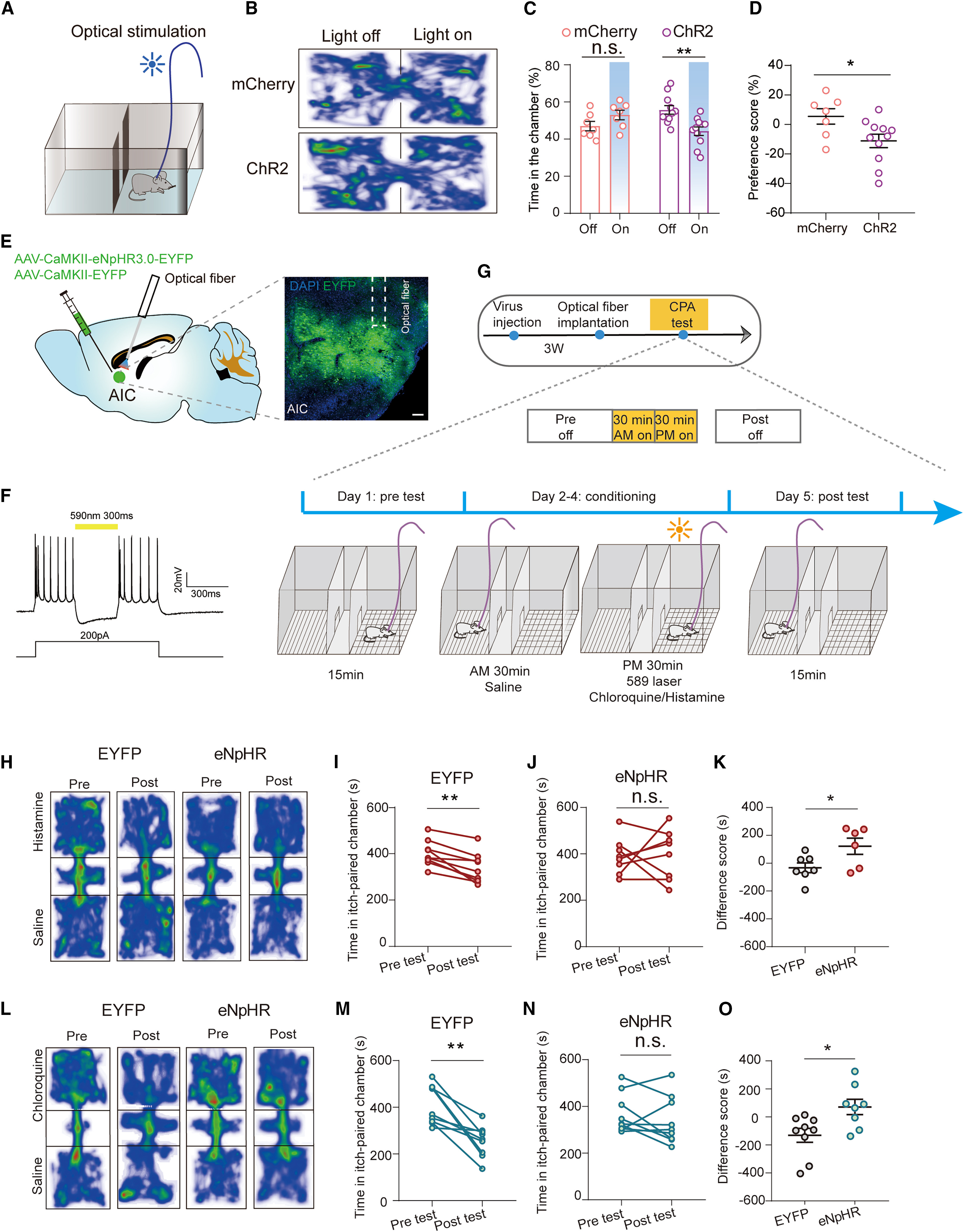
In the real-time place preference (RTPP) assay, closed-loop 20 Hz blue-light stimulation of AICExt neurons expressing AAV-CaMKII-ChR2-mCherry upon chamber entry caused robust place avoidance compared with mCherry controls, demonstrating that AICExt activation is intrinsically aversive.
Bilateral optogenetic inhibition of AICExt neurons (AAV-CaMKII-eNpHR3.0-EYFP, 590 nm yellow light) during pruritogen conditioning completely abolished both histamine- and chloroquine-induced conditioned place aversion (CPA), proving that AICExt activity is required for the aversive component of itch.
Source: et al. · Current Biology · Original figure reproduced for academic literature review under fair scholarly commentary; copyright remains with the authors/publisher.
Original figure and English caption ↗
Anterograde Trans-Synaptic Tracing, RNAscope, and Patch-Clamp Identify a Monosynaptic AICExt→dBNSTGABA Projection
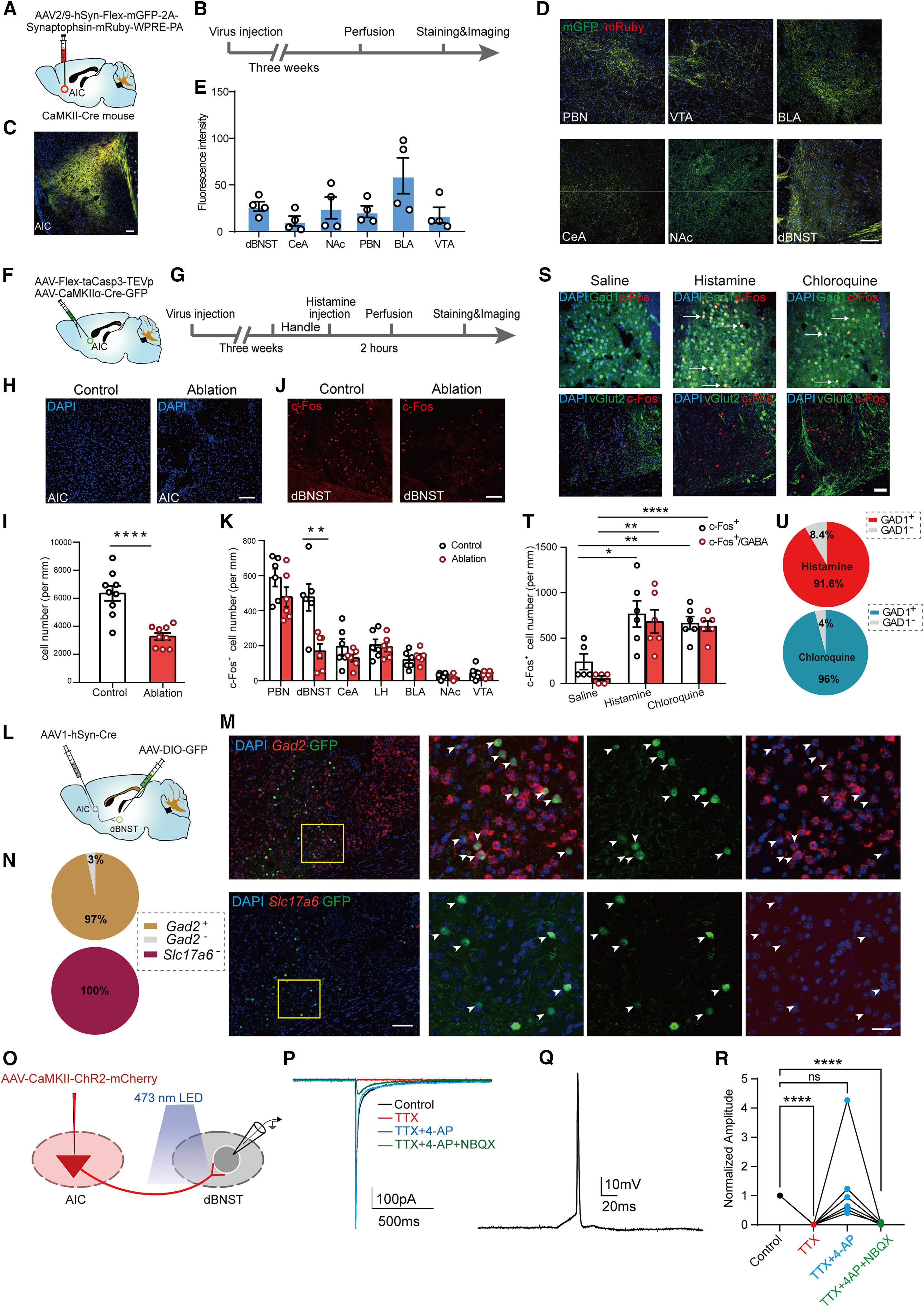
Anterograde tracing (AAV-hSyn-Flex-mGFP-2A-Synaptophysin-mRuby in CaMKII-Cre mice) revealed AICExt projections to the PBN, VTA, BLA, CeA, NAc, and dorsal bed nucleus of the stria terminalis (dBNST). Partial (48%) caspase-3 ablation of AICExt neurons selectively reduced histamine-induced c-Fos in the dBNST among all six targets. Anterograde trans-synaptic tracing (AAV2/1-hSyn-Cre in AIC + AAV2/9-DIO-GFP in dBNST) combined with RNAscope showed that 97% (148/153) of AIC-recipient dBNST neurons were Gad2+ GABAergic and 0% (0/142) were Slc17a6+.
Whole-cell patch-clamp recordings in acute slices confirmed TTX + 4-AP-resistant, NBQX-sensitive monosynaptic glutamatergic EPSCs in 75% (6/8) of AIC-recipient dBNST GABAergic neurons upon AIC terminal photostimulation. Moreover, 91.6% (histamine) and 96% (chloroquine) of itch-activated c-Fos+ cells in the dBNST of Gad1-EGFP mice were GABAergic.
Source: et al. · Current Biology · Original figure reproduced for academic literature review under fair scholarly commentary; copyright remains with the authors/publisher.
Original figure and English caption ↗
dBNST-Projecting AIC Neurons Exhibit Robust Calcium Transients During Histamine- and Chloroquine-Evoked Scratching
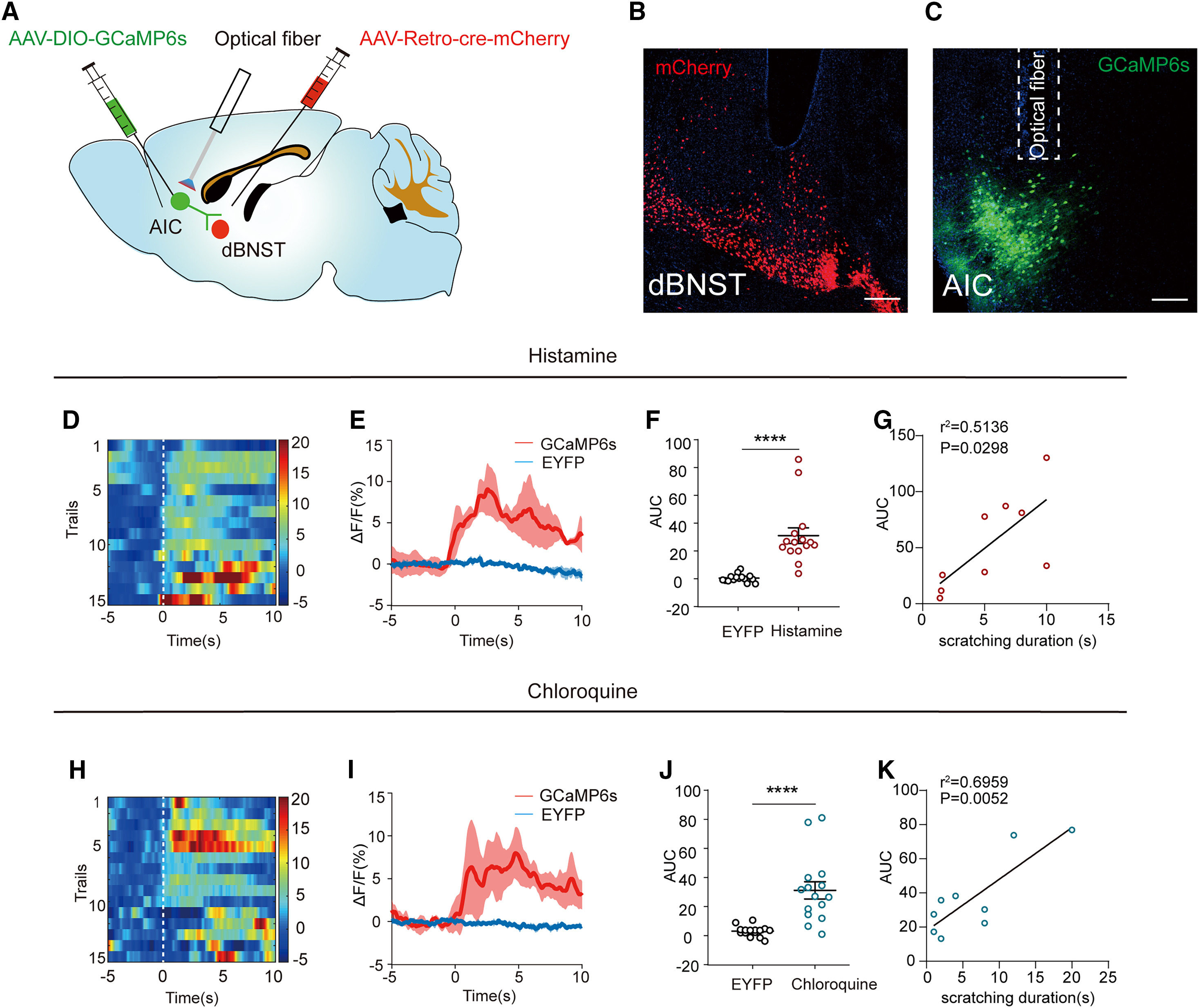
To monitor pathway-specific activity in vivo, mice were injected with retrograde AAV2-retro-hSyn-Cre-mCherry in the dBNST and Cre-dependent AAV-EF1α-DIO-GCaMP6s in the AIC for fiber photometry recordings of dBNST-projecting AIC neurons.
Fiber photometry revealed that dBNST-projecting AIC neurons displayed robust Ca2+ elevations aligned with scratching bouts evoked by both histamine and chloroquine, with the Ca2+ AUC positively correlating with scratching bout duration.
Source: et al. · Current Biology · Original figure reproduced for academic literature review under fair scholarly commentary; copyright remains with the authors/publisher.
Original figure and English caption ↗
Retrograde or Anterograde Trans-Synaptic Chemogenetic Inhibition of the AIC→dBNST Circuit Suppresses Both Scratching and Aversion
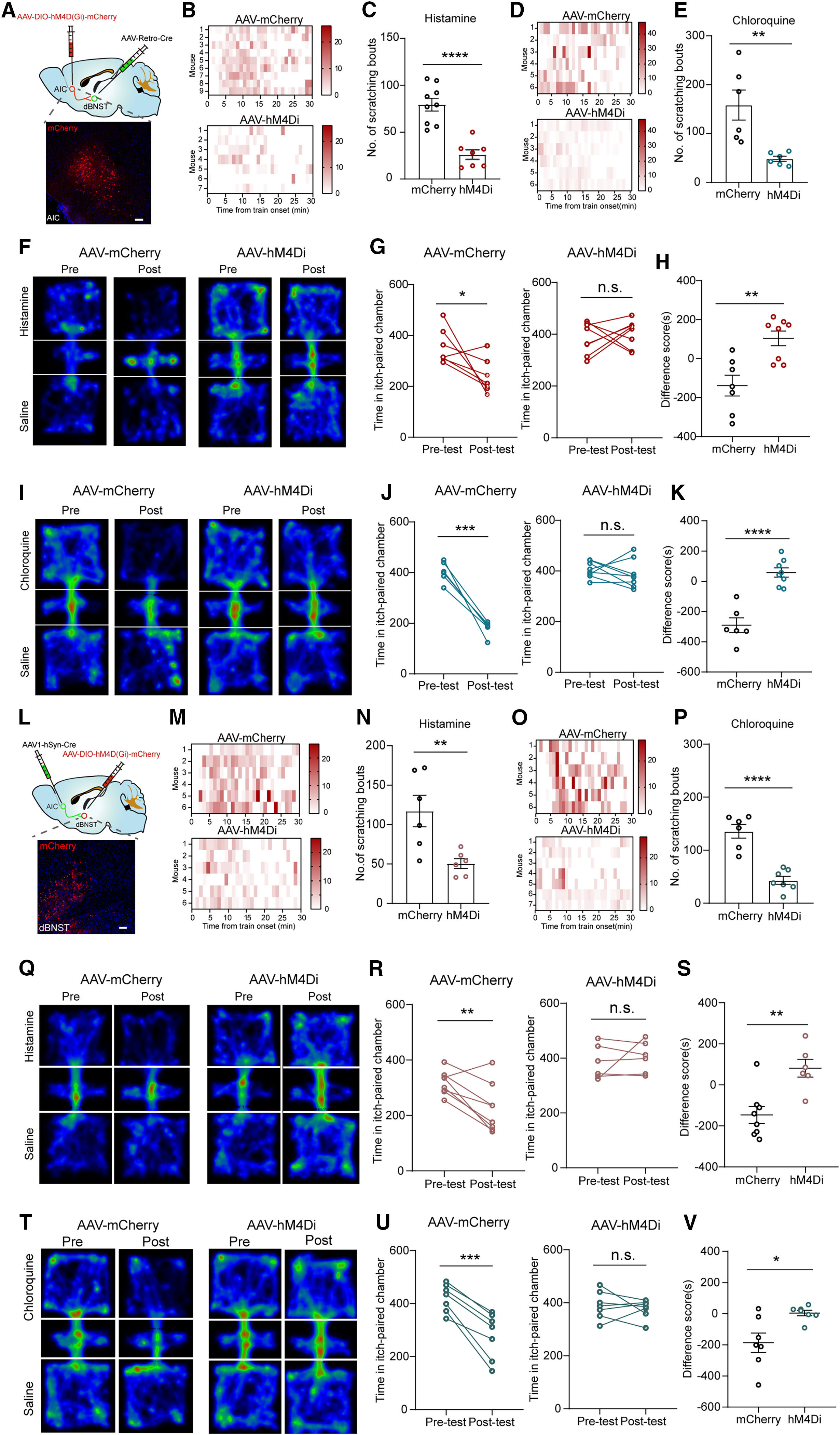
To test the functional necessity of the AIC→dBNST circuit, the authors first retrogradely expressed hM4Di in dBNST-projecting AIC neurons (AAV2/2-Retro-Cre in bilateral dBNST + AAV-hSyn-DIO-hM4Di-mCherry in bilateral AIC). Systemic CNO administration significantly reduced histamine- and chloroquine-evoked scratching bouts and frequency and abolished conditioned place aversion in both models without altering locomotion.
Second, anterograde trans-synaptic expression of hM4Di in AIC-recipient dBNST postsynaptic neurons (AAV2/1-hSyn-Cre in bilateral AIC + AAV2/9-hSyn-DIO-hM4Di-mCherry in bilateral dBNST) followed by CNO administration similarly suppressed histamine- and chloroquine-induced scratching and reversed conditioned place aversion, establishing the necessity of the AICExt→dBNSTGABA circuit for both sensory and affective dimensions of itch.
Source: et al. · Current Biology · Original figure reproduced for academic literature review under fair scholarly commentary; copyright remains with the authors/publisher.
Original figure and English caption ↗