Pain sensitivity and delayed sleep meet in the locus coeruleus
Acute sleep disruption worsens some hypersensitivity measures in a mouse headache-like model, while model induction delays sleep. Locus coeruleus noradrenergic neurons contribute, with distinct outcomes across pain and sleep measures.
After poor sleep, pain may feel closer; discomfort can make falling asleep harder. Where might these changes intersect in the brain? A study published in The Journal of Headache and Pain on March 5, 2024 examines the locus coeruleus, a small brainstem nucleus involved in both arousal and pain regulation. Combining acute sleep disruption with a nitroglycerin-induced headache-like model in mice, the team finds that noradrenergic neurons can influence mechanical sensitivity and sleep latency, with distinct effects across measures.
Activating locus coeruleus noradrenergic neurons can increase some mechanical sensitivity and delay sleep. Inhibition shortens sleep latency in model mice without significantly improving REM latency, and does not broadly reverse hypersensitivity during sleep disruption.
Contents · 7 sections
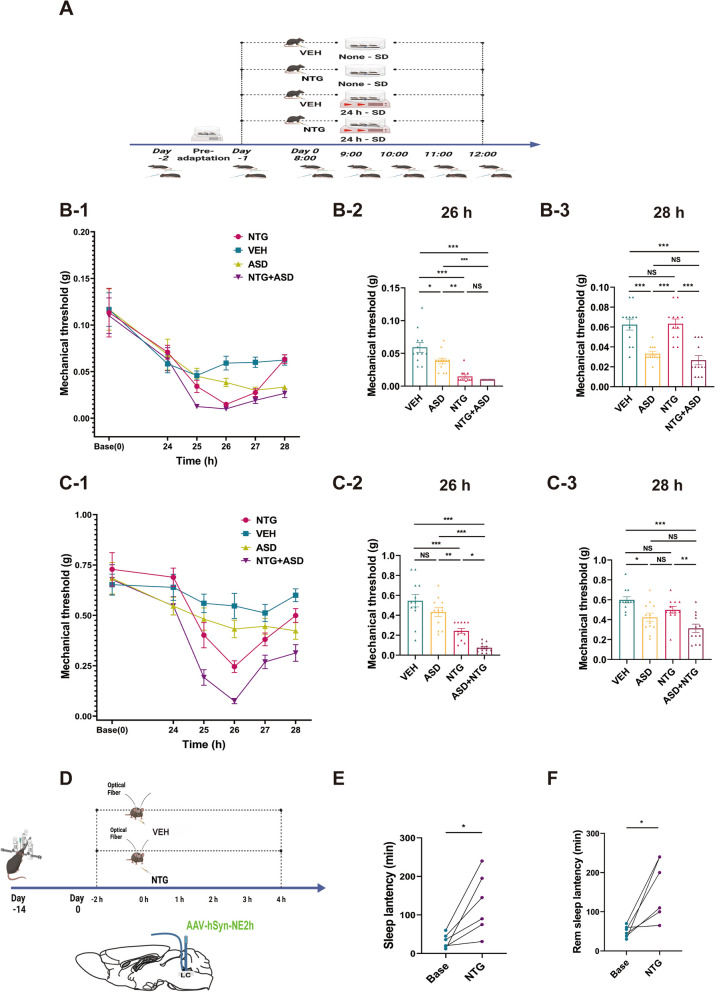
Disrupted sleep deepens the fall in hind-paw thresholds
Nitroglycerin lowers periorbital and hind-paw mechanical response thresholds. Adding acute sleep disruption lowers hind-paw thresholds further, including at the later observation point. The corresponding periorbital group comparison is nonsignificant, revealing different effects across sites.
A separate experiment finds longer latencies to sleep and to rapid-eye-movement sleep after model induction. One experiment shows increased hypersensitivity after sleep disruption, while another shows altered sleep after model treatment, bringing both directions into the investigation.
Source: Li B et al. · The journal of headache and pain · CC BY
Original figure and English caption ↗
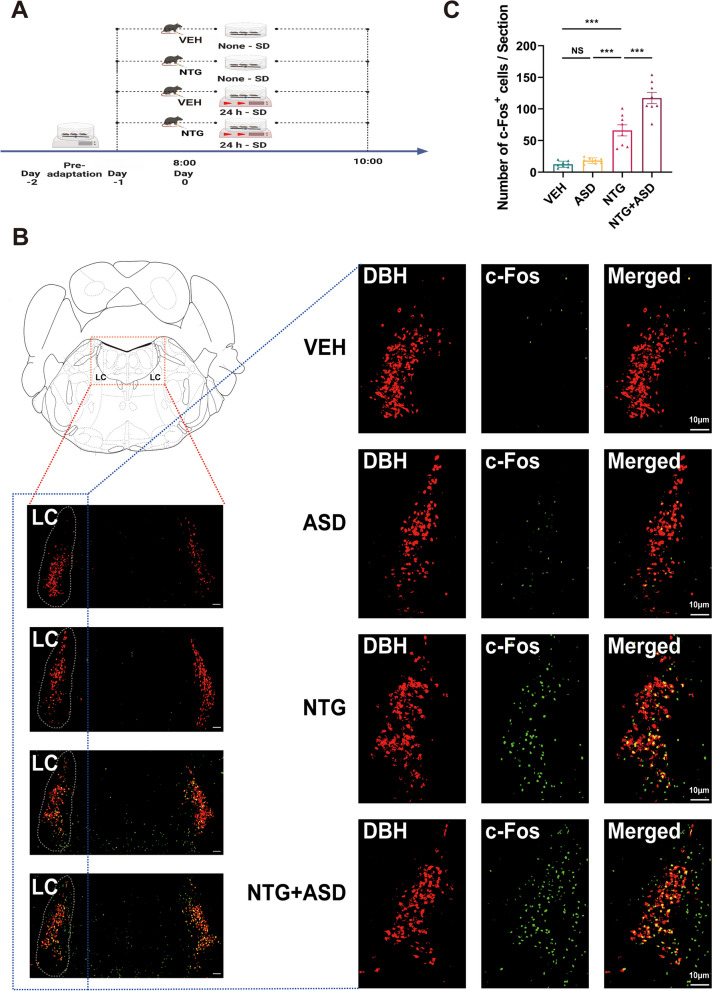
Locus coeruleus activity markers rise with the combined challenge
The locus coeruleus offers a possible intersection. Its noradrenergic cells signal to multiple regions involved in arousal and sensory regulation. Nitroglycerin increases locus coeruleus c-Fos-positive cells, with a further increase after combined sleep disruption and colabeling with a noradrenergic marker.
Sleep disruption alone does not significantly increase this marker. The pattern points to an amplified response during the subsequent challenge rather than an identical elevation whenever sleep is disrupted.
Source: Li B et al. · The journal of headache and pain · CC BY
Original figure and English caption ↗
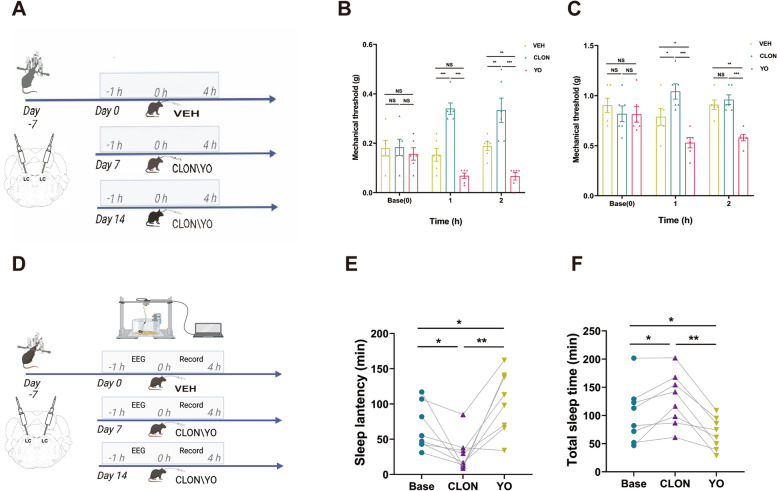
Regional modulation changes pain thresholds and sleep
Local alpha2-receptor modulation provides initial functional evidence. Conditions suppressing locus coeruleus-related activity shorten sleep latency, increase total sleep and raise periorbital thresholds. Conditions promoting activity lower thresholds, delay sleep and reduce total sleep.
These interventions connect an arousal-related nucleus with pain responses. Because local drugs can affect different cells and nearby sites, the team next examines the contribution of the noradrenergic population more specifically.
Source: Li B et al. · The journal of headache and pain · CC BY
Original figure and English caption ↗
In the model, inhibition and activation are asymmetric
In the nitroglycerin model, suppressive modulation raises mechanical thresholds, shortens sleep latency and increases total sleep. Promoting activity does not significantly lower thresholds further or worsen these sleep measures beyond model treatment alone.
Increasing and decreasing a signal need not produce mirror-image outcomes. Model induction changes the animal’s state, so effects that promote sensitivity and waking under baseline conditions do not simply add up in the model.
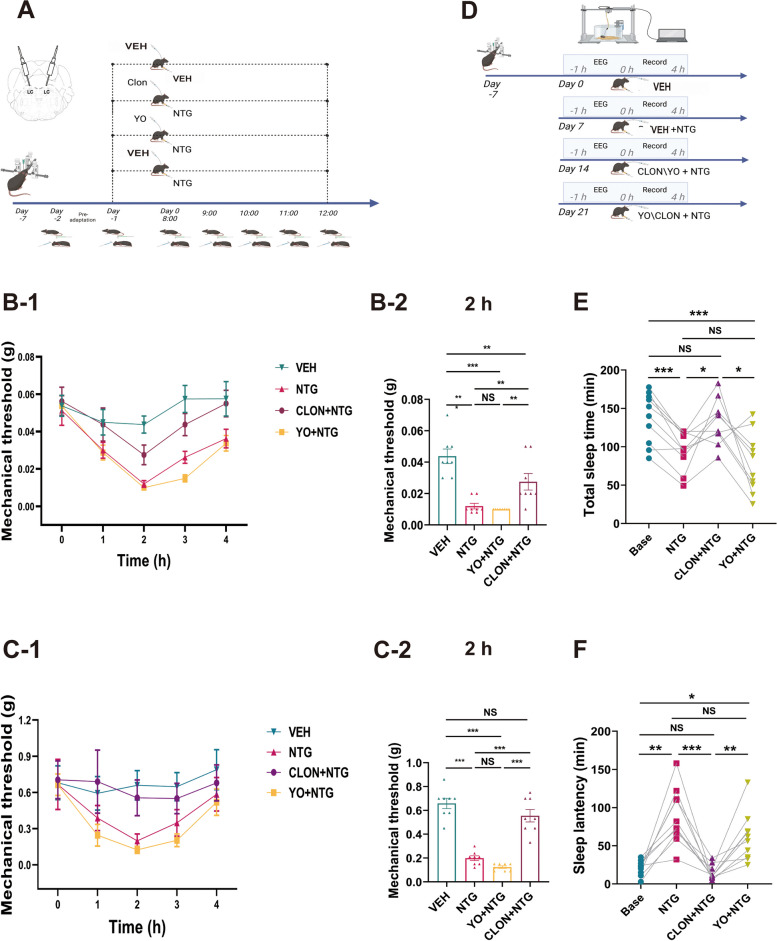
Source: Li B et al. · The journal of headache and pain · CC BY
Original figure and English caption ↗
Targeting noradrenergic cells reveals site-specific effects
Activating noradrenergic neurons lowers hind-paw thresholds, with a greater reduction after sleep disruption. Periorbital activation alone is nonsignificant, while the combined condition differs from control, showing that the measures are not interchangeable.
Inhibition raises periorbital thresholds without sleep disruption, while the hind-paw comparison with control is nonsignificant. During sleep disruption, inhibition does not significantly improve thresholds relative to disruption alone. The population contributes to sensitivity without broadly eliminating the effects of disrupted sleep.
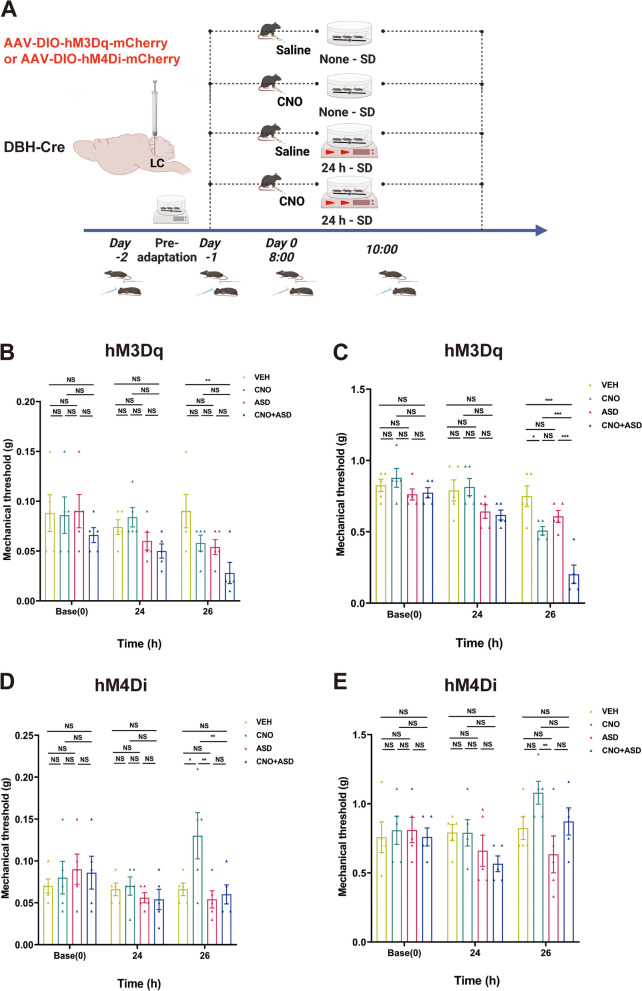
Source: Li B et al. · The journal of headache and pain · CC BY
Original figure and English caption ↗
Earlier sleep onset does not restore every sleep measure
EEG, EMG and local noradrenaline fluorescence bring the analysis back to sleep. Activating locus coeruleus noradrenergic cells lengthens both sleep and REM latencies; combined with model induction, both exceed the model-alone values.
Inhibition has a more differentiated effect: sleep latency shortens relative to the model, whereas REM latency does not significantly improve. Earlier sleep onset can therefore occur without a corresponding change in the wait for REM.
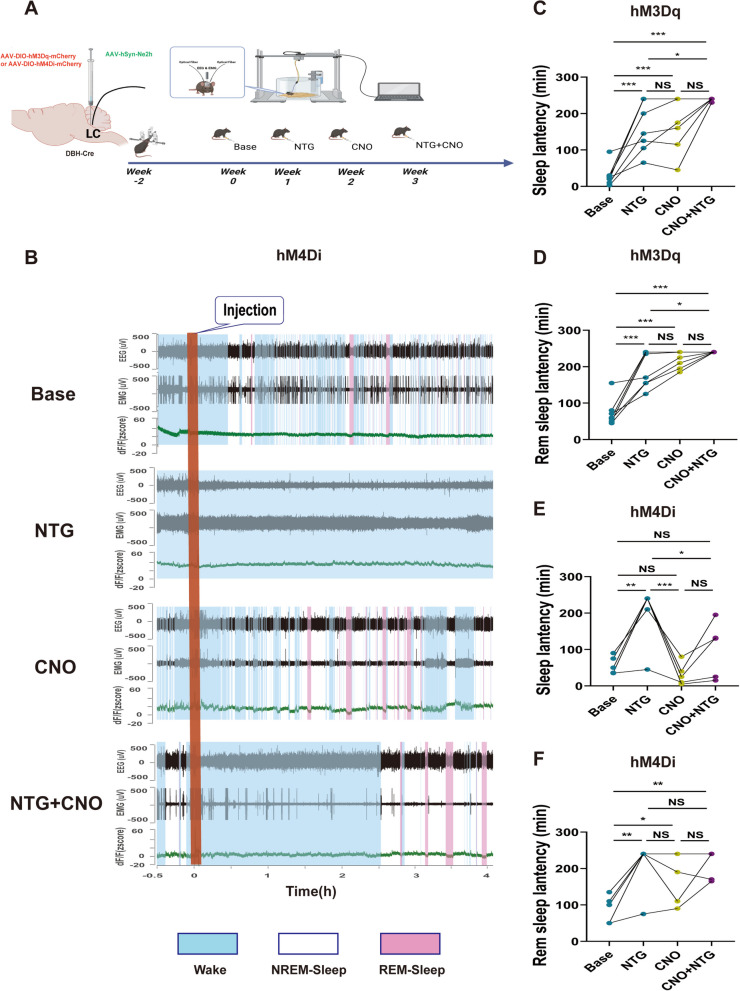
Source: Li B et al. · The journal of headache and pain · CC BY
Original figure and English caption ↗
A shared node with distinct consequences
The study examines acute sleep disruption and a drug-induced headache-like state in male and female mice aged eight to sixteen weeks. It identifies locus coeruleus involvement in both domains while showing that measurement site and sleep stage matter.
The locus coeruleus acts as a context-dependent regulatory node rather than a single controller of pain and sleep. Direct nitroglycerin effects on other sleep networks are not separated here. The central insight is that one population can influence both domains without all measures changing together.