Why do pain-related responses change during cricket hunting? A superior-colliculus circuit
Active hunting briefly raises withdrawal thresholds. Repetition prolongs the change, with superior-colliculus–zona-incerta connectivity and Tac1 signaling showing state-dependent roles.
A mouse orients toward a cricket, approaches and captures it. How does withdrawal from mechanical and thermal stimuli change afterward? Researchers followed hunting-related superior-colliculus cells into their zona-incerta output, finding a peptide contribution particularly relevant after nerve injury.
Hunting briefly raises withdrawal thresholds, prolonged by repeated hunting or SC–ZI activation. Tac1 contributes to activation effects in injured animals, with different dependence in normal mice.
Contents · 6 sections
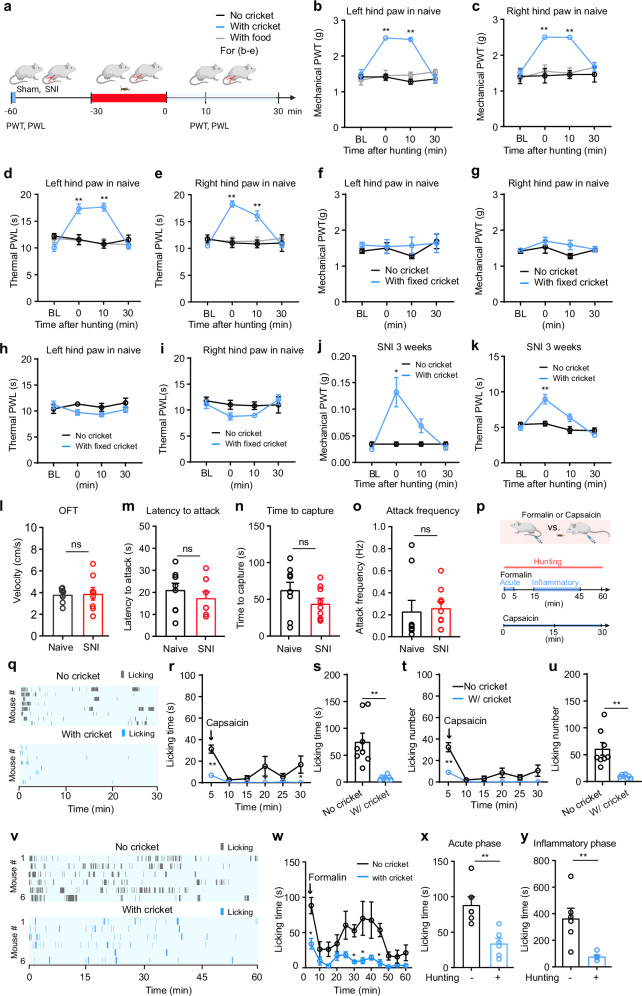
Withdrawal responses weaken briefly after active hunting
After a thirty-minute hunting session, mechanical thresholds and thermal latency rose immediately and at ten minutes, returning toward baseline by thirty minutes. Free exploration, chow feeding and fixed-cricket exposure lacked the same effect. Injured mice also showed brief changes, and chemically evoked licking decreased.
Exploration, ordinary feeding and fixed prey did not reproduce the effect, distinguishing active hunting from prey presence or eating. The task combines visual tracking, movement, motivation and capture reward after fasting, motivating examination of recruited neurons.
Source: Zhang X et al. · Nature communications · CC BY-NC-ND
Original figure and English caption ↗
A collicular population responds during hunting and stimulation
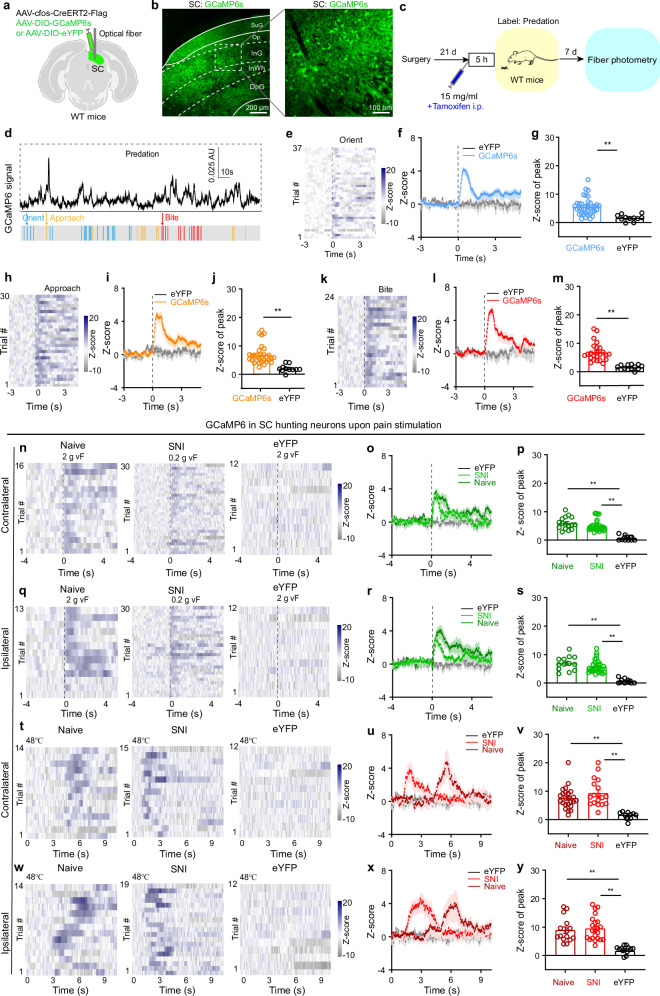
Activity-dependent tagging identified deep/intermediate collicular cells re-recruited by hunting, mostly excitatory and about half Tac1-positive. Orientation, approach and capture increased calcium activity, as did non-prey visual cues, showing broader sensory participation.
Mechanical and thermal stimuli also recruited the cells, particularly the Tac1 hunting population, whereas voluntary movement onset and unstimulated paw lifting did not produce the same significant changes. The overlap led to tests of their output.
Source: Zhang X et al. · Nature communications · CC BY-NC-ND
Original figure and English caption ↗
Output to zona incerta can change thresholds
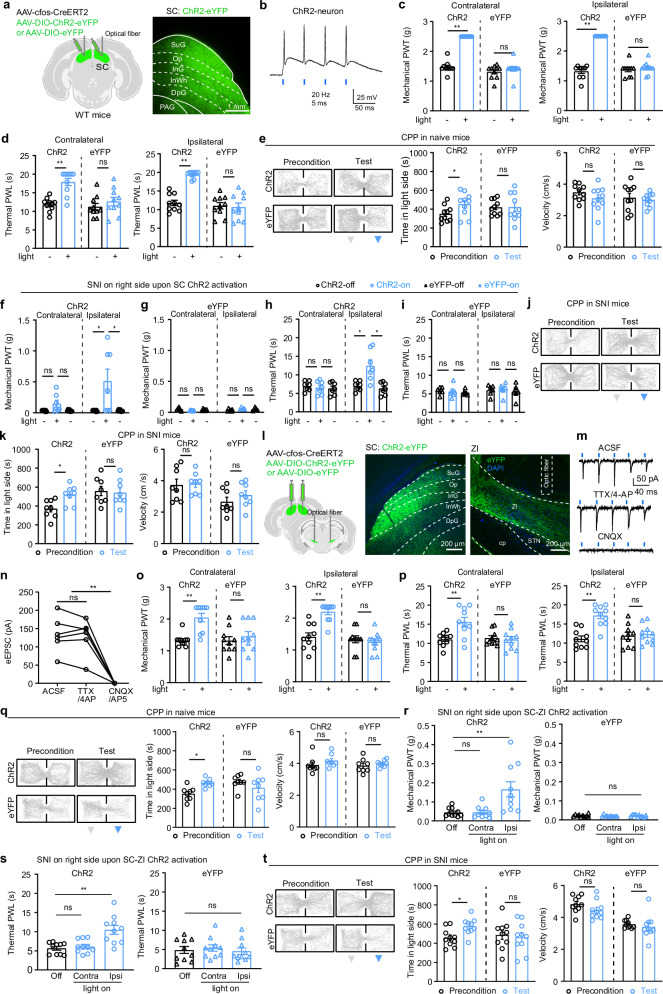
Stimulating tagged SC cells or ZI terminals raised bilateral thresholds in naïve mice and mainly injured-side measures after SNI. Slice pharmacology supported excitatory monosynaptic input, often to GABAergic/SST-associated recipients. A tested PAG output lacked comparable behavior, without excluding untested pathways.
Inhibiting hunting cells or ZI output did not significantly alter baseline thresholds or hunting. Activation effects therefore differed from basal inhibition. Some place-preference group comparisons were nonsignificant, revealing distinct trajectories across measures.
Source: Zhang X et al. · Nature communications · CC BY-NC-ND
Original figure and English caption ↗
Repeated hunting makes the change last longer
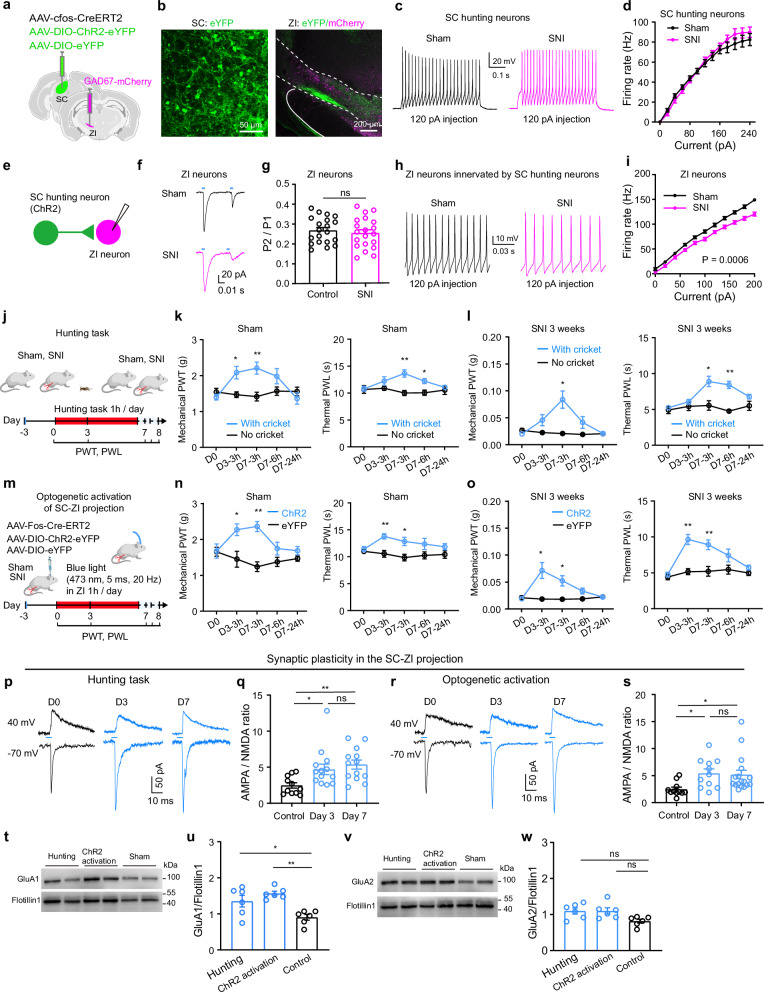
After daily hunting or SC–ZI activation, raised thresholds persisted for hours. On day seven the effect lasted at least six hours, returning to baseline by twenty-four hours after repeated activation. SNI left basal collicular/pathway measures comparable while reducing recipient ZI excitability.
Repetition increased pathway AMPA/NMDA ratios and ZI GluA1 with comparable GluA2, showing LTP-like plasticity. The longer behavioral effect accompanied altered transmission, raising a concrete question about how their time courses relate.
Source: Zhang X et al. · Nature communications · CC BY-NC-ND
Original figure and English caption ↗
Tac1 signaling matters more in the injured state
Tac1 encodes a substance-P-associated precursor. Activation of the broader Tac1-positive SC–ZI population lacked significant naïve threshold effects but improved injured-side measures after SNI. Substance P enhanced ZI GABAergic firing, blocked by NK1 antagonism, implicating peptide alongside fast glutamatergic transmission.
Reducing Tac1 in ZI-projecting excitatory cells weakened activation-related threshold and place-preference effects in SNI, while broad excitatory-pathway effects persisted normally. Intrinsic firing remained comparable with reduced projection currents, revealing state-dependent peptide contribution.
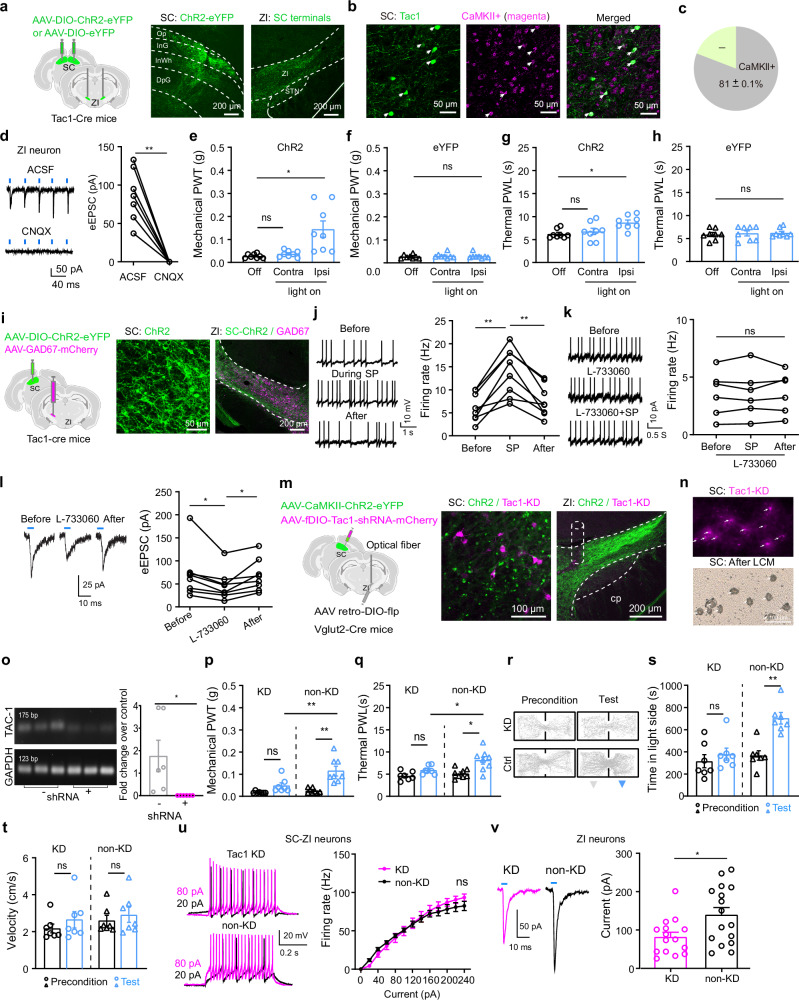
Source: Zhang X et al. · Nature communications · CC BY-NC-ND
Original figure and English caption ↗
Natural behavior meets a pain-related circuit at one connection
A whole behavior led to a state-dependent regulatory relationship: hunting changes withdrawal temporarily, repetition accompanies synaptic changes, and a peptide matters more after injury. SC–ZI provides a shared locus for behavior, timing and signaling.
Behavioral evidence mainly comes from males. Visual, motivational, motor and reward contributions remain to be separated, but the results show that pain-related responses depend on ongoing behavior and repeated experience as well as the stimulus itself.