Can the way animals stay awake change sensitivity? Four conditions and locus-coeruleus responses
A mouse study finds distinct changes in baseline thresholds, later challenges and locus-coeruleus recruitment, adding state-related clues to sleep–pain relationships.
Does reduced sleep make the body more responsive to harmful stimulation? The way wakefulness is maintained can also alter stress, arousal and movement. A 2026 The Journal of Headache and Pain study compares four acute wake-maintenance conditions and tracks locus coeruleus noradrenergic, or LC-NE, cells. Two patterns emerge: some conditions directly lower baseline thresholds, while others have smaller baseline effects but amplify responses to later challenges. Sleep-loss-associated states can thus become apparent at different times and in different stimulus contexts.
Multiple-platform conditions more strongly alter baseline sensitivity, avoidance and LC-NE recruitment. Rotating bars have smaller baseline effects but enhance responses to later challenges and heat stimulation.
Contents · 6 sections
Similar procedure durations produce different thresholds
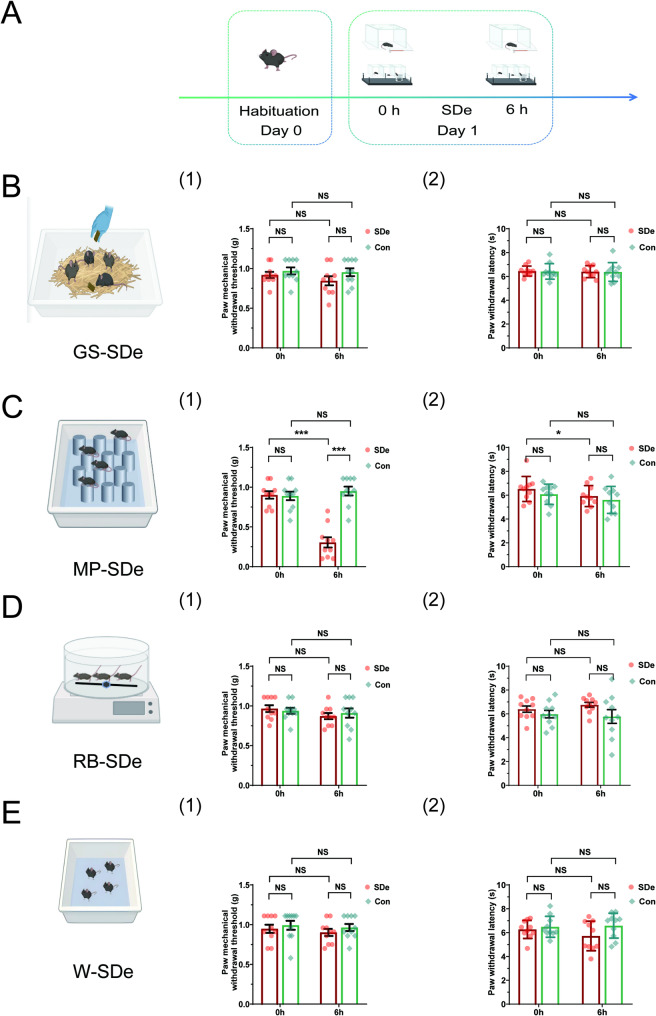
The study compared gentle stimulation, multiple platforms, rotating bars and water contact. After six hours, platforms produced clearer reductions in mechanical and thermal thresholds, while several other comparisons were nonsignificant and rotating bars had smaller baseline effects. A shared goal of maintaining wakefulness therefore accompanied different sensory outcomes.
The comparison added a state perspective to sleep–pain research. Environments, stimulation and activity burdens differed and could influence the nervous system alongside sleep changes. In addition to thresholds at the end of a procedure, the processing of later stimuli became a further question to investigate.
Source: Cao Y et al. · The journal of headache and pain · CC BY-NC-ND
Original figure and English caption ↗
Mechanical and thermal measures change differently over time
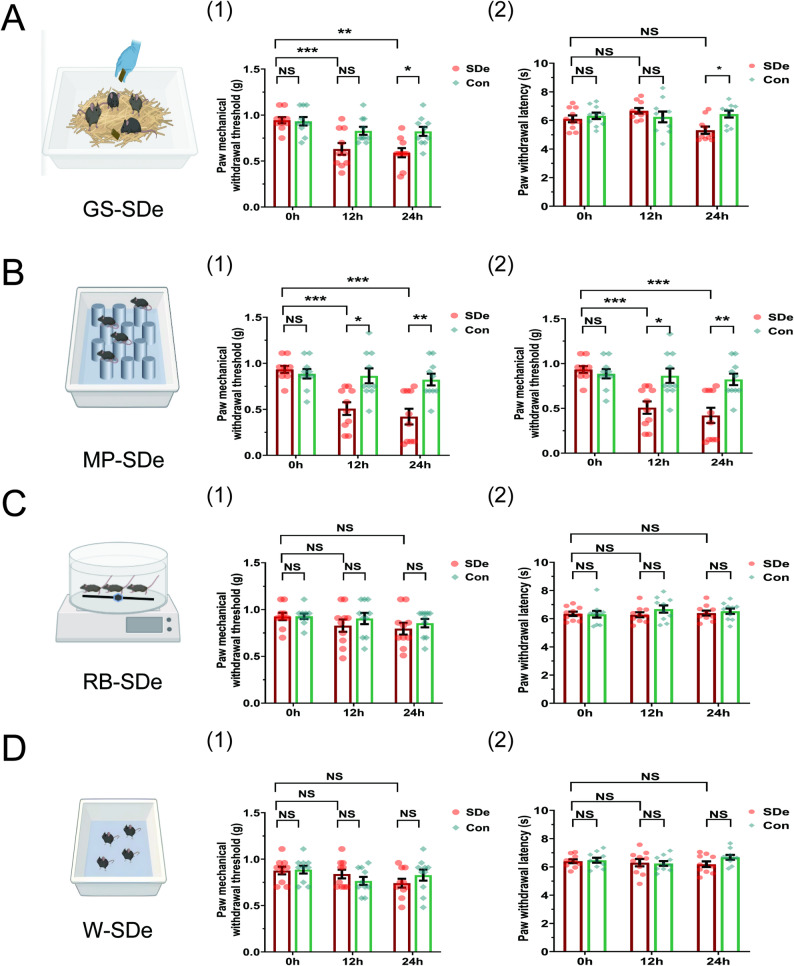
At longer durations, platforms continued to affect both thresholds more prominently. Under gentle stimulation, mechanical thresholds fell at twelve hours but did not significantly change at twenty-four, whereas thermal thresholds fell at twenty-four. Rotating bars and water contact had smaller changes. Sensory modalities and timepoints therefore followed distinct trajectories.
Longer procedures did not amplify every measure proportionally. This directed attention to rotating bars, where baseline changes were smaller. The condition offered a window onto whether responses to later challenges could differ even when immediate thresholds remained similar.
Source: Cao Y et al. · The journal of headache and pain · CC BY-NC-ND
Original figure and English caption ↗
Similar baselines, altered susceptibility
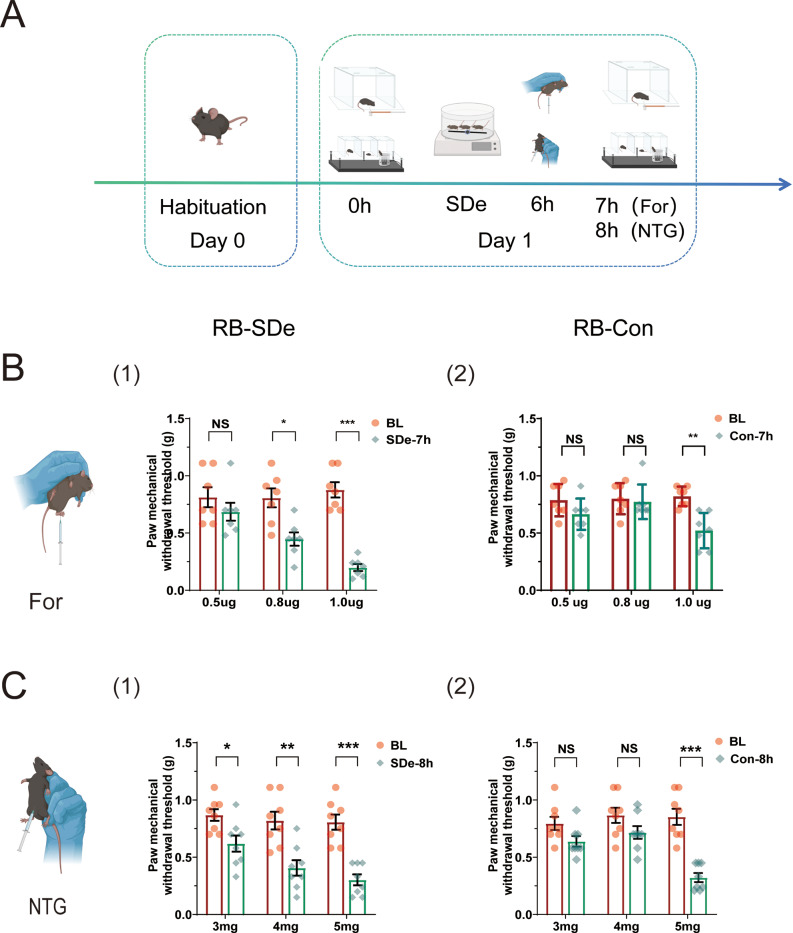
After six hours of rotating bars, weaker inflammatory or nitroglycerin challenges produced mechanical-threshold changes, while controls required stronger challenges. Baseline sensitivity and later susceptibility thus dissociated. A changed nervous-system state could become visible when additional input was introduced.
The study measured animal mechanical sensory responses, and challenge strength made the state difference clearer. Moving from baseline thresholds to later responses extended the question from current sensitivity to the magnitude of change caused by the next input, adding a more dynamic view of reduced sleep and harmful stimulation.
Source: Cao Y et al. · The journal of headache and pain · CC BY-NC-ND
Original figure and English caption ↗
Platforms accompany stronger avoidance and LC activity
After multiple platforms, open-field and elevated-maze behavior showed stronger avoidance, and LC-NE c-Fos increased, without equivalent significant changes under other conditions. DSP-4 noradrenergic lesioning attenuated the platform-related threshold reduction, linking this system with the sensory change.
The absence of corresponding significant avoidance and c-Fos changes in other conditions placed platform effects in a specific state context. Behavior, thresholds and cellular markers together showed influences spanning sensory and arousal-related levels. The contrasting rotating-bar results illustrated how similar experimental aims can produce different animal states.
LC participates in arousal and sensory regulation, and its recruitment accompanied stress-related clues in the procedure context. Avoidance, cellular labeling and pharmacology outlined the post-platform state. Comparison with smaller baseline changes after rotating bars prompted observation of that group’s cellular response to stimulation.
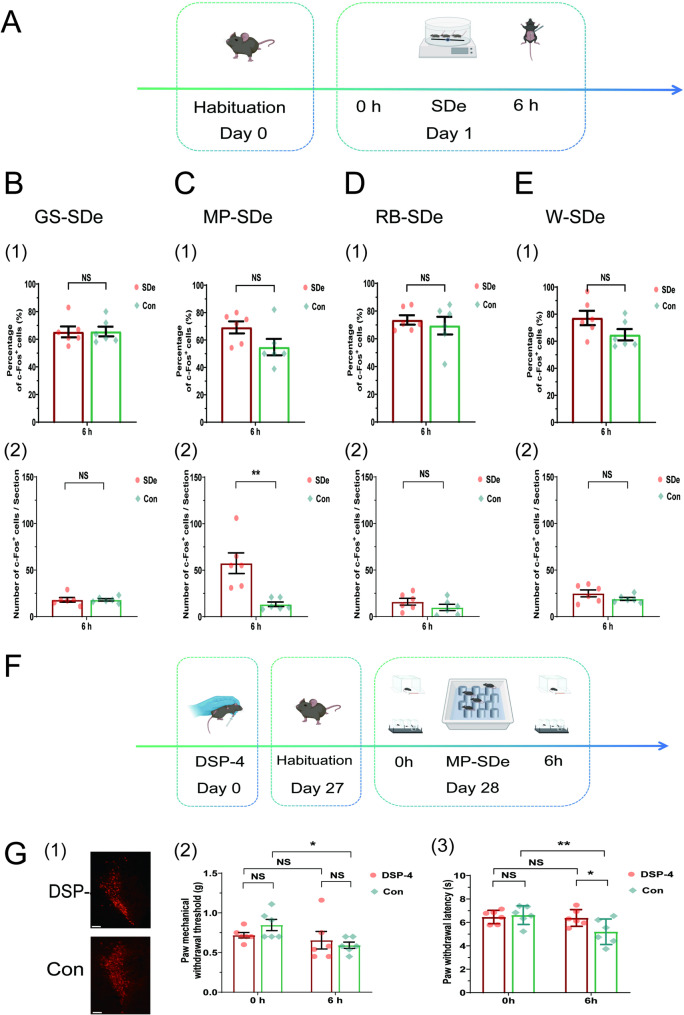
Source: Cao Y et al. · The journal of headache and pain · CC BY-NC-ND
Original figure and English caption ↗
Limited baseline recruitment with stronger heat responses
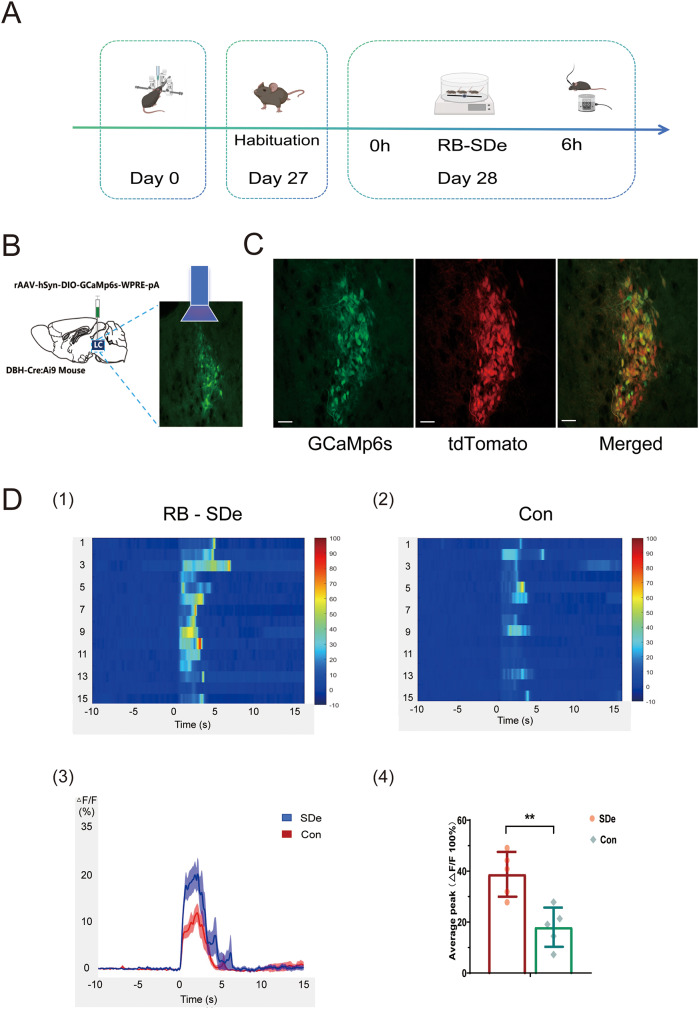
Rotating bars did not produce platform-like baseline c-Fos increases, yet later paw heat evoked larger LC-NE population calcium responses. Baseline recruitment and stimulus reactivity can change separately: the nervous system need not be continuously more active to respond more strongly to particular inputs.
The activity pattern complemented hypersensitivity triggered by weaker challenges. After rotating bars, baseline thresholds and activity markers changed little, while challenge responses increased, resembling a change in response gain. The difference emerged when input arrived rather than as continuously higher activity.
Source: Cao Y et al. · The journal of headache and pain · CC BY-NC-ND
Original figure and English caption ↗
Following sleep, wake maintenance and later responses together
Measuring only thresholds at the end of the procedure would reveal little change after rotating bars; adding a weaker challenge exposed a difference. Platforms altered baseline mechanical and thermal thresholds earlier, alongside avoidance and LC recruitment. Comparisons of sensitivity therefore depend on test timing, prior experience and whether further stimulation is introduced.
Both sexes were included, but EEG/EMG did not quantify actual sleep loss and corticosterone was not measured. Combining measured sleep, stress and sensory recordings will help determine the contributions of different factors. The findings motivate attention to procedure context and later input for a fuller picture of sleep–pain relationships.