Why do neighboring GABA populations affect mechanical sensitivity differently?
The ventrolateral periaqueductal gray and dorsal raphe are neighbors, yet their GABA-associated populations affect mechanical responses differently in mice. Inflammation further changes selected effects.
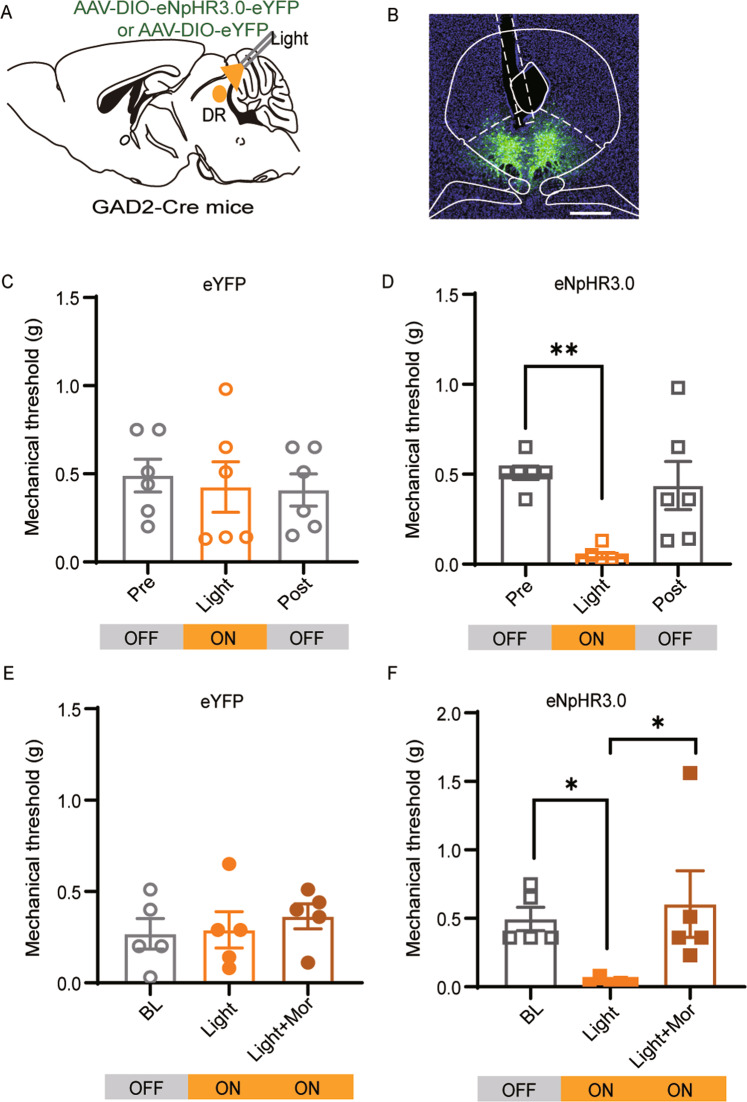
Do inhibitory neurons always reduce pain? Their effect depends on location and what they inhibit. A mouse study published in Neuropsychopharmacology on December 16, 2022 separates the neighboring ventrolateral periaqueductal gray (vlPAG) and dorsal raphe (DR). Their GABA-associated populations affect mechanical sensitivity differently, and results change with inflammatory state. The findings expose the importance of location and network context within one transmitter-defined class.
Increasing vlPAG GABA-associated activity and decreasing DR GABA-associated activity each increase mechanical sensitivity. During inflammation, suppressing vlPAG or activating DR raises mechanical thresholds, while emotion-related outcomes remain conditional.
Contents · 7 sections
What happens when both neighboring regions are modulated?
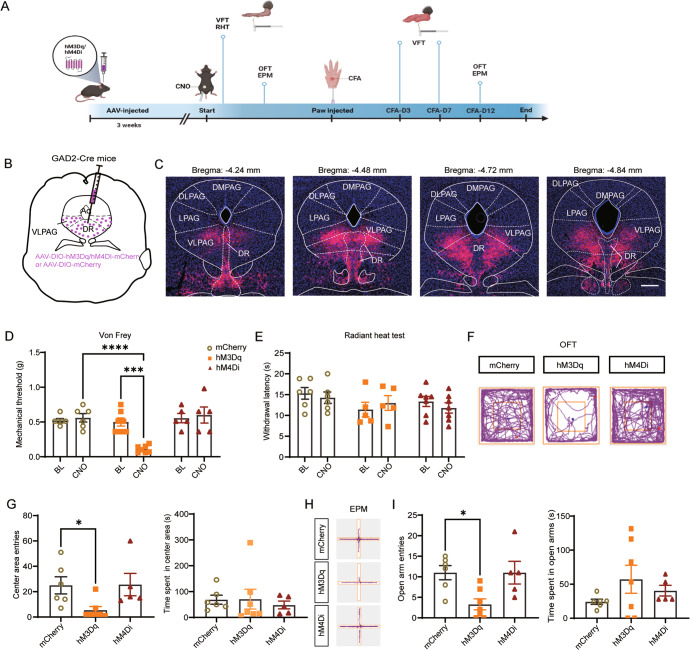
The study first increases GABA-associated activity across a broader region covering vlPAG and DR. Mechanical withdrawal thresholds fall in naïve mice, while suppressing activity across that region does not significantly change thresholds. The directions are asymmetric, and neither significantly changes thermal withdrawal.
Activation reduces entries into the open-field center and elevated open arms without significant changes in time spent there. Familiar-home-cage locomotion and rotarod performance do not change significantly. Exploration measures therefore differ, and activity in an unfamiliar setting may also influence these behavioral readouts.
Source: Xie L et al. · Neuropsychopharmacology : official publication of the American College of Neuropsychopharmacology · CC BY
Original figure and English caption ↗
Within vlPAG, mechanical and thermal effects diverge
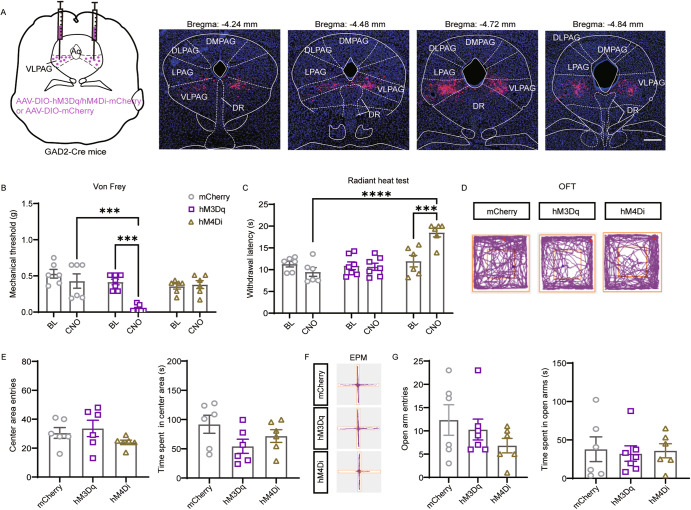
Restricting modulation to vlPAG again lowers mechanical thresholds with activation, while inhibition has no significant mechanical effect. Inhibition instead lengthens heat-withdrawal latency, indicating a weaker response to the tested thermal stimulus.
Separate vlPAG modulation does not significantly change the measured open-field or elevated-maze exploration outcomes. Mechanical and thermal effects can therefore separate from these measures, and the population does not uniformly increase or decrease responses to both stimulus types.
Source: Xie L et al. · Neuropsychopharmacology : official publication of the American College of Neuropsychopharmacology · CC BY
Original figure and English caption ↗
In DR, suppressing activity increases sensitivity
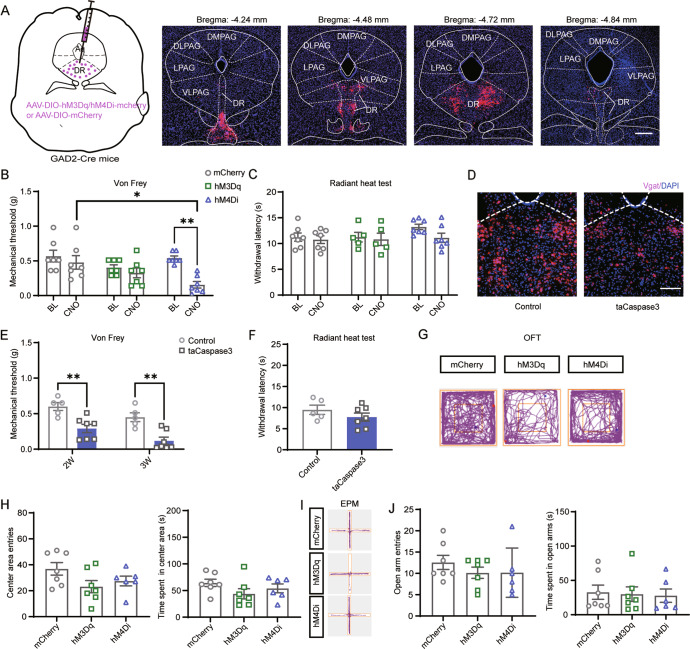
DR shows a different pattern. In naïve mice, suppressing GABA-associated activity lowers mechanical thresholds, whereas activation has no significant effect. Reducing the population also produces lower mechanical thresholds than controls at two later observations, matching the direction of acute suppression.
Thermal withdrawal and naïve open-field and elevated-maze measures do not change significantly. Compared with vlPAG, a small anatomical separation changes the relationship between the same cellular marker and mechanical responses.
Source: Xie L et al. · Neuropsychopharmacology : official publication of the American College of Neuropsychopharmacology · CC BY
Original figure and English caption ↗
The regional distinction remains during inflammation
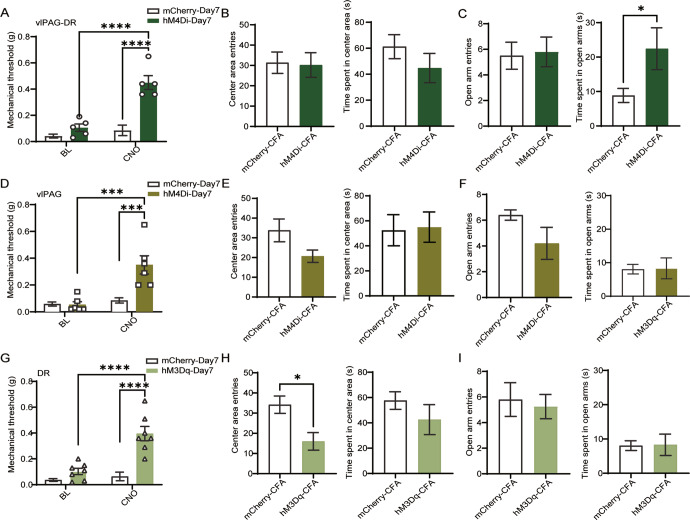
During inflammation, suppressing either the combined region or vlPAG alone raises mechanical thresholds. Combined suppression also increases open-arm time without significant open-field or open-arm-entry effects. Separate vlPAG suppression does not significantly alter the measured exploration outcomes.
DR activation raises mechanical thresholds at the later inflammatory observation but not significantly at the earlier one. Open-field center entries decrease, while center time and elevated-maze outcomes remain nonsignificant. Reduced mechanical responsiveness therefore does not automatically improve emotion-related measures.
Source: Xie L et al. · Neuropsychopharmacology : official publication of the American College of Neuropsychopharmacology · CC BY
Original figure and English caption ↗
An effect absent at baseline can emerge during inflammation
DR activation lacks a significant naïve mechanical effect but gains one later during inflammation. vlPAG inhibition likewise shifts from a nonsignificant naïve mechanical comparison to increased inflammatory thresholds. The same activity direction can yield different outcomes in different network states.
Location and state jointly shape the effect. One possibility is that different GABA populations influence different downstream targets through local inhibition and distant outputs. The specific connections were not mapped one by one in this study, leaving their coordination unresolved.
Acute inhibition and systemic drug action add another comparison
Acute suppression of DR GABA-associated cells lowers mechanical thresholds during the active period, with values returning toward the earlier level afterward. This complements the other population manipulations and links mechanical responses with the current activity state.
While the population remains suppressed, systemic morphine raises the lowered mechanical threshold. Because the drug acts at multiple sites, this relates its effect to the suppressed network state without assigning it to one DR receptor or serotonergic connection.
Source: Xie L et al. · Neuropsychopharmacology : official publication of the American College of Neuropsychopharmacology · CC BY
Original figure and English caption ↗
GABA-cell effects vary with location and state
Separating neighboring regions reveals different roles within a GABA-associated class. Mechanical versus thermal stimuli, naïve versus inflammatory states and entry counts versus duration produce different combinations. Nociceptive responses and exploration can also change separately.
The findings provide population- and region-level animal evidence about nociceptive and emotion-related networks. Identifying the outputs carrying these effects, the population dominating combined-region outcomes and their persistence across disease stages requires more specific connection-level and longitudinal evidence.