Where do antipruritic signals act in the brain? A claustrum–thalamus pathway reveals the role of kappa opioid receptors
Following histamine-induced scratching in mice, the study connects claustral neurons, thalamic projections and kappa opioid receptors to a defined central drug mechanism.
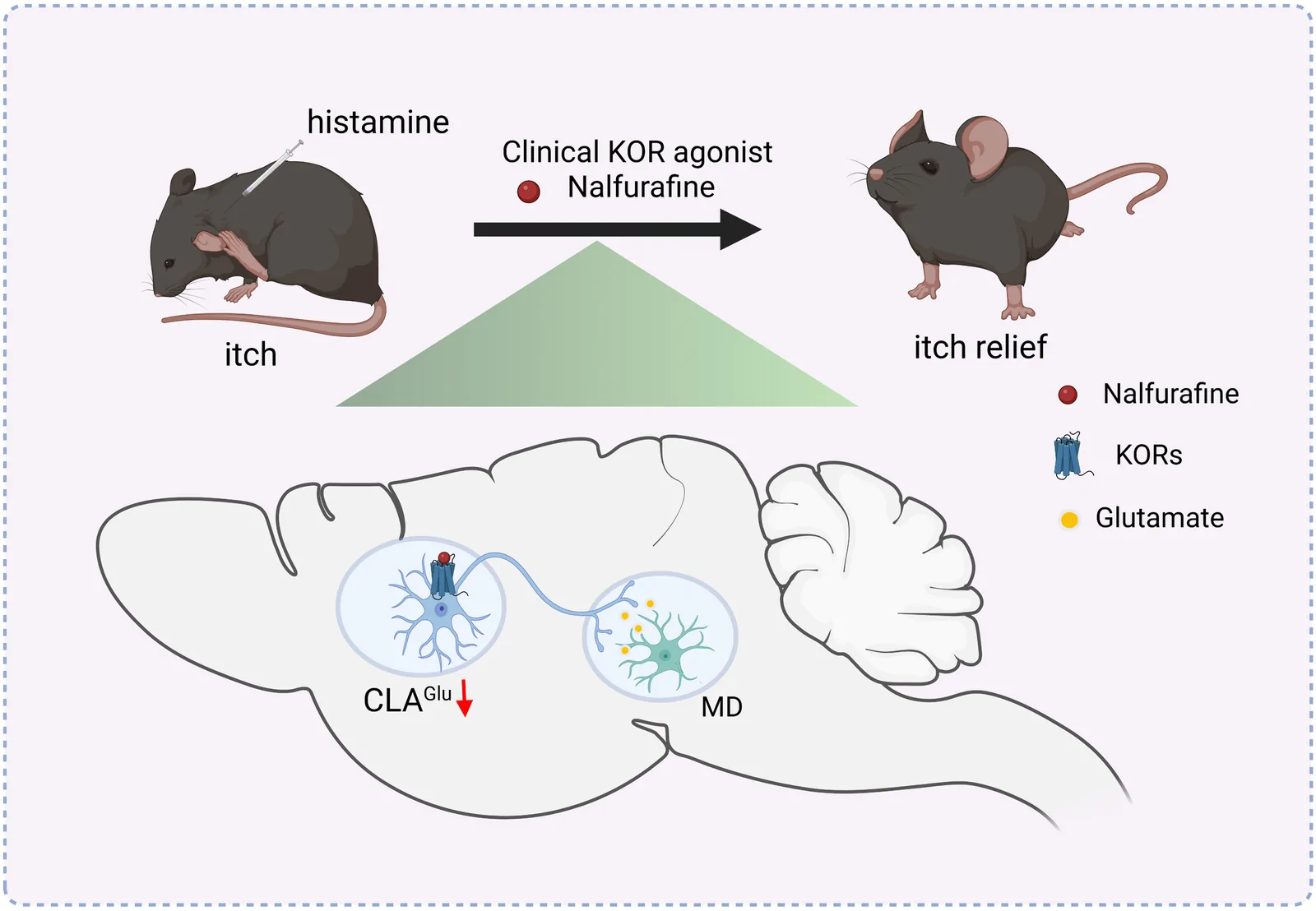
What turns an itch into the urge to scratch? Between skin and brain lies a complex chain of information processing. κ-opioid receptor agonists can reduce the response, but where do they act centrally? This study focuses on the claustrum, a thin sheet of gray matter, and follows its thalamic connection to trace the brain circuit behind the effect.
Claustral glutamatergic neurons and their projection to the mediodorsal thalamus modulate histamine-induced scratching. Kappa opioid receptors associated with the pathway contribute to the anti-scratching action of nalfurafine.
Contents · 6 sections
From an itch to an active brain node
The Science Advances study, published in 2026, first examined activity-related changes during histamine-induced scratching. Increased labeling in several regions indicated a distributed network. The subsequent work sought a defined node within that network that could explain part of the drug response.
The claustrum lies between the insula and striatum and connects with sensory and limbic regions. Most of its neurons are excitatory, giving it an anatomical basis for influencing other regions. The researchers followed cellular activity into functional tests to examine its role in scratching.
The claustrum regulates the strength of scratching
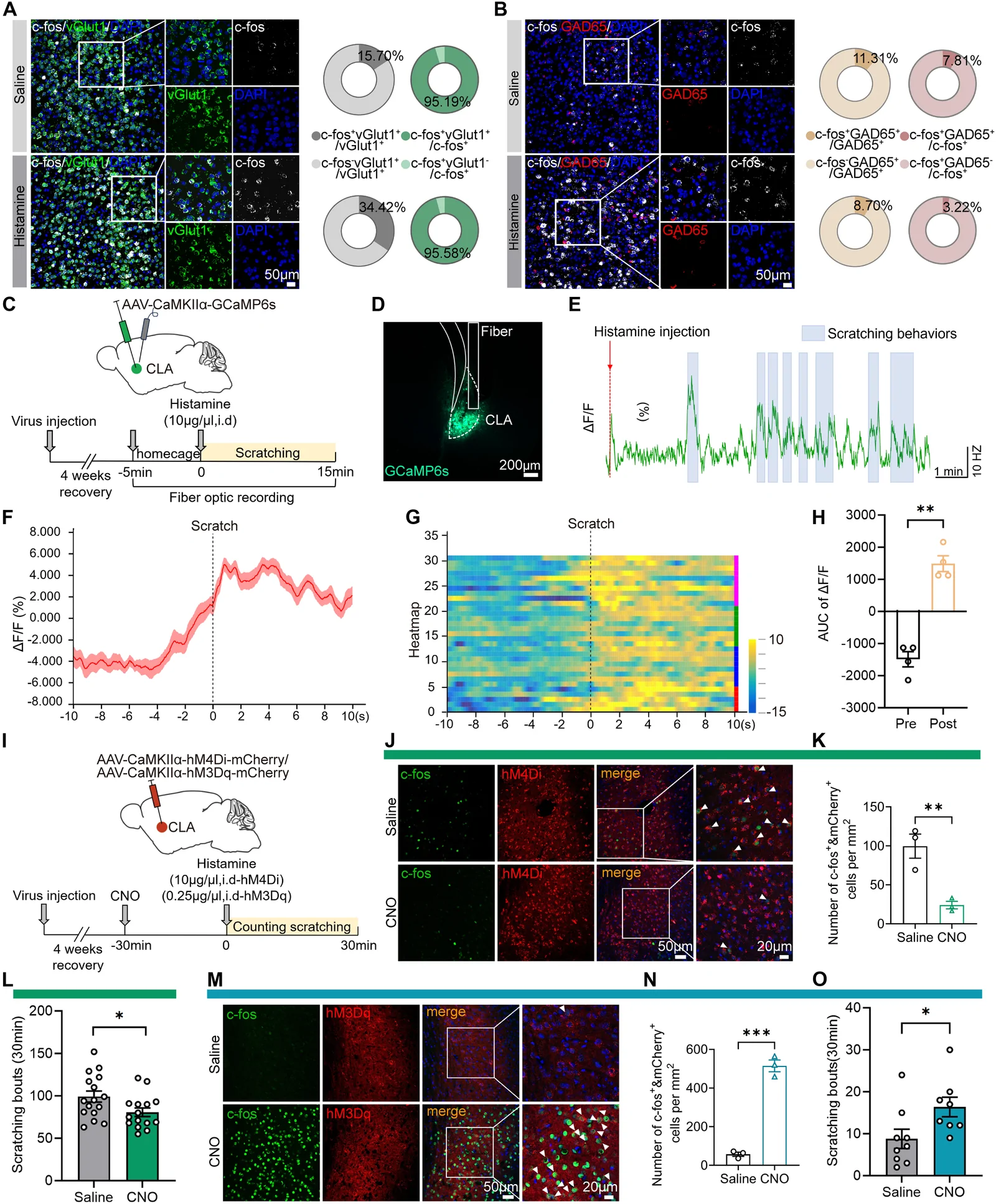
Histamine-associated activity labeling mainly involved glutamatergic claustral neurons, supported by calcium recordings. Inhibiting these cells reduced scratching, whereas activating them increased responses to low-dose histamine. Opposing interventions provide functional evidence beyond elevated activity alone.
The cells behaved like a regulator: activation alone did not evoke spontaneous scratching, and inhibition did not return the histamine response completely to baseline. The claustrum altered the strength of the response to an existing stimulus. This conditional role led the team to investigate its communication with other regions.
Source: Liu Z et al. · Science advances · CC BY-NC
Original figure and English caption ↗
Following claustral output to the thalamus
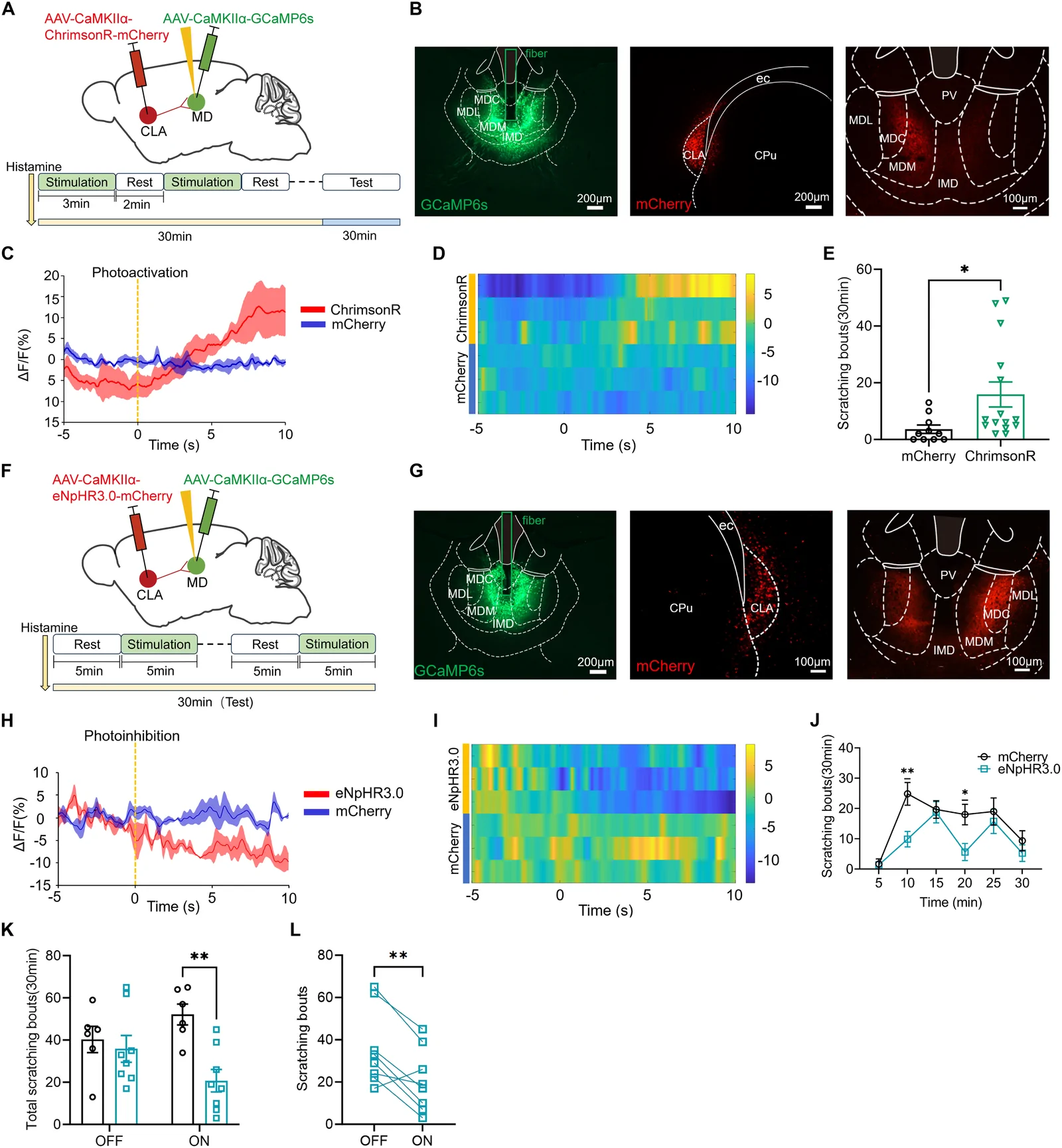
Bidirectional tracing supported a projection from the claustrum to the mediodorsal thalamus, or MD. Histamine increased activity in MD neurons and the relevant terminals. Pathway inhibition reduced scratching, while activation amplified low-dose responses; an activation effect was also observed in female mice.
Different itch-inducing agents produced different responses. Among those tested, the clearer increase in MD activity labeling occurred mainly with histamine. Different peripheral signals may therefore engage different patterns of brain processing. The claustrum–MD connection provides a defined node for investigating histamine-associated scratching.
Source: Liu Z et al. · Science advances · CC BY-NC
Original figure and English caption ↗
κ-opioid receptors bring the drug effect into focus
The kappa agonists nalfurafine and U50488H reduced histamine-related scratching and claustral activity labeling. Local administration also produced anti-scratching effects, while local receptor antagonism weakened systemic drug effects. These findings implicated the claustrum as a receptor-dependent site of action.
Receptor labeling linked κ-opioid receptors mainly to claustral glutamatergic cells. Removing their receptors partly weakened the drug effect; removing local and upstream projection-associated receptors weakened it further. Both local cells and incoming signals may contribute, extending the receptor mechanism into the claustrum’s connected network.
Drug, receptor and projection connect
The receptor intervention was narrowed to MD-projecting claustral neurons. Receptor removal weakened nalfurafine’s anti-scratching effect, and local drug administration reduced MD activity. These observations connect the drug, receptor, projection and behavior within a central mechanism.
In vivo recordings captured a timing clue: calcium activity in the claustrum and related projection could rise before scratching began. This sequence suggests involvement in processing that precedes the action. Recordings from MD populations and projection terminals provide complementary views of the communication between sensory input and behavioral output.
What else can this circuit tell us about scratching?
The study links κ-opioid receptor-associated suppression of scratching to claustral glutamatergic cells and their projection to MD. Claustral activation behaved differently in an inflammatory pain model, suggesting that a region involved in several sensations can distribute distinct tasks across its cells and connections.
Following the pathway further raises questions about which upstream inputs deliver histamine-associated information, which MD outputs shape the response, and whether other itch models use the same route. Starting from these mouse observations, a familiar sensation becomes a specific cellular communication problem, opening further research into central itch regulation.
Source: Liu Z et al. · Science advances · CC BY-NC
Original figure and English caption ↗