When the pain alarm persists, a small brainstem population applies a brake
In mice, the parabrachial nucleus does more than relay noxious information. Excitatory–inhibitory balance contributes to injury-related sensitivity and avoidance, with distinct effects on normal responses.
Pain acts as an alarm, helping the body avoid danger. After nerve injury, even a weak touch can elicit a strong response. Why does the alarm persist? A study published in Nature Communications on November 25, 2020 examines the lateral parabrachial nucleus, LPBN, in male mice. This brainstem relay also contributes to the development of abnormal sensitivity, while a small local inhibitory population can constrain injury-related amplification.
Increasing LPBN glutamatergic activity produces hypersensitivity and avoidance, while increasing local GABAergic activity alleviates injury-related abnormalities. Their effects on baseline nociception are not symmetric.
Contents · 7 sections
After injury, amplification extends beyond the periphery
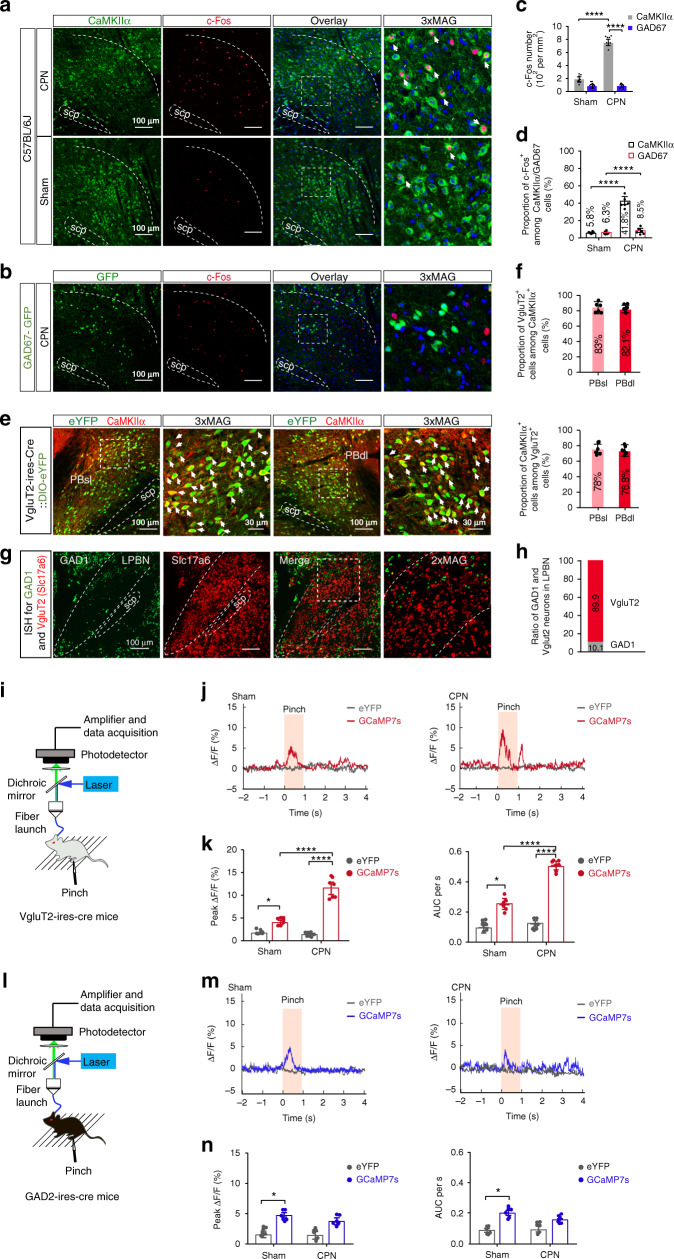
LPBN links ascending noxious information with higher brain regions and has been associated with affective pain processing. After peripheral nerve injury, its glutamatergic-associated population shows more activity labeling and larger stimulus-related calcium responses, without a corresponding enhancement in the GABAergic population.
The populations are unequal in size: GABAergic cells make up about one tenth of the two classified groups. This raises a question beyond stronger incoming signals: does regulation within the relay itself also contribute to hypersensitivity?
Source: Sun L et al. · Nature communications · CC BY
Original figure and English caption ↗
Increasing excitation produces sensitivity and avoidance
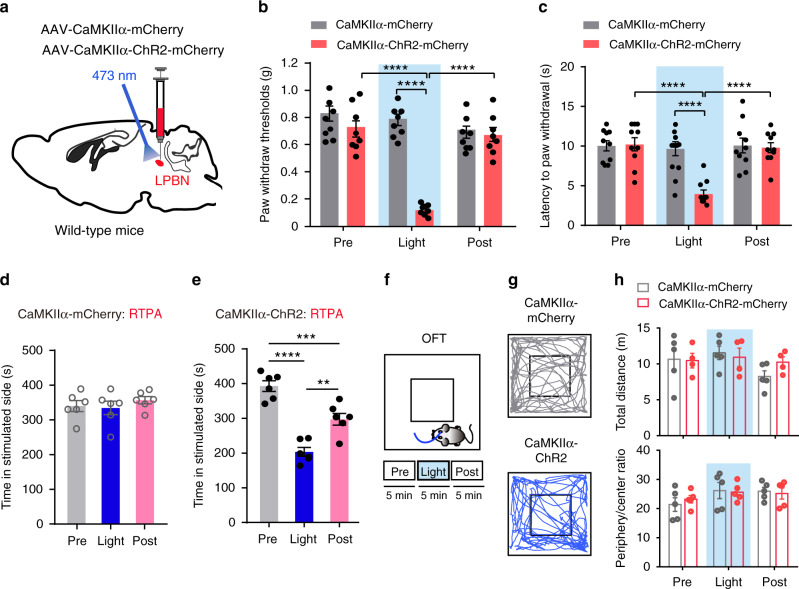
Even without nerve injury, increasing LPBN excitatory activity makes mice withdraw from weaker mechanical stimulation and respond faster to heat. They also avoid the associated compartment, with avoidance persisting into the post-stimulation observation period.
These effects have different time courses: withdrawal responses return toward their prior level after activation, while avoidance remains detectable. Total distance and open-field center-related comparisons are not significant, separating sensitivity and avoidance from a clear general locomotor or open-field anxiety change.
Source: Sun L et al. · Nature communications · CC BY
Original figure and English caption ↗
Reducing excitation also changes baseline responses
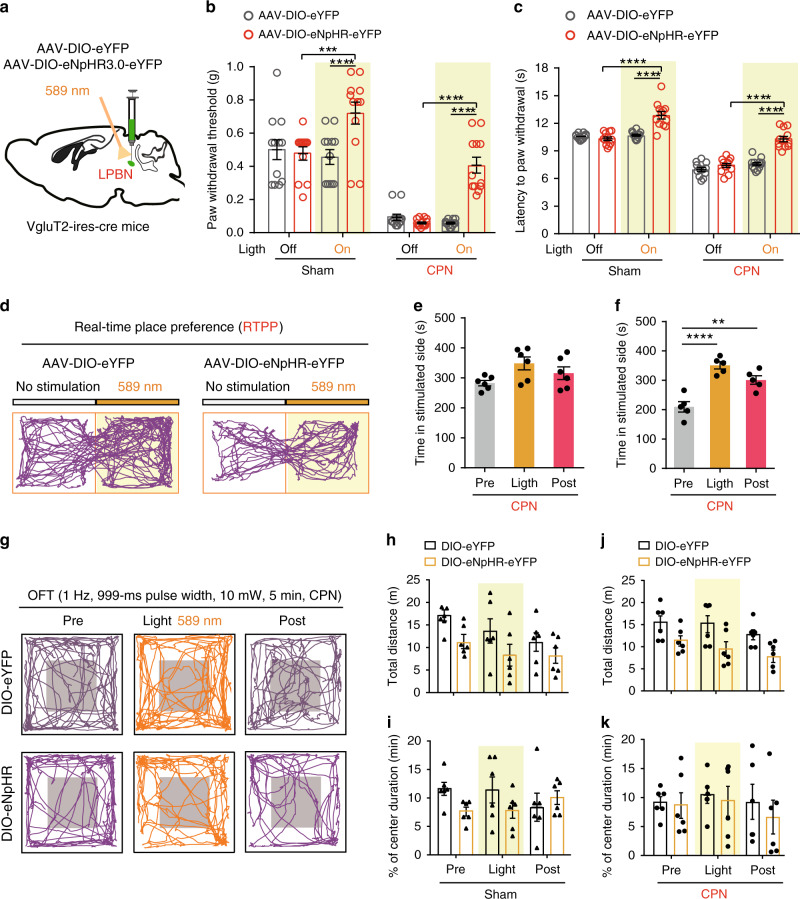
Reducing LPBN glutamatergic activity raises mechanical withdrawal thresholds and slows heat withdrawal in both control and nerve-injured mice. The node contributes to baseline nociception as well as injury-related amplification.
Only injured mice prefer the compartment associated with reduced activity; controls show no comparable preference. Altered withdrawal and relief-associated approach therefore separate, with the latter emerging against a background of existing hypersensitivity.
Source: Sun L et al. · Nature communications · CC BY
Original figure and English caption ↗
A local brake preferentially constrains injury-related amplification
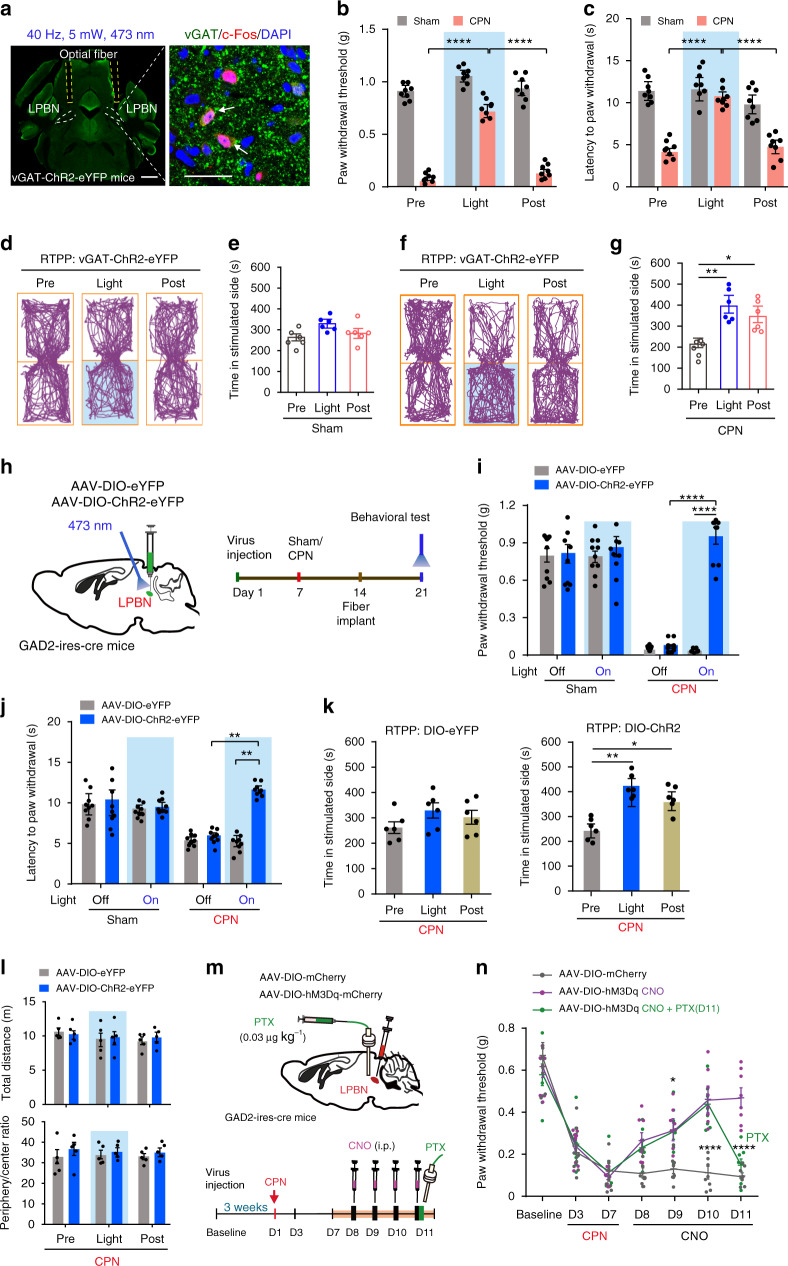
Increasing local GABAergic activity produces a different pattern: mechanical thresholds and heat-withdrawal latency rise in injured mice, while controls remain largely unchanged. Injured animals prefer the associated compartment, without significant changes in overall movement or open-field center-related measures.
This differs from directly reducing excitatory activity. The local inhibitory population preferentially constrains abnormal amplification, whereas reducing excitation also lowers baseline responsiveness. Injury changes the context in which local regulation operates.
Source: Sun L et al. · Nature communications · CC BY
Original figure and English caption ↗
Releasing the brake produces hypersensitivity without injury
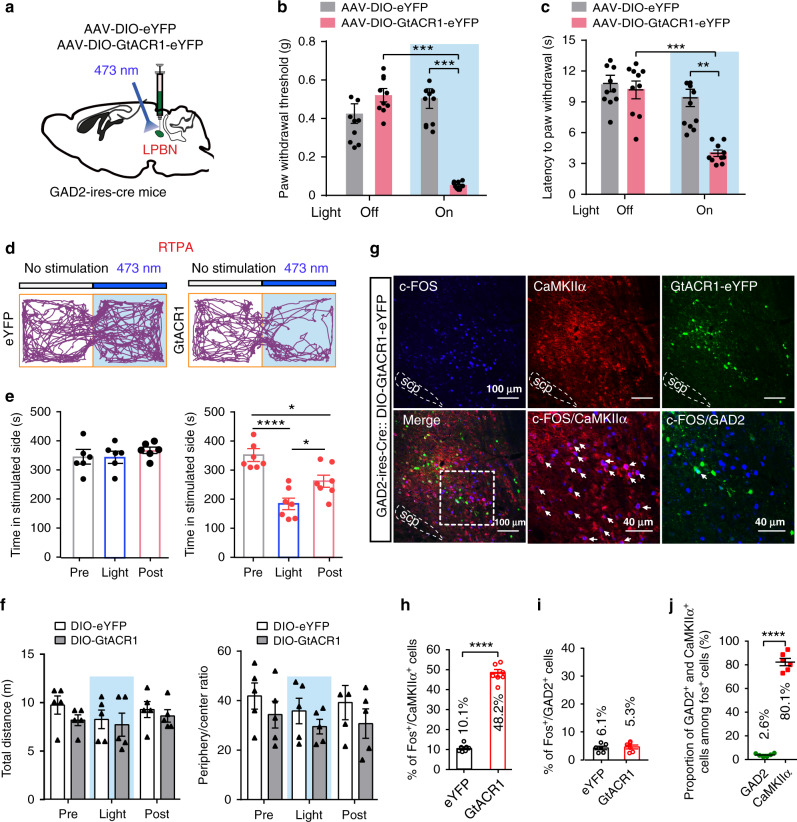
If the inhibitory population mattered only after injury, reducing its activity in intact mice might have little effect. Instead, mechanical and heat sensitivity increase, mice avoid the associated compartment, and activity labeling rises in excitatory-associated cells.
Adding inhibition in the normal state need not further reduce baseline responses, yet removing existing restraint can push the system toward hypersensitivity. This asymmetry reveals ongoing inhibitory control rather than a simple two-population on–off switch.
Source: Sun L et al. · Nature communications · CC BY
Original figure and English caption ↗
How the brake reaches excitatory cells
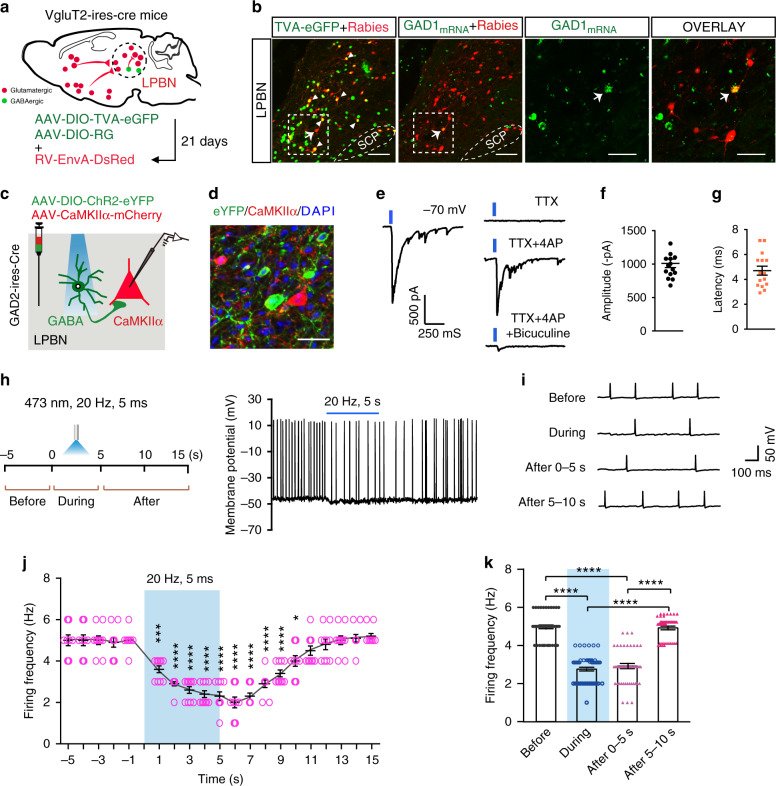
Local connectivity supplies a cellular explanation for the behavioral findings. GABAergic cells directly inhibit excitatory-associated LPBN cells; increasing inhibitory activity reduces their firing, which subsequently recovers. The populations can therefore regulate one another within the same node.
After injury, GABAergic cell density does not significantly decline, while synaptic response changes suggest reduced release efficacy. Weaker restraint need not require loss of the cells themselves. Inhibitory inputs from other regions may also contribute.
Source: Sun L et al. · Nature communications · CC BY
Original figure and English caption ↗
Sustained imbalance can leave persistent hypersensitivity
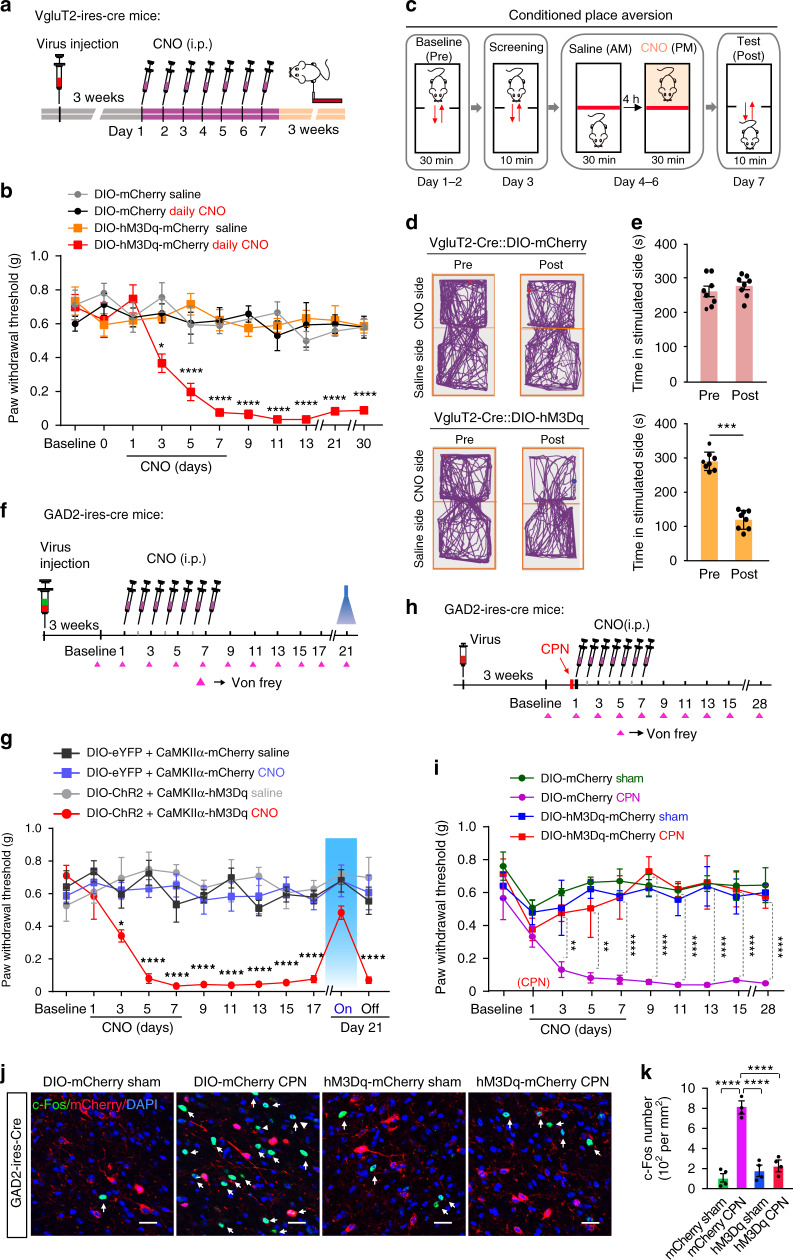
Repeatedly increasing excitatory activity leaves mechanical hypersensitivity lasting for weeks after activation ends, alongside conditioned place aversion. Increasing GABAergic activity during the early injury period prevents the corresponding sensitivity from developing and reduces excitatory activity labeling.
These findings address development and early intervention, rather than permanent elimination of established chronic pain. In male mice, LPBN emerges as a regulator of amplification and persistence as well as a relay. Its interaction with other pain pathways remains to be resolved.
Source: Sun L et al. · Nature communications · CC BY
Original figure and English caption ↗