When pain and low mood accompany one another, a locus-coeruleus cell group pushes back
In male mice, inhibitory cells near the locus coeruleus respond more strongly after nerve injury. Activating their projection to ventrolateral periaqueductal gray improves pain sensitivity and depression-like behavioral readouts.
Persistent pain can change responses to touch and accompany low mood. How does the brain recruit its own regulatory systems under this combined burden? A study in Advanced Science finds that GABAergic cells in and around the mouse locus coeruleus become more excitable after nerve injury. This enhancement appears to help oppose pain: increasing their activity further improves pain sensitivity and several depression-like behavioral measures.
Locus-coeruleus GABAergic cells contribute to bidirectional regulation through a projection to ventrolateral periaqueductal gray. Inhibiting local inhibitory cells may release excitatory cells from inhibition.
Contents · 7 sections
Changes after nerve injury emerge at different stages
The study uses a peripheral nerve-injury model and male mice for behavioral observations. Mechanical sensitivity of the injured-side paw increases within the first week. Several weeks later, immobility in tail-suspension and swim tasks increases and sucrose preference decreases. Pain sensitivity and these depression-like measures emerge at different stages of the same model.
The locus coeruleus is best known for noradrenergic cells, but cells releasing the inhibitory transmitter GABA also occupy and surround it. The team turns to this less familiar population and follows its responses to painful and other salient stimuli.
These cells become more active when painful signals arrive
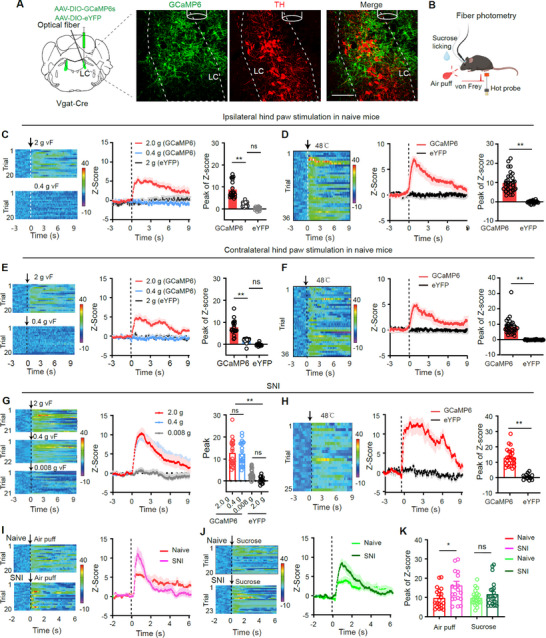
Mechanical and thermal stimulation raises calcium signals in locus-coeruleus GABAergic cells. These responses become stronger after nerve injury, as does the response to aversive air puffs. Responses during sucrose licking remain comparable between groups; the enhancement depends on the stimulus context.
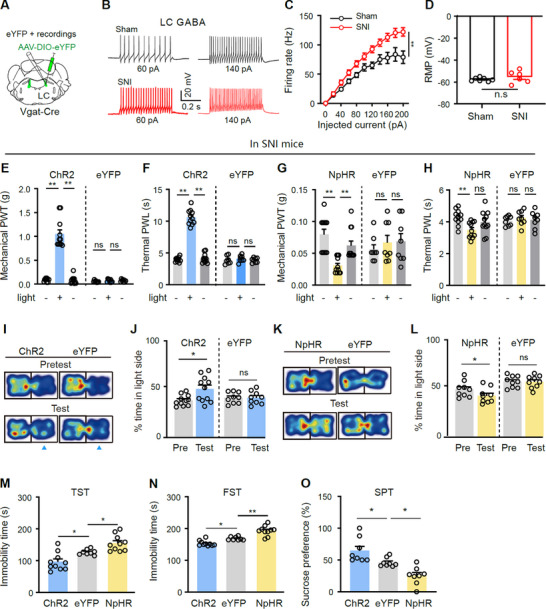
Slice recordings show more firing in response to comparable depolarizing input in injured mice, without a significant resting-potential change. Behavior worsens while these cells become more active: are they driving the problem, or working against it?
Source: Gao Y et al. · Advanced science (Weinheim, Baden-Wurttemberg, Germany) · CC BY
Original figure and English caption ↗
Increasing activity shifts behavioral readouts toward improvement
Bidirectional manipulation provides an answer. Activating these cells in injured mice raises the mechanical withdrawal threshold, lengthens thermal withdrawal latency, reduces immobility in suspension and swim tasks, and increases sucrose preference. Inhibiting them worsens pain sensitivity and depression-like measures.
The enhanced cellular response therefore resembles compensation. Nerve injury recruits it, yet behavior remains impaired. The team assesses pain at an earlier post-injury stage and depression-like behavior later, using several complementary readouts.
Source: Gao Y et al. · Advanced science (Weinheim, Baden-Wurttemberg, Germany) · CC BY
Original figure and English caption ↗
Pain relief and depression-like behavior can diverge
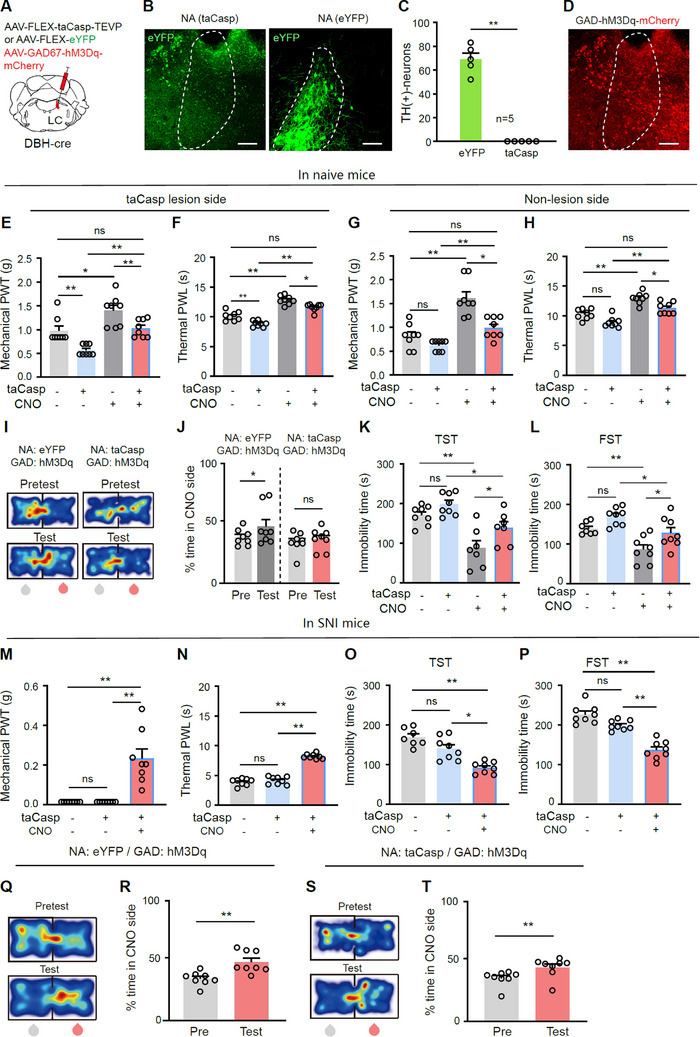
These GABAergic cells suppress painful-stimulus responses in neighboring noradrenergic cells, but behavioral regulation is not entirely routed through that neighbor. After noradrenergic-cell ablation, activating GABAergic cells still raises withdrawal thresholds and reduces immobility in injured mice.
Coactivating the two populations strengthens pain relief in injured mice but increases immobility in suspension and swim tasks. In uninjured mice, noradrenergic-cell ablation weakens the analgesic effect of GABAergic activation and eliminates the associated place preference. Pain, reward association, and depression-like behavior involve different circuit combinations.
Source: Gao Y et al. · Advanced science (Weinheim, Baden-Wurttemberg, Germany) · CC BY
Original figure and English caption ↗
One layer of inhibition may loosen another
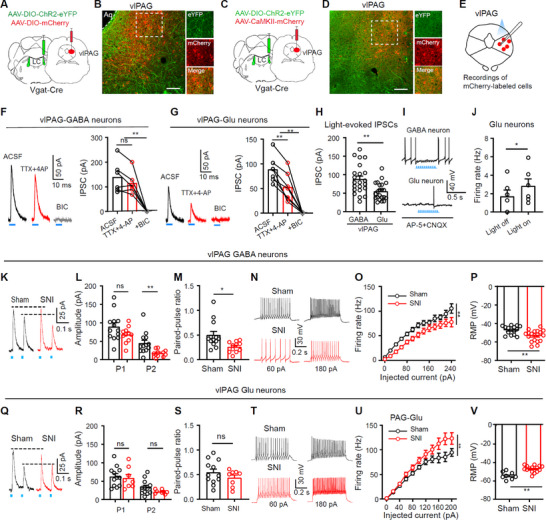
The team follows the projection to ventrolateral periaqueductal gray. Locus-coeruleus GABAergic cells provide direct inhibitory inputs to both inhibitory and excitatory cells there, with stronger input to the former. Activating the projection lowers local GABA-cell firing while increasing excitatory-cell firing.
This fits an inhibition-of-inhibition logic: suppressing cells that impose inhibition can release another population from it. Injured mice also show lower local GABA-cell excitability, higher excitatory-cell excitability, and altered synaptic-release properties at inputs to GABAergic cells.
Source: Gao Y et al. · Advanced science (Weinheim, Baden-Wurttemberg, Germany) · CC BY
Original figure and English caption ↗
Manipulating this connection reproduces several behavioral changes
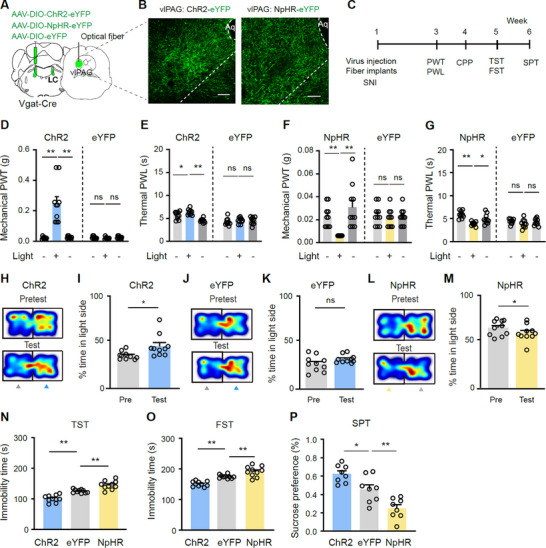
In injured mice, enhancing the periaqueductal-gray projection also raises withdrawal thresholds, reduces immobility, and increases sucrose preference; weakening it produces opposite changes. Mice spend more time at the activation-associated place and avoid the inhibition-associated place.
Suppressing local GABAergic cells reproduces part of the improvement, with no further increase when the two manipulations are combined. In uninjured mice, suppressing local excitatory cells blocks the projection-induced pain relief. These findings support a circuit model involving both local inhibitory and excitatory populations.
Source: Gao Y et al. · Advanced science (Weinheim, Baden-Wurttemberg, Germany) · CC BY
Original figure and English caption ↗
Greater activity can help resist a disease-related burden
The study expands the locus-coeruleus picture from one transmitter and one direction to cooperation among cells and projections. Increased activity during persistent pain can represent recruited compensation. Following its destination helps explain its relationship with different behavioral changes.
In the male mouse nerve-injury model, an inhibitory projection links the regulation of pain sensitivity and depression-like behavior. A particularly interesting lesson is that enhancement and deterioration need not lie on the same side: already-active cells can be working to pull the system back.