Two insular feedback brakes separately regulate head sensitivity and avoidance
Head hypersensitivity and open-area avoidance can be modulated separately in a mouse model. Two anterior-insular outputs engage endocannabinoid feedback at distinct targets, giving one molecular system different behavioral effects.

Head sensitivity and open-area avoidance coexist in one mouse model. A Research study reveals separate anterior-insular outputs contributing to each dimension, with endocannabinoids providing feedback modulation at both. One molecular system has distinct effects across projections.
Inhibiting vAI–PrL-associated cells or enhancing local eCB feedback improves head hypersensitivity; dAI–ovBNST interventions improve anxiety-like measures. Synthase reduction lacks significant benefit, while hydrolase reduction gives route-specific improvement.
Contents · 7 sections
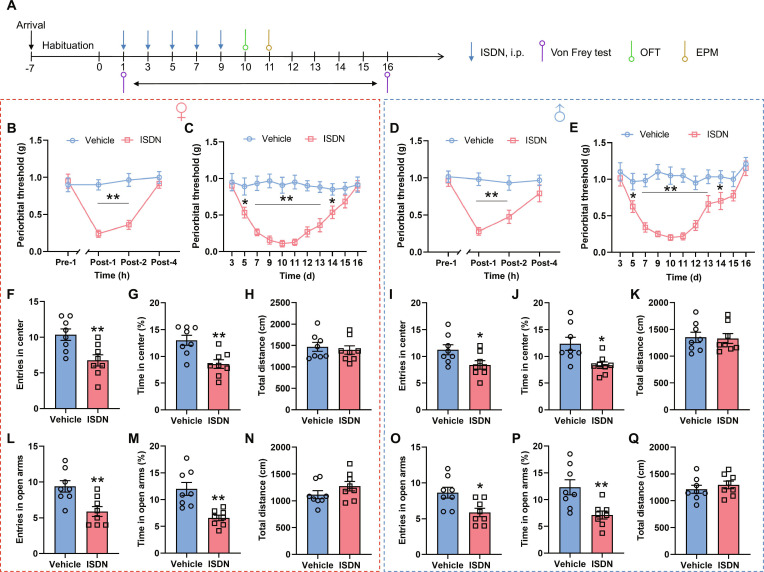
Two behaviors change after repeated ISDN
Repeated ISDN produces head mechanical-threshold decreases in both sexes. The first response is brief; repetition extends hypersensitivity across days, with recovery by days fifteen and sixteen. Exploration is assessed within this window.
Center and open-arm entries/duration decrease without clear distance changes. Mice remain active but alter open-area choices. Coexisting sensory and anxiety-like measures allow their intervention dependence to be compared.
Source: Bian J et al. · Research (Washington, D.C.) · CC BY
Original figure and English caption ↗
Two insular outputs affect different outcomes
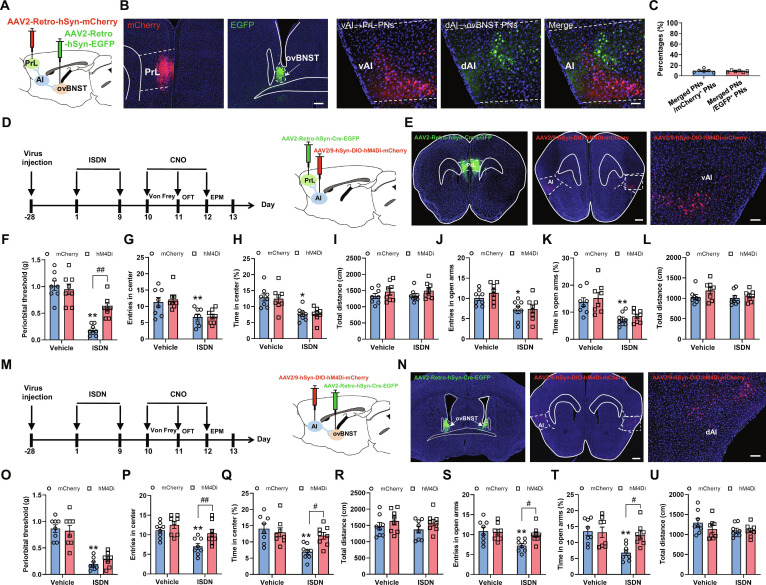
Model c-Fos increases in AI, PrL and oval BNST. Tracing identifies largely distinct ventral AI cells projecting to PrL and dorsal cells projecting to ovBNST.
PrL-projecting-cell inhibition improves head thresholds without significant anxiety-like changes. ovBNST-projecting inhibition improves exploration while hypersensitivity remains, revealing distinct dependence.
Source: Bian J et al. · Research (Washington, D.C.) · CC BY
Original figure and English caption ↗
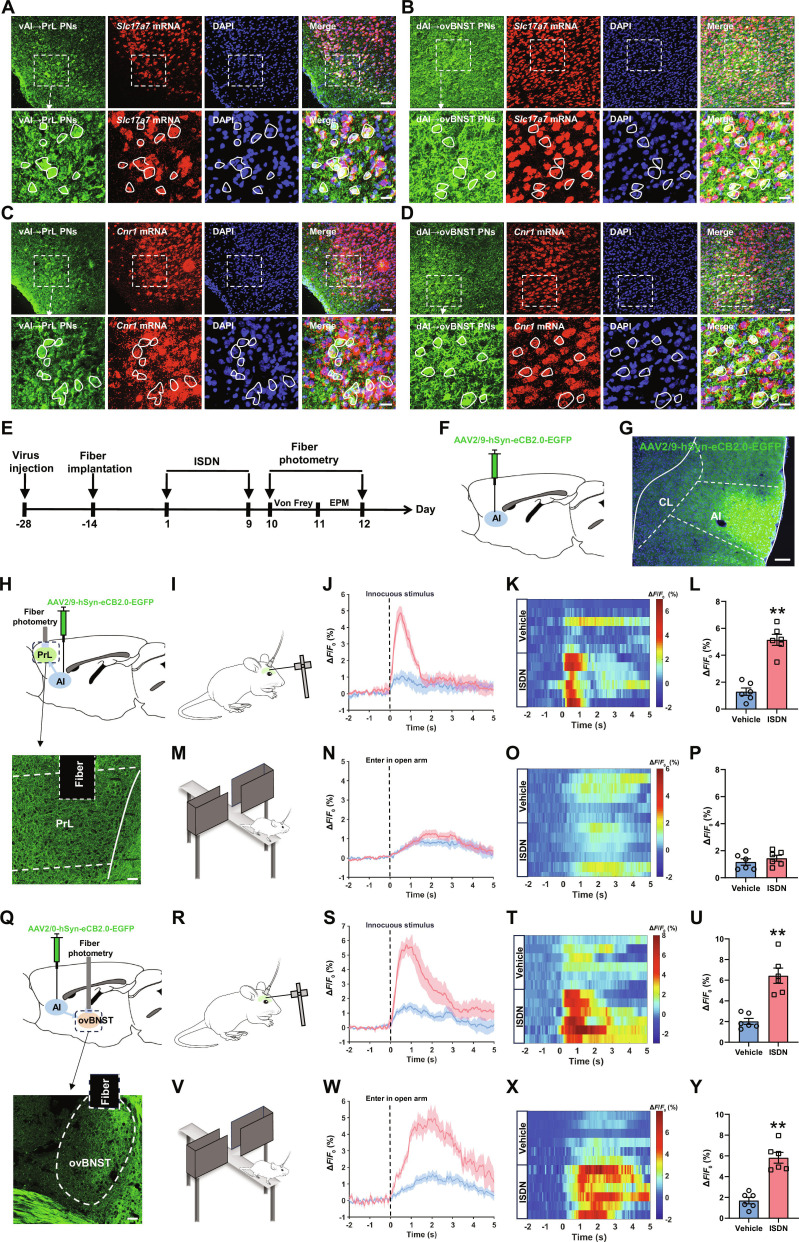
eCB signals rise during relevant events
Endocannabinoids such as 2-AG signal backward to presynaptic CB1 receptors to regulate release. Sensors on AI-origin terminals show greater model PrL responses during head stimulation but not open-arm testing; ovBNST responses increase in both settings.
This feedback allows recipient cells to regulate subsequent input. Activity triggers local signaling at the sending terminal, adjusting excitatory transmission. Synthesis, degradation and receptors therefore provide distinct functional tests.
Response context and behavioral contribution differ. ovBNST eCB rises during mechanical testing despite unchanged thresholds after pathway inhibition, prompting tests of whether elevated signaling promotes or counteracts the model.
Source: Bian J et al. · Research (Washington, D.C.) · CC BY
Original figure and English caption ↗
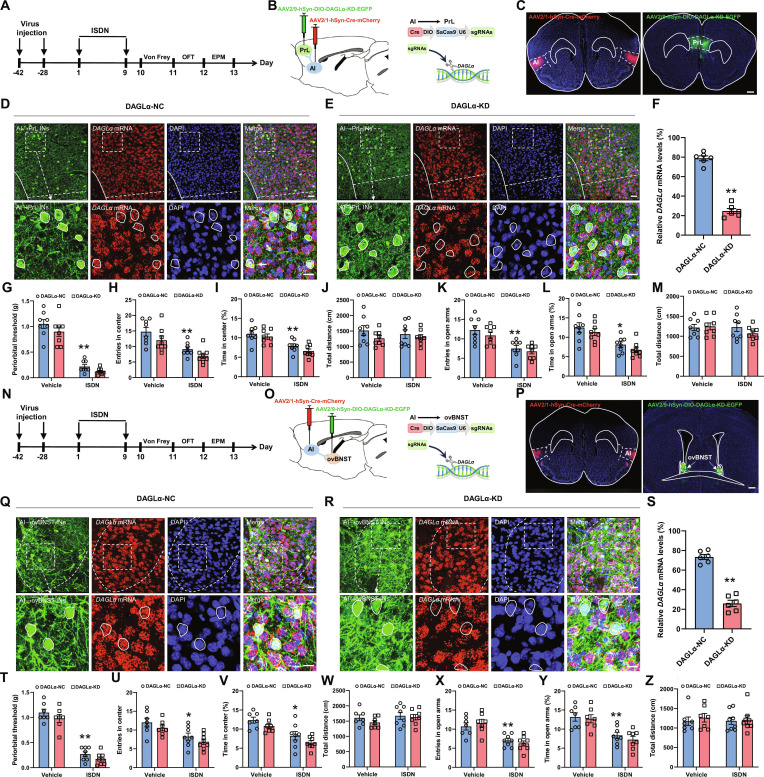
Reducing synthesis does not improve behavior
Reducing the 2-AG synthase DAGLα in AI-recipient PrL or ovBNST cells lowers expression without significantly improving hypersensitivity or anxiety-like behavior.
Targeting degradation tests the opposite direction: if the signal feeds back against excessive activity, strengthening it may be beneficial. Making eCB less readily broken down distinguishes increased signal levels from their functional effects.
Source: Bian J et al. · Research (Washington, D.C.) · CC BY
Original figure and English caption ↗
Reducing degradation benefits the two routes differently
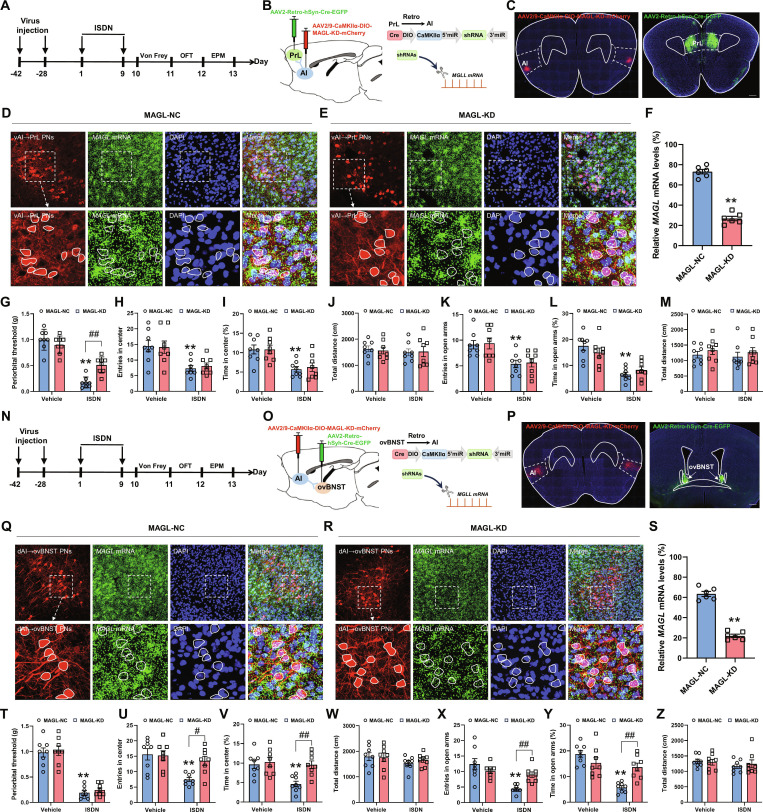
Projection-associated MAGL reduction differs from synthase reduction. PrL-related reduction improves sensitivity but not significantly anxiety-like measures; ovBNST-related reduction improves exploration but not thresholds. Controls lack significant behavioral changes.
Molecular manipulation recapitulates projection specialization. Stronger feedback affects different outcomes by target, motivating combined modulation of both dimensions.
Source: Bian J et al. · Research (Washington, D.C.) · CC BY
Original figure and English caption ↗
CB1 activation reduces excitatory events
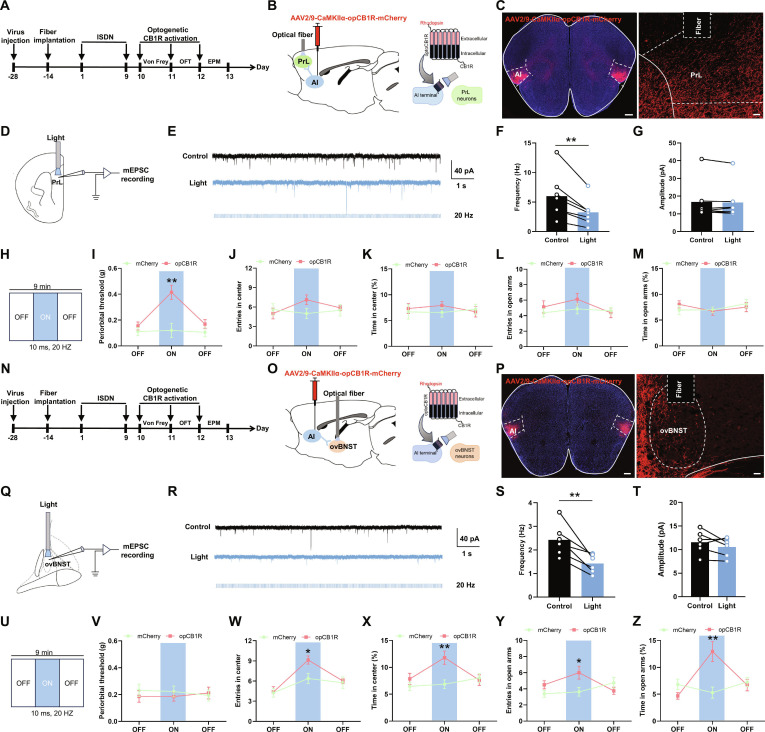
Light activation of engineered photosensitive CB1 on AI terminals reduces excitatory-current frequency without significant amplitude change. PrL activation improves hypersensitivity and ovBNST activation improves exploration, without significant cross-dimension effects.
Genetic, receptor and cell-inhibition interventions align with the same specialization. Feedback modulates synaptic input with behavioral selectivity determined by the route.
Source: Bian J et al. · Research (Washington, D.C.) · CC BY
Original figure and English caption ↗
One molecular system acts through different outputs
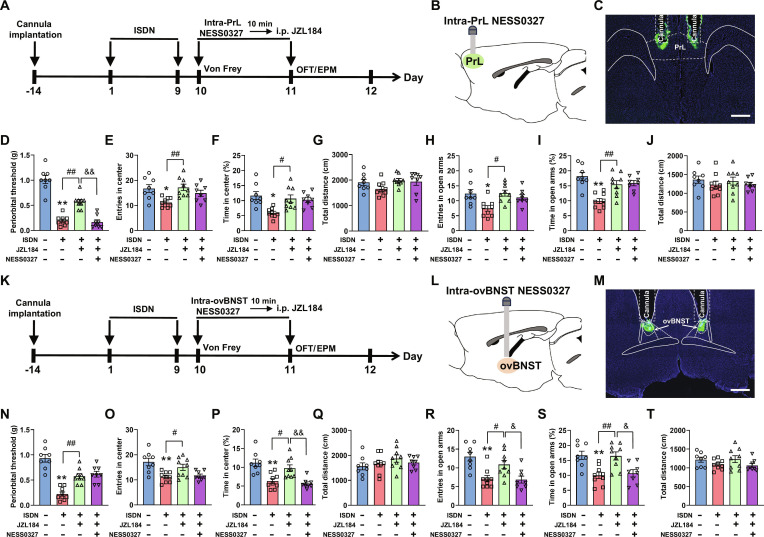
Systemic JZL184 improves both model dimensions. Local PrL CB1 blockade counteracts sensory improvement, while ovBNST blockade counteracts exploration improvement, linking systemic effects to distinct recipient regions.
Coexisting behaviors can have separate projection dependence, while one molecular system acts at different outputs. Endocannabinoid feedback provides a cellular account of linked yet separable sensitivity and avoidance.
Source: Bian J et al. · Research (Washington, D.C.) · CC BY
Original figure and English caption ↗