Cortical input shapes subthalamic activity in chronic pain
In male mice, ACC input to STN strengthens after nerve injury. Suppressing the input improves hypersensitivity and tested depression-like behaviors, while soma and terminal activation have different outcomes.
Persistent pain often accompanies emotional difficulties. How do brain connections link sensation and behavior? A 2024 PLOS Biology study examines anterior cingulate cortex, ACC, input to subthalamic nucleus, STN. In nerve-injured male mice, STN-projecting ACC cells become more excitable and evoke stronger synaptic responses in STN. Modulating the input changes hypersensitivity and some behavioral measures, with outcomes depending on animal state and whether somata or terminals are targeted.
ACC-to-STN excitatory input strengthens after nerve injury. Terminal suppression raises withdrawal thresholds and reduces tested depression-like behaviors. In naive mice, terminal activation increases sensitivity without reproducing the aversion and increased immobility caused by projection-cell soma activation.
Contents · 7 sections
An excitatory connection strengthens after injury
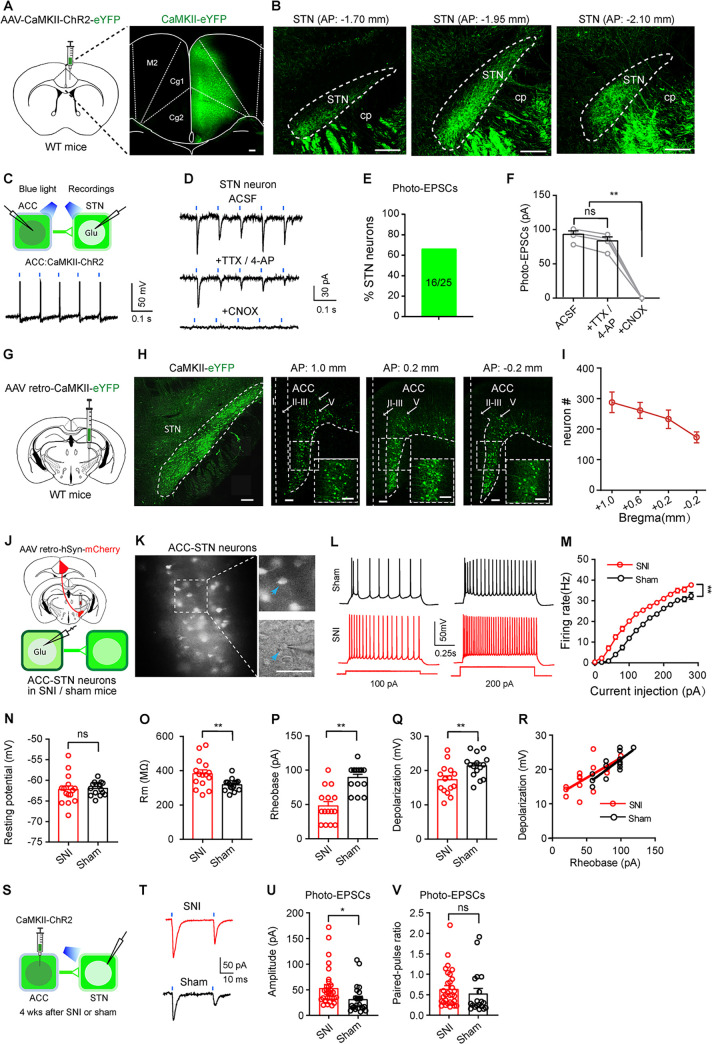
ACC participates in sensory and emotion-related processing, while STN belongs to basal-ganglia networks. Tracing and synaptic recordings identify a direct glutamatergic connection. STN-projecting ACC cells are mainly in cortical layer V, defining a particular population to investigate.
After nerve injury, these cells fire more with matched current and show altered excitability measures, while resting potential is unchanged statistically. Evoked excitatory currents in STN are larger, but paired-pulse ratios do not significantly change: cellular and connection changes spare some measures.
Source: Wang YD et al. · PLoS biology · CC BY
Original figure and English caption ↗
Sensation and context evoke cortical responses
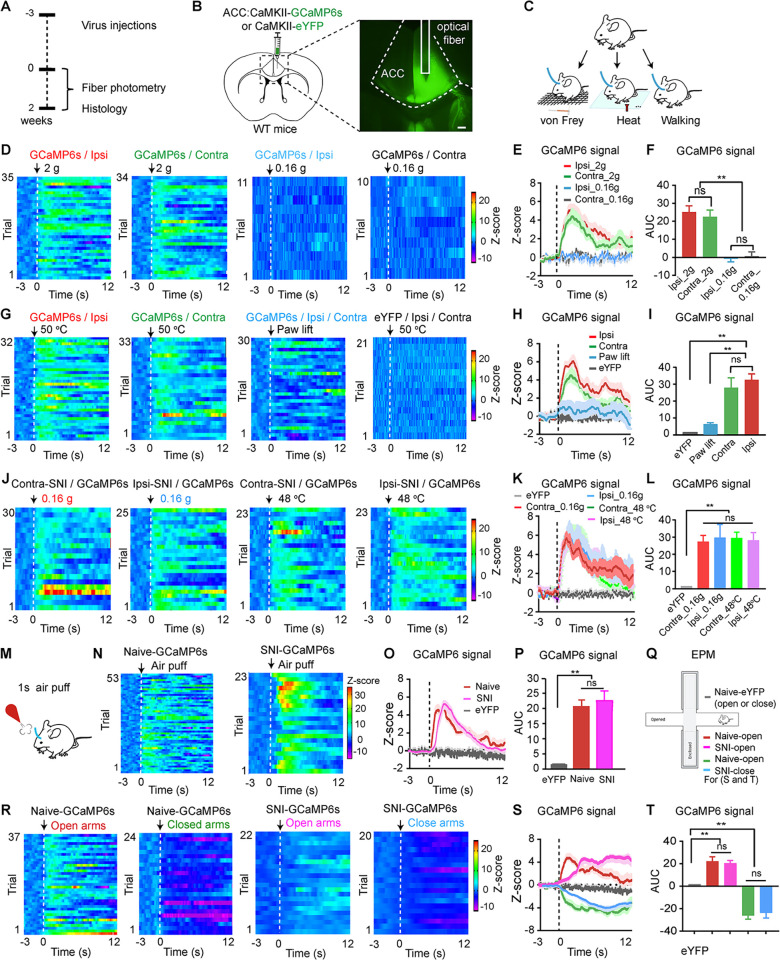
In naive mice, mechanical or thermal stimuli that elicit withdrawal increase ACC population calcium. Weaker mechanical stimulation and spontaneous paw lifts during exploration do not produce the same significant change. After injury, milder stimuli accompany clear signals, matching increased behavioral sensitivity.
ACC signals also change with air puff or entry into an elevated-maze open arm, falling on return to a closed arm. Calcium recordings therefore track sensory events and tested contexts beyond a single paw movement.
Source: Wang YD et al. · PLoS biology · CC BY
Original figure and English caption ↗
Cortical activity influences STN responses
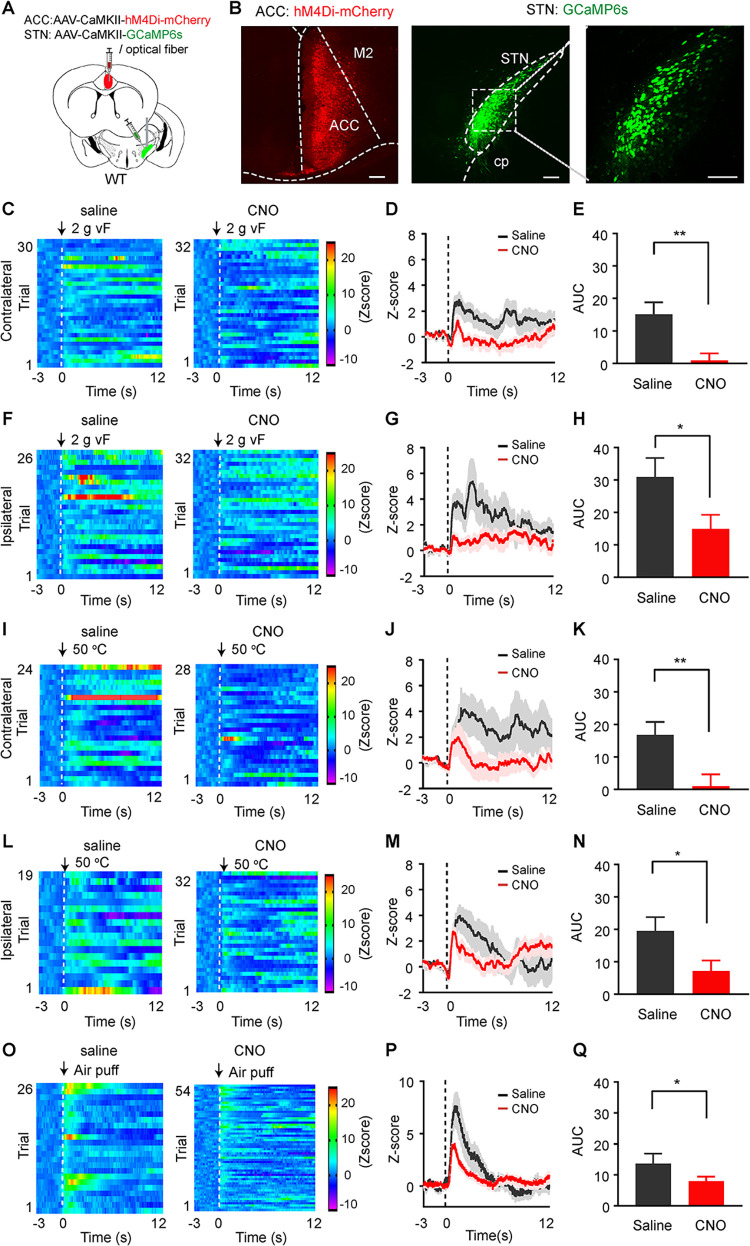
Suppressing excitatory ACC cells reduces STN calcium responses to mechanical, thermal and air-puff stimuli. The effect occurs in tested naive and injured conditions, supporting an ACC contribution to STN sensory responses. Recipient responses thus relate to cortical state, rather than only to local cellular activity.
Maze-context findings differ. Naive STN shows no significant arm-transition response; corresponding changes emerge after injury but are not significantly reduced by ACC suppression. Other inputs may shape STN state, with sensory and contextual responses regulated differently.
Source: Wang YD et al. · PLoS biology · CC BY
Original figure and English caption ↗
Projection-cell modulation changes sensitivity and avoidance
Activating STN-projecting ACC somata lowers withdrawal thresholds in both hind paws of naive mice, produces avoidance of the paired location and increases immobility during suspension and swimming. Movement speed in the place task does not significantly change, separating avoidance from simply moving more slowly. Withdrawal thresholds describe sensitivity to tested stimuli, whereas place choice and immobility offer different behavioral information.
In injured mice, suppressing the population raises thresholds, increases preference for the intervention-paired location, reduces immobility and improves the tested female-urine sniffing measure. Suppression does not significantly alter tested withdrawal thresholds in naive mice, making the effect state-dependent.
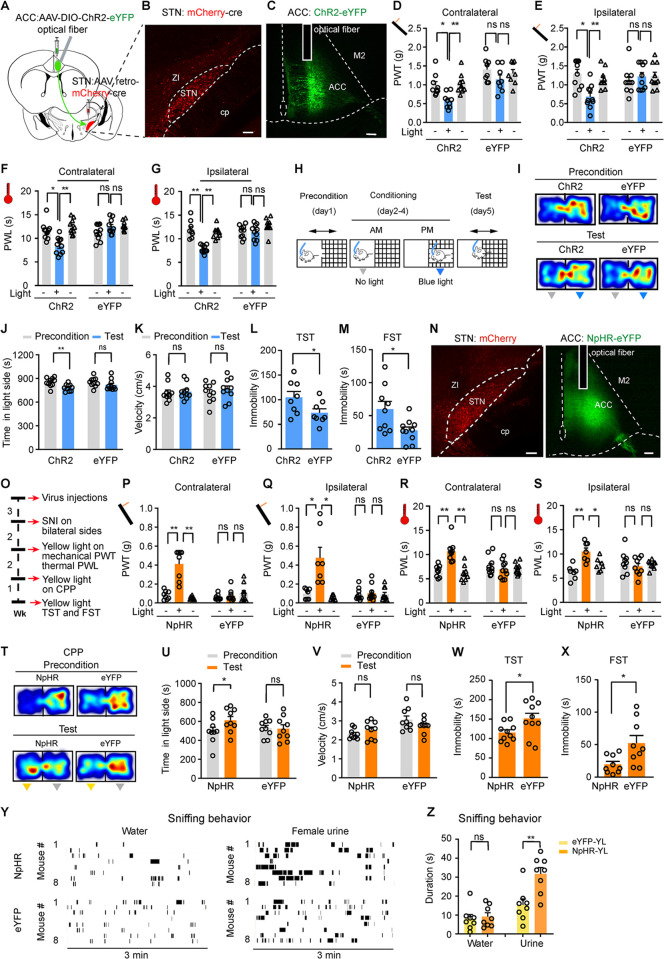
Source: Wang YD et al. · PLoS biology · CC BY
Original figure and English caption ↗
Terminal modulation produces a different pattern
These ACC cells also send branches to other regions. Activating their STN terminals still lowers naive-mouse withdrawal thresholds but does not significantly induce place avoidance or increased immobility. The full behavioral pattern from soma activation does not emerge at this output.
Yet terminal suppression in injured mice improves hypersensitivity, reduces immobility, increases tested sniffing and produces place preference. In naive mice, terminal suppression again has no significant threshold effect. The meaning of activation and suppression depends closely on the network’s starting state.
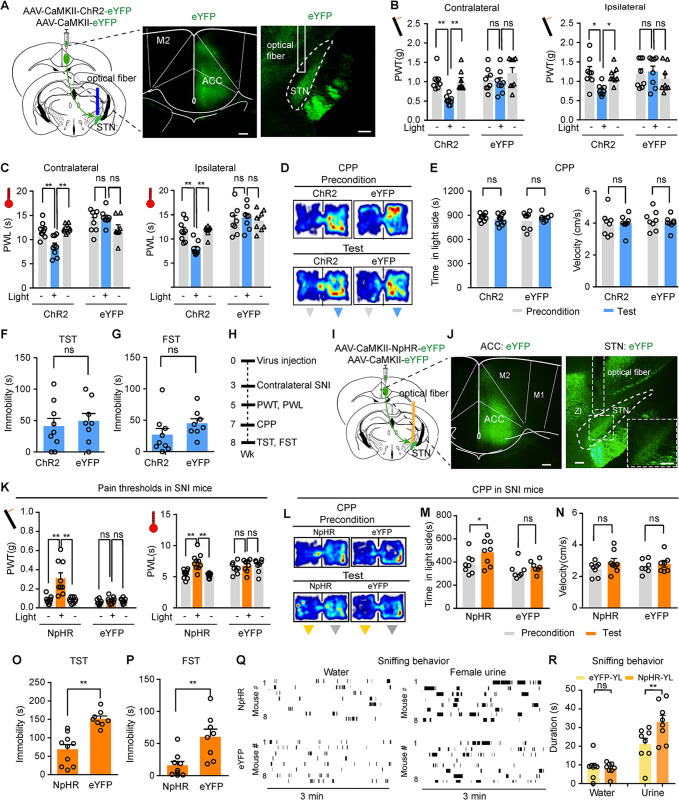
Source: Wang YD et al. · PLoS biology · CC BY
Original figure and English caption ↗
Elevating STN activity again counters improvement
The team next combines input and recipient manipulation. In injured mice, additional STN-cell activation counters threshold improvements from ACC-terminal suppression and eliminates the accompanying place-preference and immobility improvements. STN activity is therefore an important component of the input-intervention effect.
In separate naive mice, ACC-terminal suppression reduces hypersensitivity and place avoidance caused by STN activation. Together, these combinations show that recipient-cell excitability and cortical input interact in shaping tested behavior.
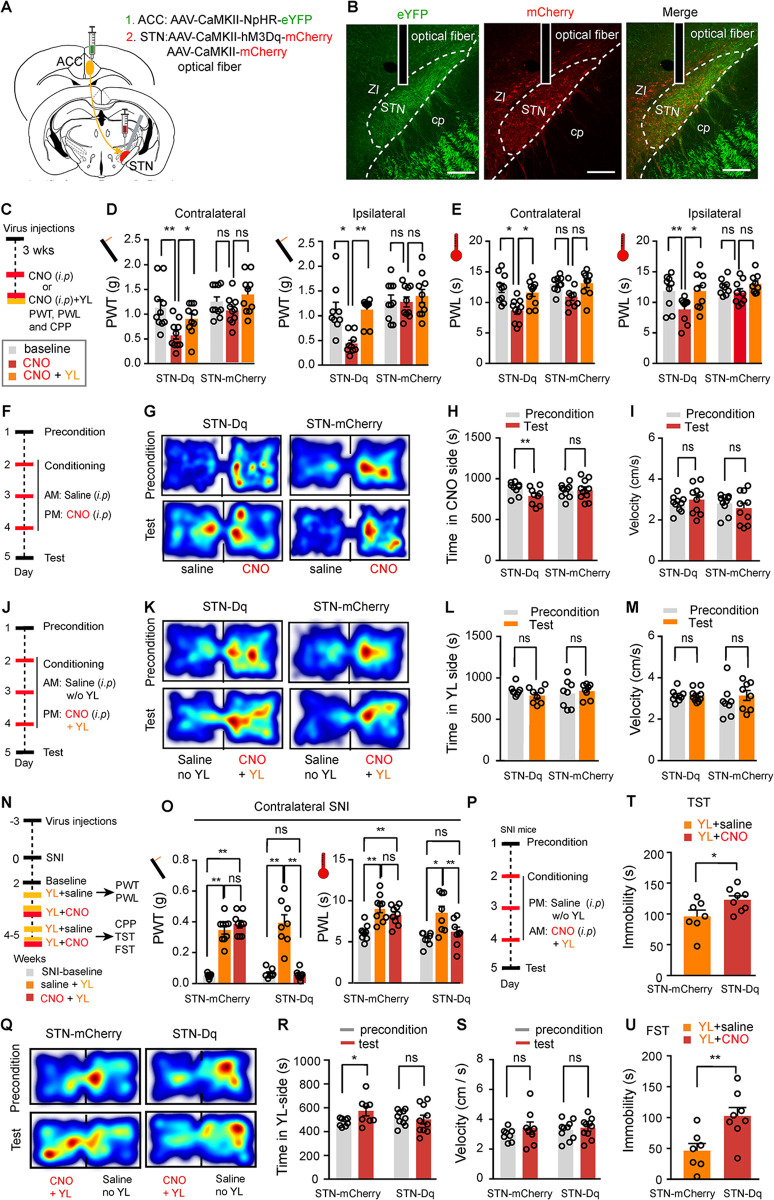
Source: Wang YD et al. · PLoS biology · CC BY
Original figure and English caption ↗
A connection whose contribution changes with state
This male-mouse study examines chronic hypersensitivity and depression-like measures through one connection while showing that they do not change together under every activation condition. Somata, local terminals and recipient cells contribute related but distinct components.
The insight is that cortical input to basal ganglia carries more than movement-related information: after nerve injury, it can help maintain sensory and behavioral changes. Understanding this role brings connection strength, recipient state and specific behavioral outcomes into the same picture.