How novelty changes pain-related behavior: clues from a hypothalamic ensemble
A novel object or environment changes pain-like responses in mice. Following novelty leads researchers to a lateral-hypothalamic ensemble and its diverse outputs.

Novelty draws attention. When mice explore an unfamiliar object, their responses to painful stimulation can change too. Which brain cells connect exploration with pain-related behavior? A 2026 Nature Communications study follows the trail into the lateral hypothalamus (LH), identifying cells active during novelty exploration and tracing their outputs. Activating the ensemble can reduce pain-like behavior in the tested models, while its individual connections produce strikingly different effects.
Novelty-recruited LH cells also respond to nociceptive and other salient events. Their activation improves selected pain-like and anxiety-related measures in the tested models, while GABAergic and glutamatergic outputs have distinct target-dependent effects.
Contents · 6 sections
Responses change when a novel object appears
During the second formalin phase, novel objects or environments reduced paw-licking duration and bouts in both sexes. Novel objects also lengthened hotplate withdrawal latency in baseline and inflammatory conditions. Several pain-related measures thus changed alongside exploration.
Social novelty also altered conditioned place aversion. Under the tested conditions, the opioid-receptor antagonist naltrexone did not reverse the main novelty-related effect. The team therefore turned toward the circuits recruited by novelty and their links with exploration, sensation and affect-related behavior.
Identifying cells recruited by a novel experience
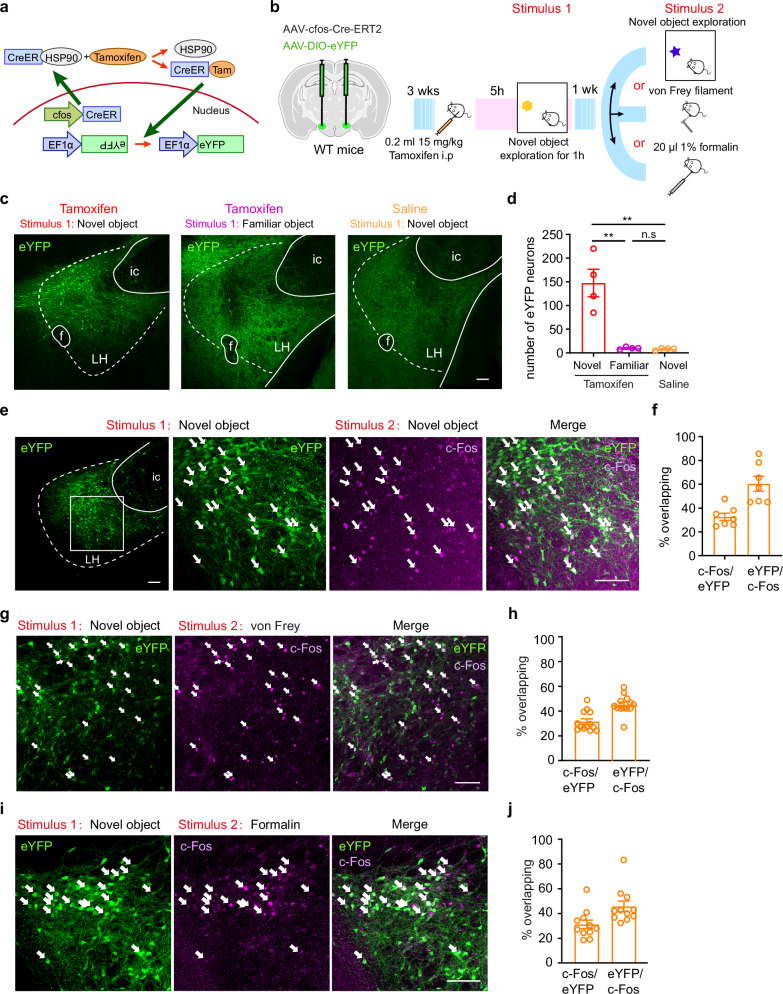
Novelty exploration produced activity labeling across several brain regions, with LH chosen for closer study. Cells tagged during exploration were partly reactivated by later exploration, and members of this ensemble also responded to mechanical or formalin stimulation. Distinct experiences thus converged within an overlapping population.
In vivo recordings made the link clearer. Tagged cells responded to exploration and nociception, selected anxiety-related contexts, air puffs and rewards, suggesting sensitivity to several salient events. LH controls not captured during the novelty experience responded more weakly, making experience-dependent recruitment a useful functional clue.
Source: Jia T et al. · Nature communications · CC BY-NC-ND
Original figure and English caption ↗
Changing ensemble activity changes behavior
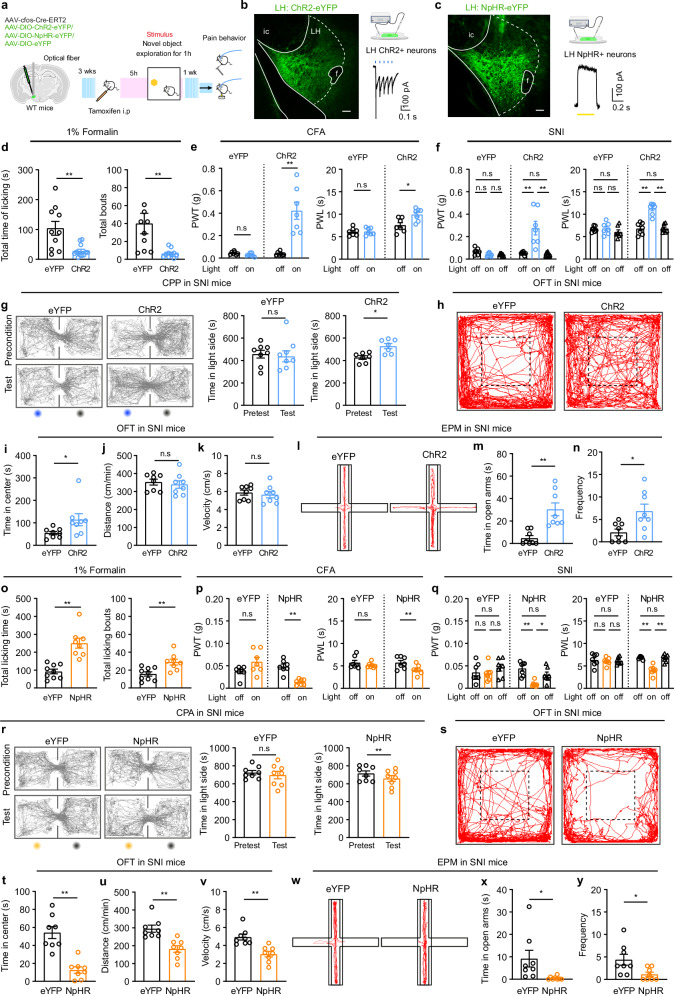
In inflammatory and nerve-injury models, activating the novelty-tagged ensemble reduced selected licking responses and increased some mechanical and thermal thresholds. Chronic nerve-injury mice also showed place preference and greater center or open-arm exploration. Inhibition worsened selected nocifensive and avoidance measures, linking ensemble activity with behavior in both directions.
The effect depended on state and population. Somatic activation did not clearly raise baseline thresholds in naive mice, and activating noncaptured LH controls did not produce the same changes. A shared brain region can therefore contain populations with different behavioral effects, motivating a closer look at the recruited ensemble.
Source: Jia T et al. · Nature communications · CC BY-NC-ND
Original figure and English caption ↗
Different transmitters, convergent ensemble effects
The ensemble included GABAergic and glutamatergic cells, with partial overlap with orexin and MCH identities. Both transmitter-defined subgroups responded to nociceptive stimulation, and activating either at the cell bodies improved selected model phenotypes. Different transmitter populations could thus converge on similar behavioral outcomes.
Not every readout changed, including some licking-bout comparisons. Somatic activation also recruits multiple outputs, whose net effect can conceal differences between individual connections. The team therefore followed the long-range projections to specific target regions.
Different routes lead to different effects
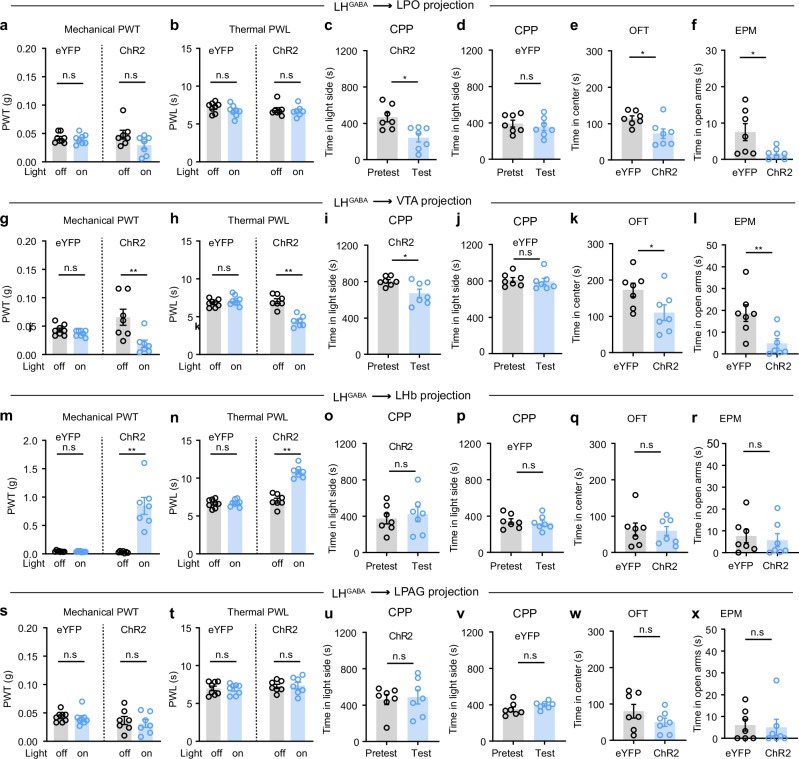
Activating GABAergic novelty-ensemble terminals in the lateral habenula (LHb) increased thresholds without clear place-preference or anxiety-related exploration changes. Lateral periaqueductal gray (LPAG) outputs were largely null. Lateral preoptic area (LPO) and ventral tegmental area (VTA) stimulation produced aversion and avoidance, and the VTA route also lowered thresholds.
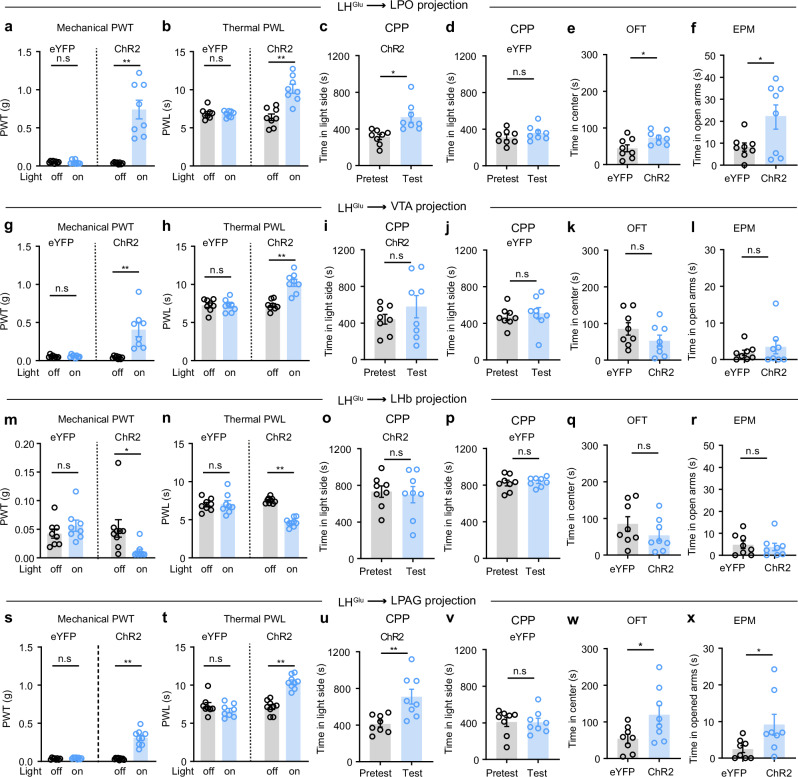
Glutamatergic outputs produced another pattern. LPO and LPAG stimulation improved selected nocifensive and anxiety-related measures, VTA mainly affected thresholds, and LHb increased sensitivity without clear anxiety-related changes. The same target can yield different outcomes depending on the incoming signal, separating some sensory and affect-related effects.
Source: Jia T et al. · Nature communications · CC BY-NC-ND
Original figure and English caption ↗
Novelty and pain meet through a combination of circuits
The study follows a novel experience into recruited cells and their distinct outputs, turning the link between novelty and pain-related behavior into a circuit-level story. The ensemble’s net effect differs from individual projection effects, making coordination between outputs central to understanding the behavioral change.
The evidence comes from both sexes in tested inflammatory and nerve-injury models, with some analyses pooled across sex. How outputs coordinate during natural exploration and which downstream cells receive their signals remain open questions. Following these connections offers more specific entry points into the interaction of sensation, exploration and affect.
Source: Jia T et al. · Nature communications · CC BY-NC-ND
Original figure and English caption ↗