How does gentle touch affect exploration during chronic pain? Clues from hippocampal CA1
A rat study connects exploratory behavior, brain imaging and local rhythms to investigate gentle forehead stimulation and hippocampal activity.
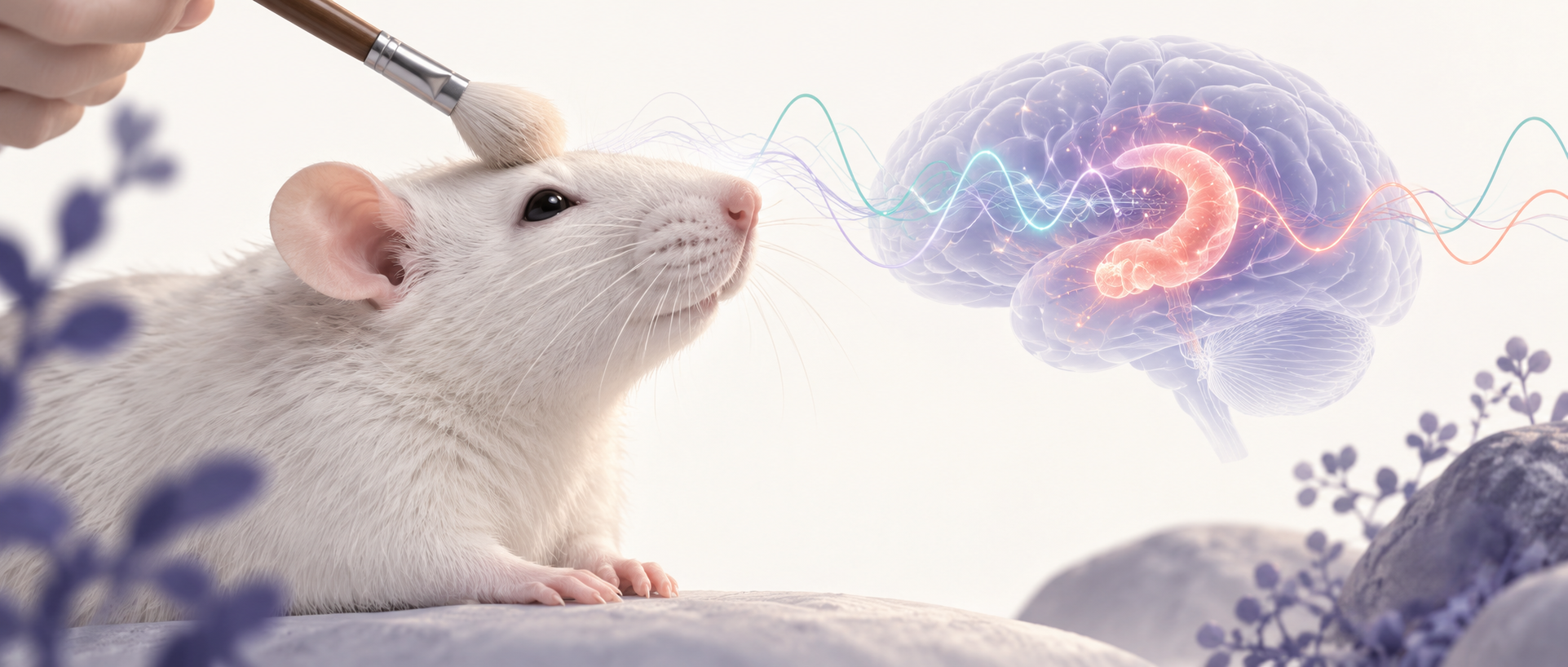
After pain persists for weeks, animals may explore unfamiliar spaces less. Alongside bodily sensitivity, how the brain organizes behavior also deserves attention. A 2026 Frontiers in Molecular Neuroscience study examined gentle mechanical forehead stimulation in rats with chronic inflammatory pain. After two weeks, some exploratory measures improved, while hippocampal CA1 calcium signals and low-frequency rhythms changed. These links between touch, behavior and brain activity turn a familiar sensory experience into a research question that can be followed across several levels.
Gentle tactile stimulation accompanies improvement in some exploration and arousal measures, along with stronger CA1 calcium activity and delta and theta power. Withdrawal-threshold changes differ between experimental cohorts.
Contents · 7 sections
Animals explore less alongside bodily hypersensitivity
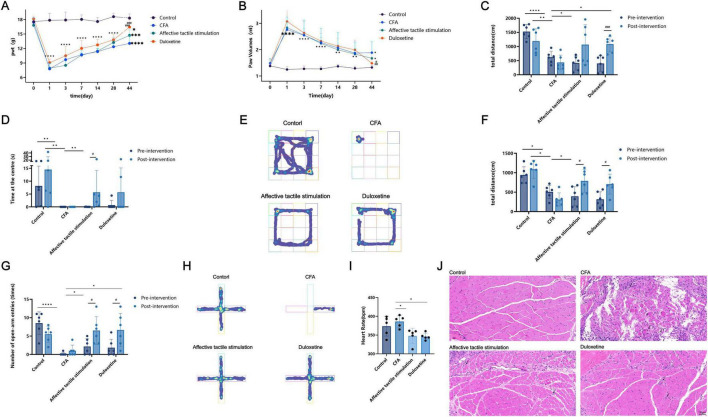
In the chronic inflammatory pain model induced by complete Freund’s adjuvant, or CFA, rats showed lower mechanical withdrawal thresholds, paw swelling and reduced exploration in an open field and elevated plus maze. Gentle forehead stimulation was introduced after the chronic state had developed, with a duloxetine comparison group, to examine behavioral change during persistent pain.
The touch was delivered as gentle automated mechanical stimulation. After habituation, animals showed no overt escape or struggling. This allowed observation of a relatively standardized sensory input without the immediate variability of human–animal interaction. The study then examined its relationships with exploration, peripheral inflammatory measures and brain activity.
Exploration of open spaces improves
In the initial behavioral cohort, tactile treatment produced small, nonsignificant increases in mechanical thresholds and decreases in swelling. Duloxetine significantly improved both measures. Compared with the concurrent CFA group, tactile-treated rats had greater open-field distance and center time, while their within-group pre/post distance change was not significant. The behavioral pattern was therefore clearer in exploratory measures.
In the elevated plus maze, tactile-treated rats traveled farther and entered open arms more often; heart rate was lower than in untreated CFA animals. These changes linked exploration with physiological arousal. Tissue sections also offered qualitative signs of milder inflammation. The observations prompted a further question: does gentle stimulation accompany activity changes that can be localized in the brain?
Source: Zeng L et al. · Frontiers in molecular neuroscience · CC BY
Original figure and English caption ↗
Hippocampal CA1 comes into view
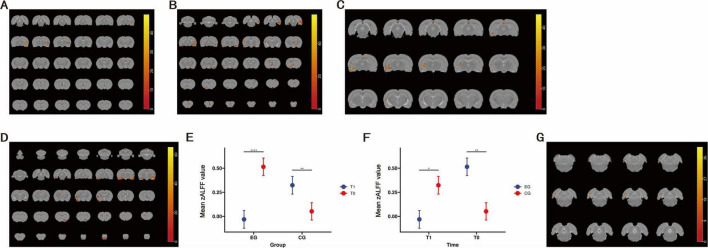
Functional MRI offered a view across brain regions. Regional homogeneity, or ReHo, and low-frequency amplitude, or ALFF, characterize local signal synchrony and fluctuation magnitude. Comparisons between tactile and CFA groups identified increased right CA1 ReHo and left CA1 ALFF, alongside changes in other sensory and affect-related regions. These results made the hippocampus a focus for local recordings.
Left perirhinal ALFF also showed a group-by-time interaction, indicating different temporal trajectories in this region. Imaging outlined an activity pattern involving several regions. CA1 stood out as one site for closer examination, while changes elsewhere suggested broader relationships between touch and the chronic state.
Source: Zeng L et al. · Frontiers in molecular neuroscience · CC BY
Original figure and English caption ↗
Whole-brain connectivity changes over the observation period
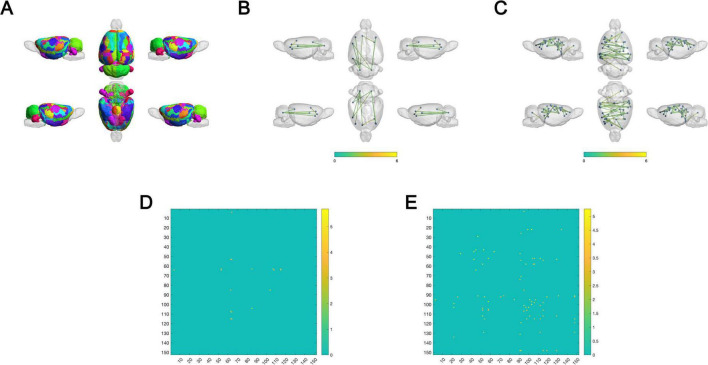
Whole-brain connectivity showed a significant time effect, with no significant group or interaction effects. Between assessments, some connections strengthened and more weakened. These changes over the observation period offered another scale of evidence about network dynamics during persistent inflammatory pain.
CA1 seed analyses also implicated cerebellar molecular-layer and somatosensory relationships, while time-related entorhinal connectivity included right CA1. Covariation between regional signals extended the investigation from one brain area to network relationships. How tactile information reaches the hippocampus remains a question connecting imaging observations with local cellular activity.
Source: Zeng L et al. · Frontiers in molecular neuroscience · CC BY
Original figure and English caption ↗
CA1 calcium and low-frequency rhythms increase together
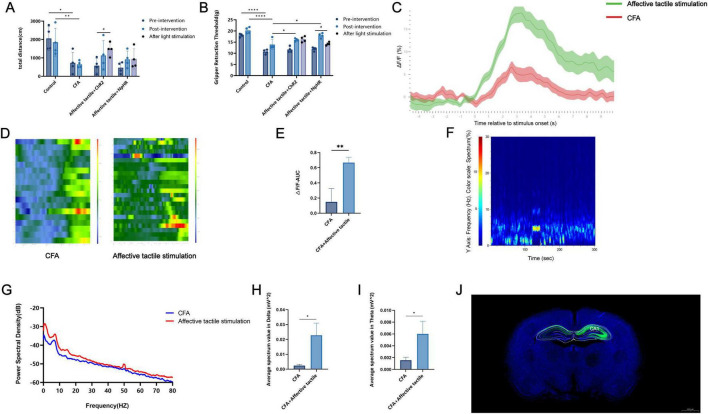
Following the imaging clues, the researchers recorded population calcium mainly in right CA1. Tactile-associated responses and their area under the curve were greater than in the CFA group, indicating stronger local calcium activity. Field recordings further showed increased delta, at 1–4 Hz, and theta, at 4–8 Hz, power, extending the observations from population dynamics to local electrical rhythms.
Calcium signals and field potentials describe the same region from different perspectives, together showing touch-associated CA1 changes. Stronger low-frequency rhythms offer clues to population coordination. Their specific relationship with exploration can be investigated further through more selective studies of cells or rhythms.
Source: Zeng L et al. · Frontiers in molecular neuroscience · CC BY
Original figure and English caption ↗
Exploration and thresholds do not always change together
In a separate local-recording and optogenetic cohort, tactile treatment alone produced higher withdrawal thresholds than CFA. This differed from the modest, nonsignificant change in the initial cohort, indicating variation in the magnitude of threshold effects across cohorts. Exploration and hypersensitivity also responded differently to CA1 modulation.
With CA1 activation, exploration increased relative to pre-intervention, but thresholds did not rise further. During CA1 inhibition, exploration did not improve, while thresholds rose in the pre/post stimulation comparison. This divergence reveals a richer picture in which changes in overall activity within one region relate differently to exploration and sensory responses.
Following gentle input across scales of brain activity
Behavior, imaging, calcium and field recordings bring one research question into view at several scales. Gentle touch accompanies improvements in some exploration and arousal measures, while CA1 shows measurable local responses. Following the routes of tactile input and the contributions of specific cell populations will help explain how sensory input influences behavior during chronic pain.
These observations come from a chronic inflammatory pain model in male rats. The lack of consistent parallel changes in exploration, sensory thresholds and low-frequency activity is particularly interesting. Their differing relationships leave clear questions for future research and suggest that chronic pain involves several layers of regulation.