How does ear stimulation engage brainstem? Noradrenergic clues in a nitroglycerin model
Concha stimulation improves orofacial behavioral measures in male mice, alongside changes in LC TH labeling, trigeminal norepinephrine signals and α2A receptor protein.
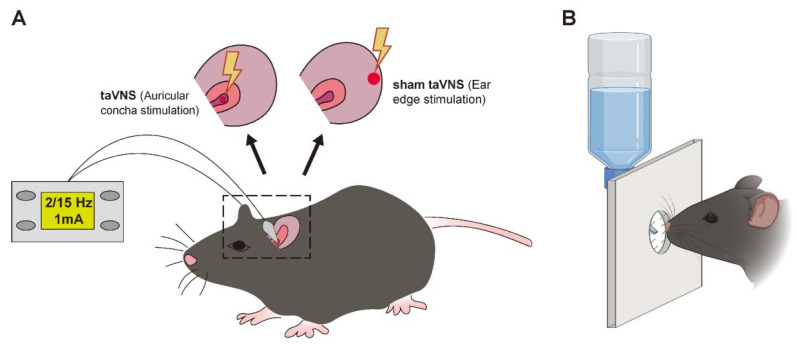
How can a stimulus at the ear influence orofacial processing? A Biomedicines study compares concha and ear-edge stimulation in nitroglycerin-model male mice. Repeated concha stimulation increases drinking during facial mechanical contact and reduces grimace scores. Researchers then examine locus coeruleus, or LC, and spinal trigeminal nucleus caudalis, or Sp5C, for noradrenergic changes.
Repeated concha stimulation improves drinking and grimace measures and increases LC TH labeling and Sp5C α2A protein. Anesthetized acute-model recordings show stronger stimulation-evoked NE-sensor responses than controls.
Contents · 6 sections
Comparing concha with ear edge
Repeated nitroglycerin treatment in eight-week-old males is followed by concha or ear-edge stimulation. Auricular sensory inputs differ by location, making an adjacent-site comparison informative for behavioral and central responses.
Repeated-model intervention occurs during modeling, followed by behavioral and protein observations. Separate mice receive a single nitroglycerin exposure for brief transmitter recordings. These examine longer intervention history and immediate stimulus responses, respectively.
Orofacial sensation enters brainstem through the trigeminal system and interacts with broader modulatory networks. Whether auricular input influences this processing is the central question. Behavioral responses, brainstem cells and transmitter conditions therefore provide complementary levels of observation.
Source: Song X et al. · Biomedicines · CC BY
Original figure and English caption ↗
Longer drinking and lower grimace scores
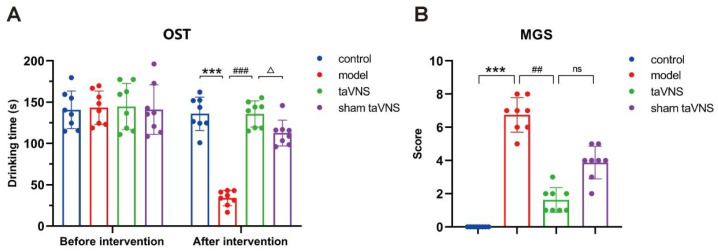
The task combines drinking reward with facial mechanical contact. Model drinking declines, then increases after concha stimulation and exceeds the ear-edge group. The measure links orofacial stimulation with reward-related behavioral choice.
Model grimace scores rise and decrease after concha stimulation. The ear-edge versus concha score difference is only a nonsignificant upward trend. Drinking and grimace outcomes align, with distinct site-comparison results.
One measure reflects behavior during device contact, the other facial state. Together they describe the repeated-model changes and show that ear-edge stimulation is not behaviorally inert.
Source: Song X et al. · Biomedicines · CC BY
Original figure and English caption ↗
Noradrenergic-associated labeling changes
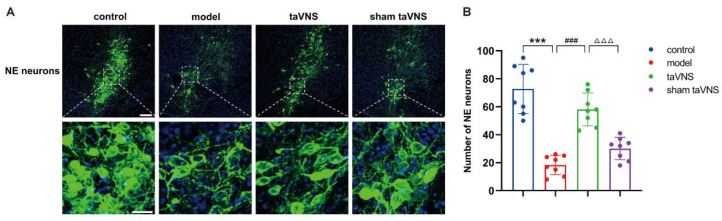
LC is a major norepinephrine source with widespread projections. Tyrosine-hydroxylase, or TH, staining examines associated cellular labeling. Model TH-positive counts decline, while concha-treated counts exceed model and ear-edge groups.
TH participates in catecholamine synthesis, linking the labeling change to transmitter-associated state. Behavioral improvement and LC labeling motivate examining NE signals at an orofacial-processing site.
Source: Song X et al. · Biomedicines · CC BY
Original figure and English caption ↗
Sp5C signals rise after stimulation
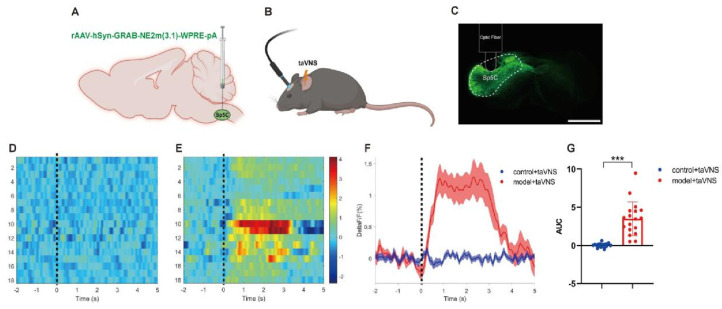
Sp5C processes orofacial information and receives brainstem modulation. NE2m recordings during concha stimulation under isoflurane show a marked response within seconds in acute nitroglycerin-model mice, versus small control fluctuations.
The model response area is larger, indicating state-dependent transmitter-associated responses to comparable stimulation. These immediate dynamics complement LC labeling after repeated intervention.
Source: Song X et al. · Biomedicines · CC BY
Original figure and English caption ↗
α2A receptor protein changes with repeated stimulation
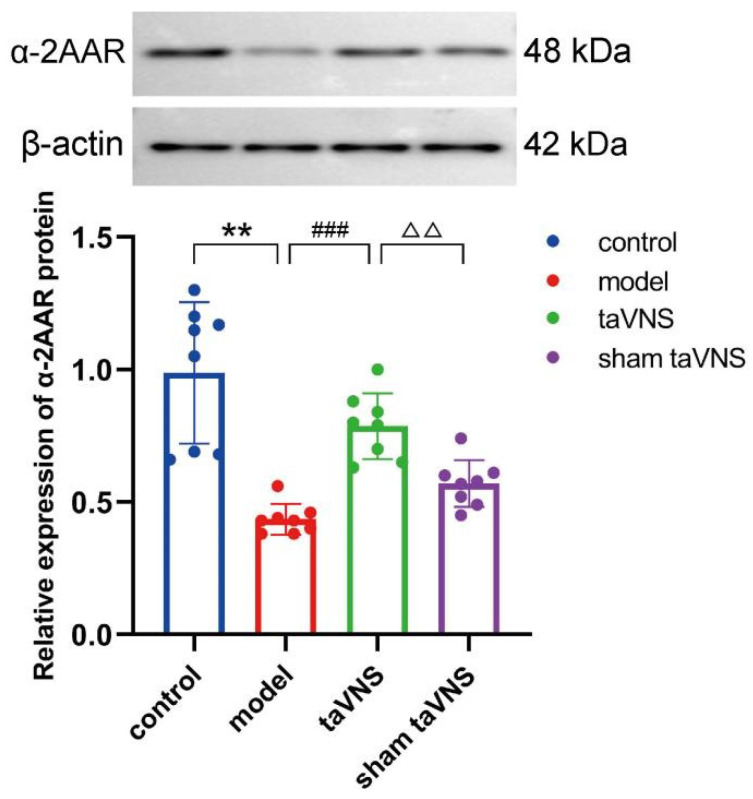
Sp5C α2A adrenergic-receptor protein decreases in the model and increases after concha stimulation, exceeding ear-edge values. Cellular labeling, local NE responses and receptor protein provide complementary observations of noradrenergic modulation.
α2A is one receptor through which NE acts. Protein measurements extend attention from signal sources to recipients: after intervention, receptor state changes alongside transmitter-associated responses.
Source: Song X et al. · Biomedicines · CC BY
Original figure and English caption ↗
Auricular input and brainstem modulation converge
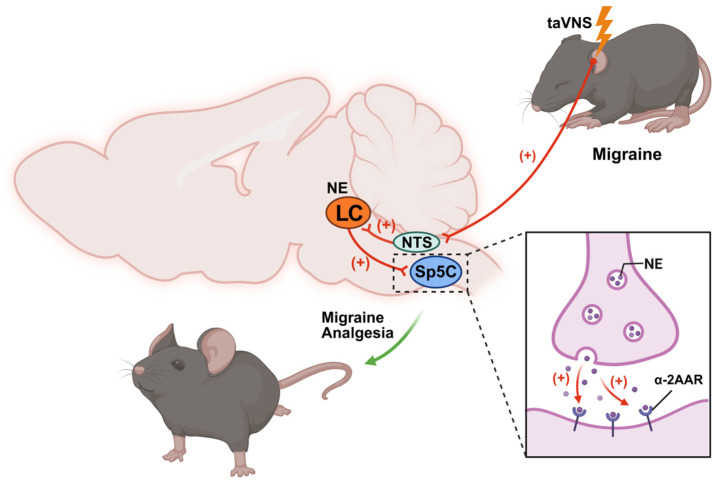
The paper proposes that auricular input through NTS and LC may enhance NE-related Sp5C modulation. This framework connects peripheral stimulation, transmitter systems and sensory processing. Distinct molecular outcomes across sites highlight input selection.
In male nitroglycerin-model mice, behavior, labeling, transmitter dynamics and receptor protein link auricular stimulation with broader brainstem-state changes. A peripheral stimulation site relates to the transmitter environment of orofacial processing.
Source: Song X et al. · Biomedicines · CC BY
Original figure and English caption ↗