How does distraction change brain processing during itch?
A rat study links itch and distraction in prelimbic cortex. Related populations overlap substantially, yet either activation or inhibition can reduce scratching, suggesting more complex regulation than a simple switch.
An itch invites scratching, but an engaging event can sometimes draw attention elsewhere. Does itch compete with other information for processing in the brain? A rat study published in iScience on December 17, 2022 examined prelimbic cortex, PrL. Scratching and an external distractor were each associated with activity changes, and the related populations overlapped substantially. Both increasing and decreasing distractor-associated activity reduced scratching under the respective tested conditions, linking sensory processing with attention-related regulation.
PrL contributes to acute itch-related scratching and responds to an external distractor. Overlapping labeling and reciprocal population responses suggest a role in itch modulation through attentional allocation.
Contents · 6 sections
PrL activity changes as scratching begins
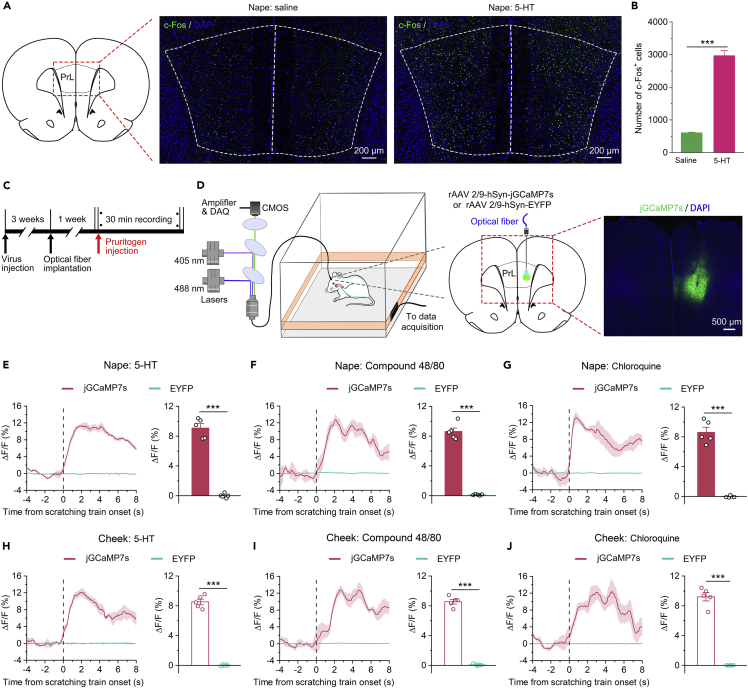
Itch engages linked sensory, attentional and behavioral processes. PrL is a prefrontal region previously associated with attention. In this study, itch conditions increased PrL c-Fos labeling, an activity-associated measure.
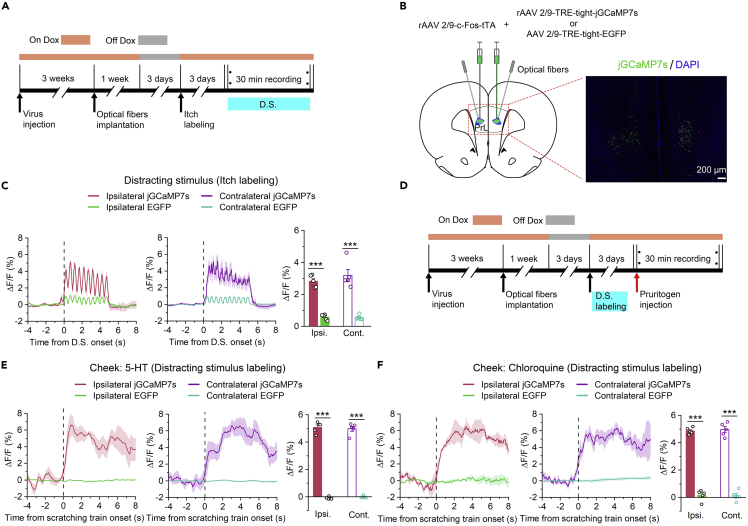
Across different acute itch conditions at the nape and cheek, PrL population calcium increased around scratching onset without equivalent changes in fluorescent controls. This links activity and behavior in time, while remaining a population readout rather than a direct report of subjective itch.
Source: Wu GY et al. · iScience · CC BY
Original figure and English caption ↗
Reducing activity reduces scratching
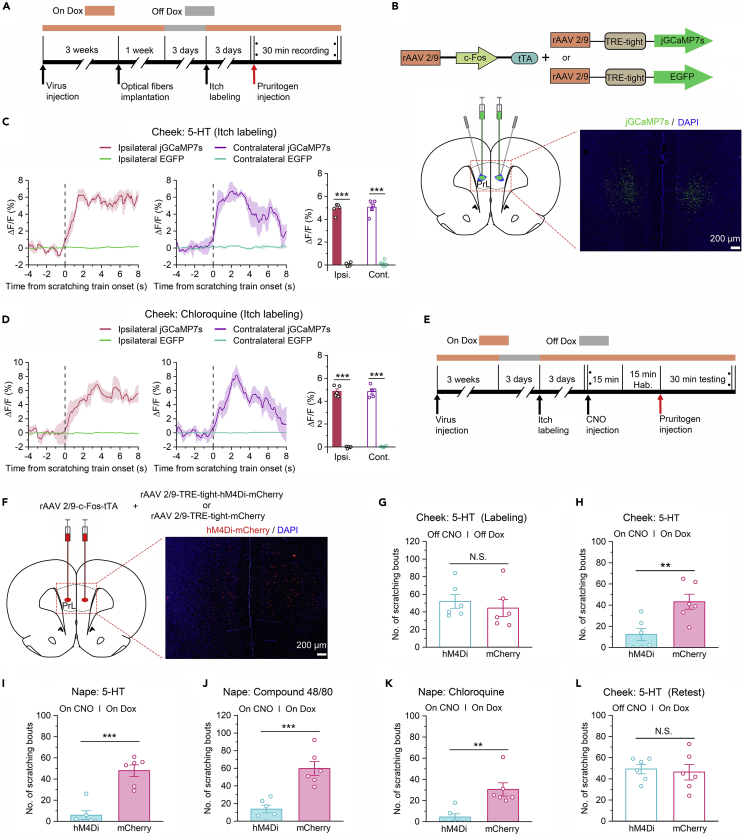
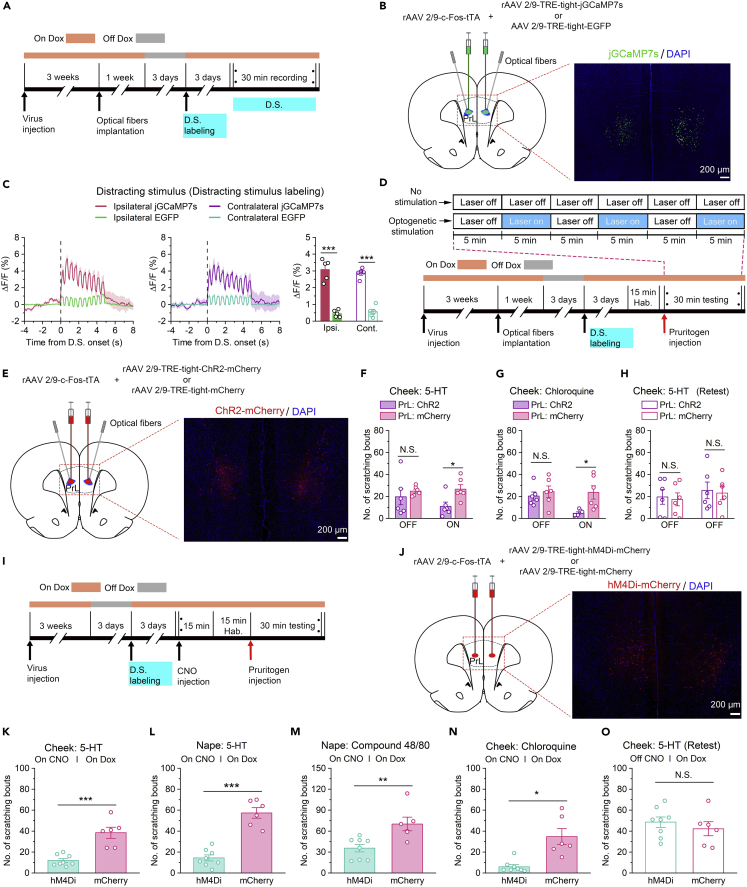
If PrL merely followed scratching, altering its activity might leave behavior unchanged. Reducing PrL activity decreased scratching across tested acute conditions at the nape and cheek. A temporally linked inhibitory approach produced a corresponding effect.
In the latter comparison, reductions occurred during active intervention, without significant inactive-period group differences. Inhibiting itch-experience-associated cells also reduced scratching, while retesting without the intervention showed no significant group difference. The effects therefore depended on the tested conditions and timing.
Source: Wu GY et al. · iScience · CC BY
Original figure and English caption ↗
An external distractor also changes scratching
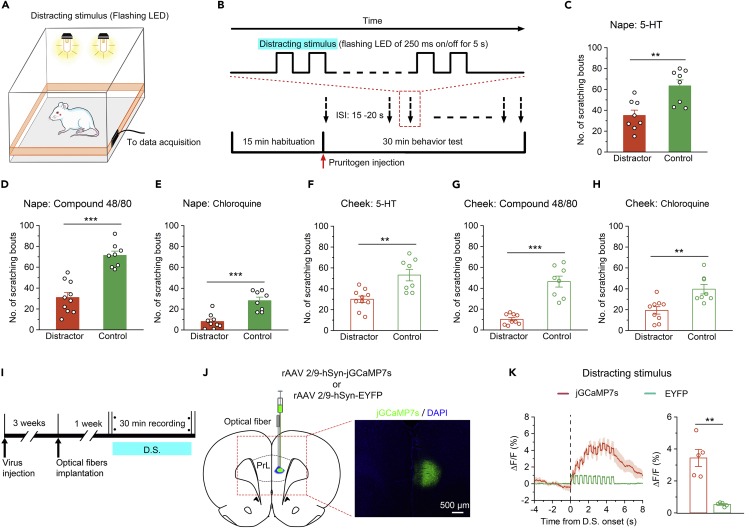
A visual distractor reduced scratching relative to the no-distractor control across the tested acute conditions and body sites. The distractor alone also increased PrL population calcium, showing that the region responds beyond scratching itself.
Attentional redirection is an interpretation based on the stimulus and behavioral changes. Rats cannot report their attentional focus as humans do, and the study lacked an independent subjective attention measure. The links among distraction, PrL activity and scratching were observed, while finer attentional allocation remains to be assessed.
Source: Wu GY et al. · iScience · CC BY
Original figure and English caption ↗
Both activity directions can reduce scratching
Distractor-experience-tagged cells showed population calcium responses to the distractor. Activating them reduced scratching during active periods, without significant inactive-period differences. A later no-activation retest also showed no significant difference.
The story was not simply more activity, less scratching. In separate corresponding comparisons, inhibiting the related population also reduced scratching, without a significant difference at the no-inhibition retest. The authors proposed that occupying or disrupting related processing could alter scratching; the two directions do not establish an identical internal mechanism.
Source: Wu GY et al. · iScience · CC BY
Original figure and English caption ↗
Itch and distraction recruit overlapping cells
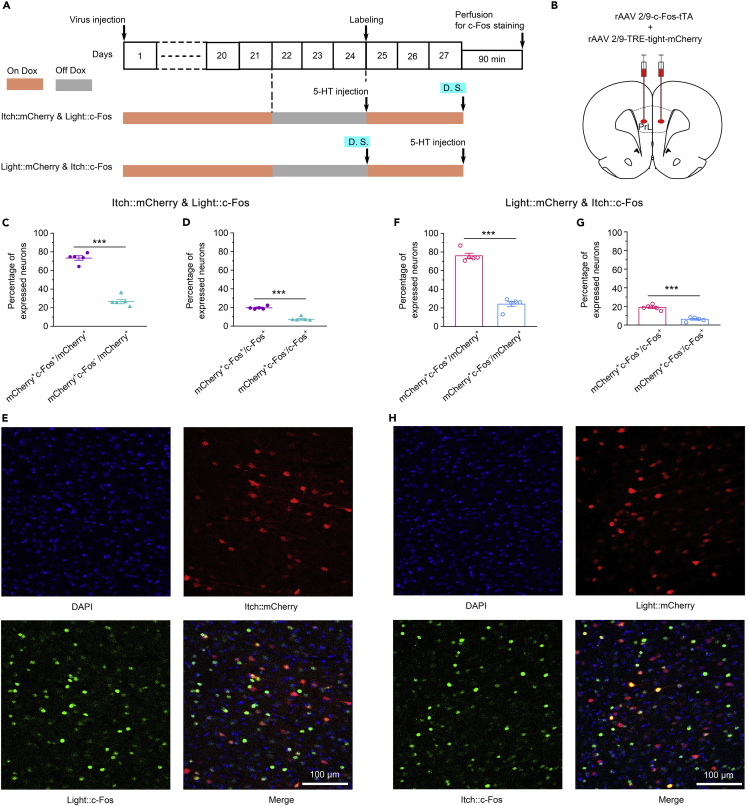
Reciprocal labeling comparisons asked whether the experiences recruit shared cells. About 73% of initially itch-tagged cells overlapped with distractor-associated labeling; about 76% of initially distractor-tagged cells overlapped with itch-associated labeling.
Each percentage uses its initially tagged population as the denominator. They show substantial overlap rather than complete identity, alongside nonoverlapping cells. How shared and distinct components cooperate remains an open question.
Source: Wu GY et al. · iScience · CC BY
Original figure and English caption ↗
Sensation and attention may share processing resources
Population responses crossed between experiences: itch-associated cells responded to distraction, while distractor-associated cells responded during scratching. This complements labeling overlap without tracking every cell across both experiences or establishing that all attentional shifts reduce itch.
This acute-itch rat study offers a cortical link between attention-related processing and scratching. Adaptation, nonoverlapping-cell functions and more direct attention assessment remain important questions. It informs interactions between sensation and cognition, while therapeutic efficacy for chronic itch remains untested.
Source: Wu GY et al. · iScience · CC BY
Original figure and English caption ↗