How does an inhibitory input to thalamus alter mechanical sensitivity?
A rostral zona incerta input to paraventricular thalamus contributes to nociceptive responses in mice. Increasing it more clearly raises mechanical withdrawal thresholds, while thermal effects differ across tests and intervention directions.
Brain regulation can differ between mechanical and thermal nociceptive stimuli. A mouse study published in Metabolites on February 3, 2023 examines the rostral zona incerta (ZIR) and paraventricular thalamus (PVT). The input, supplied substantially by inhibitory cells, contributes to nociceptive responses: increasing and decreasing related activity shift mechanical withdrawal thresholds in opposite directions. Thermal responses are less uniform, revealing differences across sensory tests.
The ZIR–PVT input modulates mechanical withdrawal and alters pain-related behavior in inflammatory and nerve-injury conditions. Several thermal, early inflammatory paw-licking, locomotor and anxiety-related comparisons show no significant changes.
Contents · 7 sections
An inhibitory input from zona incerta
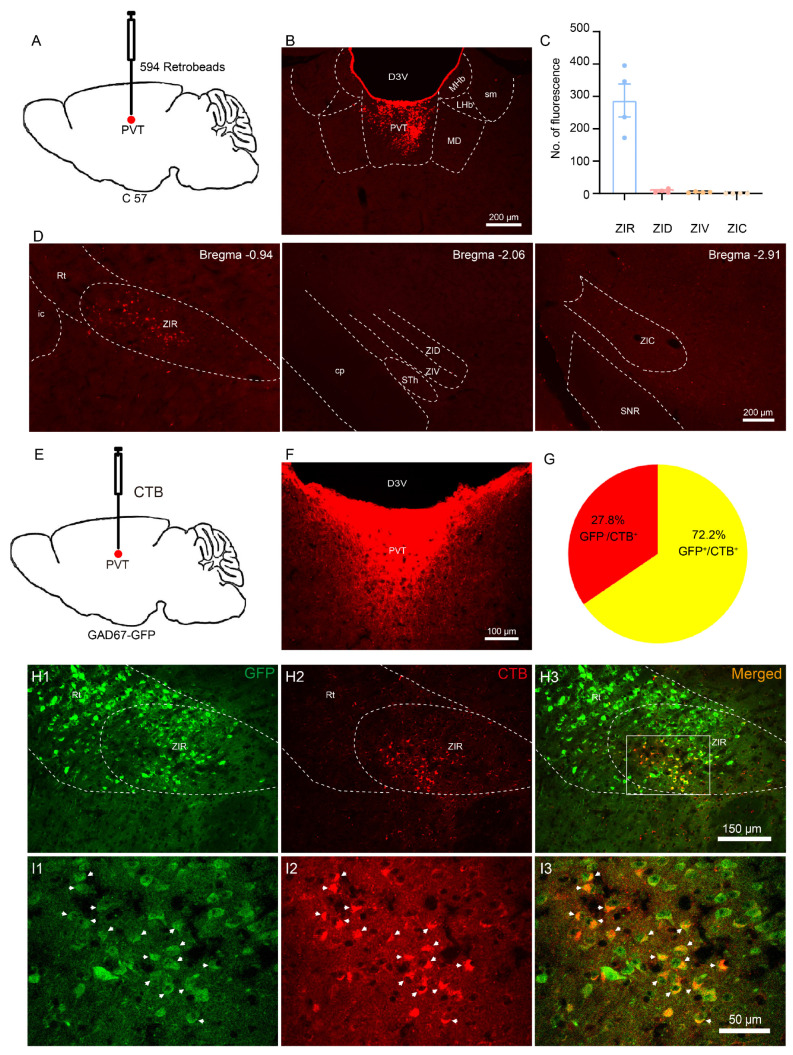
PVT is predominantly excitatory and receives inhibitory influences from elsewhere. Tracing its inputs identifies labeled cells concentrated in rostral zona incerta, with fewer in other sectors, directing attention toward ZIR.
About seven in ten labeled PVT-projecting ZIR cells also carry a GABA-associated marker. They form a substantial inhibitory source within a heterogeneous connection, bringing cellular identity into the question of nociceptive processing.
Source: Wu FL et al. · Metabolites · CC BY
Original figure and English caption ↗
The receiving PVT population responds to nociceptive stimuli
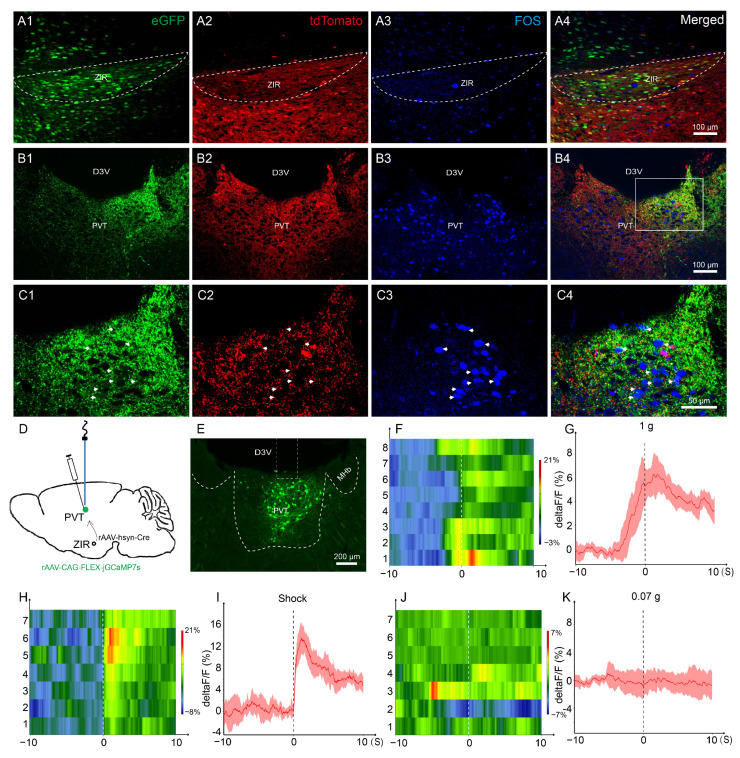
After nociceptive stimulation, activity-associated labeling appears in PVT, with ZIR fibers apposed to some labeled cells. Calcium recordings from the ZIR-input-associated PVT population increase around stronger mechanical and electrical stimuli, without a significant corresponding response to light touch.
The signal comes from the receiving side of the connection, indicating recruitment during the tested nociceptive events. Population calcium does not make every cell pain-exclusive; it first establishes a temporal link between an input-associated population and the stimulus.
Source: Wu FL et al. · Metabolites · CC BY
Original figure and English caption ↗
Mechanical and thermal responses do not always move together
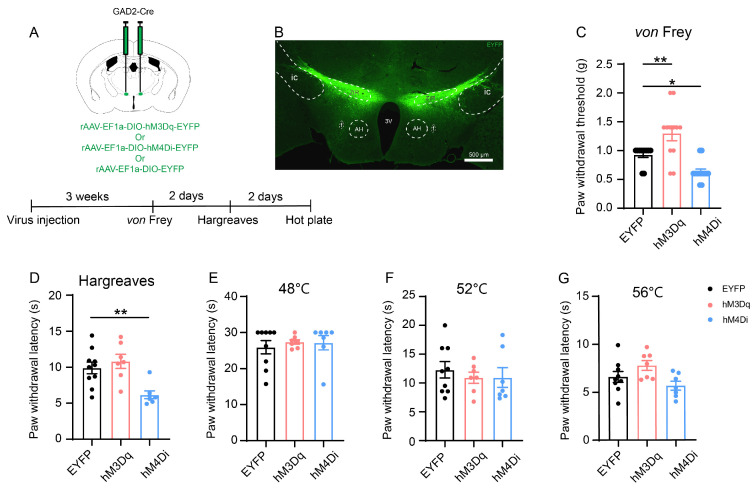
Increasing activity in ZIR GABA-associated cells raises mechanical withdrawal thresholds; reducing activity lowers them. A lower threshold means withdrawal occurs with a lighter stimulus, reflecting greater mechanical sensitivity. The opposing results support regional modulation of mechanical responses.
Thermal results differ. Reducing activity shortens withdrawal latency to localized heat, whereas activation has no significant effect. Neither direction significantly changes hotplate responses. The way a stimulus is encountered and the behavioral response tested shape the observed modulation.
Source: Wu FL et al. · Metabolites · CC BY
Original figure and English caption ↗
Focusing on PVT input preserves the mechanical effect
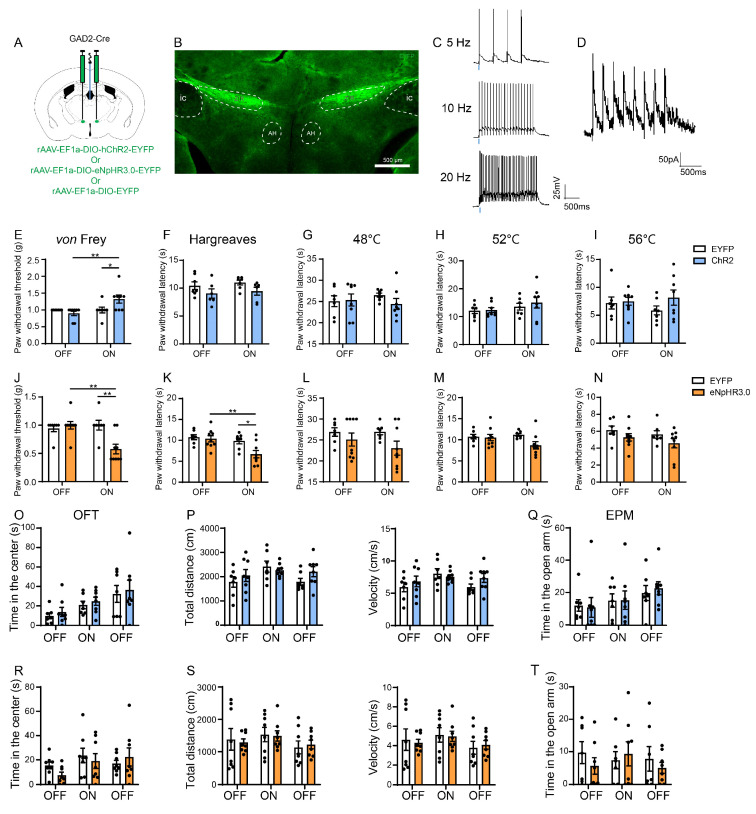
Increasing ZIR GABA-associated terminal activity in PVT evokes inhibitory synaptic currents and raises mechanical thresholds. Reducing terminal activity lowers mechanical thresholds and, in the tested comparison, shortens localized-heat withdrawal latency. Increasing the input does not significantly alter thermal responses.
Overall distance, speed, open-field center time and elevated open-arm time do not change significantly. The mechanical effects therefore occur without a general locomotor reduction or a significant shift in these exploratory measures, while hotplate effects remain nonsignificant.
Source: Wu FL et al. · Metabolites · CC BY
Original figure and English caption ↗
Conditional effects extend to inflammation and nerve injury
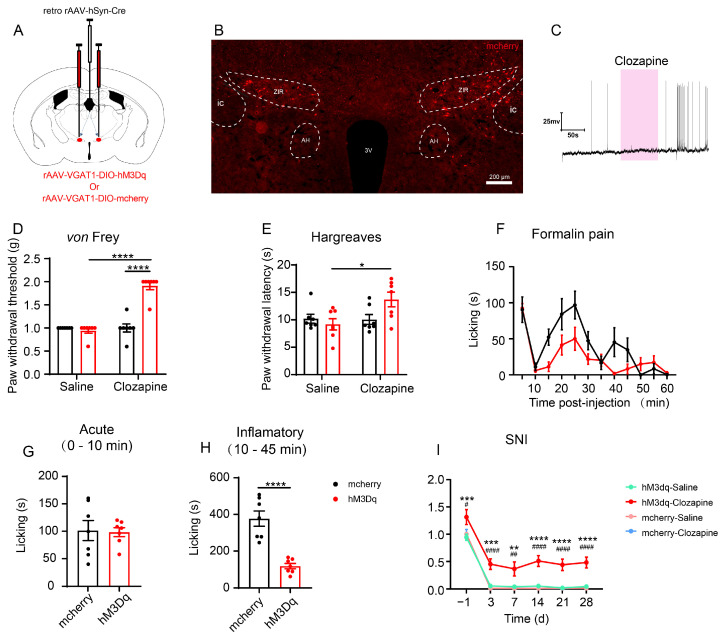
Increasing activity in PVT-projecting ZIR GABA-associated cells raises mechanical thresholds. Heat withdrawal changes relative to the group’s own baseline, without a significant direct difference from controls. The manipulated population is defined by its projection relationship and may act through additional branches.
In the inflammatory model, later paw licking decreases without a significant early-phase change. In the nerve-injury model, mechanical thresholds exceed corresponding controls at multiple observed times. These outcomes extend modulation across pain-related settings while retaining differences between behavioral components and timepoints.
Source: Wu FL et al. · Metabolites · CC BY
Original figure and English caption ↗
GABA receptors contribute to local regulation
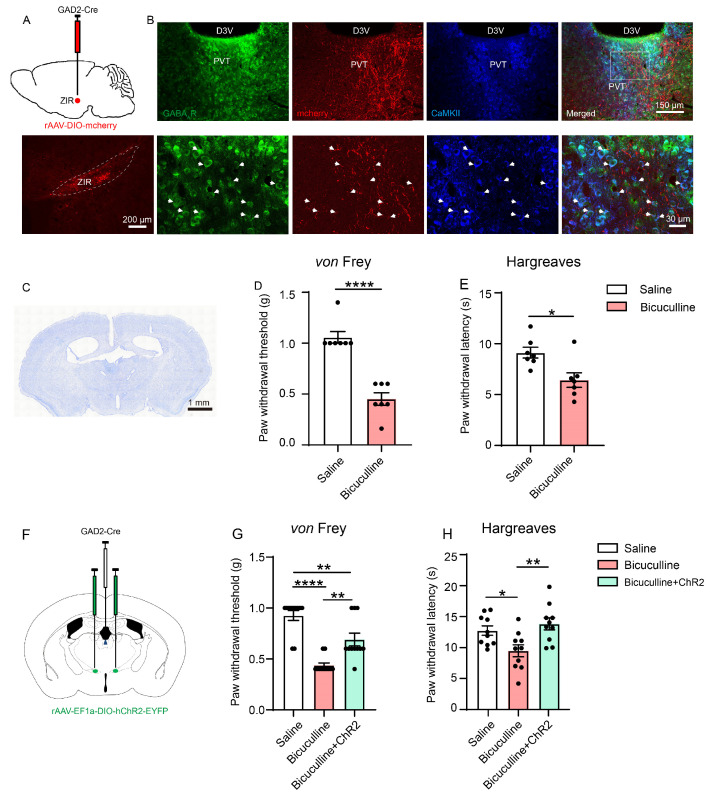
GABAA-receptor labeling overlaps an excitatory-cell-associated marker in PVT, with ZIR fibers apposed to these regions. Local receptor blockade lowers mechanical thresholds and shortens heat-withdrawal latency, consistent with greater sensitivity when local inhibitory regulation is disrupted.
Increasing ZIR input during receptor blockade partly restores the mechanical threshold, which remains below the saline control; heat-withdrawal latency also increases. Receptor pharmacology and input activation jointly affect behavior, while the responsible recipient cells and transmission components remain to be resolved.
Source: Wu FL et al. · Metabolites · CC BY
Original figure and English caption ↗
One pathway contributes differently across sensory tasks
The mouse study places the inhibitory ZIR–PVT connection within nociceptive regulation. Mechanical withdrawal provides the most consistent effect, while thermal outcomes depend on the test, activity direction and comparison setting. Stable locomotor and exploration measures further focus attention on the tested sensory responses.
Withdrawal and licking each capture part of pain-related behavior rather than the whole experience. How ZIR subpopulations influence PVT, how these effects relate sensation to emotion and whether they persist in other long-term states remain open questions.