How does an ascending locus coeruleus pathway shape pain and avoidance?
A mouse study follows the locus coeruleus–parafascicular thalamus connection to examine norepinephrine-associated changes in sensation and exploration over the injury timeline.
How do the brain’s regulatory signals change as pain persists? The locus coeruleus is a major source of norepinephrine, with outputs to different brain regions. In JCI Insight, a mouse study followed its ascending connection to the thalamic parafascicular nucleus and linked sensory and avoidance changes to the receiving cells, local receptors and time after nerve injury.
LC–PF-associated input and local α2 receptors contribute to selected sensory and avoidance changes after injury. Pathway inhibition has a clearer early mechanical effect, with later changes in thermal responses and selected exploration measures.
Contents · 6 sections
Sensation and exploration change after nerve injury
In the spared nerve injury model, mice developed lower mechanical withdrawal thresholds on both sides, persisting for weeks. Hot-plate responses changed at the higher tested temperature but not the lower one. Later, selected open-field and elevated-plus-maze measures showed increased avoidance with comparable total movement. Sensory sensitivity and exploration captured different changes after injury.
The team focused on the thalamic parafascicular nucleus, or PF. Its CaMKIIα population responded to mechanical and tail-pinch stimulation with calcium signals. Inhibiting these cells in uninjured mice increased mechanical and thermal sensitivity and reduced center and open-arm time. Activation did not significantly change behavior, raising questions about the PF state after injury.
Activating thalamic cells reveals a changing response
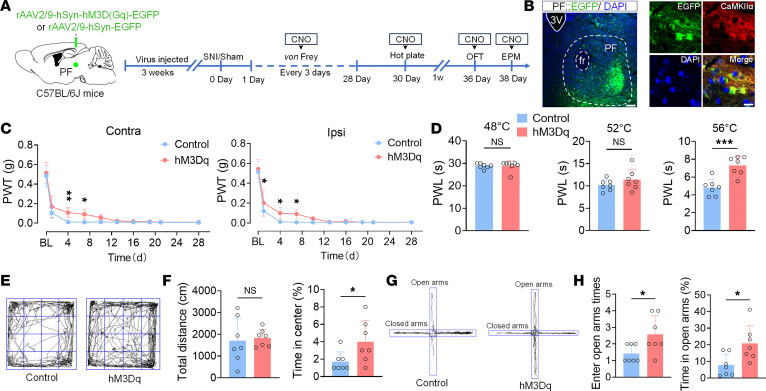
Activating PF cells in injured mice gave a different result. Mechanical thresholds improved most clearly during the first postoperative week, with a weaker effect later. Thermal sensitivity and selected anxiety-like measures still improved on day28. Further inhibition did not significantly worsen the injury phenotype. The regulatory response varied with state and time after injury.
The timing difference was striking. Mechanical and thermal tests both examine injury-related responses, yet they did not follow the same trajectory during intervention. As injury progressed, the circuit’s influence on sensation and exploration changed. This prompted the researchers to follow upstream inputs that might regulate these thalamic cells.
Source: Liu ZY et al. · JCI insight · CC BY
Original figure and English caption ↗
The thalamus receives a signal from locus coeruleus
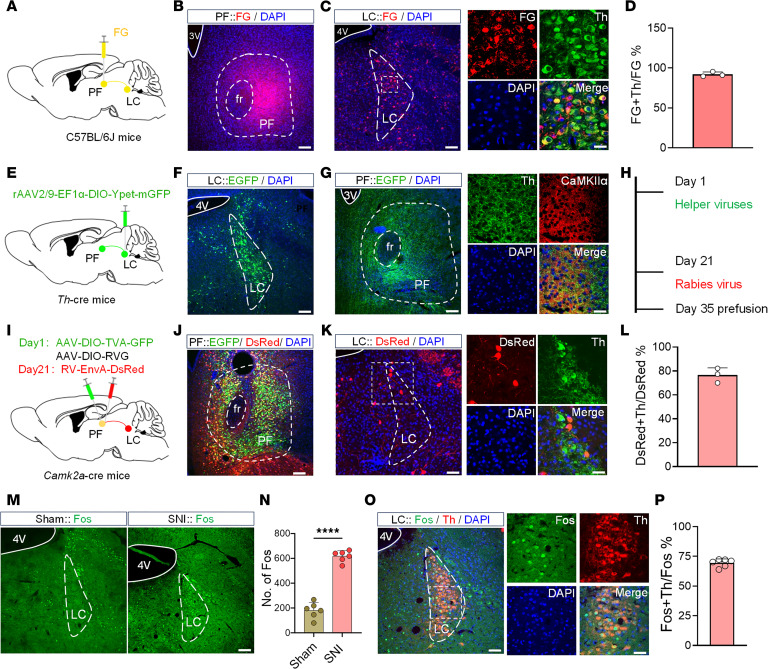
Tracing pointed upstream to locus coeruleus. Retrograde labeling from PF identified many LC cells, mostly tyrosine-hydroxylase-positive and concentrated dorsally. Anterograde terminals and monosynaptic tracing further connected norepinephrine-associated LC cells with the PF CaMKIIα population. LC activity labeling increased after nerve injury, bringing this ascending route into focus.
Functional experiments again revealed a state difference. Activating the PF-connected LC population lowered pain thresholds and changed selected avoidance measures in uninjured animals, while inhibition had no significant effect. In injured mice, inhibition improved the phenotype and additional activation did not significantly worsen it. The same connection responded differently across states.
Source: Liu ZY et al. · JCI insight · CC BY
Original figure and English caption ↗
Reducing LC input eases early mechanical sensitivity
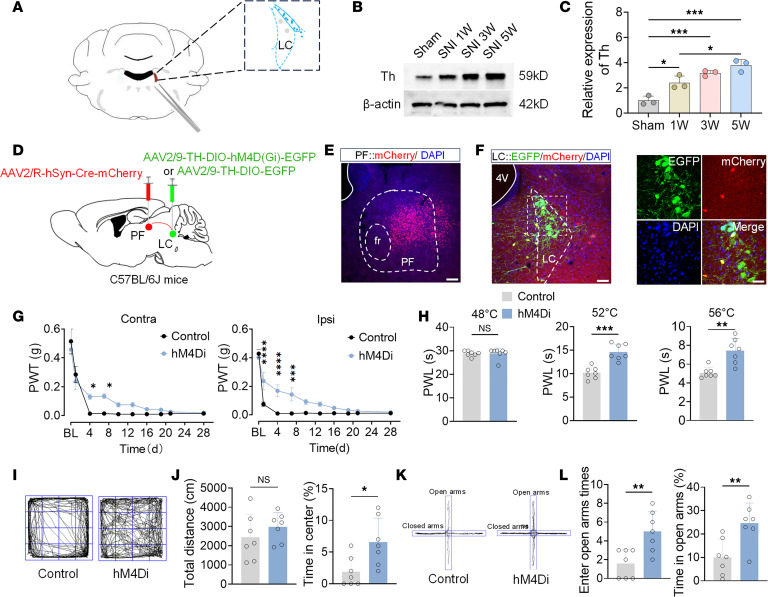
Inhibiting the LC–PF-associated population produced a time course resembling direct PF activation: mechanical sensitivity improved more clearly early on, with weaker later effects, while later thermal and avoidance responses could still change. TH protein levels also increased along the injury course. Behavioral timing, cellular activity and LC-associated markers converged on the same connection.
The findings support a role for LC-associated input in regulating PF function and raise further questions. Why do mechanical and thermal responses differ? How do these cells and their other connections change after injury? Tracking endogenous transmitter release and more precise projection activity can clarify the changing regulation. The team next examined local norepinephrine receptors in PF.
Source: Liu ZY et al. · JCI insight · CC BY
Original figure and English caption ↗
α2 receptors connect transmitter signaling with cellular activity
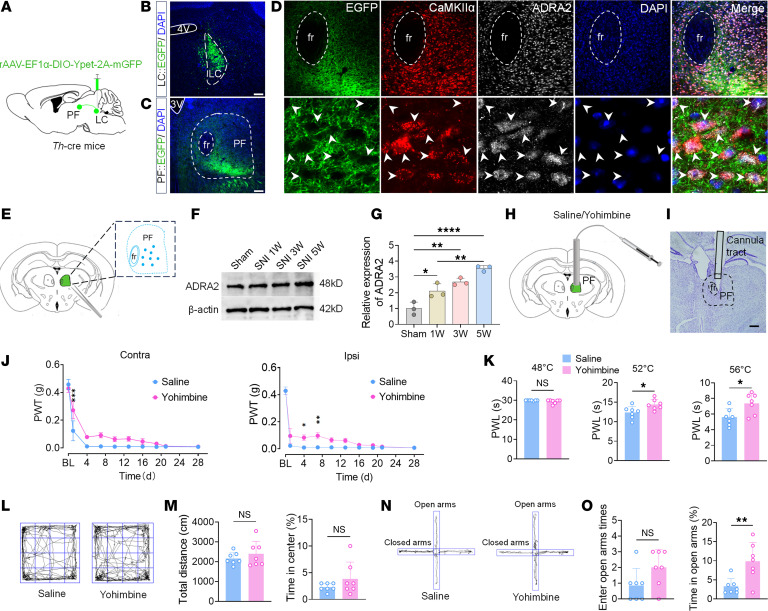
PF CaMKIIα cells near LC terminals expressed α2 adrenergic receptors, with increased receptor protein after injury. Local α2 blockade improved mechanical and thermal responses and increased open-arm time in injured mice; open-field center time did not change significantly. Thresholds in uninjured animals did not show the same change, linking local receptors with selected injury-related responses.
Cellular recordings added another response: α2 blockade increased PF neuronal firing and selected spontaneous excitatory-event measures. Alongside behavior, the observations suggest that norepinephrine-associated LC input influences PF activity through local α2 signaling and contributes to sensory and avoidance changes. Receptor subtypes, synaptic locations and PF outputs remain directions for further investigation.
Source: Liu ZY et al. · JCI insight · CC BY
Original figure and English caption ↗
One transmitter, different effects at different destinations
Norepinephrine’s effect depends on more than its amount: the receiving cells and receptors matter as well. This work connects an ascending LC route with a defined thalamic population and places behavioral changes on the injury timeline. Early mechanical sensitivity, later thermal responses and selected avoidance measures reveal different aspects of the circuit’s role.
The findings currently come from male mice with nerve injury. Other pain causes, longer observation periods and comparisons across sexes can test whether the circuit behaves similarly. Following its inputs, receptors and outputs offers a more specific starting point for understanding changing regulation during persistent pain and its relationship to behavioral choices.