How do three prefrontal–thalamic outputs regulate different aspects of pain?
Foxp2-labeled cells connect prefrontal cortex with thalamus; distinct outputs influence sensitivity, licking and place preference, while cholinergic input and α4β2 receptors modulate sensory responses.
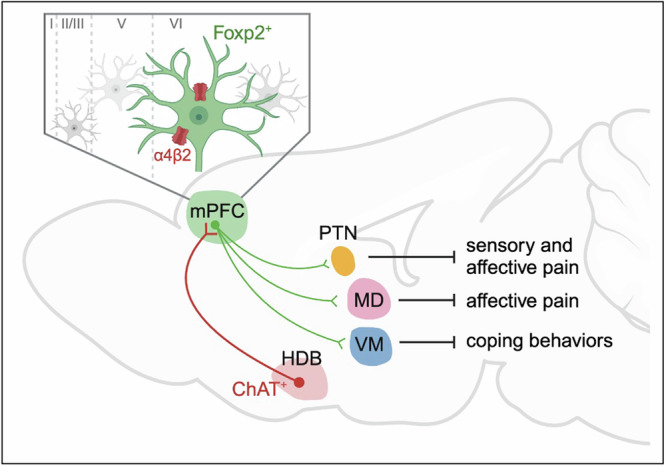
Pain-related behavior is not a single measure: withdrawal, licking after sustained stimulation and preference for a relief-associated setting can change differently. A Nature Communications study in adult male mice identifies thalamus-projecting Foxp2-expressing prefrontal cells. Their overall activity falls with acute stimulation and inflammation, while activation improves multiple outcomes. Three thalamic outputs reveal distinct contributions from the same prefrontal cell class.
The PTN output improves mechanical/heat responses and produces place preference; MD influences preference and VM reduces second-phase formalin licking. Local α4β2 agonist sensory effects depend on Foxp2-cell activity.
Contents · 7 sections
Finding a deep-layer thalamic-projecting population
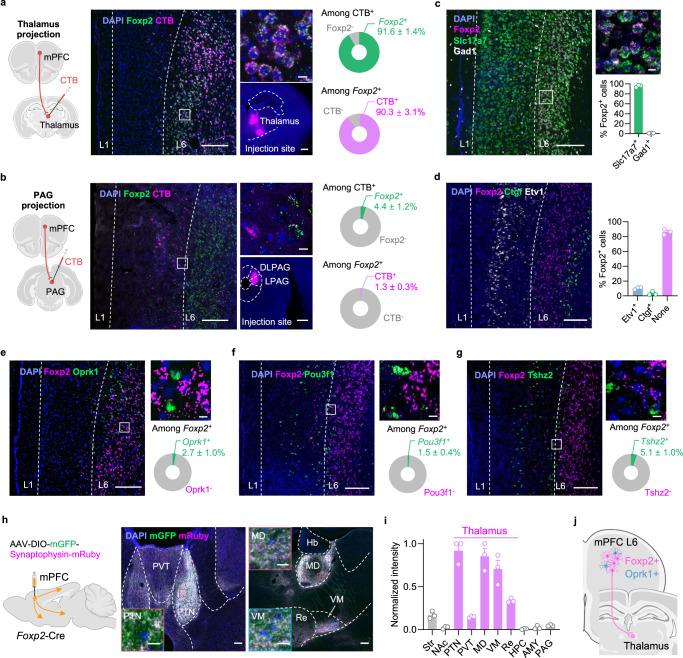
Tracing and molecular labeling identify Foxp2 mainly in layer-six glutamatergic cells with strong overlap with thalamic retrograde labeling. Other projection populations show little overlap. The marker selects one output class within a heterogeneous prefrontal region.
Major terminals lie in PTN, mediodorsal thalamus, or MD, and ventromedial thalamus, or VM. Other targets have weaker or undetected labeling. Cell identity and destinations allow a specific output population to be examined.
Source: Xie G et al. · Nature communications · CC BY
Original figure and English caption ↗
Population calcium events decline across pain states
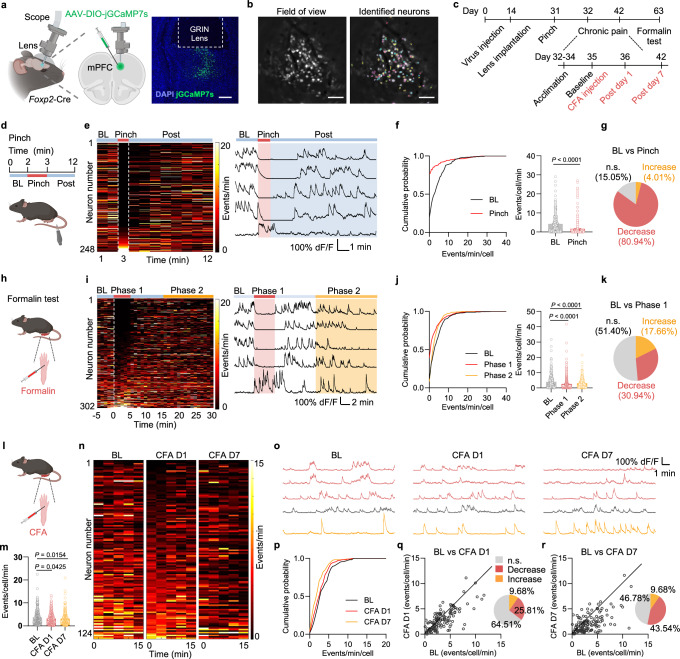
Miniscopic recordings show reduced overall calcium-event frequency during pinch, without significant amplitude change, followed by recovery. Most cells decrease and a few increase. Formalin phases and CFA days one and seven also reduce overall frequency, with heterogeneous cellular responses.
Tracking the same cells across CFA days confirms changes beyond differences in sampled populations. Their reduced overall output-associated activity motivates causal behavioral tests.
Source: Xie G et al. · Nature communications · CC BY
Original figure and English caption ↗
Persistent blockade and brief modulation differ
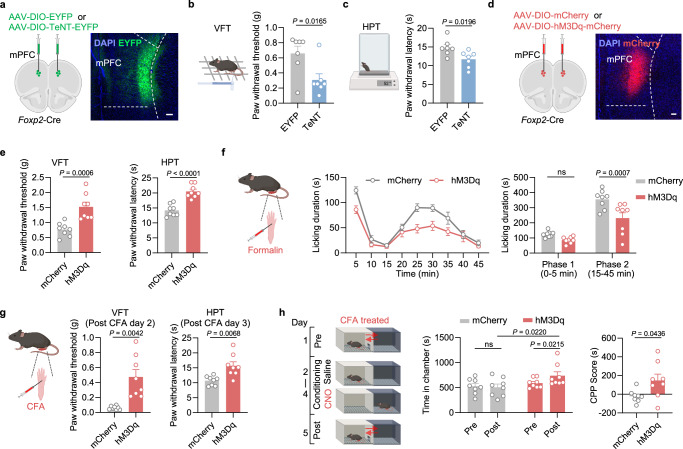
Persistent output blockade lowers mechanical thresholds and heat latencies weeks later. Brief activation raises both, reduces second-phase but not first-phase formalin licking, improves CFA hypersensitivity and produces preference for the activation-paired setting.
Brief chemogenetic inhibition does not significantly alter tested sensitivity, licking or preference. Persistent output loss and temporary activity reduction thus differ. Activation affects both sensory responsiveness and environmental choice.
Source: Xie G et al. · Nature communications · CC BY
Original figure and English caption ↗
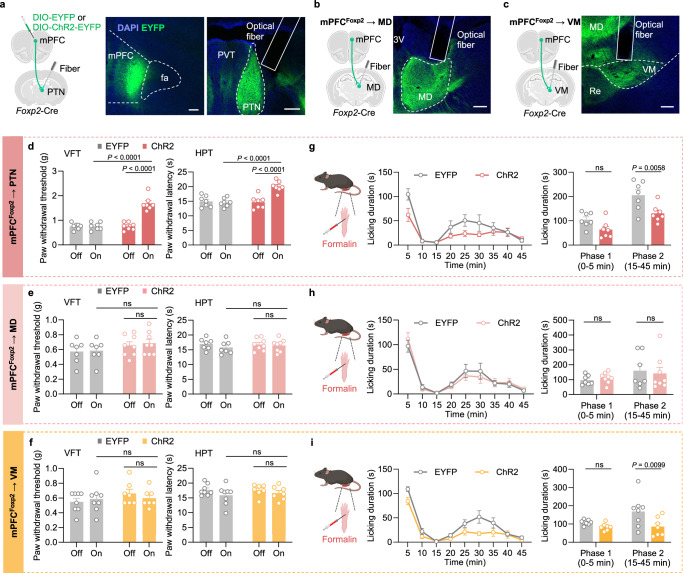
Three targets have distinct behavioral effects
PTN-terminal activation raises normal mechanical thresholds and heat latencies, unlike MD or VM activation. PTN and VM reduce second-phase formalin licking; MD does not. None significantly improves first-phase licking.
VM affects coping behavior without raising the tested baseline thresholds. PTN affects both measures, while MD lacks significant acute-test effects. The signal’s destination matters.
Source: Xie G et al. · Nature communications · CC BY
Original figure and English caption ↗
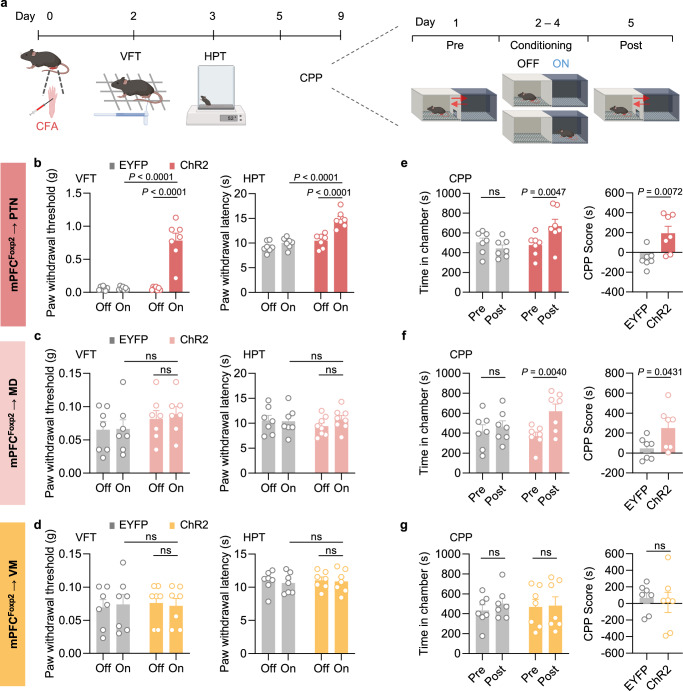
Threshold improvement and preference dissociate
After CFA, PTN activation improves mechanical and heat hypersensitivity, unlike MD or VM. PTN and MD both produce activation-associated place preference, while VM does not. MD changes environmental choice without improving thresholds.
Thresholds, licking and preference do not change together across branches. Their functional map reveals distinct contributions to different aspects of responding to stimulation.
Source: Xie G et al. · Nature communications · CC BY
Original figure and English caption ↗
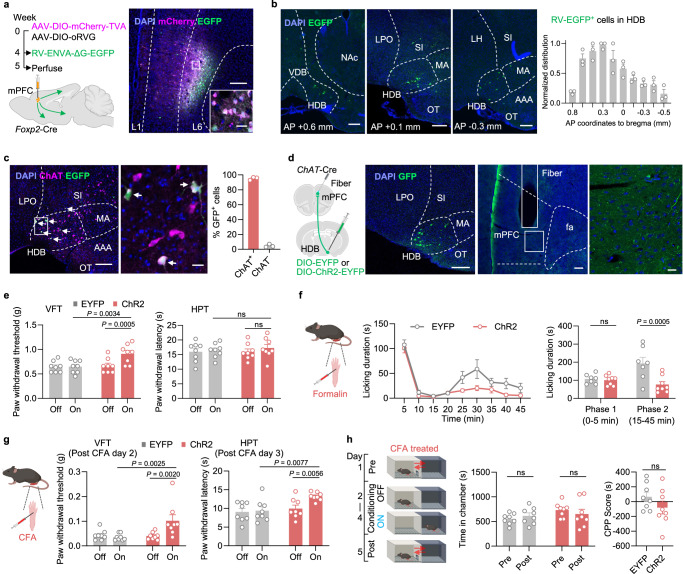
Basal-forebrain input affects sensitivity and coping
Monosynaptic tracing identifies HDB cholinergic input to Foxp2 cells. HDB–mPFC activation raises normal mechanical thresholds without significant heat changes and reduces second-phase but not first-phase licking.
In CFA mice, the input improves mechanical and heat hypersensitivity without significant place preference. Upstream cholinergic and direct Foxp2 activation therefore have distinct behavioral scope.
Source: Xie G et al. · Nature communications · CC BY
Original figure and English caption ↗
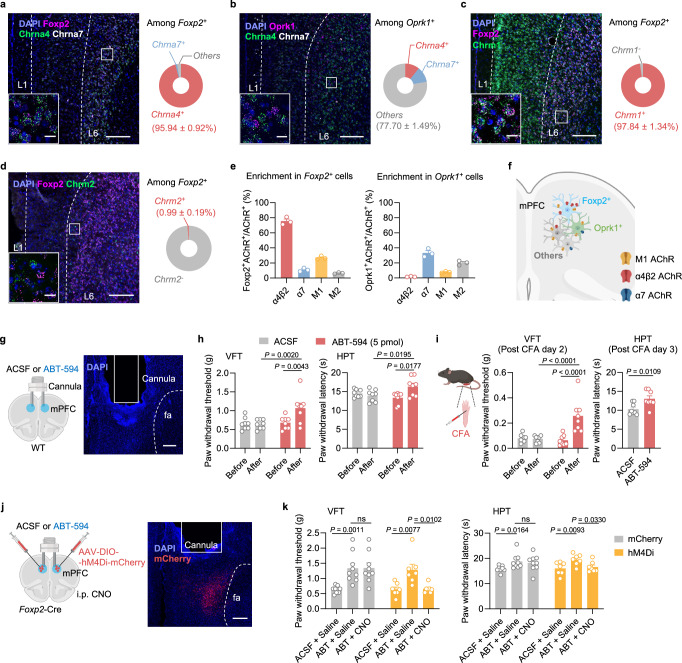
α4β2 signaling acts through Foxp2-cell activity
Foxp2 cells are enriched for α4β2 nicotinic-receptor expression. Local ABT-594 raises healthy and CFA mechanical thresholds and heat latencies without significant preference effects. Foxp2 inhibition abolishes the sensory benefit.
The adult male-mouse study links cell identity, cholinergic input and thalamic destinations. Prefrontal regulation does not uniformly reduce every pain-related behavior: outputs and receptor modulation have distinct behavioral scope.
Source: Xie G et al. · Nature communications · CC BY
Original figure and English caption ↗