How do hypersensitivity and sleep changes reach different outputs? A branching route from lateral septum
In male nerve-injured mice, a shared node influences mechanical hypersensitivity and NREM. Following its outputs reveals two populations with distinct contributions.
Pain and disrupted sleep often occur together. Do their neural links remain coupled all the way? A 2026 Nature Communications study identified a shared node in male nerve-injured mice: inhibitory cells in dorsal lateral septum. Reducing their activity improved both mechanical sensitivity and sleep measures. Following their connections further revealed different downstream populations for sensory and sleep effects—a shared starting point with distinct outputs.
Dorsal lateral septum influences mechanical thresholds and NREM through different lateral-preoptic populations. α2A-associated drug effects also engage this branching network.
Contents · 6 sections
Mechanical sensitivity precedes clearer sleep changes
Sleep comprises distinct states, while sensitivity has its own behavioral measures. Separately following mechanical thresholds, wakefulness, NREM and REM reveals when they change together and when they diverge. The study follows those differences into distinguishable neural routes.
Mechanical hypersensitivity emerged earlier, while sleep disruption became clearer later after nerve injury. EEG and EMG showed more wakefulness and less non-REM sleep, without consistently significant REM changes. The phenotypes overlapped but did not develop in parallel from the same day.
Dexmedetomidine altered measured wakefulness and NREM, with effects varying across conditions; stronger conditions also produced more loss of righting. Sleep, withdrawal and sedation measures described different aspects of state and prompted investigation of their neural relations.
Septal activity changes with sensory and sleep states
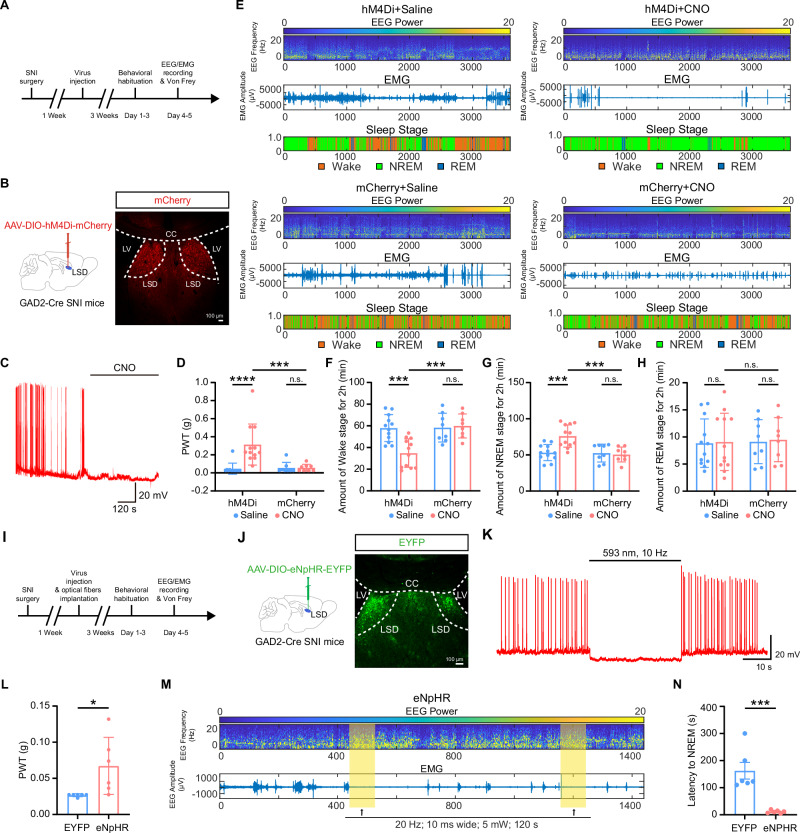
Dorsal-lateral-septal GABAergic cells showed stronger activity-related labeling, calcium activity and firing in the model. Mechanical responses were larger; activity rose at NREM-to-wake transitions and fell during wake-to-NREM transitions. The same population responded around both sensory input and state changes.
Reducing activity attenuated mechanical hypersensitivity, decreased wakefulness, increased NREM and shortened entry into NREM. Increasing activity in normal mice instead enhanced sensitivity and wakefulness. REM remained nonsignificant in several comparisons; the main shift concerned wakefulness and NREM.
Source: Fan H et al. · Nature communications · CC BY
Original figure and English caption ↗
Drug effects engage a local receptor node
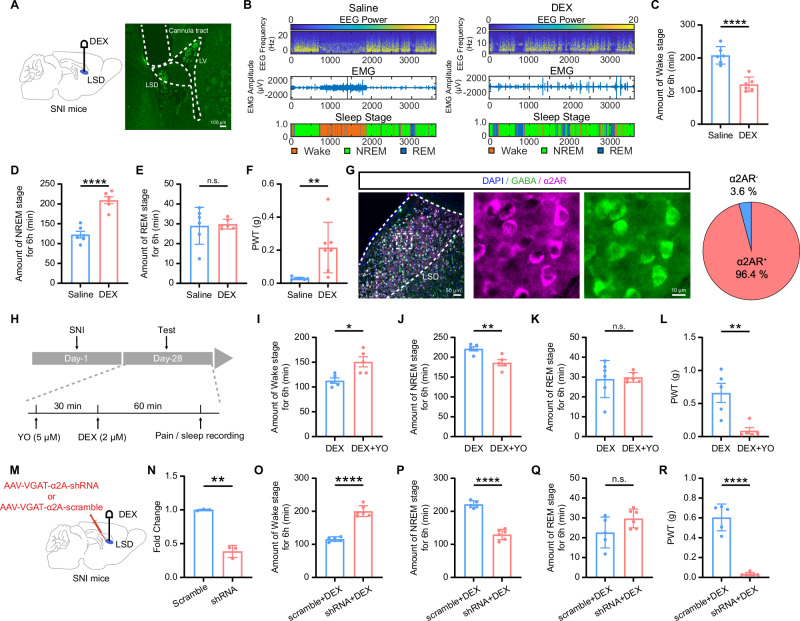
Many examined septal GABAergic cells expressed α2A adrenergic receptors. Local drug action reduced heightened activity while improving mechanical thresholds and wake–NREM allocation. Blocking or reducing the receptor weakened these effects, linking cellular response, receptor and behavior at one node.
Sham animals did not show equivalent clear changes, placing the local effect within injury state. Related receptors also occur elsewhere, with lateral septum as an important contributor examined here. The next question was how this change reached sensory and sleep networks separately.
Source: Fan H et al. · Nature communications · CC BY
Original figure and English caption ↗
A shared input branches in lateral preoptic area
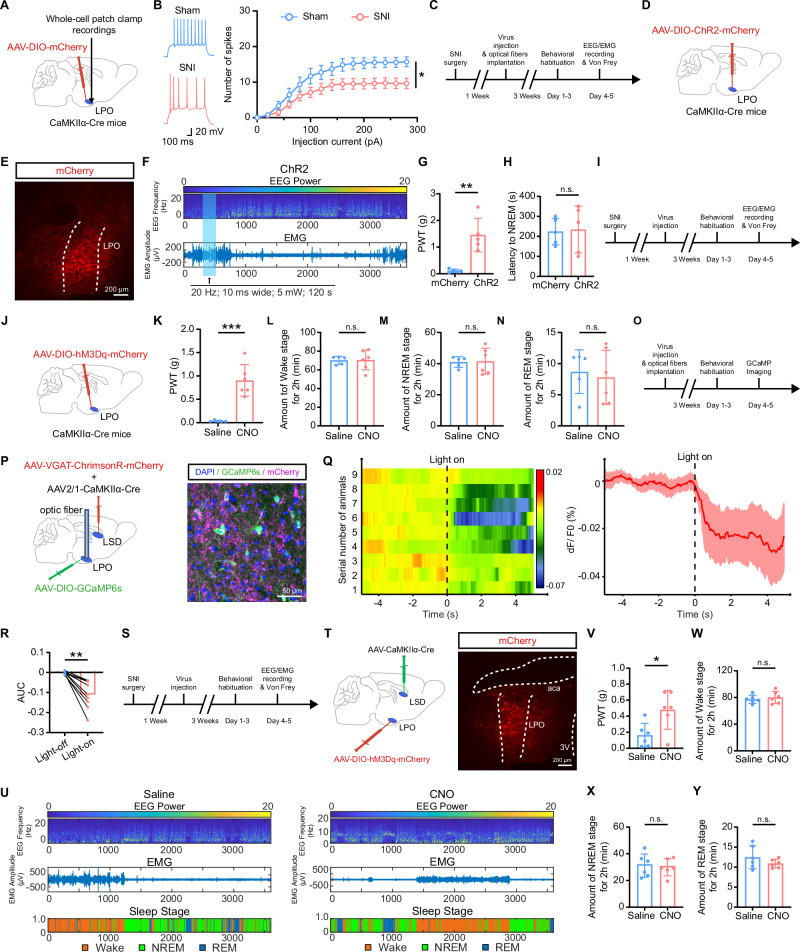
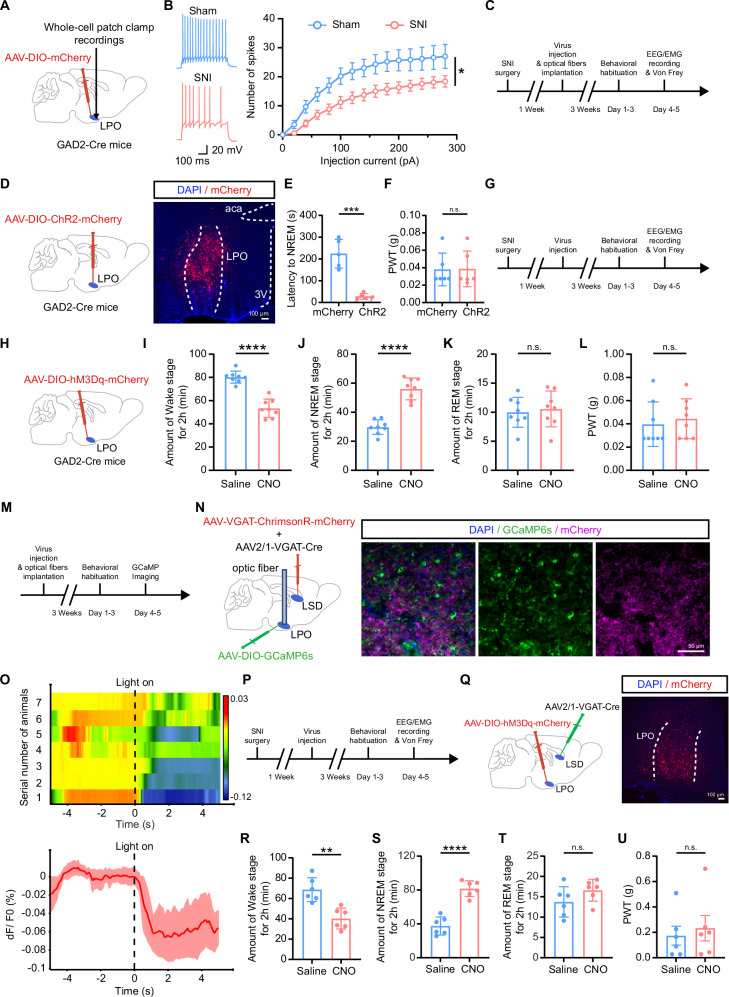
Lateral septum projects to glutamatergic and GABAergic cells in lateral preoptic area (LPO). Increasing source-terminal activity reduced calcium signals in both recipient populations, which also fired less after injury. A shared inhibitory input reached two different populations.
Increasing LPO excitatory activity attenuated hypersensitivity without clear sleep improvement. Increasing LPO GABAergic activity promoted NREM without changing mechanical thresholds. Input-defined populations showed similar separation, giving the two outcomes distinct outputs.
Source: Fan H et al. · Nature communications · CC BY
Original figure and English caption ↗
Downstream populations separate the two improvements
After drug-related reduction of upstream activity, both LPO populations became more active. Reducing the excitatory recipients weakened mechanical improvement; reducing GABAergic recipients weakened wake–NREM improvement. These findings linked receptor effects with two functionally distinct populations.
Synaptic observations showed a lower paired-pulse ratio after injury alongside weaker transmission-strength measures. Source firing, local synapses and recipient activity represent different levels. Behavioral divergence and these changes together describe state-dependent regulation.
Source: Fan H et al. · Nature communications · CC BY
Original figure and English caption ↗
Co-occurring outcomes can have distinct outputs
Mechanical sensitivity and sleep can share an upstream node yet change through separate recipients. The revealing step is resolving simultaneous improvement into network functions: shared input does not couple the outcomes at every stage.
The evidence concerns male-mouse nerve injury and measured sleep intervals. NREM changes were clearest, while null REM and mechanical-threshold outcomes helped distinguish population functions. Following co-occurring behaviors from a shared node to separate outputs reveals distinctions hidden in the overall observation.