How are mechanical responses regulated after injury? A GABA-associated route from zona incerta to brainstem
A male-mouse study links activity of zona-incerta-derived brainstem terminals with mechanical thresholds, examining source terminals and RVM-associated recipient populations separately.
After nerve injury, the same touch can elicit a response more readily, with changes beyond peripheral signals. Brain networks can regulate sensory processing from above. A Brain Sciences study examines zona incerta (ZI) and rostral ventromedial medulla (RVM) in male mice. Tracing links a GABAergic source with the brainstem node; increasing source-terminal activity raises injured-side mechanical thresholds, while reducing it lowers thresholds under baseline conditions. A diencephalon–brainstem route becomes connected with mechanical sensitivity.
ZI-derived terminals influence mechanical thresholds, and associated recipient populations within RVM also affect the measured responses; the detailed cellular relay remains unresolved.
Contents · 6 sections
Sensory signals ascend while regulation can descend
RVM is an important descending regulatory node associated with both stronger and weaker responses. It receives information from several regions, linking network state with lower-level processing. Studying an input asks where it originates and how changing its activity affects behavior. Cells within the same brainstem region can have different roles.
ZI lies in the diencephalon and contains many GABAergic cells, with previous work linking it to sensory regulation. The study focuses on its relationship with RVM and mechanical responses. Mechanical thresholds describe the stimulus level eliciting paw withdrawal, providing a common readout across baseline and nerve-injury states.
Injury-side activity meets a brainstem connection
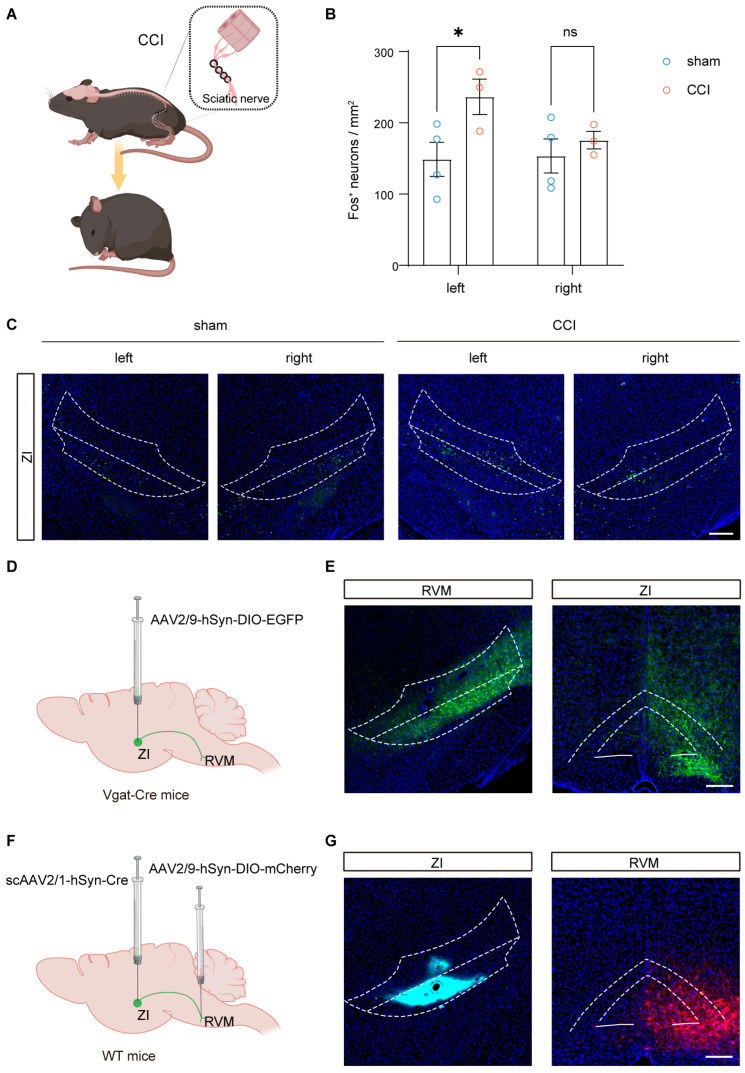
In chronic constriction injury, Fos labeling rises in injury-side ZI without significant contralateral change. The lateral difference draws attention to spatial organization. Recruitment identifies activity-related cells, while anatomy asks whether the region connects with the brainstem regulatory node.
GABAergic-source axons are visible in RVM, and anterograde tracing supports the ZI–RVM connection. Images identify a candidate route, while local recipient identity and functional synaptic responses remain uncharacterized. Behavioral observations follow the anatomical link before placing it within the wider descending network.
Source: Zou L et al. · Brain sciences · CC BY
Original figure and English caption ↗
Reducing source-terminal activity lowers mechanical thresholds
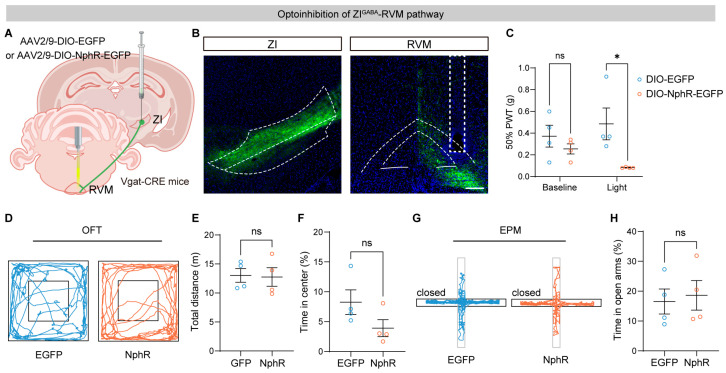
Under baseline conditions, reducing ZI-derived GABAergic terminal activity in RVM lowers the measured paw threshold. The animal withdraws more readily under the same stimulus conditions. The anatomical connection gains a functional link to maintenance of mechanical responsiveness.
Open-field distance, center time and open-arm time show no significant changes. The mechanical measure changes relatively independently of these movement and anxiety-related observations. Baseline sensitivity provides one functional window, followed by a test in the injured state.
Source: Zou L et al. · Brain sciences · CC BY
Original figure and English caption ↗
Increasing source activity raises injured-side thresholds
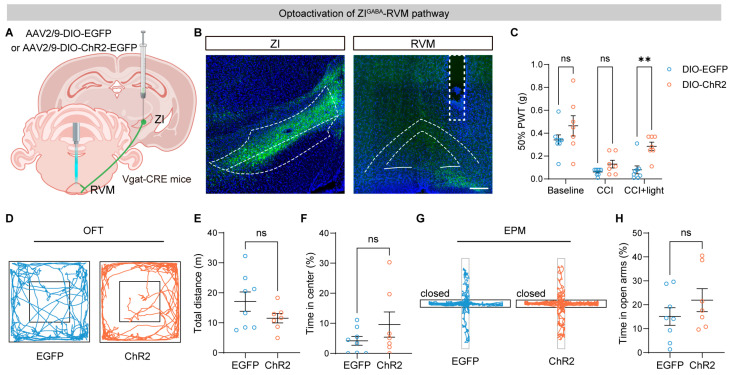
After injury, mechanical thresholds are already lower. Increasing ZI-derived terminals in RVM raises injured-side thresholds and attenuates the measured sensitivity. This complements baseline inhibition, while the observations concern different states: everyday sensitivity and established post-injury responses.
Corresponding movement and exploration measures show no significant changes, focusing the relationship on terminal activity and mechanical thresholds. One behavioral window can be examined across states: input contributes at baseline, while raising activity after injury changes heightened responses.
Source: Zou L et al. · Brain sciences · CC BY
Original figure and English caption ↗
Associated recipient cells also affect mechanical responses
Another set of observations targets RVM cells labeled through ZI-associated anterograde marking. Reducing this brainstem population lowers baseline thresholds, while increasing it raises thresholds in the nerve-injury model. These changes concern local associated cells, whereas the earlier results concern source terminals, bringing input and recipient regions into separate functional comparisons.
The behavioral findings do not specify the contribution of every recipient cell type. Diverse RVM cells and local connections shape how population changes become descending output. The observations link associated brainstem activity with mechanical responses, while movement and exploration remain without similarly significant changes.
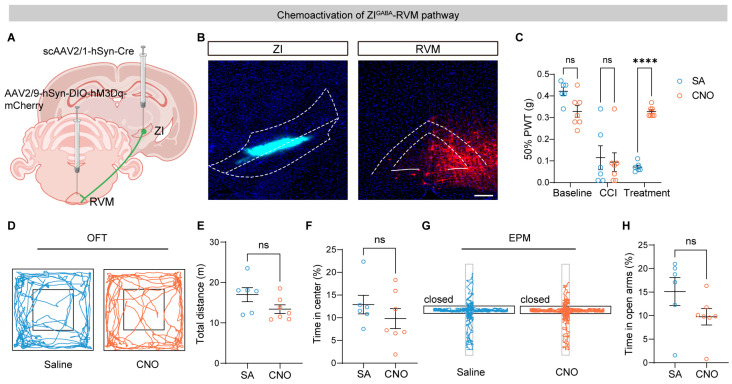
Source: Zou L et al. · Brain sciences · CC BY
Original figure and English caption ↗
A diencephalon–brainstem link participates in sensitivity regulation
Focusing on mechanical paw withdrawal in male mice, the study gives descending regulation a specific connection to examine. ZI-derived terminals and RVM-associated populations have distinct functional observations, while injury-side labeling provides spatial clues. Source, target and animal state make sensitivity an outcome traceable through a network.
The clearest insight is that responses after peripheral injury can also be adjusted by activity from higher regions. Recipient types and local output organization remain open, but the connection joins diencephalon and brainstem regulation within one framework. As signals ascend, the network retains room for descending changes in responsiveness.