Greater touch sensitivity after surgery accompanies stronger accumbens-core responses
A male-mouse study links postoperative mechanical sensitivity with nucleus accumbens core and anterior cingulate input; the associated network can also influence thermal responses at baseline.
Why can the same touch elicit paw withdrawal more readily after surgery? Alongside peripheral tissue changes, brain networks processing these signals can also change. An iScience study in male mice finds increased nucleus accumbens core (AcbC) activity and stronger responses to both lighter and stronger mechanical stimuli in a postoperative model. Reducing local activity raises mechanical thresholds, with anterior cingulate cortex (ACC) input also involved. A region familiar for its reward-related roles enters the story of postoperative sensory change.
AcbC and ACC-input-associated populations respond more strongly in the postoperative model, and reducing associated activity improves mechanical thresholds. Activation at baseline lowers both mechanical thresholds and thermal withdrawal latency.
Contents · 6 sections
Mechanical and thermal responses change differently
In a skin–muscle incision and retraction model, operated-side mechanical withdrawal thresholds fall during the two-week observation, without the same contralateral change. Thermal withdrawal latency and overall movement distance do not significantly differ. The sensory change here primarily concerns greater mechanical responsiveness rather than uniform changes across modalities.
Nucleus accumbens sits at the intersection of basal-ganglia and limbic networks and participates in reward, motivation, behavioral regulation and sensory processing. The study focuses on its core rather than treating the entire accumbens as functionally uniform, linking postoperative withdrawal changes with a more specific node.
A contralateral brain node responds more strongly
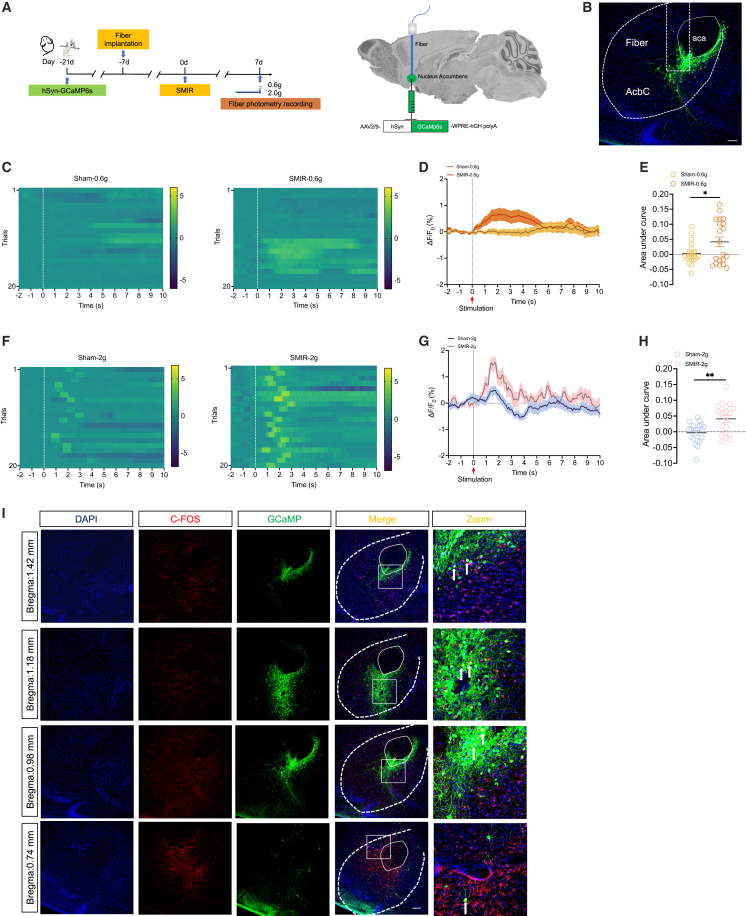
AcbC opposite the operated side shows increased activity-related labeling and firing. Active cells include both D1- and D2-receptor-associated types, providing a cellular background for the population response rather than identifying only one participating type.
A lighter mechanical stimulus elicits a small calcium response in controls but a stronger one after surgery. A stronger stimulus produces responses in both groups, still larger in the postoperative group. Inputs at different intensities therefore reach a more responsive neural population, changing the scale of the network response.
Source: Xu Y et al. · iScience · CC BY-NC-ND
Original figure and English caption ↗
The effect of changing activity depends on the background
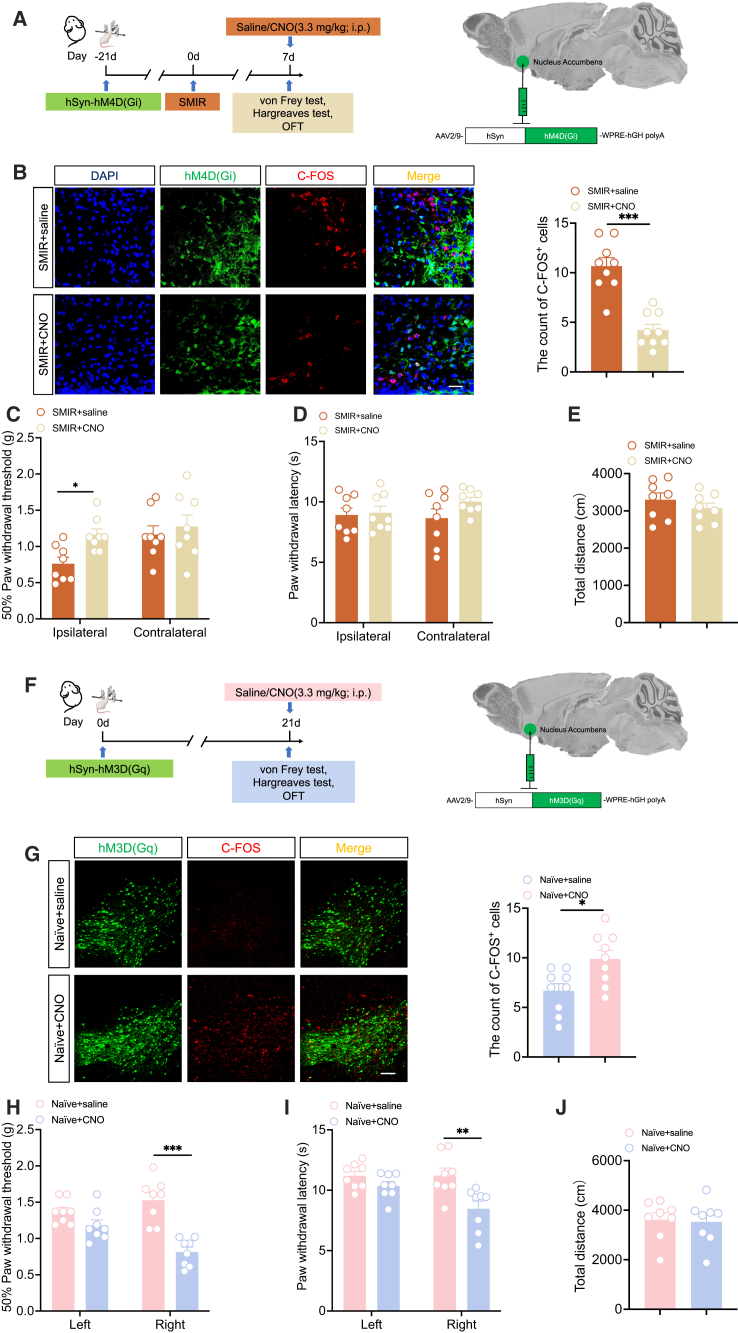
Reducing contralateral AcbC activity after surgery raises operated-side mechanical thresholds, without significant changes in contralateral thresholds or thermal responses on either side. Movement distance remains comparable, connecting the population with the model’s prominent mechanical phenotype.
At baseline without surgery, increasing left AcbC activity lowers both right-sided mechanical thresholds and thermal withdrawal latency, again without a significant movement change. The network can influence both modalities, although the postoperative model primarily changes mechanical responses. State and activity jointly shape the behavioral readout.
Source: Xu Y et al. · iScience · CC BY-NC-ND
Original figure and English caption ↗
Anterior cingulate activity influences the core
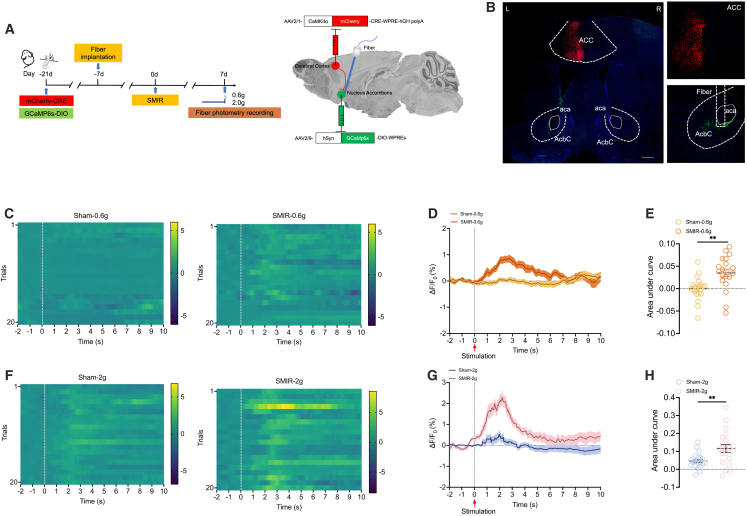
Anatomical observations show AcbC connections from CaMKII-associated excitatory ACC cells, with prominent source labeling in the Cg2 subdivision. Raising associated ACC activity increases AcbC calcium events and firing, linking core activity with cortical input.
AcbC populations associated with ACC input also show stronger calcium responses to both mechanical stimulus intensities after surgery. Whole-core and input-associated observations converge, placing the postoperative change within a cortical–core network and giving increased local activity an upstream context.
Source: Xu Y et al. · iScience · CC BY-NC-ND
Original figure and English caption ↗
Modulating associated activity changes mechanical measures
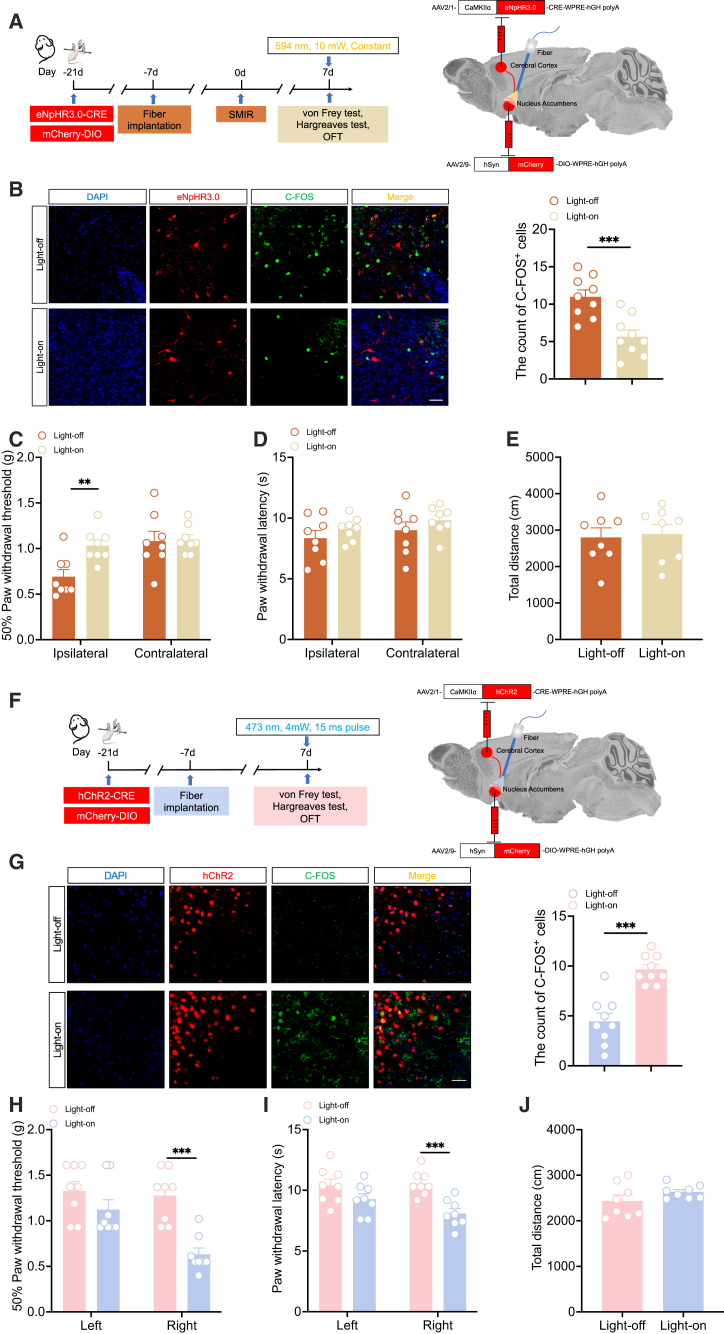
Reducing ACC–AcbC-associated activity raises operated-side mechanical thresholds after surgery, without significant opposite-side or thermal changes. Activation at baseline lowers opposite-side mechanical and thermal measures. The observations again show that an associated network can yield different sensory readouts in different states.
Movement distance does not significantly change, so withdrawal differences are not accompanied by a corresponding fall in overall activity. Cortical input and local activity form a network context for postoperative mechanical sensitivity, while the respective roles of the input-defined connection and the broader core population remain to be resolved more finely.
Source: Xu Y et al. · iScience · CC BY-NC-ND
Original figure and English caption ↗
Postoperative sensitivity includes changes in brain processing
Focusing on paw-withdrawal responses in male mice, the study shows postoperative mechanical sensitivity alongside a more responsive core network. After peripheral conditions change, cortical modulation and local population activity also contribute to processing, allowing the same mechanical input to produce different behavioral responses.
The core displays state-dependent sensory regulation. The contrast between postoperative mechanical changes and thermal effects of baseline activation highlights that a network’s functional range can differ from the phenotype expressed by one model. Understanding postoperative sensitivity involves both tissue changes and how incoming signals are processed in the brain.