From scratching to cautious exploration: how itch signaling changes
Acute and persistent itch can recruit the same thalamocortical connection with different cellular contributions. Research in male mice links scratching with anxiety-like behavior during chronic itch.
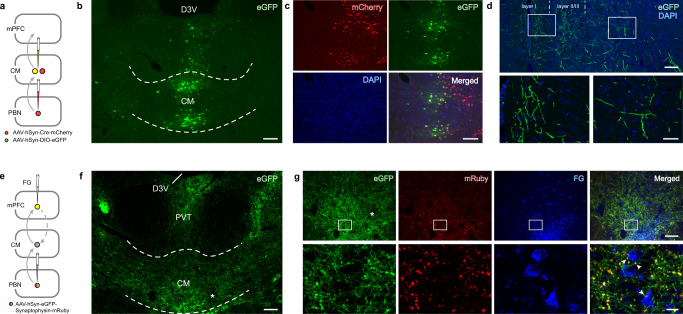
Itch invites an almost immediate scratch. When it persists, the changes can extend beyond scratching to reduced exploration of exposed spaces. How does sensory irritation connect with behavioral state? A study published in Nature Communications on May 3, 2023 traced links among the parabrachial nucleus, PBN, central medial thalamic nucleus, CM, and medial prefrontal cortex, mPFC, in male mice. The connection contributed to itch-related responses, while acute and chronic models recruited cortical excitatory and inhibitory cells differently.
CM-related activity accompanies scratching, and suppressing mPFC-projecting CM cells reduces scratching in acute and chronic models. Chronic itch also strengthens cortical feedforward inhibition and NMDA currents in interneurons, linking circuit adaptation with selected exploratory changes.
Contents · 6 sections
Thalamic activity follows the timing of scratching
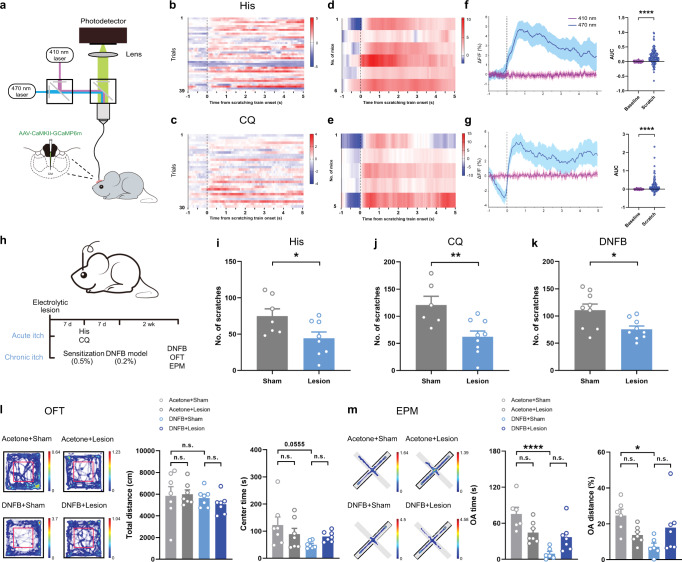
In two acute itch models, CM population calcium signals rose around scratching onset. Reducing CM tissue integrity decreased scratching in both acute and chronic models, providing complementary activity and functional evidence for its contribution.
At this stage, open-arm exploration in the chronic model did not significantly improve. Open-arena center-time differences were also not significant. Reduced scratching and altered exploration could therefore dissociate, motivating examination of more specific cellular connections.
Source: Li JN et al. · Nature Communications · CC BY
Original figure and English caption ↗
A PBN-related connection stands out in acute itch
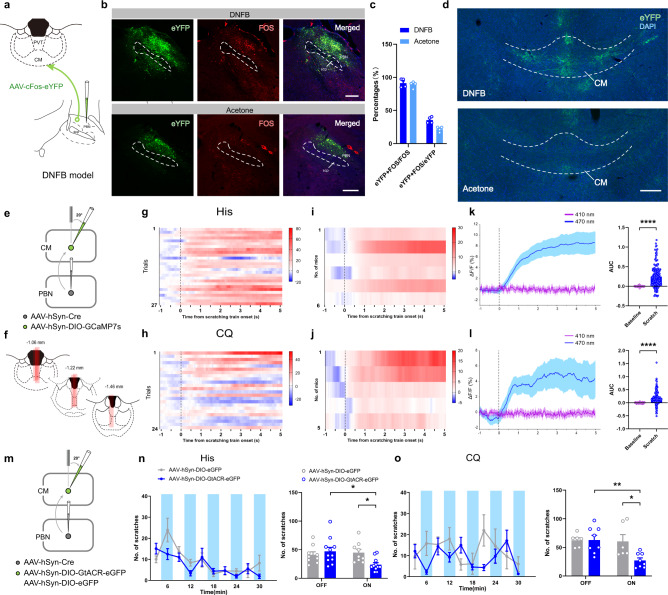
PBN receives itch-related spinal information, providing a starting point for tracing its next destination. PBN-related projections entered CM, and recipient cells showed scratching-associated calcium increases. Suppressing this input-defined population reduced acute scratching, whereas chronic scratching and anxiety-related exploration did not show the same significant improvement.
Participation of a node does not mean that each input matters equally at every stage. Other inputs to CM and its cortical connections may carry different weight during persistent stimulation. Separating upstream from downstream comparisons helps reveal these differences.
Source: Li JN et al. · Nature Communications · CC BY
Original figure and English caption ↗
Cortex-projecting CM cells connect with broader behavioral changes
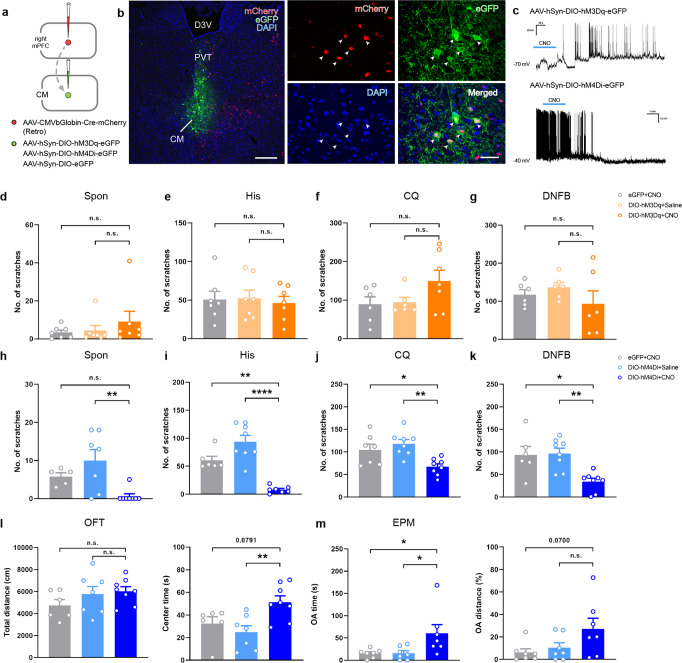
Anatomical findings connected CM with mPFC. Suppressing mPFC-projecting CM cells reduced scratching in acute and chronic models. Increasing this population did not significantly increase spontaneous or model-induced scratching under the tested conditions, showing asymmetric effects.
In the chronic model, suppression increased open-arm time. Center time increased within the suppressed group, but the direct comparison with another control group was not significant. Total distance did not change significantly, supporting selected exploratory changes rather than uniform recovery across anxiety-related measures.
Source: Li JN et al. · Nature Communications · CC BY
Original figure and English caption ↗
The same input has different effects across itch states
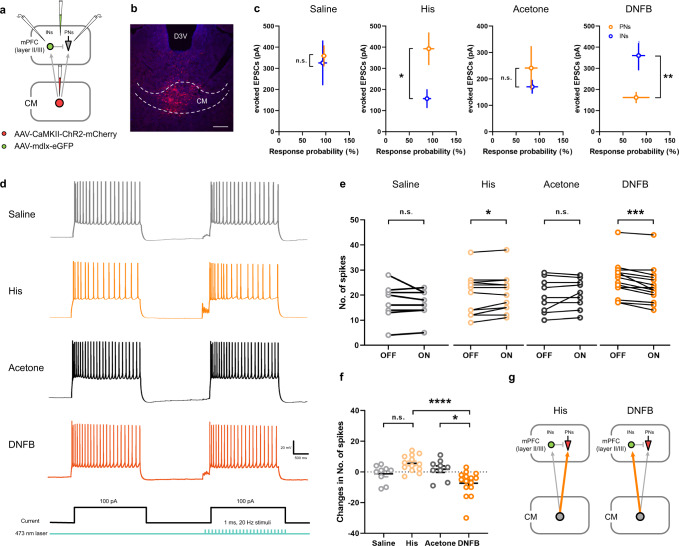
CM contacts both mPFC pyramidal cells and inhibitory interneurons. Input-evoked excitation favored pyramidal cells in the acute model and interneurons in the chronic model. These interconnected cell types jointly influence cortical output.
Within-cell comparisons showed more pyramidal firing during input activation in the acute model and less in the chronic model. However, the acute change magnitude did not significantly differ from its control group, making increased inhibition in the chronic state the clearer finding.
Source: Li JN et al. · Nature Communications · CC BY
Original figure and English caption ↗
Excitatory input can recruit an inhibitory relay
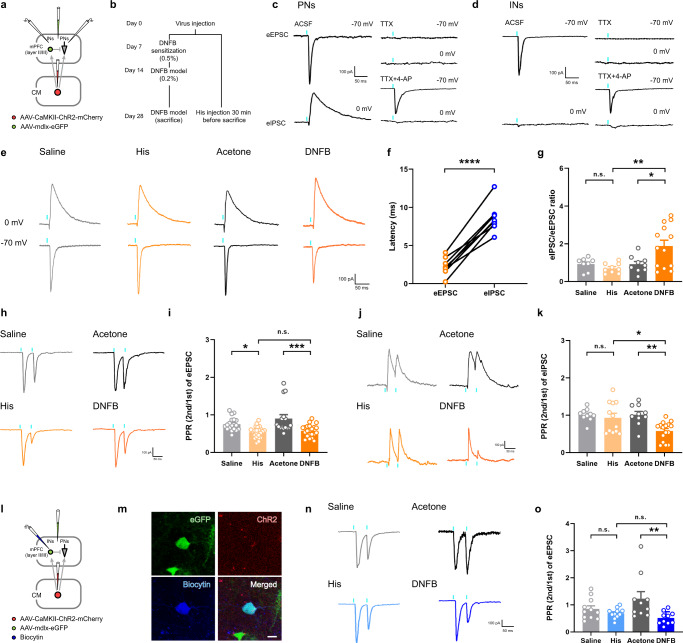
Electrical responses supported direct CM excitation of both pyramidal cells and interneurons. Interneurons then inhibit pyramidal cells, forming feedforward inhibition through a local relay. The inhibitory/excitatory current ratio increased in the chronic model, shifting the measured balance toward inhibition.
The acute model did not show the same significant ratio increase. Persistent itch therefore involved altered local cellular coordination, beyond simply prolonging an acute signal. These circuit-specific responses do not establish shutdown of all prefrontal activity.
Source: Li JN et al. · Nature Communications · CC BY
Original figure and English caption ↗
Interneuron NMDA signals offer a further lead
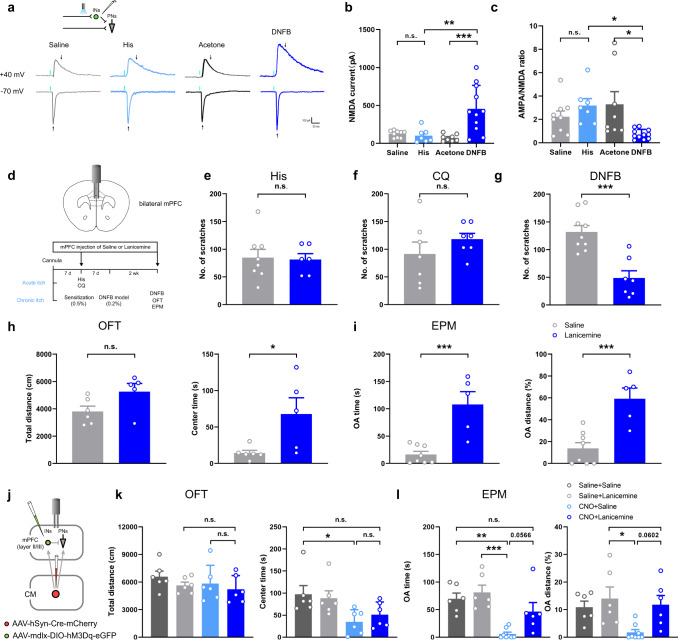
In the chronic model, interneuron NMDA currents increased and the AMPA/NMDA ratio decreased, without the same acute changes. Local NMDA antagonism reduced chronic scratching and increased selected exposed-space exploration, while acute scratching and total travel distance did not change significantly.
These findings offer a molecular link between sensation and behavioral state, although local drug action is not exclusive to this cell type. Further work must distinguish interneuron subtypes and examine other sexes and chronic-itch contexts.
Source: Li JN et al. · Nature Communications · CC BY
Original figure and English caption ↗