Different receptor roles in pain sensitivity and sweet-water preference
A mouse study follows glutamatergic dorsal-raphe inputs to ventral tegmental area. Nerve injury weakens transmission; activating the pathway improves pain sensitivity and sucrose preference, with medial-accumbens D2 and D1 receptors contributing to different components.
Why can persistent pain sensitivity and reduced sweet-water preference appear sequentially in the same mouse? A study published in Nature Communications on August 23, 2023 follows changes after nerve injury through a pathway from dorsal raphe via ventral tegmental area to nucleus accumbens. Glutamatergic transmission weakens after injury; activation improves reflexive pain sensitivity and sucrose preference. At the downstream destination, these outcomes involve different dopamine receptors.
Nerve injury weakens excitatory transmission from dorsal-raphe VGluT3 cells to VTA dopamine cells and reduces medial-accumbens dopamine responses. Blocking medial D2 receptors disrupts activation-related improvement in mechanical sensitivity, while D1 blockade disrupts sucrose-preference improvement.
Contents · 7 sections
Sensitivity precedes reduced preference
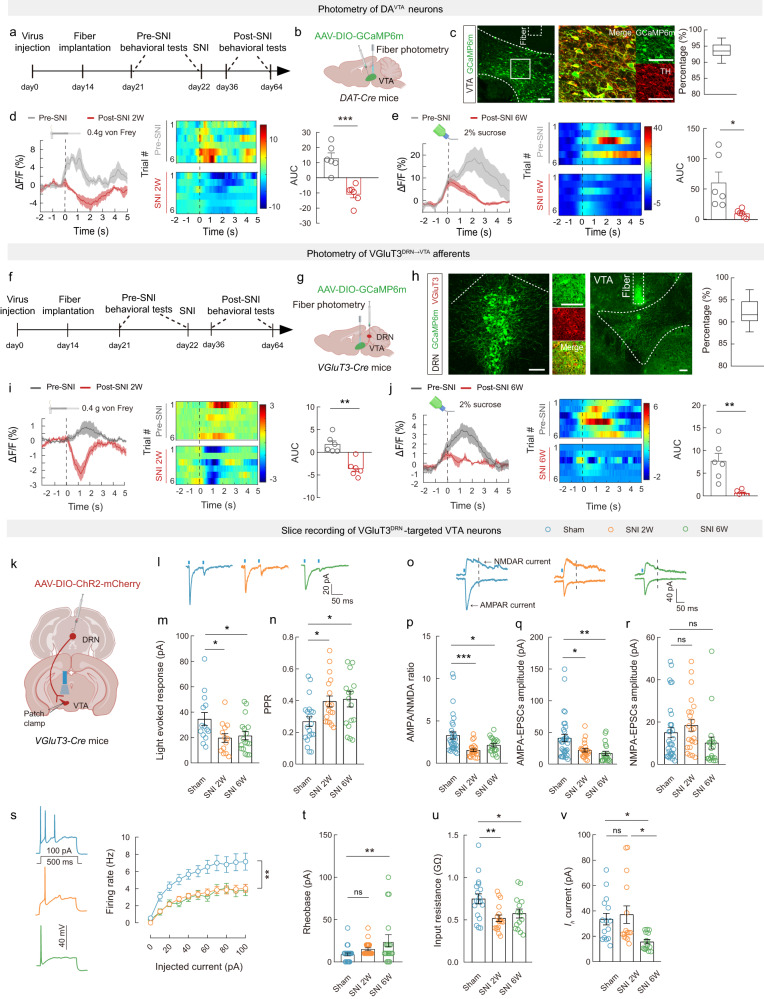
Spared nerve injury produces persistent mechanical hypersensitivity. By two weeks, pain sensitivity is present while sucrose preference is not yet reduced; by six weeks, preference also falls. Pain- and reward-related changes therefore emerge at different stages.
VTA dopamine-cell calcium responses change alongside this progression. At two weeks, responses to mechanical stimulation shift from increases to decreases. At six weeks, sucrose-licking responses also weaken, while the two-week sucrose response remains preserved. Sham controls lack these changes at corresponding time points, linking them with the post-injury course.
A reward-related input loses excitatory strength
Dorsal raphe is associated with serotonin, yet VGluT3-expressing cells also transmit glutamate and some coexpress serotonin markers. Tracing and slice recordings show preferential output to VTA dopamine cells, capable of evoking fast excitatory postsynaptic currents.
After injury, these excitatory currents weaken and the AMPA component decreases, while the NMDA component does not change significantly. Tested dopamine cells fire less, with reduced Ih current at six weeks. The ratio of currents evoked by two successive stimuli also increases, suggesting weaker presynaptic transmitter release. Alongside AMPA-current changes, this places adaptation at both input release and recipient response. Upstream input and intrinsic electrophysiological properties both change during the chronic course.
Source: Wang XY et al. · Nature communications · CC BY
Original figure and English caption ↗
Strengthening the input improves two behavioral measures
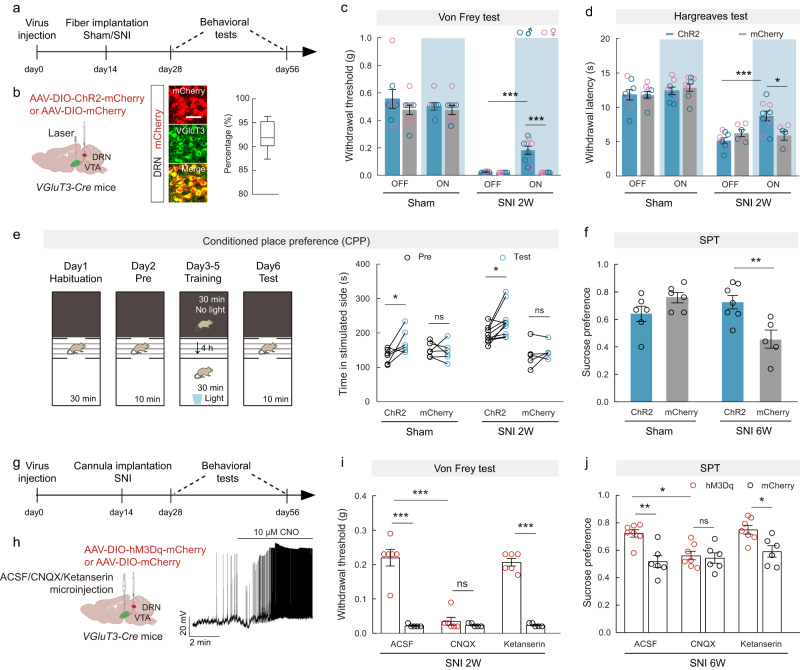
Activating dorsal-raphe VGluT3 terminals in VTA increases mechanical withdrawal thresholds and thermal withdrawal latency in nerve-injured mice, and increases sucrose preference at six weeks. Baseline mechanical and thermal responses in sham mice and open-field travel distance do not change significantly.
Mice also prefer a stimulation-paired location, including sham-operated mice. Because the pathway itself contributes to reward, place preference can reflect stimulation-related reward alongside relief after injury. Mechanical responses, thermal responses and sucrose choices supply distinct behavioral observations.
Source: Wang XY et al. · Nature communications · CC BY
Original figure and English caption ↗
Which cotransmitter contributes to improvement?
Some VGluT3 cells transmit both glutamate and serotonin. Activating the raphe population while separately blocking receptors in VTA shows that AMPA-related blockade abolishes improvements in mechanical thresholds and sucrose preference, unlike the tested serotonin-2A/2C blockade.
This comparison links glutamatergic transmission with the measured improvements within the tested input, target region and receptor scope. It helps distinguish contributions from cotransmitters present in overlapping cells.
What happens when the input is weakened?
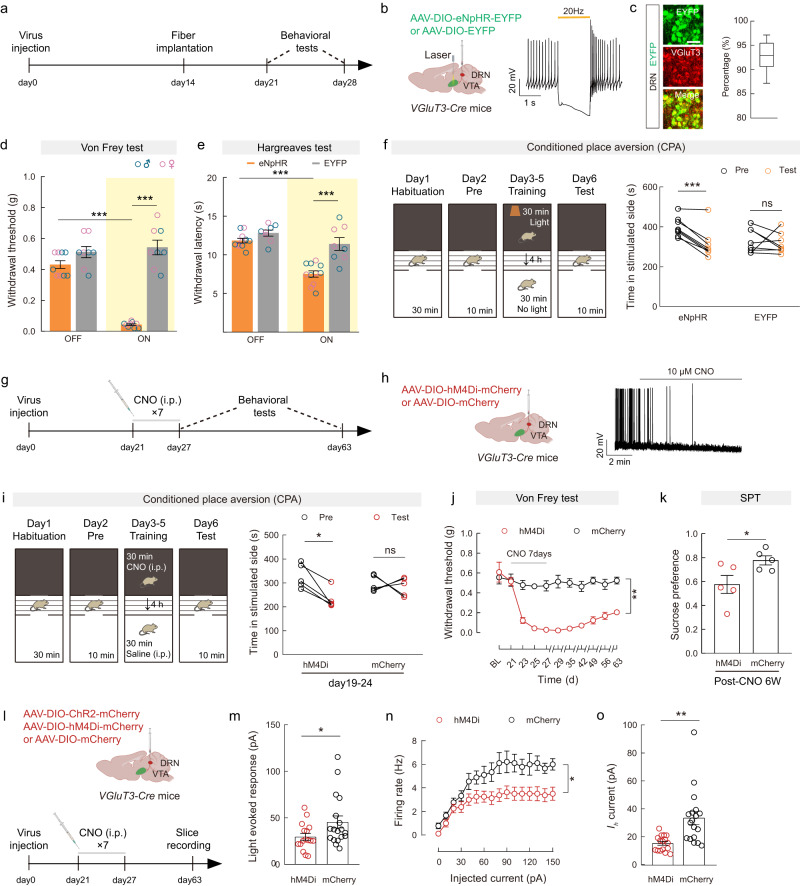
Inhibiting VGluT3 terminals in VTA in uninjured mice increases mechanical and thermal sensitivity without a significant travel-distance change. In a separate experiment, repeated inhibition of raphe VGluT3 cell bodies produces mechanical hypersensitivity lasting weeks, followed by reduced sucrose preference.
The latter intervention targets cell bodies and may involve other output branches. Weeks later, input-recipient VTA cells show reduced excitability and synaptic currents, linking temporary suppression with more persistent network adaptation.
Source: Wang XY et al. · Nature communications · CC BY
Original figure and English caption ↗
Medial and lateral accumbens show different changes
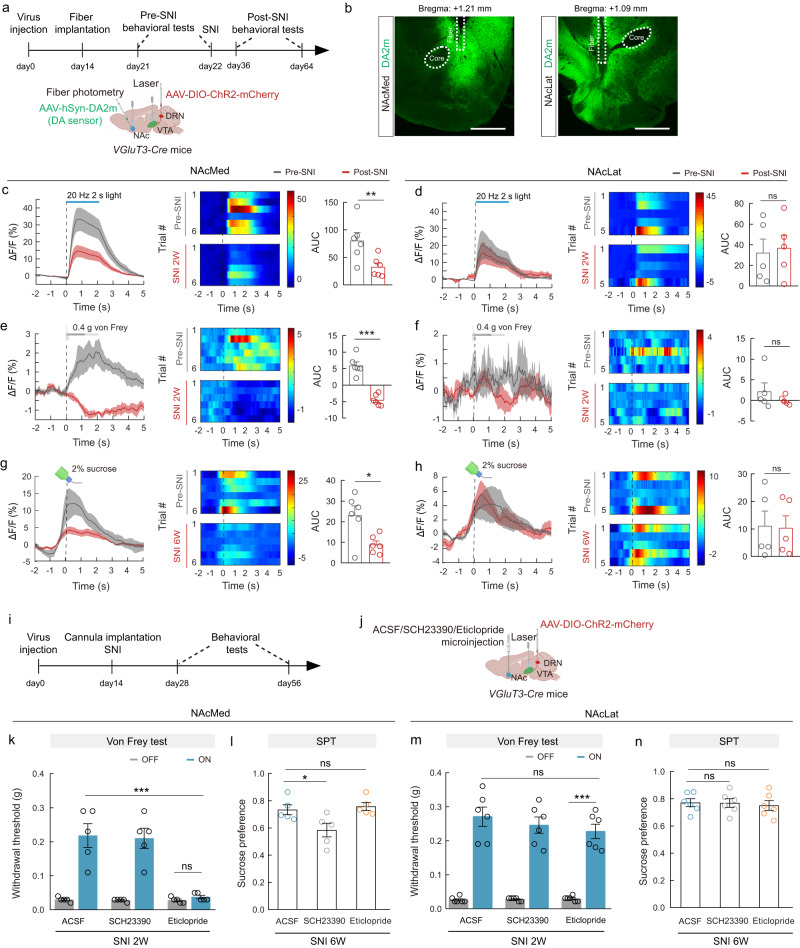
Activating this VTA input evokes dopamine-sensor signals in both medial and lateral accumbens. After injury, activation-evoked, mechanical-stimulation-related and sucrose-licking responses decline medially, while corresponding lateral comparisons do not change significantly.
Receptor blockade separates the outcomes: medial D2 blockade disrupts mechanical-threshold improvement, whereas D1 blockade disrupts sucrose-preference improvement. The lateral pharmacological comparisons lack the same blockade. Direct raphe-terminal activation in medial accumbens also fails to improve tested sensitivity or sucrose preference, implicating the route via VTA.
Source: Wang XY et al. · Nature communications · CC BY
Original figure and English caption ↗
Pain sensitivity and reward can share a route with different endpoints
Using adult mice of both sexes, recordings, synaptic measurements and bidirectional interventions reveal pathway adaptation after chronic nerve injury. Reduced Ih accompanies later preference changes and remains a candidate mechanism; its behavioral contribution is not tested here through isolated Ih manipulation.
The notable distinction is that pain sensitivity and reward-related behavior need not follow wholly separate routes. One glutamatergic input passes through the dopamine system to a shared subregion, yet affects different receptor-associated behavioral components under the tested pharmacological conditions.