Beyond pain, why does exploration become cautious? A pontine–thalamic pathway with two effects
Persistent inflammation makes mice more sensitive to stimuli and less likely to enter open areas. A study finds that PPTg→CM connectivity can influence both changes.
Pain may change more than the body’s response to a stimulus. A mouse with persistent inflammation also enters open space less often and spends less time on the brightly lit side, as though its surroundings call for extra caution. A 2026 Anesthesiology study follows a connection from the pedunculopontine tegmental nucleus (PPTg) to central medial thalamus (CM), asking why sensitivity and avoidance so often travel together. Reducing activity improved several inflammatory-state outcomes; increasing it in controls moved behavior in the opposite direction.
PPTg glutamatergic populations and their CM output contribute to CFA-associated sensitivity, spontaneous nociceptive-related behavior and avoidance. Suppression improves the inflammatory state, while activation produces related changes in controls.
Contents · 6 sections
The same environment brings different choices after inflammation
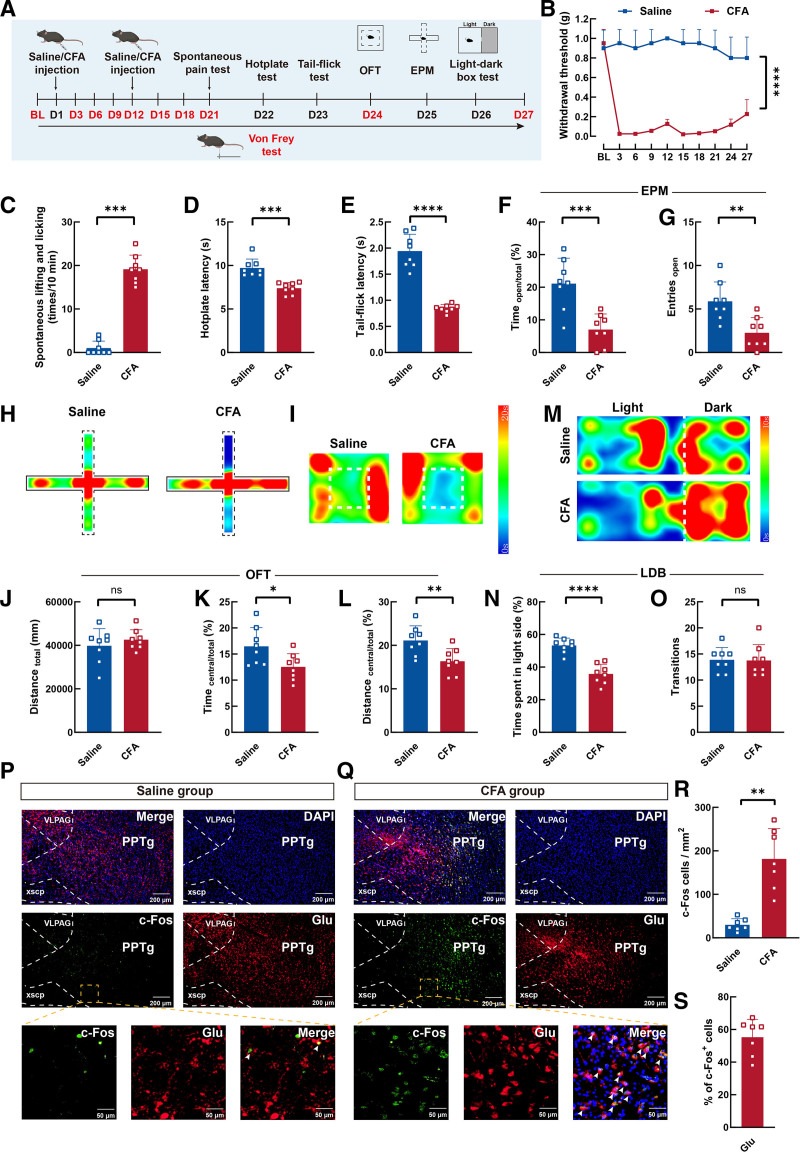
In CFA mice, mechanical thresholds fell, heat and tail responses became faster, and spontaneous nociceptive-related behavior increased. Open-arm, center and light-side exploration decreased while total distance and light–dark transitions remained similar. Sensation and spatial choices changed together, revealing several facets of the inflammatory state.
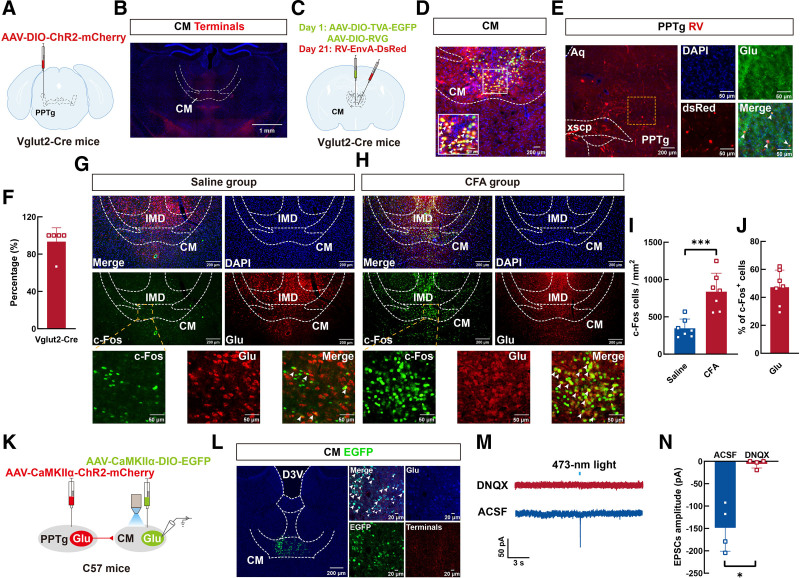
PPTg activity labeling increased, mainly overlapping glutamatergic markers. The pontine nucleus contains diverse populations and contributes to arousal and movement. Identifying a population within the regional response allowed modulation to be related to defined cells.
Source: Gao SJ et al. · Anesthesiology · CC BY-NC-ND
Original figure and English caption ↗
With lower pontine activity, mice explore open areas again
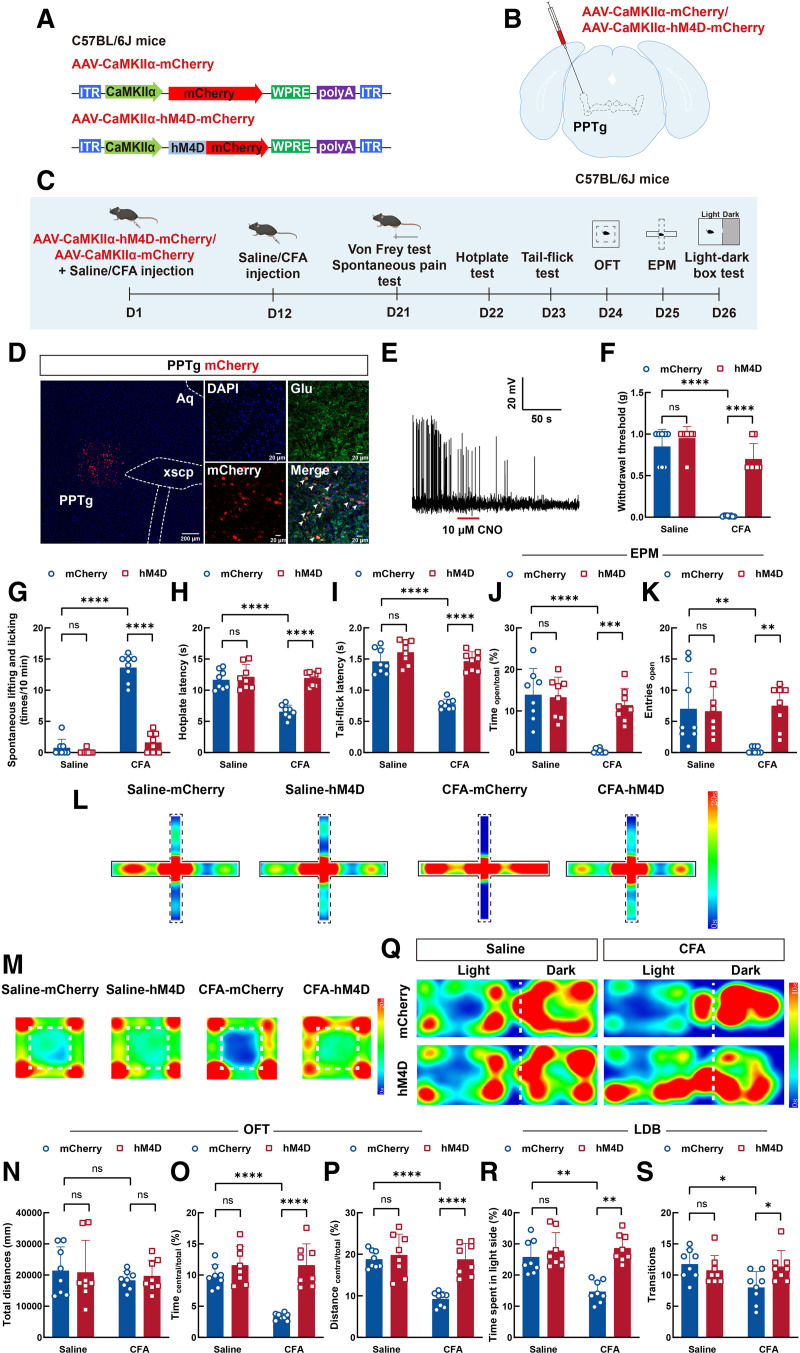
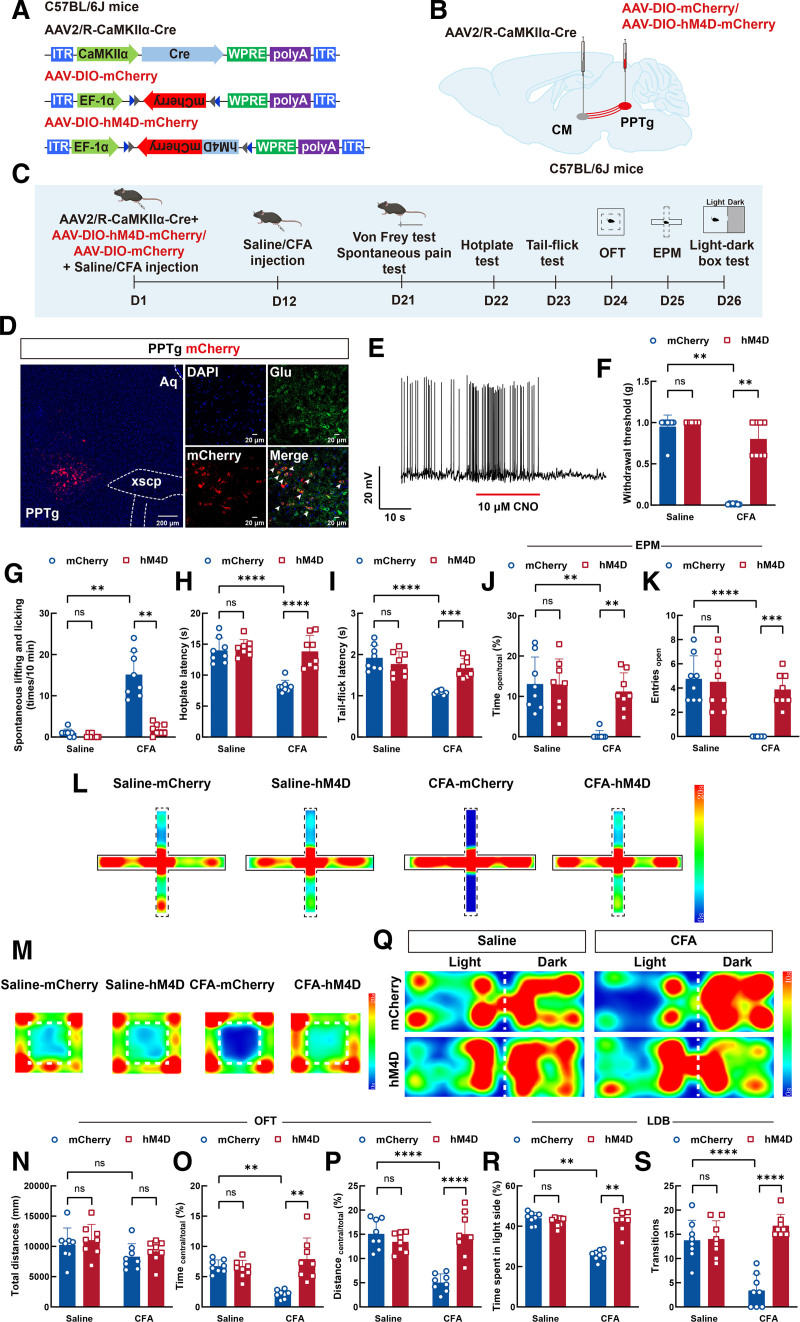
Suppressing PPTg glutamatergic-related cells raised CFA thresholds and thermal latencies, reduced spontaneous behavior and improved open- and light-zone exploration. Distance remained similar, and most control-state measures lacked matching changes. The same modulation therefore had different effects in inflammatory and baseline contexts.
Interestingly, mice did not travel farther overall; they redistributed some of their movement toward open and bright areas. Together with improved mechanical thresholds, thermal responses and spontaneous nociceptive-related behavior, this was more than a change in movement quantity. The inflammatory state that had narrowed exploration could be eased by modulating this population.
Source: Gao SJ et al. · Anesthesiology · CC BY-NC-ND
Original figure and English caption ↗
Even without inflammation, activating these cells increases sensitivity and avoidance
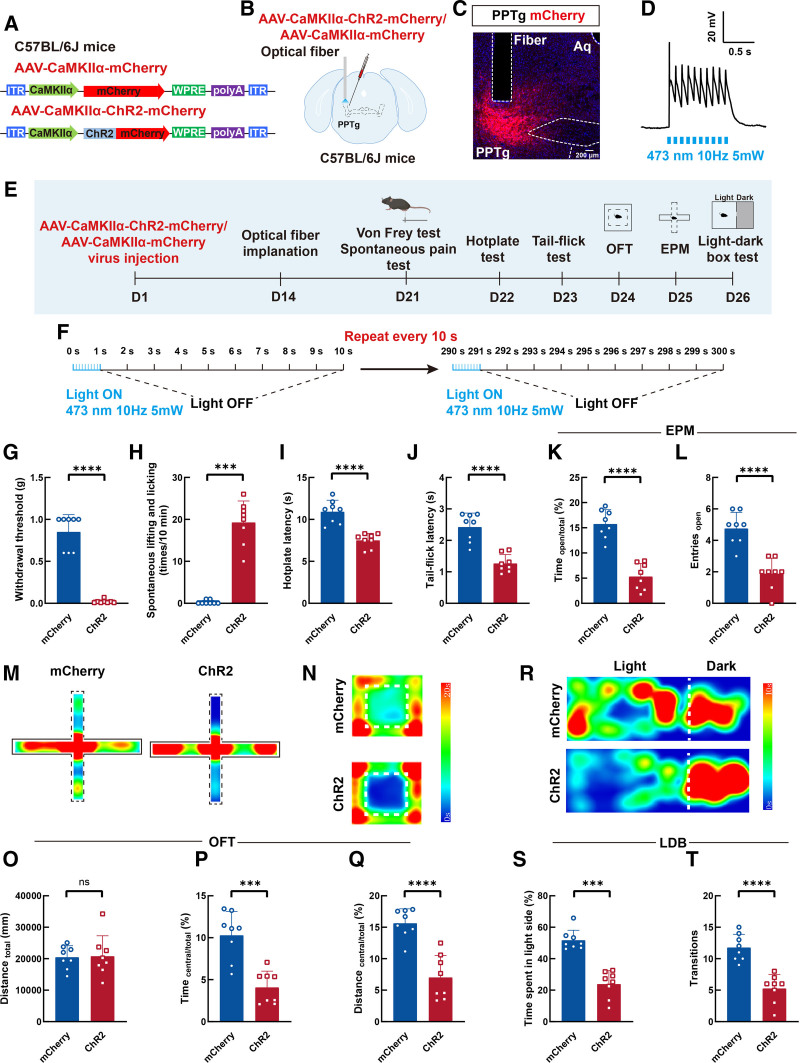
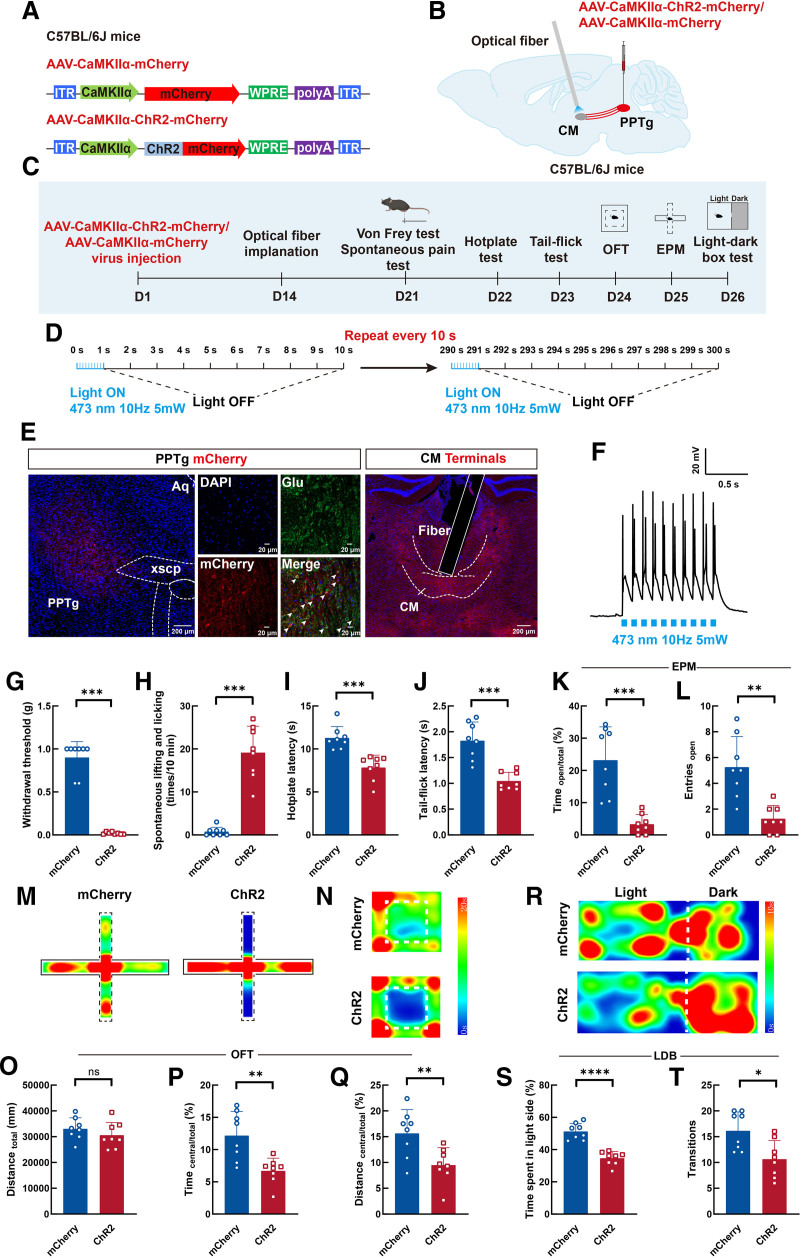
If these cells merely watched pain unfold, increasing their activity might leave behavior unchanged. Yet optical activation in control mice lowered mechanical thresholds, accelerated thermal responses, increased spontaneous nociceptive-related behavior and reduced exploration of open and bright areas. Overall movement remained similar. Altering cellular activity was sufficient to shift sensitivity and environmental choices toward greater sensitivity and avoidance.
Thresholds, spontaneous actions and avoidance came from different tasks but changed together with increased activity. Their convergence linked recruitment with behavior and prompted examination of where these PPTg cells send their output.
Source: Gao SJ et al. · Anesthesiology · CC BY-NC-ND
Original figure and English caption ↗
A signal from the pons reaches thalamic CM
Terminal labeling and monosynaptic retrograde tracing supported connectivity from PPTg glutamatergic cells to CM glutamatergic cells. CM activity labeling also increased after CFA. Terminal stimulation evoked excitatory currents in CM that were blocked by DNQX, placing the connection within both anatomy and local function.
Glutamate provides excitatory transmission here: PPTg input can drive an electrical response in CM cells. Pontine activity was therefore more than an isolated point of recruitment; it had a traceable downstream connection. CM was also recruited during inflammation, prompting the next question: does this connection actually contribute to sensation and choice?
Source: Gao SJ et al. · Anesthesiology · CC BY-NC-ND
Original figure and English caption ↗
Modulating the connection changes both kinds of behavior again
Suppressing CM-projecting PPTg cells improved CFA mechanical, thermal, spontaneous and avoidance measures, with similar overall movement and mostly unchanged controls. Activating the corresponding CM terminals produced opposing effects in controls. Population and output modulation therefore produced convergent behavioral changes.
Reducing projecting-cell activity at one end and increasing its terminals in CM at the other again shifted sensation and avoidance in opposite directions. The finding connected pontine activity, thalamic responses and behavior into one account. A more detailed question remains: does sensory relief encourage exploration, or do components within the output contribute separately to the two behaviors?
Source: Gao SJ et al. · Anesthesiology · CC BY-NC-ND
Original figure and English caption ↗
Pain and avoidance share a connection that can modulate both
The study gives the pairing of sensitivity and avoidance a specific neural connection. Their relationship extends beyond appearing together in behavior: changing glutamatergic PPTg cells and their CM output influences stimulus responses, spontaneous behavior and spatial choice together. The persistent-inflammatory state of greater sensitivity and caution has a pontine–thalamic site capable of affecting several facets.
The results come from a CFA inflammatory model in adult male mice. Most effects of suppression were small at baseline and clearer during inflammation. The same connection can therefore carry different weight in different bodily states. Understanding why pain reshapes broader behavior requires considering cellular connectivity together with the animal’s current condition.
Source: Gao SJ et al. · Anesthesiology · CC BY-NC-ND
Original figure and English caption ↗