After nerve injury, RE input recruits stronger prefrontal inhibition
In SNI mice, RE-to-prefrontal input strengthens with a larger inhibitory contribution. Reducing it improves hypersensitivity and accompanying behaviors, including after morphine tolerance.
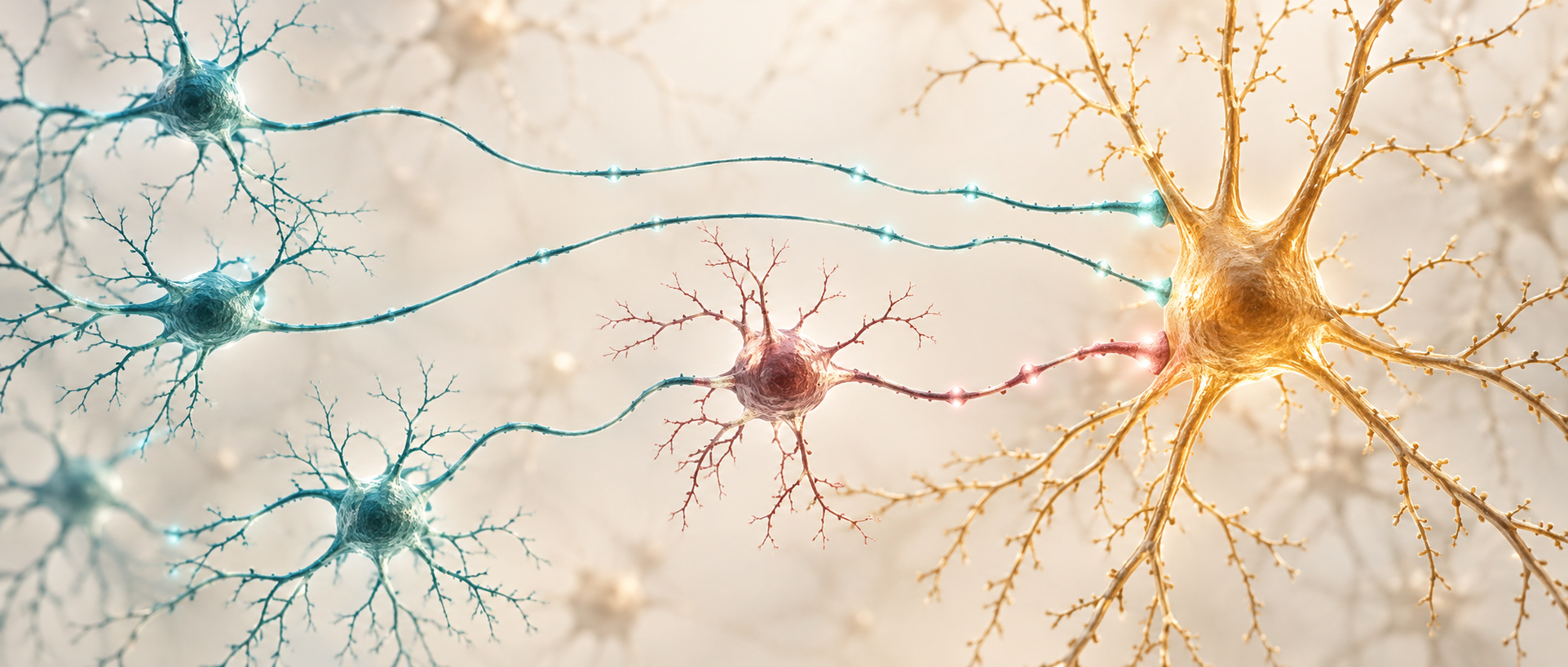
Why might stronger excitatory input weaken downstream output? A PLOS Biology study finds this pattern in nerve-injured mice. Thalamic nucleus reuniens, or RE, input to medial prefrontal cortex, or mPFC, excites projection cells and recruits local GABA inhibition. Greater inhibitory enhancement accompanies reduced firing in prefrontal cells projecting to ventrolateral periaqueductal gray, or vlPAG. The study tests consequences for sensitivity, social investigation and immobility.
SNI strengthens RE-associated excitatory and inhibitory currents, with a higher inhibitory ratio. RE–mPFC inhibition improves sensitivity/behavior, increases ipsilateral vlPAG stimulus responses and raises mechanical thresholds after morphine tolerance.
Contents · 7 sections
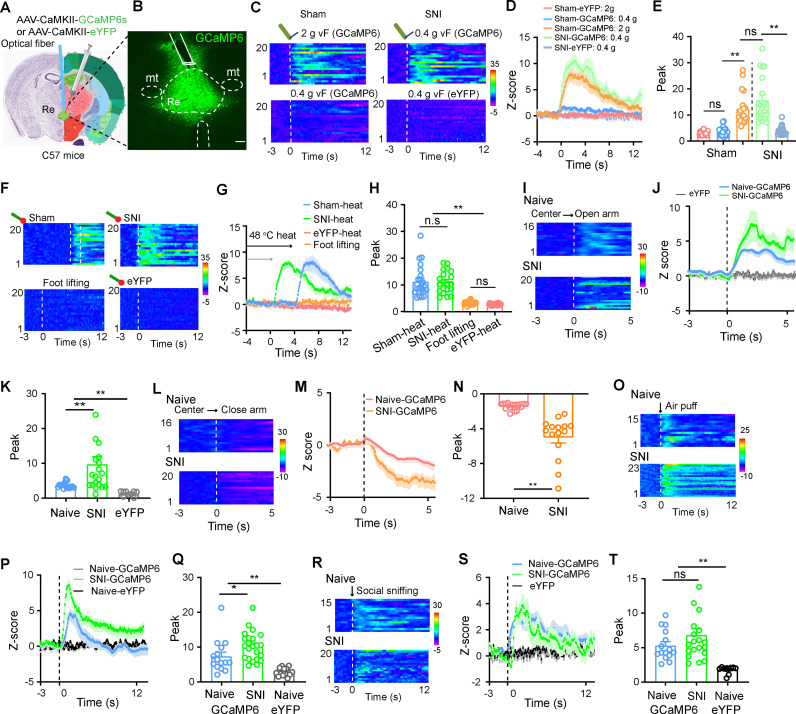
RE responds to lighter stimuli after nerve injury
SNI RE glutamate-associated populations respond clearly to lighter mechanical stimulation, while sham mice chiefly respond to stronger stimulation. Heat-response peaks are comparable but latency is shorter after injury.
Open-arm entry and air-puff responses are greater after SNI, while unfamiliar-juvenile sniffing responses do not significantly differ. Injury affects selected contexts rather than all responses uniformly.
Source: Bao ST et al. · PLoS biology · CC BY
Original figure and English caption ↗
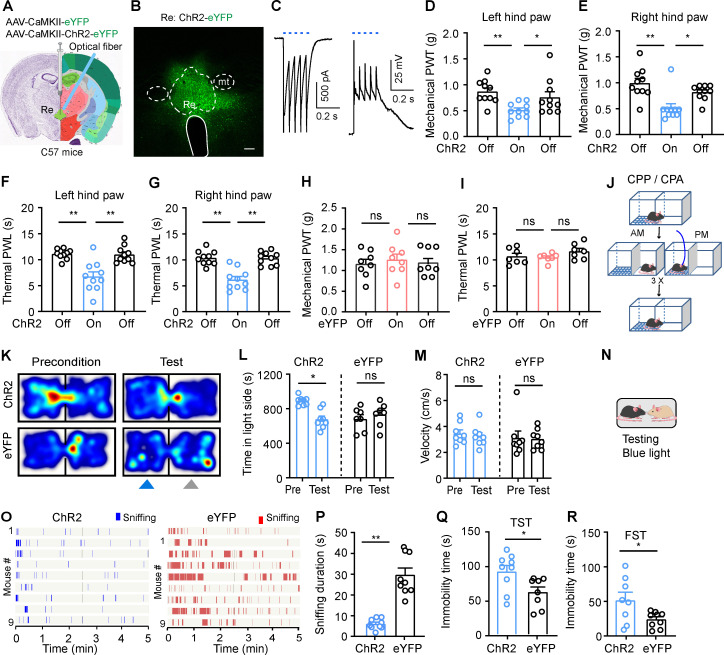
RE activation changes thresholds and behavior
Optical RE activation in normal mice lowers bilateral mechanical thresholds and heat latency, produces stimulation-context aversion, reduces social sniffing and increases tail-suspension/swimming immobility.
Place-test speed does not significantly change. Sensory outcomes and choices are modifiable by RE recruitment, motivating inhibition tests after nerve injury.
Source: Bao ST et al. · PLoS biology · CC BY
Original figure and English caption ↗
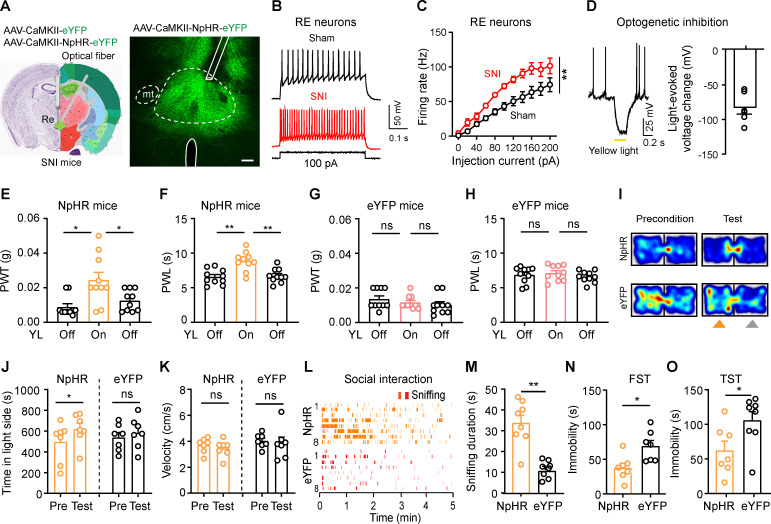
Lowering RE activity improves model responses
Mechanical/heat hypersensitivity emerges soon after injury and persists. At four weeks, reduced novel-mouse investigation and increased immobility accompany it, motivating sensory, place-choice and social measures.
After SNI, RE cells fire more readily in slices. Further activation does not lower model thresholds further, whereas inhibition raises mechanical thresholds and heat latency. The same inhibition leaves normal-mouse thresholds unchanged.
SNI mice prefer the inhibition-paired context, sniff more and show less immobility, without significant place-test speed changes. Selected outcomes are also verified in female SNI mice, linking effects to injury state.
Source: Bao ST et al. · PLoS biology · CC BY
Original figure and English caption ↗
Stronger input accompanies greater local inhibition
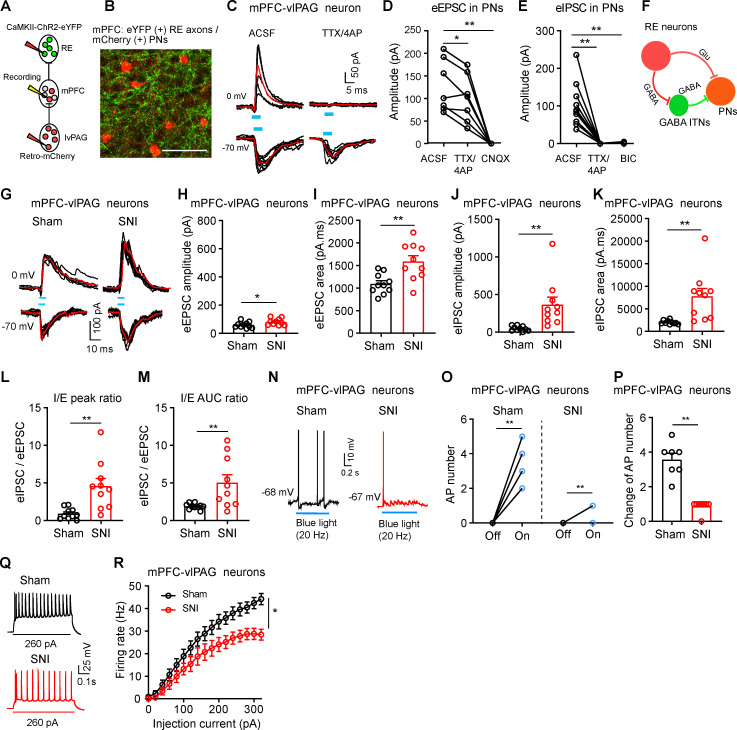
Tracing and recordings show direct RE excitation of vlPAG-projecting prefrontal cells and local GABA cells, which provide indirect inhibition onto projection cells.
Both currents grow after SNI, with a higher inhibitory/excitatory ratio and less projection-cell firing to RE stimulation. GABA-related blockade removes the firing difference, linking input recruitment to output regulation.
Source: Bao ST et al. · PLoS biology · CC BY
Original figure and English caption ↗
RE-terminal modulation reproduces state-dependent effects
Unilateral RE-terminal activation in mPFC increases ipsilateral sensitivity without significant contralateral changes. Terminal inhibition in normal mice leaves thresholds, place choices and immobility unchanged.
In SNI, terminal inhibition raises thresholds, produces paired-context preference, increases social investigation and reduces immobility, with similarly directed female validation. Population and terminal outcomes converge on this prefrontal input.
Reducing prefrontal input enhances vlPAG responses
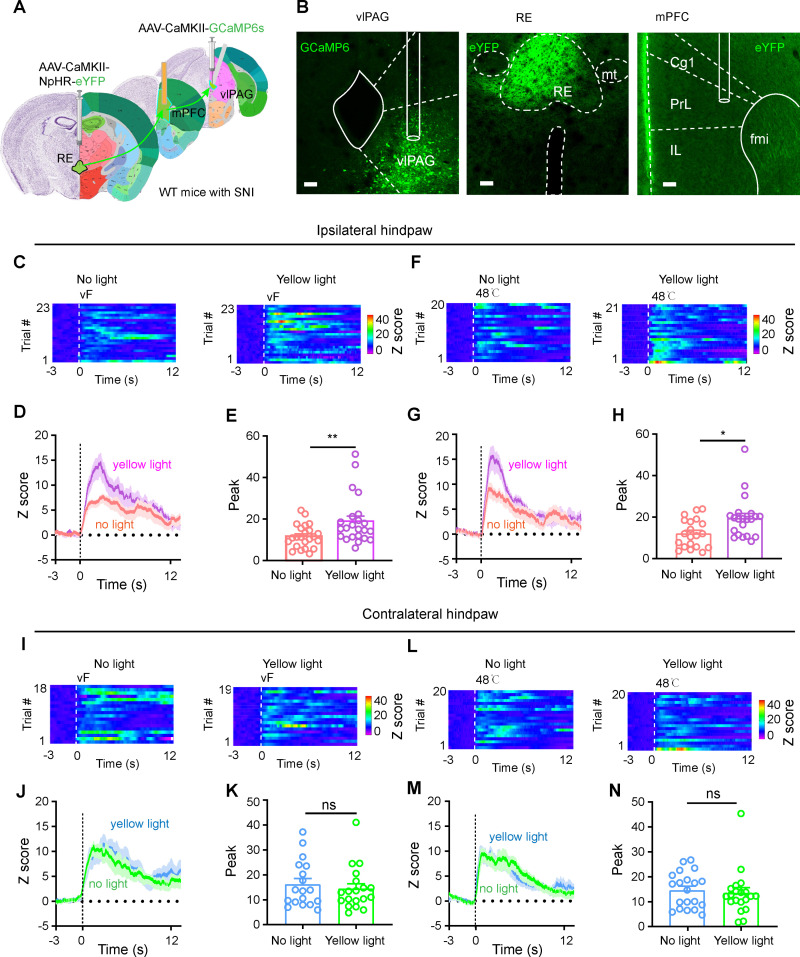
During RE–mPFC inhibition, vlPAG glutamate-associated populations respond more strongly to ipsilateral mechanical/heat stimuli, without equivalent significant contralateral changes.
The result accords with stronger local inhibition: reducing excessive input can strengthen a downstream response. Threshold and activity directions depend on the observed population and circuit stage.
Source: Bao ST et al. · PLoS biology · CC BY
Original figure and English caption ↗
The input remains modifiable after tolerance
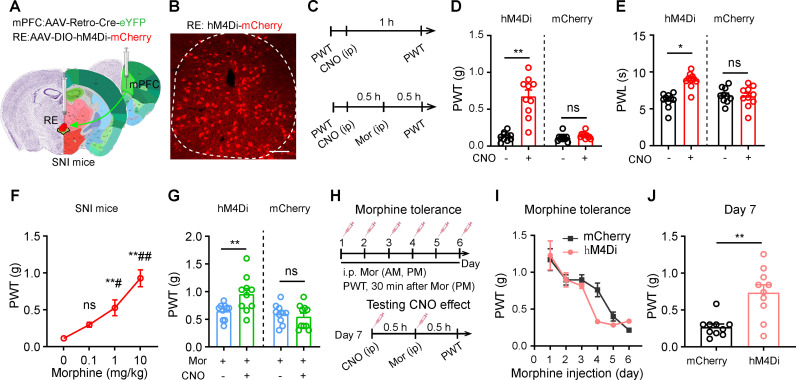
Chemogenetic inhibition of mPFC-projecting RE populations improves SNI sensory measures alone and augments lower-dose morphine threshold effects. After repeated morphine reduces drug efficacy, circuit inhibition still raises mechanical thresholds.
After repeated morphine, first evoked excitatory currents increase in both prefrontal projection and GABA cells, while paired-pulse ratios do not significantly change, adding synaptic observations alongside post-tolerance behavioral results.
Terminal-inhibition effects persist under tested naloxone conditions. This chiefly male study with selected female validation links injury-associated sensitivity and accompanying behavior to strengthened prefrontal input with greater local inhibitory recruitment.
Source: Bao ST et al. · PLoS biology · CC BY
Original figure and English caption ↗