How newborn cells generated in enriched environments help limit seizures
A male mouse study connects enrichment, entorhinal cortex and newborn hippocampal cells. These cells recruit local inhibition and contribute to enrichment-associated protection.

How does greater opportunity for exploration leave an effect in the brain? A 2024 Advanced Science study follows environmental enrichment into hippocampal dentate gyrus: proliferation and immature-neuron markers increase, and later severe seizures require more time and greater cumulative challenge. Entorhinal cortical activity relates to newborn-cell production, while activity in the maturing cells recruits local inhibitory networks. Environmental experience, cell generation and seizure susceptibility converge in one research question.
Enrichment increases newborn-cell-associated dentate measures and reduces seizure susceptibility in the tested model. Interventions in entorhinal or newborn cells each weaken the enrichment-associated effect.
Contents · 7 sections
What environmental experience changes
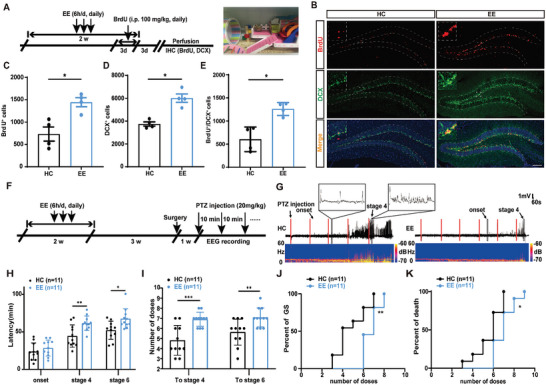
Enrichment provides varied sensory, movement and exploration opportunities. Relative to ordinary housing, dentate proliferation markers, immature-neuron markers and their overlap increase, indicating enhanced adult hippocampal neurogenesis-related processes.
In a cumulative drug-challenge model, enriched mice reach severe seizure stages later and require greater cumulative challenge. Enrichment and newborn-cell increases occur together, but determining the cellular contribution requires intervention.
Source: Li Z et al. · Advanced science (Weinheim, Baden-Wurttemberg, Germany) · CC BY
Original figure and English caption ↗
Cells recruited during seizures
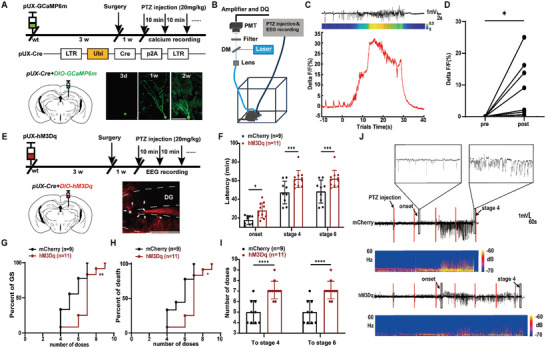
The study labels adult-born dentate granule cells and records calcium together with EEG as they mature. Their calcium activity increases during induced seizures. This response alone does not identify whether they facilitate or constrain seizures; changing their activity tests the effect.
Activating these cells delays onset and severe stages and raises the required cumulative challenge. Another activation approach improves selected measures without clearly delaying the most severe stage. In ordinary housing, inhibiting newborn cells does not clearly change susceptibility, showing dependence on approach and baseline context.
Source: Li Z et al. · Advanced science (Weinheim, Baden-Wurttemberg, Germany) · CC BY
Original figure and English caption ↗
The contribution left by enrichment
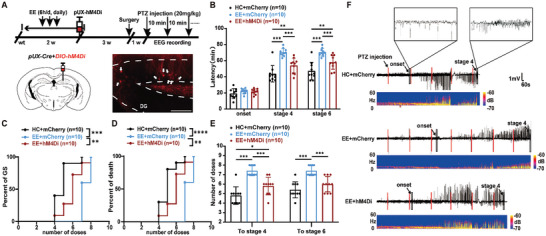
The study next labels cells generated under enrichment and tests them after maturation. Seizure delays and greater required challenge remain detectable after enrichment has ended. Inhibiting this population weakens these effects, supporting its contribution to enrichment-associated protection.
Some protection remains after inhibition, indicating that enrichment may also recruit other cells and processes. Newborn cells are a functionally supported component, whose birth context and later state shape interpretation of their contribution.
Source: Li Z et al. · Advanced science (Weinheim, Baden-Wurttemberg, Germany) · CC BY
Original figure and English caption ↗
How environmental signals reach hippocampus
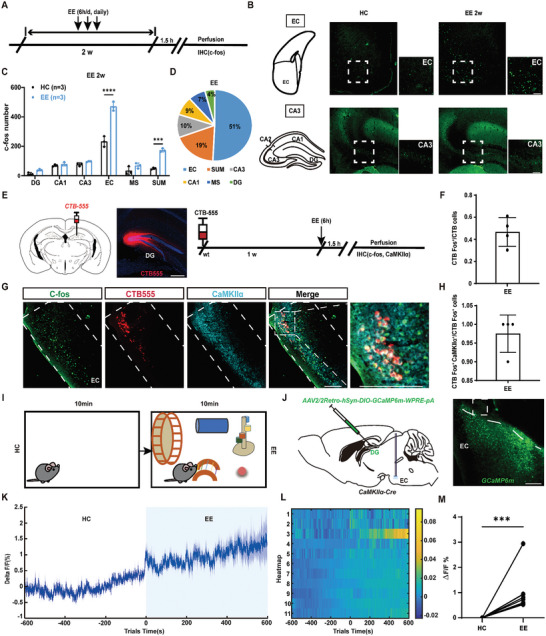
Among upstream regions of dentate gyrus, entorhinal cortex (EC) and supramammillary nucleus show more activity markers after enrichment, with a particularly prominent EC change. Many dentate-projecting EC cells are recruited and predominantly carry excitatory-cell-associated labeling.
Recordings show increased calcium in these projection cells during enrichment. Anatomical input and real-time environmental responses identify EC as a candidate linking experience with dentate changes. The other region with increased activity does not show the same required contribution in the tested intervention.
Source: Li Z et al. · Advanced science (Weinheim, Baden-Wurttemberg, Germany) · CC BY
Original figure and English caption ↗
Upstream activity affects cell generation
Sustained EC excitatory-population activation increases dentate proliferation and immature-neuron markers. Later newborn cells have longer, more complex dendrites. Reducing EC activity decreases newborn-cell-related labeling, showing bidirectional effects on neurogenesis-associated measures.
Dendrites receive neuronal input. Their changes extend the findings beyond cell counts to development. EC effects also involve local excitatory and inhibitory transmission, with multiple recipient populations contributing to the environment in which newborn cells develop.
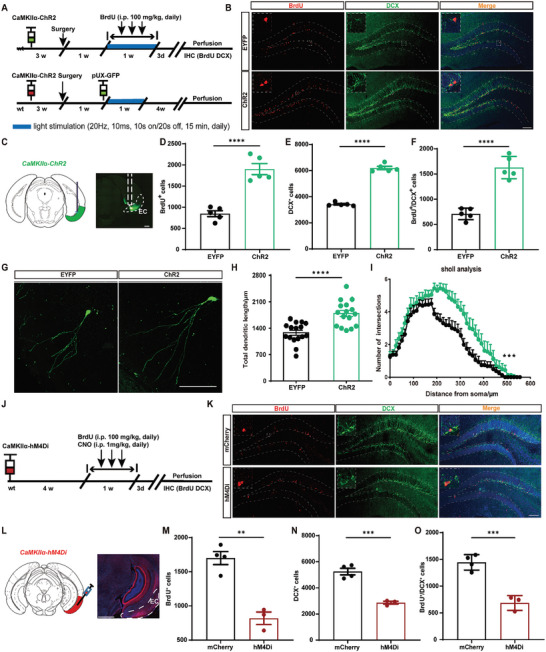
Source: Li Z et al. · Advanced science (Weinheim, Baden-Wurttemberg, Germany) · CC BY
Original figure and English caption ↗
The upstream contribution is context dependent
Inhibiting EC excitatory cells during enrichment weakens both increased neurogenesis and later reduced susceptibility. The same inhibition in ordinary housing does not clearly alter susceptibility. The contribution differs with environmental experience.
The intervention targets an EC excitatory population with multiple downstream connections. Combined with projection-cell responses and newborn-cell interventions, it supports EC participation while leaving room for other local components and outputs.
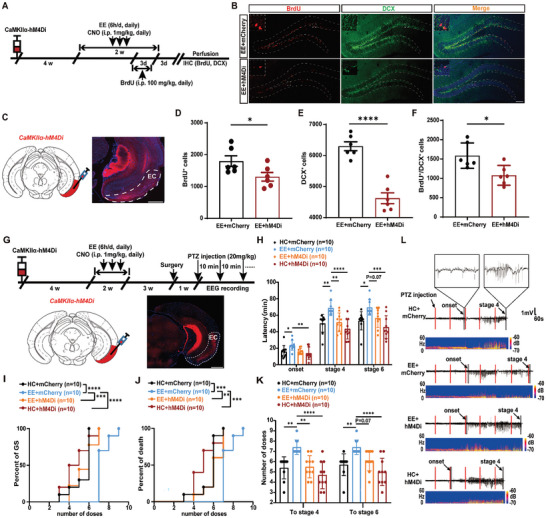
Source: Li Z et al. · Advanced science (Weinheim, Baden-Wurttemberg, Germany) · CC BY
Original figure and English caption ↗
Newborn cells recruit local inhibition
Activating newborn granule cells increases nearby GABAergic calcium activity and reduces mature-granule-cell activity markers. Directly activating local GABA cells likewise delays severe seizures. Together, these results support protective recruitment of inhibition.
These cells arise under ordinary or enriched conditions in adult male mice, with outcomes focused on susceptibility in the tested induced model. Experience can influence how hippocampal networks respond to strong challenge through upstream activity and newborn-cell development. Birth timing and context remain important to understanding their function.
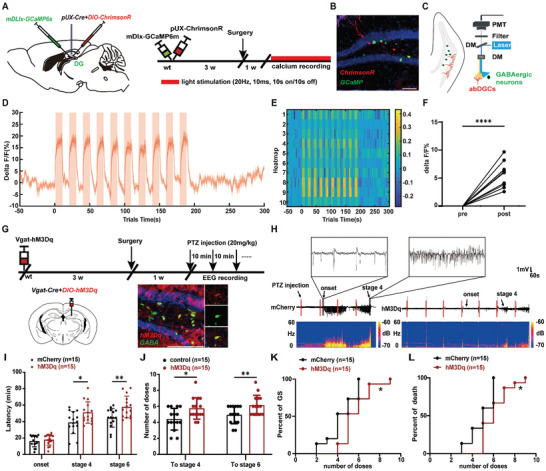
Source: Li Z et al. · Advanced science (Weinheim, Baden-Wurttemberg, Germany) · CC BY
Original figure and English caption ↗