Why keep working to avoid harm? Safety value in a thalamic–accumbal connection
A mouse study connects successful avoidance with cholinergic and dopamine signals and AMPA plasticity to investigate how safety outcomes influence motivation.

When an action successfully avoids danger, it may seem that nothing happened. Yet that outcome can be worth pursuing, motivating another effort. How does the brain connect action-derived safety with motivation? A 2026 Nature Communications study starts with the projection from the paraventricular thalamus, or PVT, to nucleus accumbens, or NAc. It follows signals after successful avoidance into cholinergic interneurons and learning-related synaptic changes. The value of safety thus becomes a question linking behavior, transmitters and local plasticity.
PVT→NAc activity around successful avoidance contributes to later motivation and influences dopamine through cholinergic interneurons. Learning-related AMPA potentiation offers a local plasticity mechanism for this connection.
Contents · 6 sections
Outcome reliability influences subsequent effort
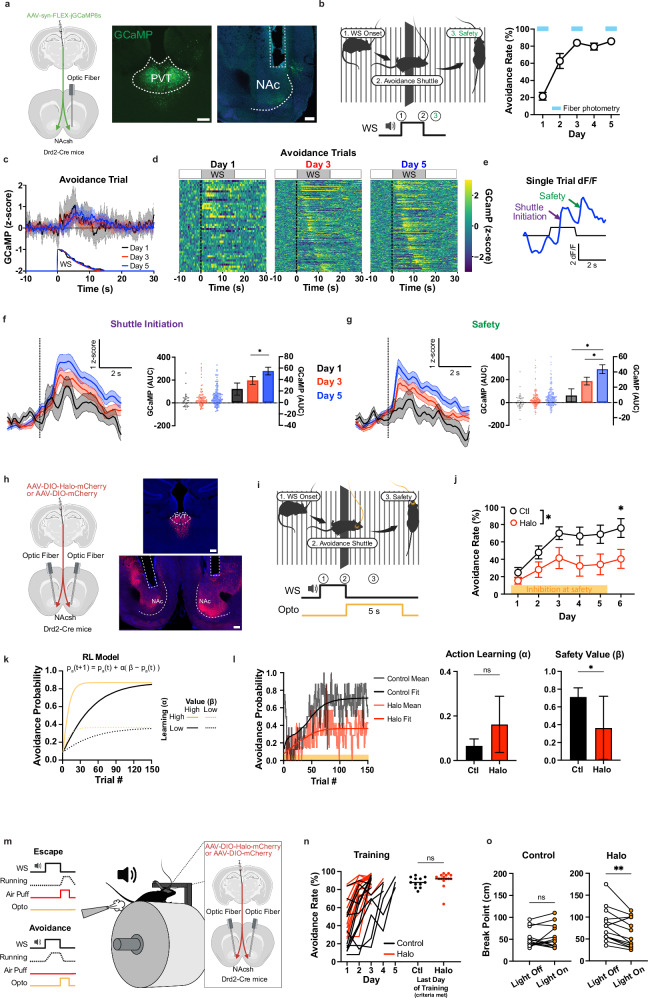
During active avoidance, crossing a hurdle during warning prevented the expected shock and ended the warning. With learning, PVT→NAc terminal calcium developed distinct peaks at movement initiation and successful avoidance. The study focused on the successful-outcome period and its influence on subsequent action.
Weakening the action–outcome contingency reduced avoidance and safety-associated activity; restoring it allowed recovery. In a running air-puff avoidance task, pathway inhibition lowered the effort breakpoint. Reliable success and continued effort thus showed an updateable relationship.
Source: Macdonald EE et al. · Nature communications · CC BY
Original figure and English caption ↗
Brief suppression affects later persistence
Suppressing PVT→NAc terminals only after successful avoidance impaired stable performance, with differences persisting in a later light-off test. Outcome-period modulation therefore affected subsequent behavior. Reinforcement-learning fits primarily related the deficit to lower estimated safety value rather than a matching action-learning-rate change, with related support from another model.
Excessive enhancement of the projection increased estimated value while lowering action-learning rate. The two directions of modulation had different details, showing that input strength and timing matter. Outcome-period interventions and effort tasks together offered specific clues to the projection’s contribution to motivation.
Safety-associated signals can change with preserved immediate behavior
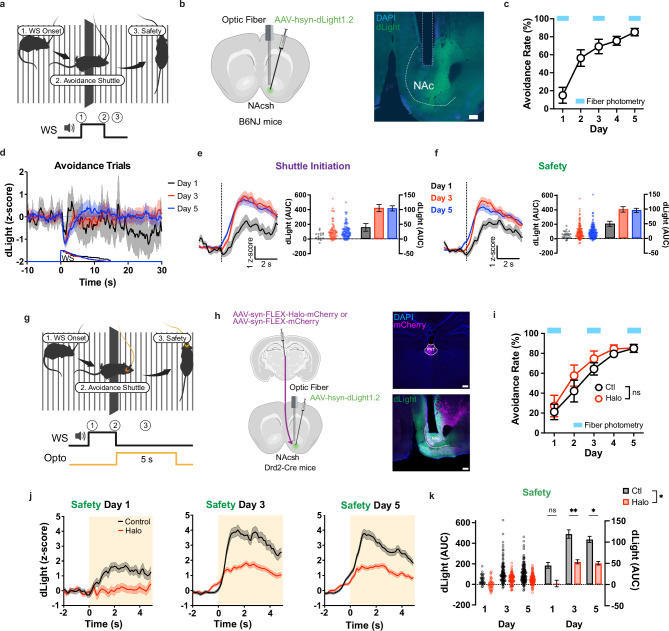
Dopamine responses appeared in the accumbens after successful avoidance. Further independent recordings captured an increase with training, although the initial recordings did not show a significant change across days. Briefly reducing PVT input on one side then attenuated safety-associated dopamine while immediate avoidance remained similar. The brain’s response to success could change even while the action was still completed successfully.
PVT provides excitatory input: how does it connect with dopamine-terminal release? This question brought the study from projections into local accumbal cells. Translation between thalamic input and dopamine became an important segment linking outcome signals with motivation.
Source: Macdonald EE et al. · Nature communications · CC BY
Original figure and English caption ↗
Cholinergic cells connect input with dopamine
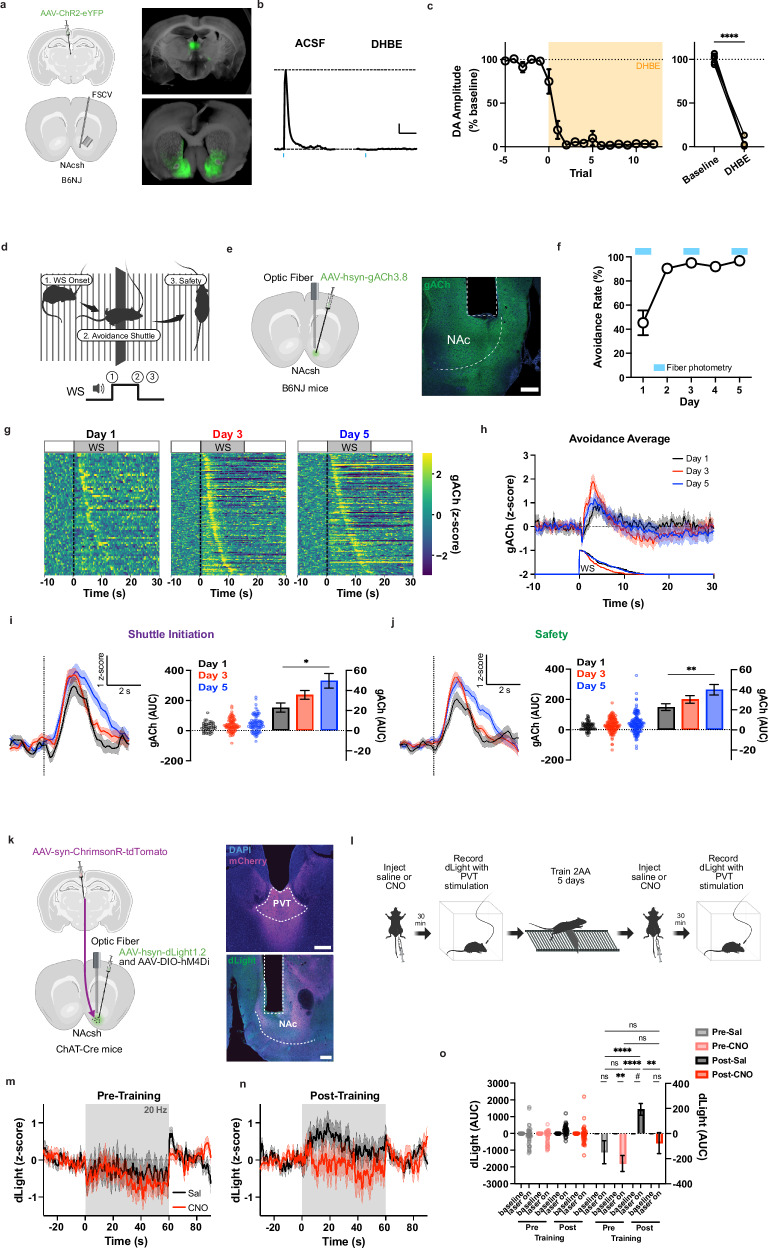
In slices, PVT-terminal stimulation evoked dopamine responses that were abolished by a nicotinic antagonist. In vivo acetylcholine, or ACh, signals increased with learning and preceded the dopamine peak during safety. Suppressing NAc cholinergic interneurons, or CINs, abolished PVT-evoked dopamine after training.
Pharmacological blockade, cell suppression and the timing of the two signals converged at this local step. Thalamic input influenced dopamine through cholinergic cells, forming a translation route from incoming projection to transmitter release. The next question was why this route changes after learning.
Source: Macdonald EE et al. · Nature communications · CC BY
Original figure and English caption ↗
Outcome control accompanies stronger AMPA input
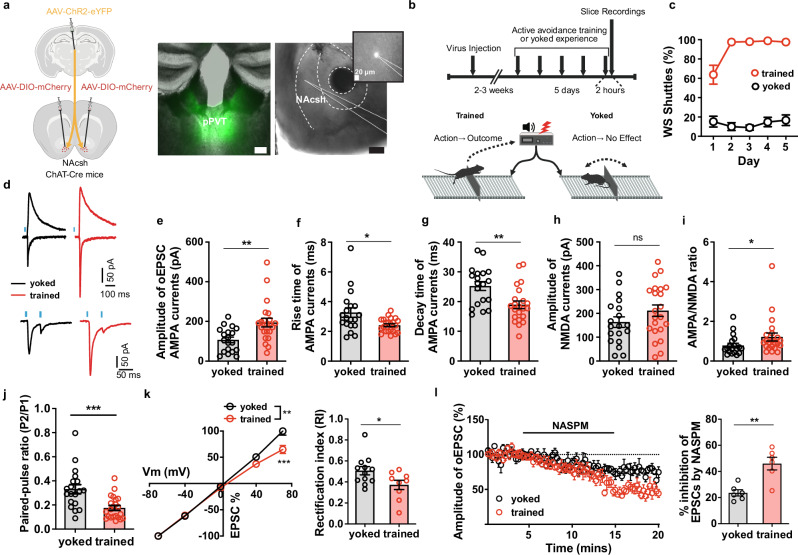
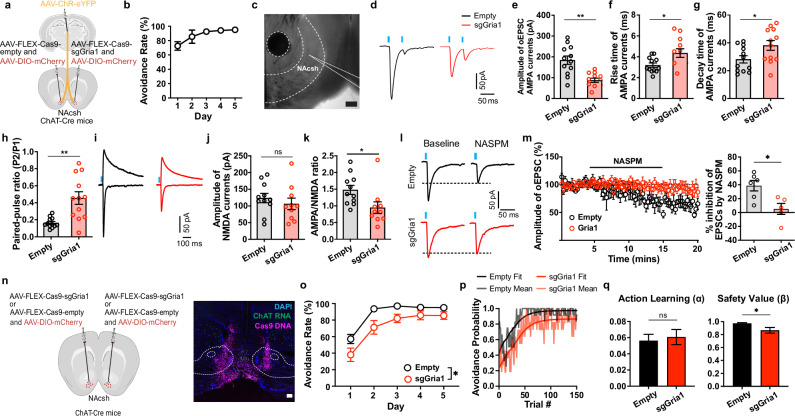
Trained and yoked animals experienced similar warnings and shocks, but only trained mice controlled outcomes through action. Training increased PVT→CIN AMPA currents and AMPA/NMDA ratios while NMDA amplitude remained similar. Rectification and NASPM sensitivity supported GluA2-lacking calcium-permeable AMPA receptors, and paired-pulse changes suggested a presynaptic contribution too.
Deleting Gria1 in cholinergic cells prevented training-related synaptic potentiation and impaired avoidance, without equivalent baseline differences in untrained animals. Behavioral models also offered clues to altered safety value, although their descriptions differed in detail. Together, these observations linked learning-related strengthening with sustained avoidance, providing a cellular answer to why success can motivate further effort.
Source: Macdonald EE et al. · Nature communications · CC BY
Original figure and English caption ↗
Connecting successful outcomes with the next effort
From outcome-period projection activity through cholinergic translation in CINs to learning-dependent AMPA potentiation, the study connects a continuous framework. How avoidance becomes an outcome worth repeating can be followed from behavioral choices into local cellular communication. Safety matters both as the absence of threat and as support for continued action.
The study included adult male and female mice and centered on active avoidance. Roles across goals, states and sexes, and the lasting influence of synaptic changes on natural choices, will extend the picture. The findings give the relationship between successful outcomes and motivation defined cellular and synaptic locations.
Source: Macdonald EE et al. · Nature communications · CC BY
Original figure and English caption ↗