An old friend in a scent: how mice recognize familiar companions
A companion’s scent carries individual information. Researchers identify response combinations in medial amygdala and follow their role in social discrimination.
Scent is an important way for mice to recognize companions. It can signal not only that another animal is nearby, but also who it is and whether it has been encountered before. How does the brain receive this mixture and connect it with experience? A 2026 Science Advances study follows the trail into posteroventral medial amygdala (MeApv), connecting odor input, single-cell responses and ensembles associated with a particular companion.
MeApv VGluT2 cells and accessory-olfactory input contribute to social-odor discrimination. Silencing a companion-associated ensemble impairs related discrimination, while selective activation brings familiar–unfamiliar discrimination back in defined tests.
Contents · 6 sections
Which cells respond to a companion’s scent?
After male-soiled bedding exposure, male subjects showed increased MeApv activity labeling, mainly in VGluT2-positive excitatory cells, without the same clear change in the adjacent posterodorsal region. Calcium recording also revealed responses to social scents, live companions and female stimuli, identifying cells for further investigation.
Clean bedding produced weaker responses, with a nonsignificant area comparison but a difference in peak signals. These readouts captured distinct aspects of the response. The more prominent social-stimulus activity motivated tests of which odor-guided behaviors the cells support.
Approaching companions but struggling with familiar and new
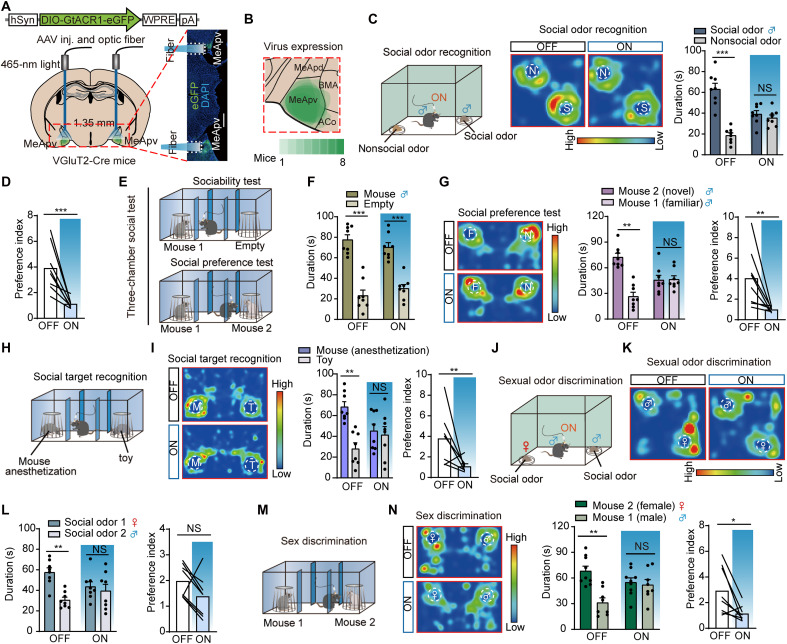
Silencing MeApv VGluT2 cells weakened social-versus-neutral odor preference and familiar–novel discrimination, while companion-versus-empty approach remained. Nonsocial odor habituation, buried-food finding, predator-odor freezing and novel-object preference showed no comparable deficits.
Discrimination and approach thus diverged. Selected responses to male and female stimuli changed, although not every preference-index comparison was significant. Broad VGluT2 activation did not clearly alter same- or opposite-sex discrimination, drawing attention to ensemble selection and activity organization.
Source: Zheng L et al. · Science Advances · CC BY
Original figure and English caption ↗
Where does the odor input arrive, and how does the network respond?
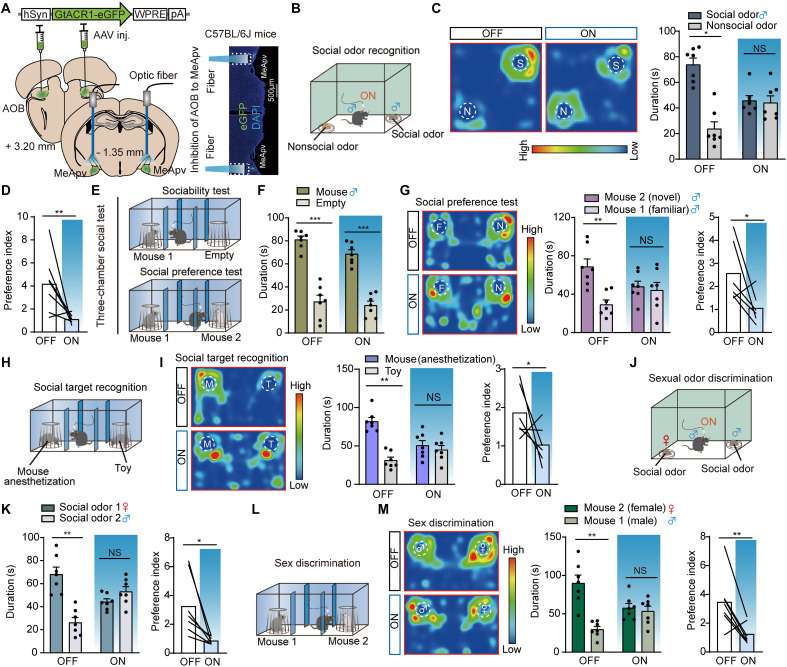
The accessory olfactory bulb (AOB) supplies social-information input to MeApv. Silencing its terminals impaired selected social-odor, familiar–novel and sex discrimination while relatively preserving approach. The input and downstream-cell results converged on an incoming sensory route.
Local populations also differed. VGluT1 inhibition did not produce the same clear effect, while activating Gad2 inhibitory cells caused discrimination changes resembling VGluT2 silencing; Gad2 inhibition did not. These perturbations offer clues to how excitatory and inhibitory members work within the network.
Source: Zheng L et al. · Science Advances · CC BY
Original figure and English caption ↗
Different companions recruit different response combinations
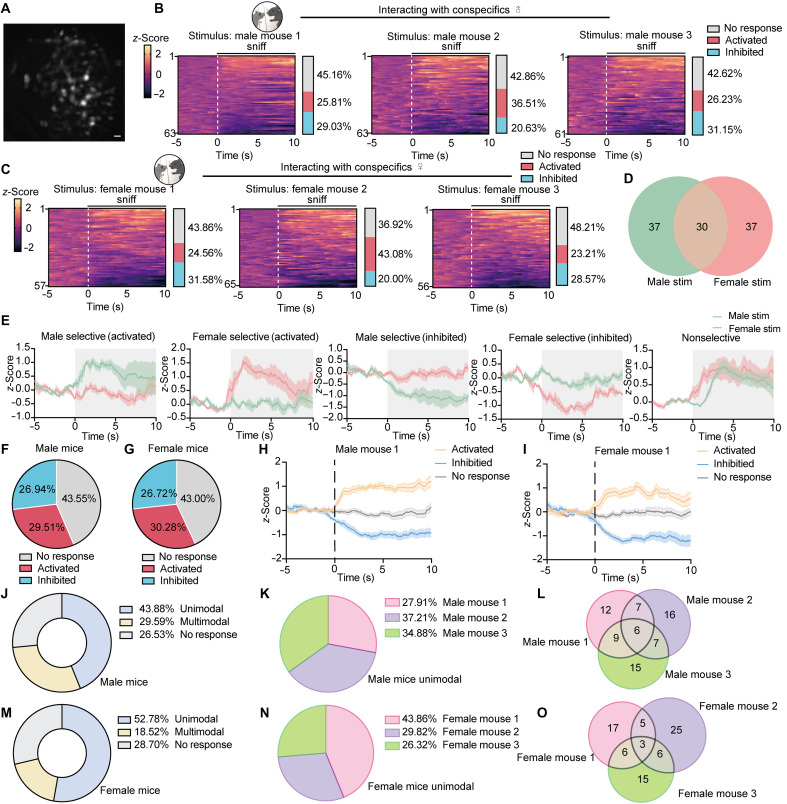
Single-cell recording revealed differences within the population. Presenting three male or three female stimulus mice produced activated, inhibited and nonresponsive cells. Some responded to one individual and others to several, with limited overlap between response combinations indicating a population-level representation of social information.
Retesting after 24 hours added a temporal dimension. Some cells retained responses, while many gained, lost or reversed them; stable activation represented a smaller fraction. Companion-related information therefore combined persistence with changing cellular response patterns.
Source: Zheng L et al. · Science Advances · CC BY
Original figure and English caption ↗
Tagging an encounter-associated ensemble to test discrimination
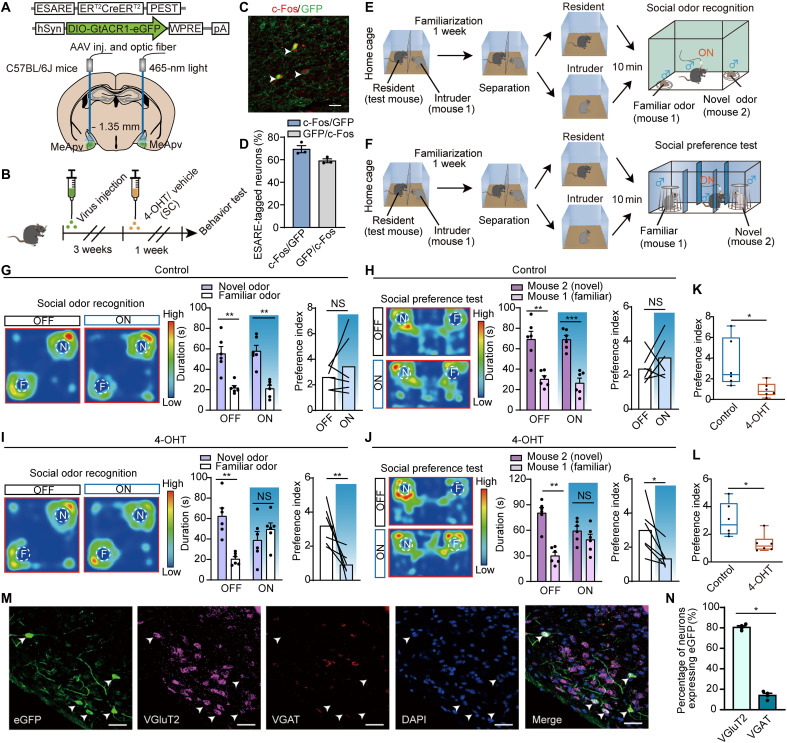
The team tagged cells active during barrier-separated cohousing with companion one. The ensemble was predominantly VGluT2-positive. Silencing it later impaired discrimination related to that companion’s scent and identity, connecting an earlier encounter with a recruited population and later behavior.
Discrimination of other companions did not change in the same way, and activity labeling associated with another companion overlapped only modestly with the companion-one ensemble. These controls highlighted the relevance of which cells an encounter recruits, beyond overall regional activity.
Source: Zheng L et al. · Science Advances · CC BY
Original figure and English caption ↗
Selective reactivation brings familiar–novel discrimination back
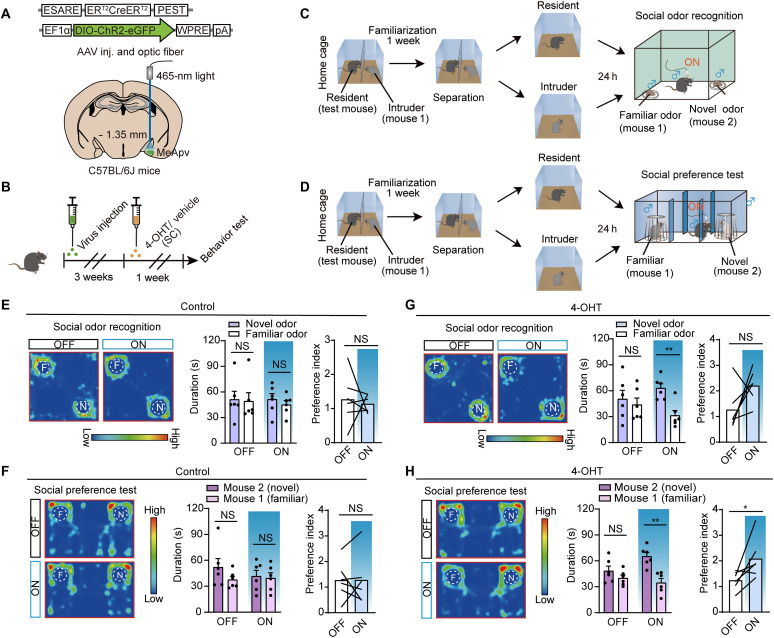
After 24-hour separation, controls no longer clearly preferred the new companion. Activating the previously tagged companion-one ensemble restored discrimination in defined tests, with a significant live-companion preference-index comparison. In the odor task, familiar–novel exploration differed within the activated condition, while the on–off index comparison remained a nonsignificant trend.
Selective activation alongside a broad-activation null is a distinctive finding of the study. The evidence comes from odor-guided tasks in male mice. Molecular subtypes, changing ensembles and downstream readout remain open, offering specific cellular questions about how scent connects a companion with experience.
Source: Zheng L et al. · Science Advances · CC BY
Original figure and English caption ↗