Why keep pressing when the reward has lost value? Stress and premature habits
Female and male mice still learn to earn reward, but chronic stress makes them less responsive to changes in consequences; opposing effects on two amygdala–striatal pathways alter subsequent learning.
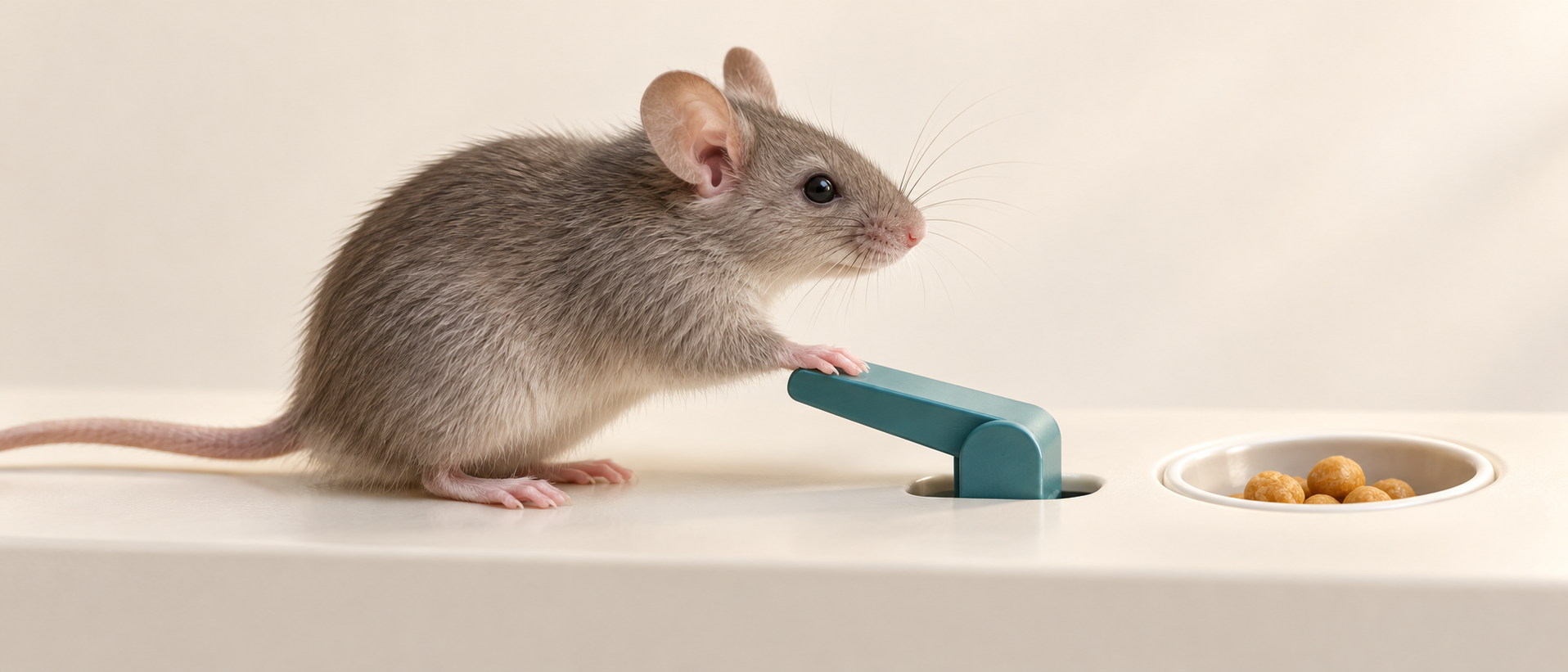
Pressing a lever earns food, but is pressing still worthwhile after eating enough of that food? Flexible action links behavior to its consequences, while habits efficiently execute familiar routines. A study published on February 19, 2025 in Nature finds that chronic stress does not prevent female and male mice from learning to press, but reduces adjustment when reward value or causal contingency changes. Two amygdala–dorsomedial-striatal pathways are affected oppositely: one supporting action–outcome learning is suppressed, while another involved in habit formation becomes progressively engaged during training.
Stress changes how subsequent learning uses reward: enhancing BLA input or suppressing CeA input allows stressed mice to adjust their actions again according to outcome value.
Contents · 7 sections
Learning to press differs from adjusting to the outcome
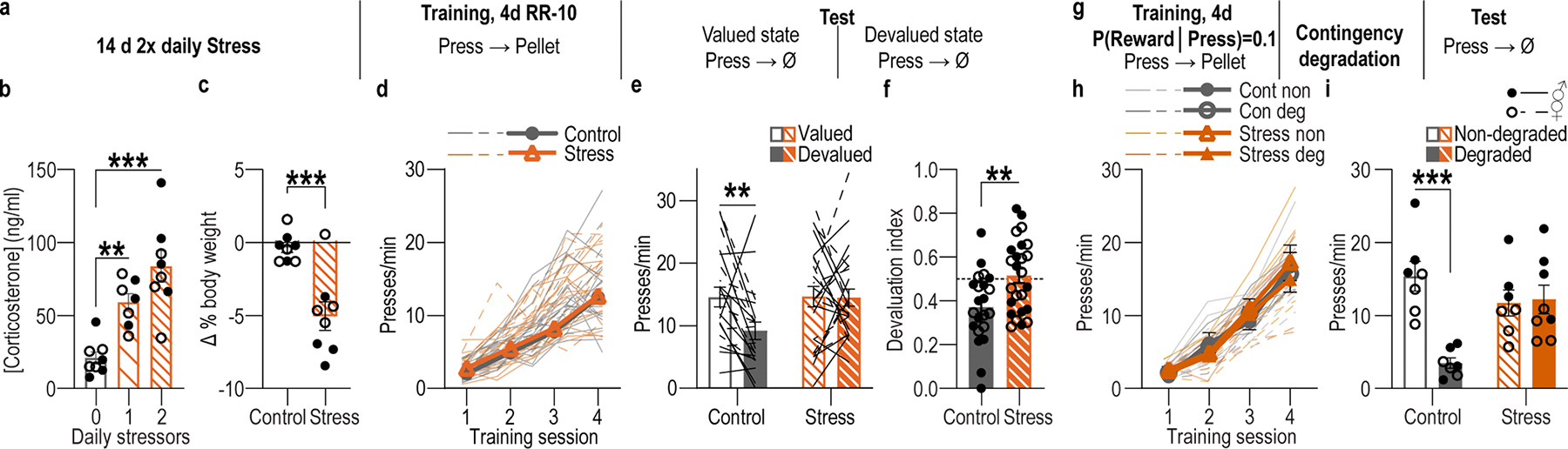
Stressed and control mice both learn to press for food, with similar acquisition. When eating that food to satiety temporarily reduces its value, controls press less while stressed mice continue pressing more. The difference appears when outcome value changes.
Similar consumption, food discrimination and devaluation efficacy focus the question on use of experience. Mice can learn that pressing earns food, yet adjustment to whether that food is currently worthwhile depends on the learning strategy controlling action.
Source: Giovanniello JR et al. · Nature · TDM
Original figure and English caption ↗
The habit persists when food no longer requires pressing
A second test changes the action–outcome relationship: food also arrives without pressing, removing the action’s former causal advantage. Controls subsequently reduce pressing while stressed mice adjust less. Value and contingency tests produce converging outcomes.
Habits normally make well-practiced behavior efficient; here, habitual control emerges prematurely. The chronic-stress procedure also lacks major anxiety- or depression-like phenotypes in classic assays, showing that altered behavioral control can occur without those conspicuous changes.
The same earned reward engages pathways differently
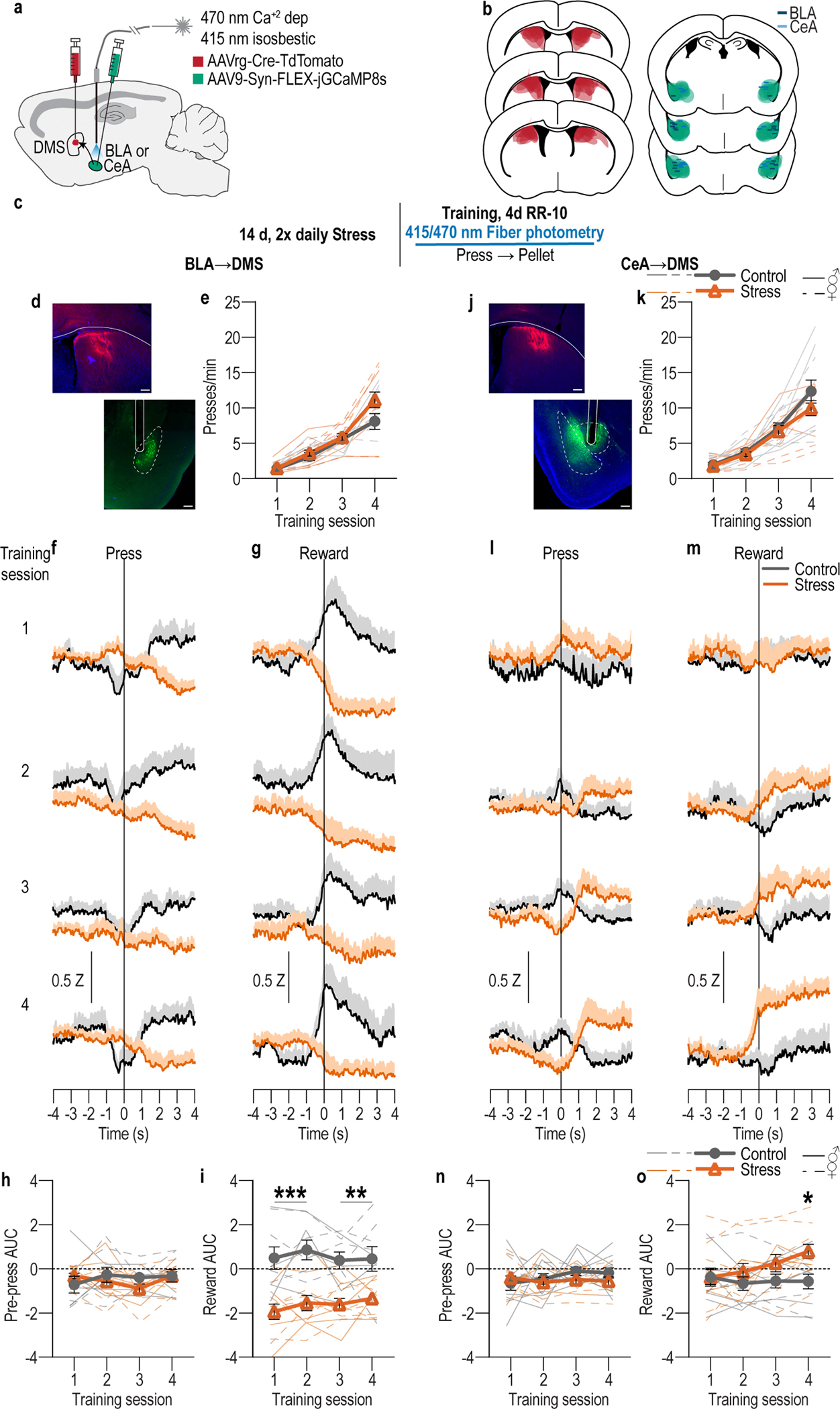
Both BLA and CeA project to DMS. During ordinary learning, earned reward activates DMS-projecting BLA cells, providing an opportunity to link an action to its consequence. After stress, this reward-associated response is markedly weakened.
The corresponding CeA output is not strongly active during ordinary action–outcome learning, but progressively responds to reward after stress. Baseline spontaneous calcium stays broadly unchanged in both pathways; differences emerge during learning events, revealing altered use of later experience.
Source: Giovanniello JR et al. · Nature · TDM
Original figure and English caption ↗
Restoring BLA activity during learning
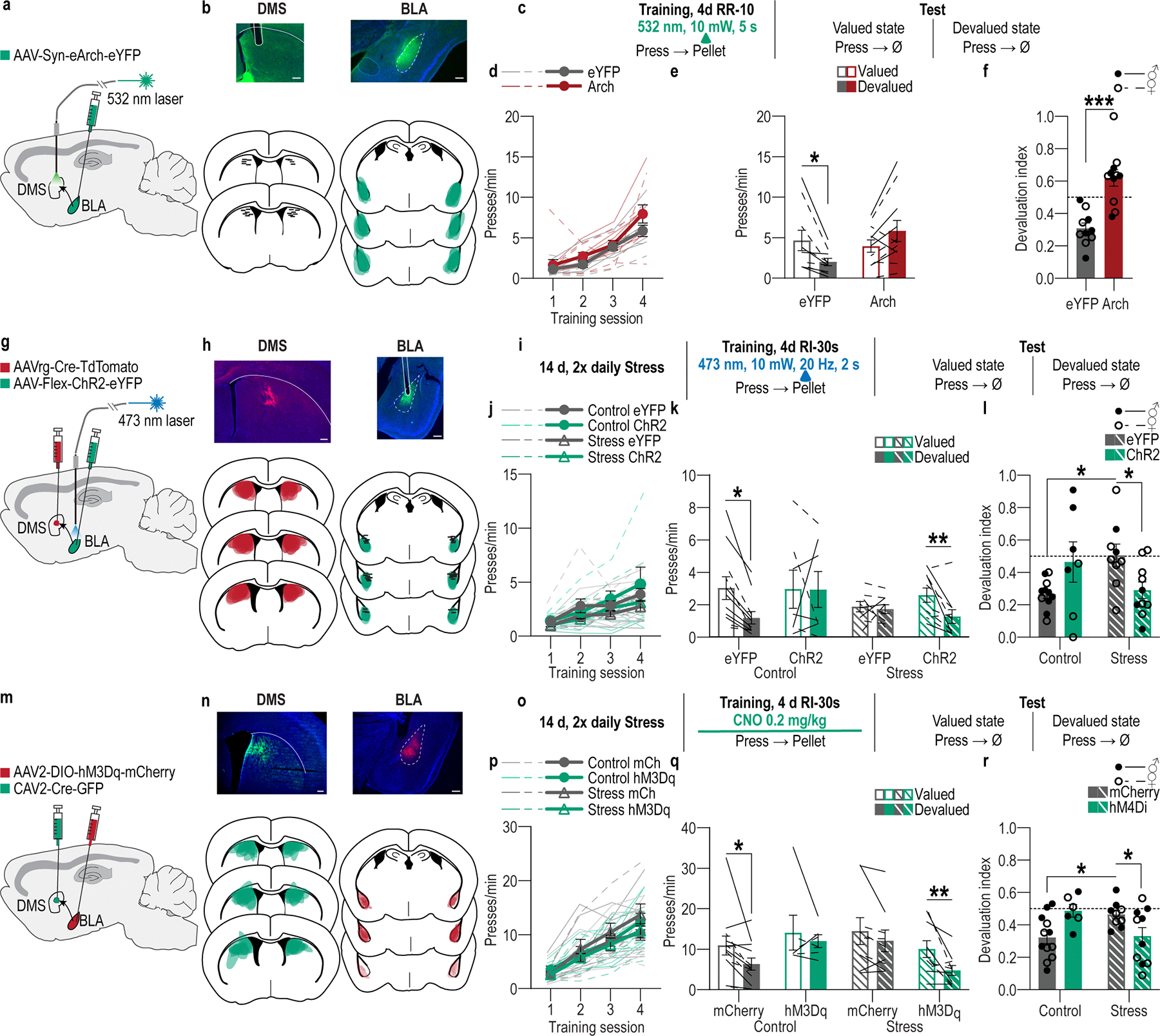
Suppressing BLA terminals at earned reward leaves acquisition intact but reduces later adjustment to devaluation. Conversely, enhancing this output during post-stress training allows mice to reduce pressing again when reward is devalued.
Manipulations occur during training and are absent during later choice tests. The effect therefore concerns knowledge formed during learning rather than simply suppressing movement at test. Two activation approaches produce converging improvement in stressed mice, supporting this output’s learning contribution.
Source: Giovanniello JR et al. · Nature · TDM
Original figure and English caption ↗
CeA output contributes to habits after repeated experience
After extended practice, controls form habits and no longer clearly reduce actions after devaluation. Inhibiting CeA terminals at reward prevents this overtraining-associated habit formation, preserving value-based adjustment.
After stress, comparable inflexibility appears with less training. Suppressing CeA output restores devaluation sensitivity without clearly altering acquisition. The pathway contributes both to naturally practiced habits and to stress-induced acceleration of habit formation.
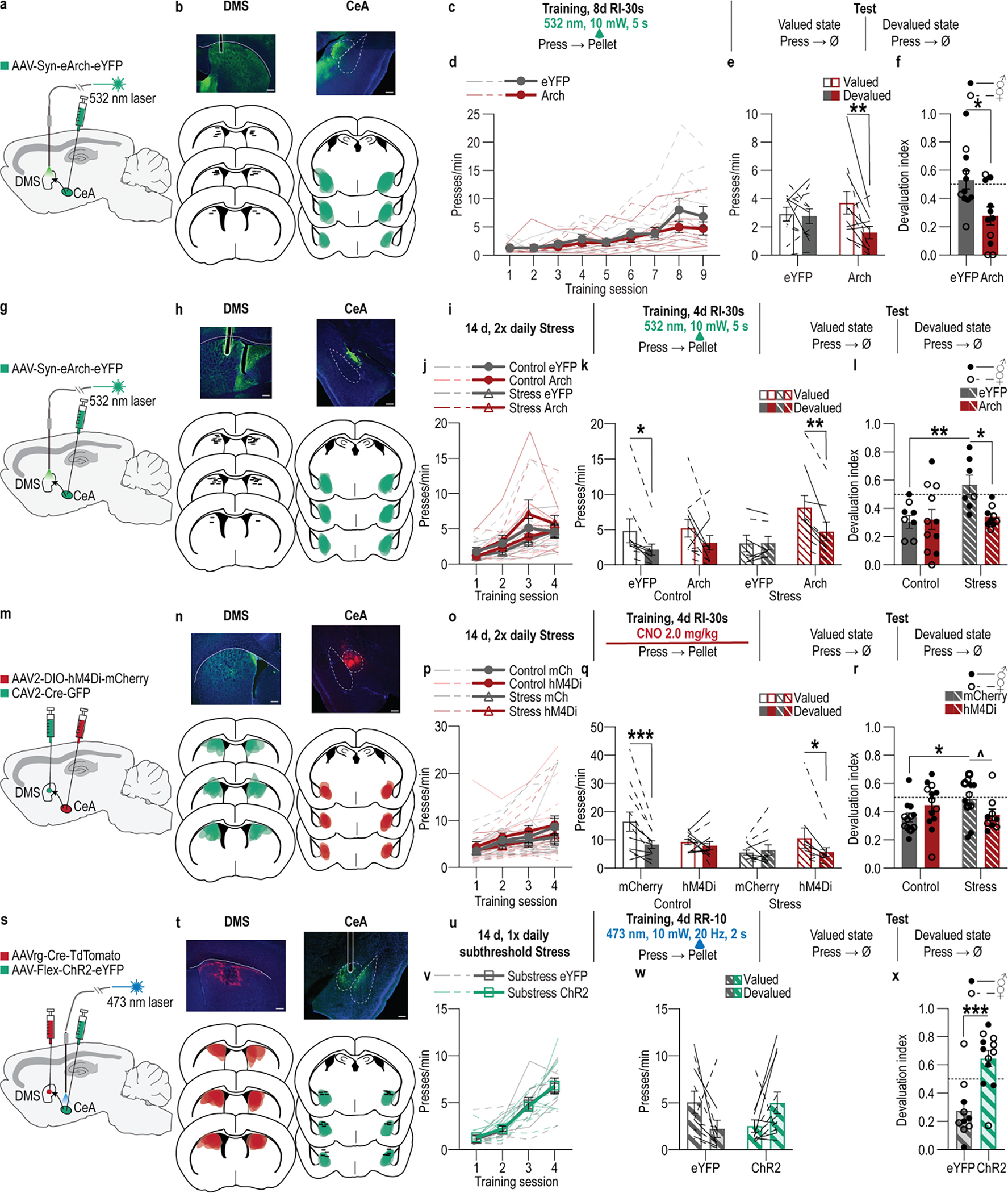
Source: Giovanniello JR et al. · Nature · TDM
Original figure and English caption ↗
CeA activation alone is insufficient for the same outcome
Enhancing CeA output during reward learning without stress does not clearly disrupt action–outcome learning or promote premature habit. Milder chronic stress alone is also insufficient; combining the two produces greater devaluation insensitivity.
The combination shows that pathway effects depend on prior experience. The background left by stress interacts with activity during later reward to alter behavioral control. Both amygdala inputs also respond to aversive events, so their roles extend beyond a simple positive-versus-negative division.
Stress changes what is learned, beyond action counts
This study in female and male mice reveals two forms of control over a familiar action: flexible adjustment to consequences or continuation along a previously successful routine. Similar training action counts can conceal altered use of reward knowledge, exposed by value and contingency tests.
How stress prepares the two pathways, and which DMS cells receive and integrate them, remain specific questions. The results show that restoring consideration of consequences can occur during learning: supporting BLA-related learning or limiting CeA contributions to premature habit changes later choice.