Why does a looming shadow trigger slower escape? Early experience changes collicular oxytocin signaling
Social deprivation during a particular early-life window alters adult visual defense. Peptide totals remain broadly unchanged, while collicular oxytocin reception changes.

An expanding dark disk sends a mouse running toward shelter. This untrained defensive response connects a visual alarm with escape. How does early separation from the mother and littermates change that later sprint? A 2026 Communications Biology study finds that timing matters. Deprivation during postnatal days 10–20 leads to slower adult escape and shorter refuge occupancy. Following this change, researchers identify oxytocin receptors in the superior colliculus as a signaling-reception component.
Later preweaning deprivation reduces Oxtr expression and threat-related recruitment in intermediate/deep superior colliculus. Local receptor reduction reproduces defensive changes, while enhancing oxytocin input improves selected action measures.
Contents · 6 sections
The same experience has different outcomes at different ages
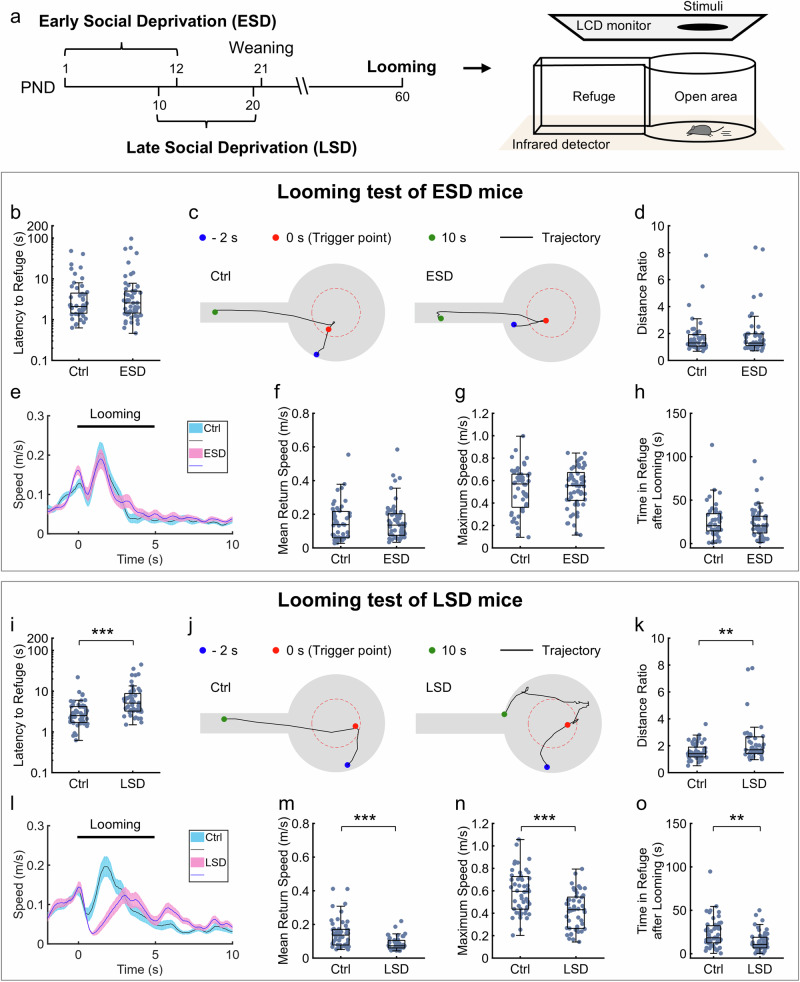
Pups underwent daily three-hour separation during either postnatal days 1–12 or 10–20. As adults, the later-window group returned more slowly, followed longer routes, reached lower speeds and spent less time in shelter after the expanding disk. The earlier-window group performed similarly to controls in this task.
Both periods fall before weaning but involve different developmental contexts. Effects do not simply follow an earlier-means-greater rule: the later window was more sensitive in this visual-defense task. That timeline raised the next question—where did the response to an incoming visual alarm change?
Source: Tan H et al. · Communications biology · CC BY-NC-ND
Original figure and English caption ↗
The difference appears when the threat arrives
Before the threat, habituation speed and refuge occupancy were comparable. Body weight across ages and open-field and elevated-plus-maze behavior also showed no clear group differences. Slower adult return thus did not accompany generalized inactivity or delayed weight growth; the change centered on visually evoked action.
A defense sequence includes starting to run, choosing a route and remaining hidden after arrival. Measuring these components gave weaker defense a concrete form. Both sexes were approximately equally represented, and sex-separated comparisons showed no clear differences in the main later-deprivation effects within this sample.
Peptide totals remain, but reception changes
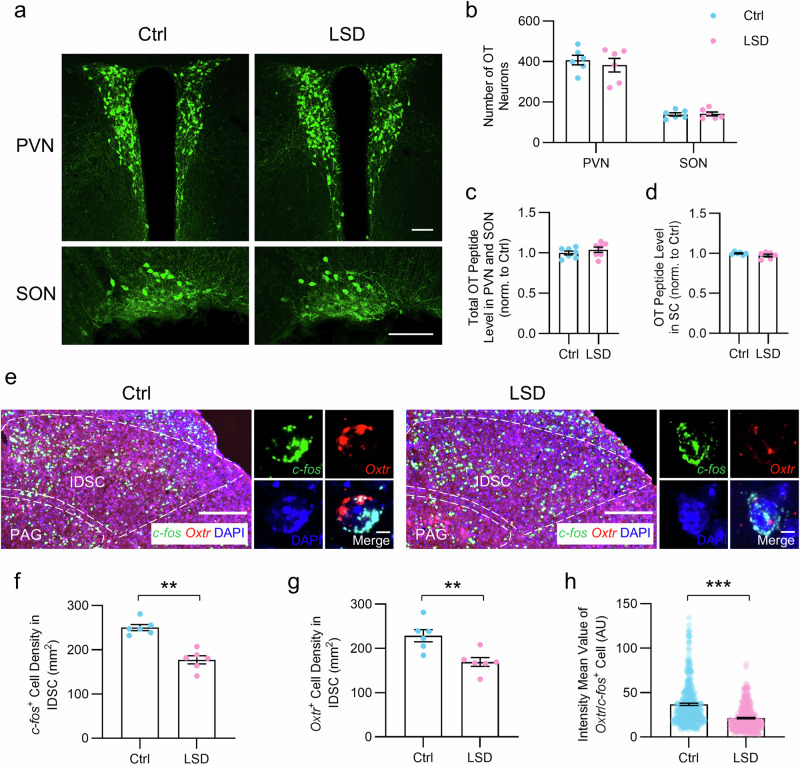
The superior colliculus links visual information with orienting and defense. More than half of the recruited intermediate/deep-layer cells expressed Oxtr. Later deprivation reduced Oxtr-positive density and signal alongside c-fos-positive recruitment, changing the cell populations responding to the visual alarm.
Interestingly, oxytocin-cell numbers and tissue peptide totals in PVN and SON, and collicular peptide totals, remained broadly unchanged. Signal stores were still present while local reception changed. Tissue totals describe peptide reserves; the clearest finding concerns collicular receptor expression and recruitment rather than brain-wide oxytocin depletion.
Source: Tan H et al. · Communications biology · CC BY-NC-ND
Original figure and English caption ↗
Reducing collicular receptors also slows return
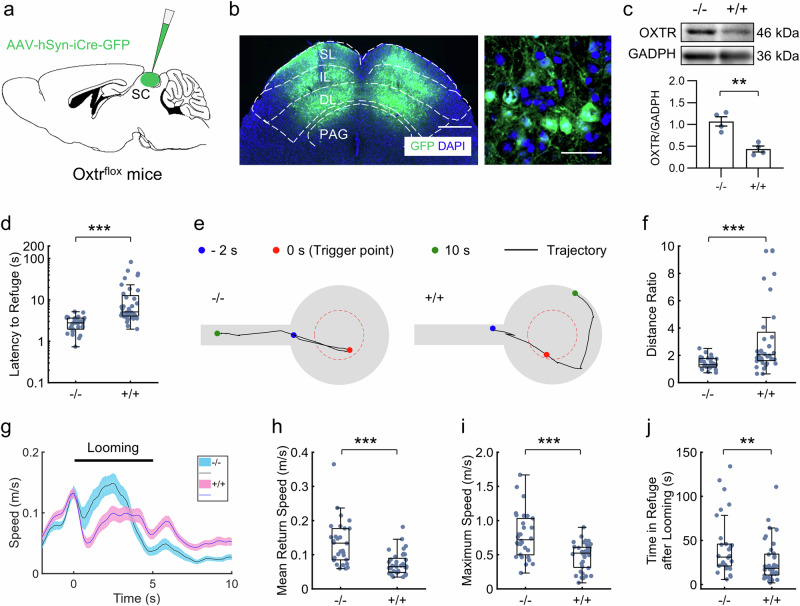
Reducing Oxtr in the superior colliculus produced delayed return, longer routes and lower speeds, echoing later deprivation. This functional link connected receptor expression with action: collicular oxytocin reception contributes to translating a visual alarm into escape.
The result places oxytocin in a specific context. Often discussed in relation to social approach, it here contributes to defensive organization. The same signal can enter different behavioral processes through different regional receptors. Local manipulation identifies this visual-defense contribution, while early experience may affect other pathways too.
Source: Tan H et al. · Communications biology · CC BY-NC-ND
Original figure and English caption ↗
Enhancing input changes different parts of escape
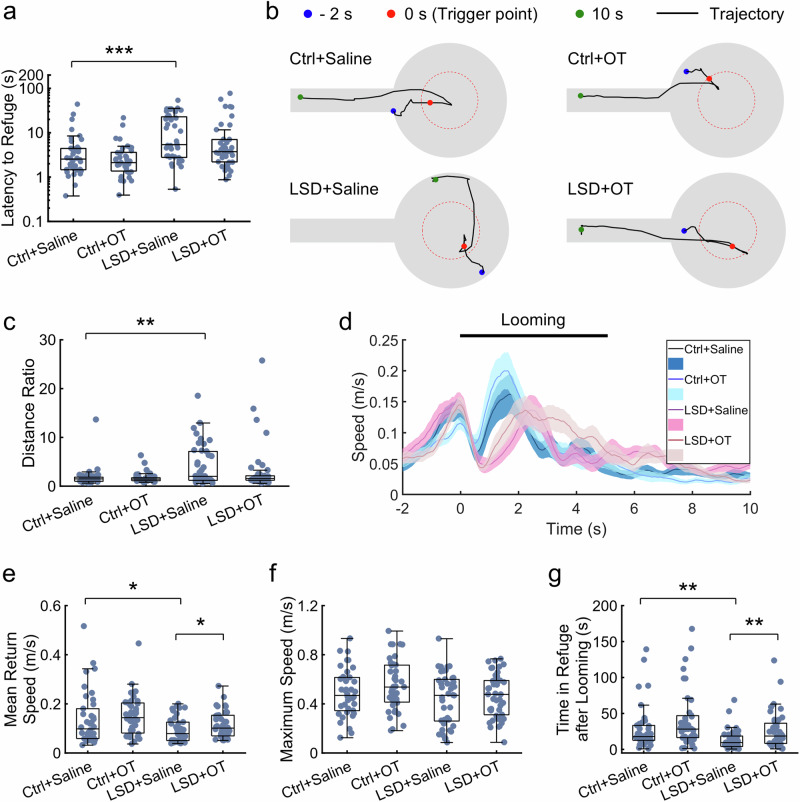
Enhancing PVN oxytocin-neuron terminals in intermediate/deep colliculus shortened return latency, increased maximum speed and extended refuge occupancy. Mean speed and path ratio did not change clearly in parallel. Initiation, the fastest sprint and post-arrival occupancy can respond to the same input without moving together.
Repeated intranasal oxytocin in later-deprived mice improved mean return speed and refuge time. Its selected behavioral effects differed from terminal enhancement. Together, the findings show that adult defense remains modifiable, while their distinct action components underscore the importance of signal location and context.
Source: Tan H et al. · Communications biology · CC BY-NC-ND
Original figure and English caption ↗
Early social experience leaves a trace in adult defense
The study connects early social experience with molecular reception and adult visual-defense organization. The change is expressed through escape initiation, route choice and refuge duration rather than a simple more-or-less-fear scale. Following these components reveals how developmental experience shapes responses to environmental danger.
The evidence concerns mice, two preweaning windows and a specific visual-threat task. Receptor changes, input enhancement and intranasal treatment reveal different facets of the system. Together, they suggest that early experience can change signal reception, leaving its developmental imprint on a rapid adult escape.