Which part of stress-related memory impairment involves piriform cortex?
A mouse study links piriform CaMKIIα-associated activity with memory-task performance after stress. Suppression improves selected memory outcomes without corresponding significant changes in emotion-related behavior.
Memory difficulties and reduced exploration can coexist after prolonged social stress, but do they involve the same population? A mouse study published in Translational Psychiatry on September 10, 2022 focuses on piriform cortex (PC), usually associated with olfaction. Stress-susceptible mice show greater activity in its CaMKIIα-associated cells. Suppressing the population improves selected memory outcomes without significantly changing the tested emotion-related behavior, separating contributions to co-occurring changes.
Stress-susceptible mice show greater PC-associated activity. Suppression improves novel-arm and water-maze target preference without significant acquisition-latency or emotion-related effects. Activation also alters memory outcomes, alongside complex additional behavioral and abnormal-activity effects.
Contents · 6 sections
One experience leaves several behavioral changes
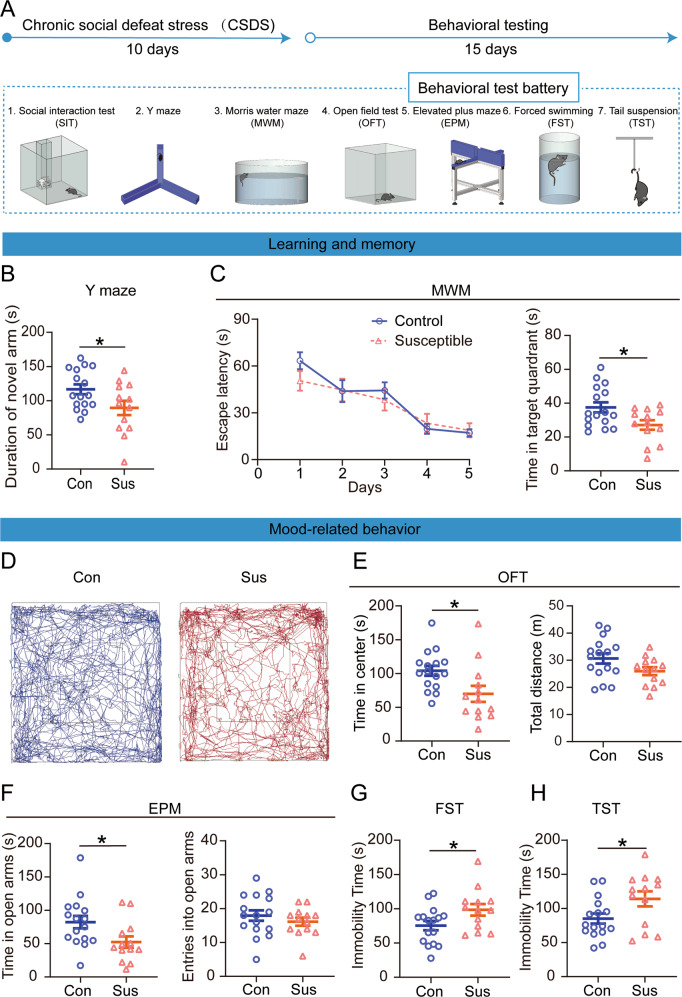
Social interaction separates susceptible and resilient mice, with subsequent main comparisons focusing on susceptible and control groups. Susceptible mice spend less time in the Y-maze novel arm and the water-maze target quadrant during the probe, without significant acquisition-latency differences.
Susceptible mice also spend less time in the open-field center and elevated open arms and remain immobile longer during swimming and tail suspension. Total open-field distance and open-arm entries do not differ significantly, so the measures do not shift uniformly.
The coexistence of memory-task, exploration and coping-related differences raises a specific question: can a population contribute more clearly to one part of this behavioral pattern?
Source: Wang H et al. · Translational psychiatry · CC BY
Original figure and English caption ↗
Greater activity appears in an olfactory-associated cortex
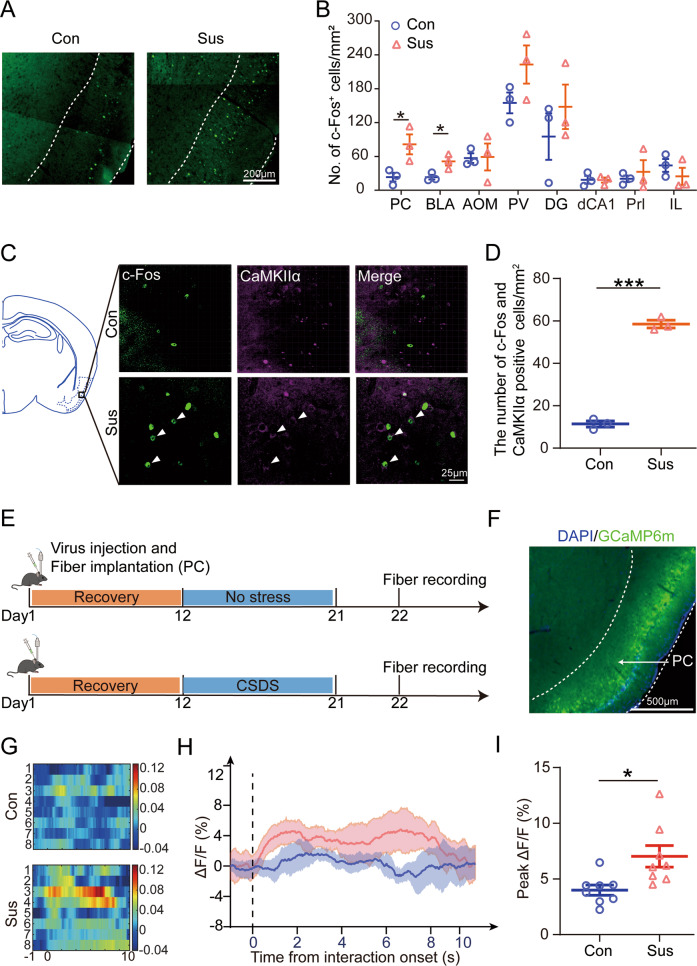
After social interaction, c-Fos labeling increases in PC and basolateral amygdala, without significant differences in several other sampled regions. PC is not the only changed region, but offers a less familiar focus for the memory question.
Within PC, more active cells overlap CaMKIIα-associated labeling. Population calcium responses around social-contact onset are also larger in susceptible mice. PC connections with olfaction, amygdala and memory networks make the functional meaning of this change worth examining.
Source: Wang H et al. · Translational psychiatry · CC BY
Original figure and English caption ↗
Increasing PC activity affects memory and other measures differently
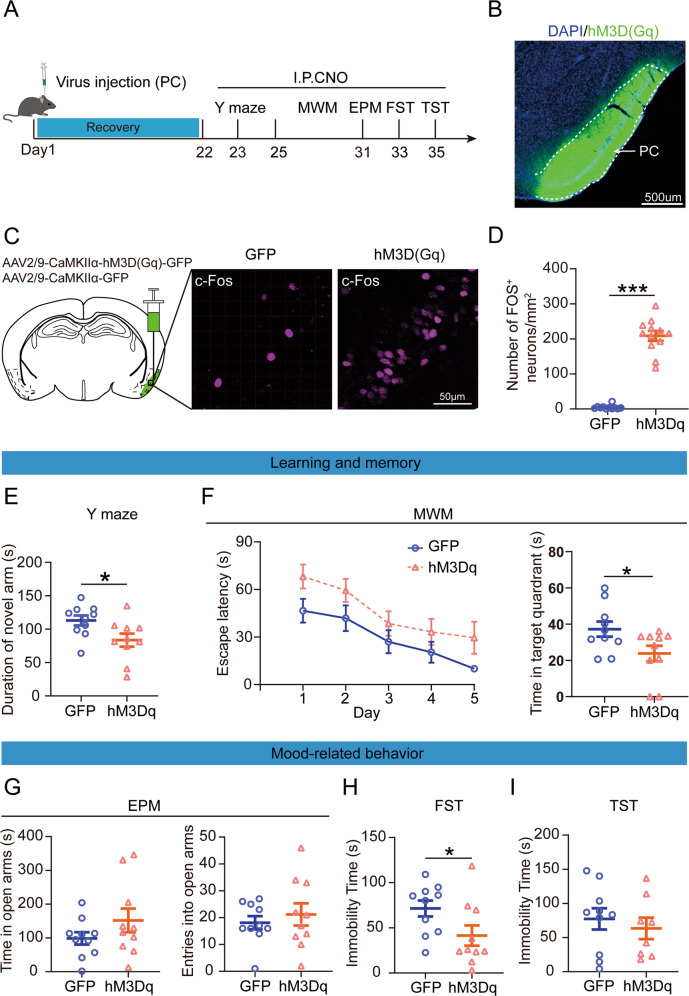
In mice without the same stress background, increasing PC CaMKIIα-associated activity reduces novel-arm and water-maze target-quadrant time, without a significant acquisition-latency difference. Higher activity can therefore accompany impaired memory-related performance.
The emotion-related pattern does not reproduce that of susceptible mice: elevated open-arm measures and tail-suspension immobility remain nonsignificant, while swimming immobility decreases. Weaker memory-task performance can coexist with an opposing change in a coping-related measure.
Source: Wang H et al. · Translational psychiatry · CC BY
Original figure and English caption ↗
Initial convulsions precede impaired performance after optical activation
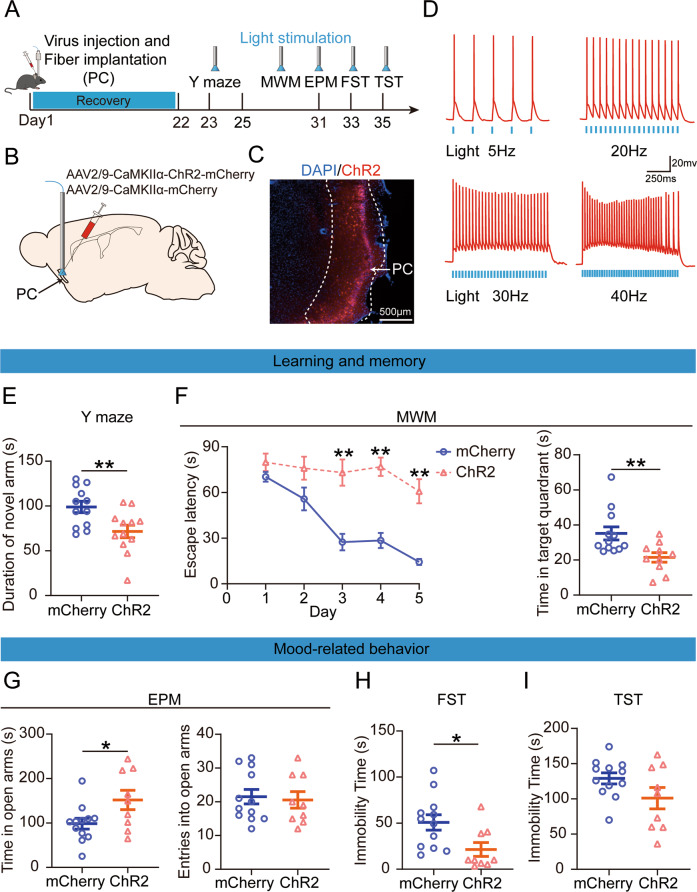
Optical activation likewise reduces novel-arm and target-quadrant time and increases water-maze acquisition latency. Open-arm time increases and swimming immobility decreases, while open-arm entries and tail-suspension comparisons remain nonsignificant.
This experiment initially produces transient convulsions, and behavior is assessed after the phenomenon subsides. Prior abnormal activity may therefore contribute to later task performance. The convergent activation findings also raise questions about the broader network state during PC hyperexcitation.
Source: Wang H et al. · Translational psychiatry · CC BY
Original figure and English caption ↗
Suppressing activity after stress improves memory outcomes
Suppressing the PC-associated population during behavioral assessment after stress increases susceptible mice’s novel-arm and target-quadrant time, without a significant acquisition-latency change. This further connects PC activity with post-stress memory-task performance.
Open-field center time, distance, elevated-maze behavior and swimming or tail-suspension immobility do not significantly improve relative to susceptible controls. Selected memory changes can therefore separate from the remaining emotion-related pattern, suggesting only partly shared regulation.
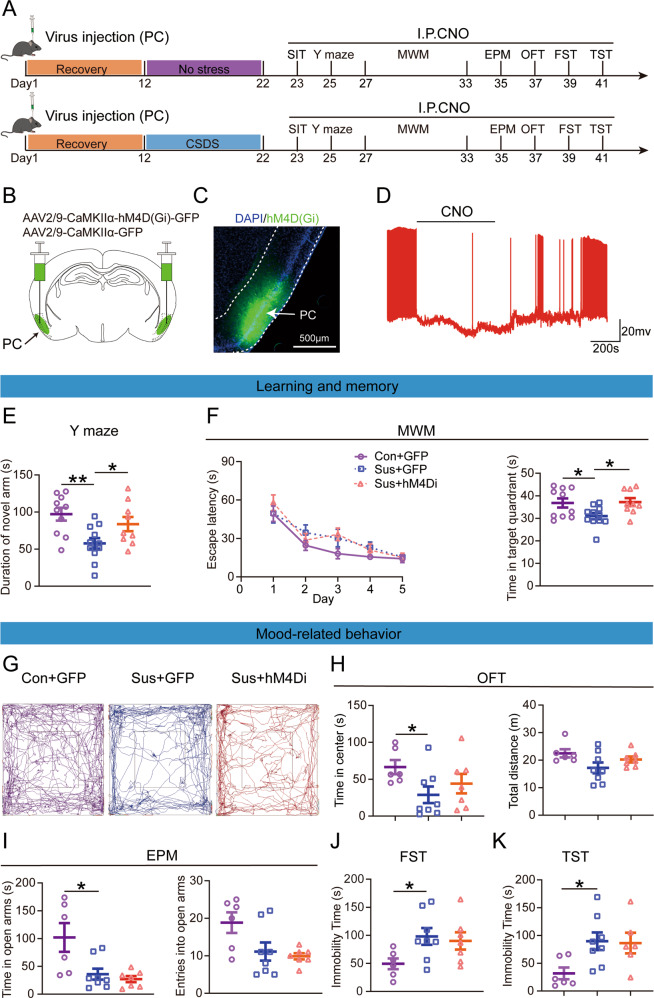
Source: Wang H et al. · Translational psychiatry · CC BY
Original figure and English caption ↗
How does piriform cortex engage the post-stress memory network?
PC receives olfactory information and connects with amygdala, entorhinal cortex and hippocampus. Sensory cues during prolonged social experience may help shape its activity, while specific connections and subpopulations remain to explain its influence on spatial tasks.
The study does not isolate a downstream projection or synaptic mechanism, or directly separate olfactory changes from broader hyperexcitable-state effects. It provides converging regional, marker-associated and functional evidence.
Post-stress memory and emotion-related changes can coexist yet separate under functional modulation. PC provides a concrete example: selected memory outcomes improve while exploration and coping measures retain their differences. How these outcomes interact across the broader network remains open.