When inhibition weakens, newborn hippocampal cells feel the consequences
Interneuron GSK-3β overexpression reduces dentate-gyrus GABA signals in male mice. Excitatory activity rises as neurogenesis declines; enhancing GABA receptor signaling improves cellular and behavioral outcomes.
A newborn neuron grows within a neighborhood. Adult mouse dentate gyrus retains neurogenesis: stem cells activate, precursors differentiate, and young neurons develop dendrites and connections. A more active niche need not produce more new neurons. An Aging Cell study follows altered GSK-3β activity in an Alzheimer’s disease mouse model into inhibitory interneurons. It connects reduced GABA signals, increased neighboring excitatory activity, precursor apoptosis and slower discrimination of similar contexts.
Interneuron GSK-3β overexpression weakens GABA signals and disrupts dentate-gyrus activity and neurogenesis. Excitatory-cell inhibition or GABA receptor activation improves cellular measures; receptor activation also improves similar-context discrimination.
Contents · 6 sections
A change in cells that provide inhibition
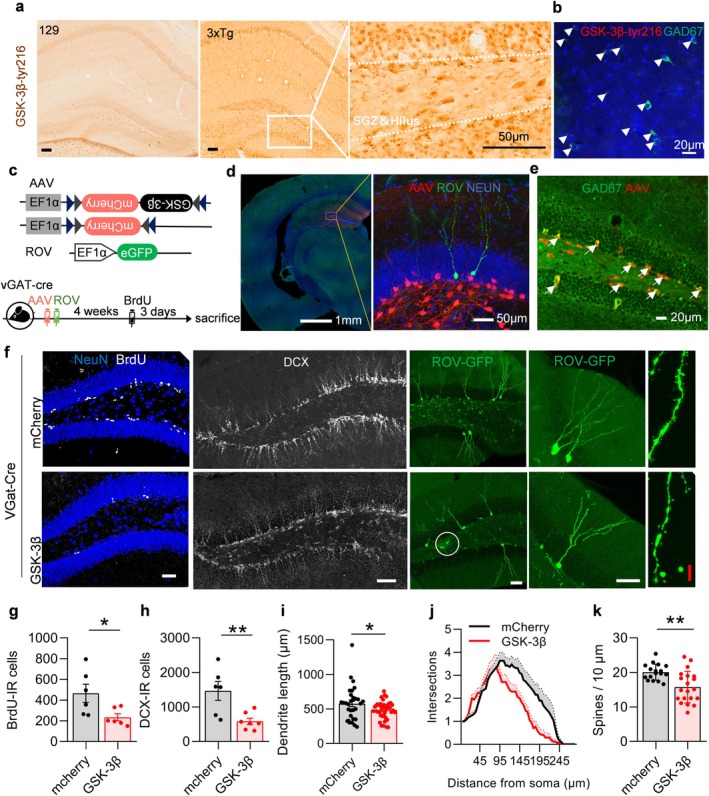
In two-month-old 3×Tg-AD mice, an activated GSK-3β marker increases in dentate gyrus and overlaps GAD67-labeled inhibitory interneurons, linking a synaptic-regulatory kinase with cells maintaining local circuit balance.
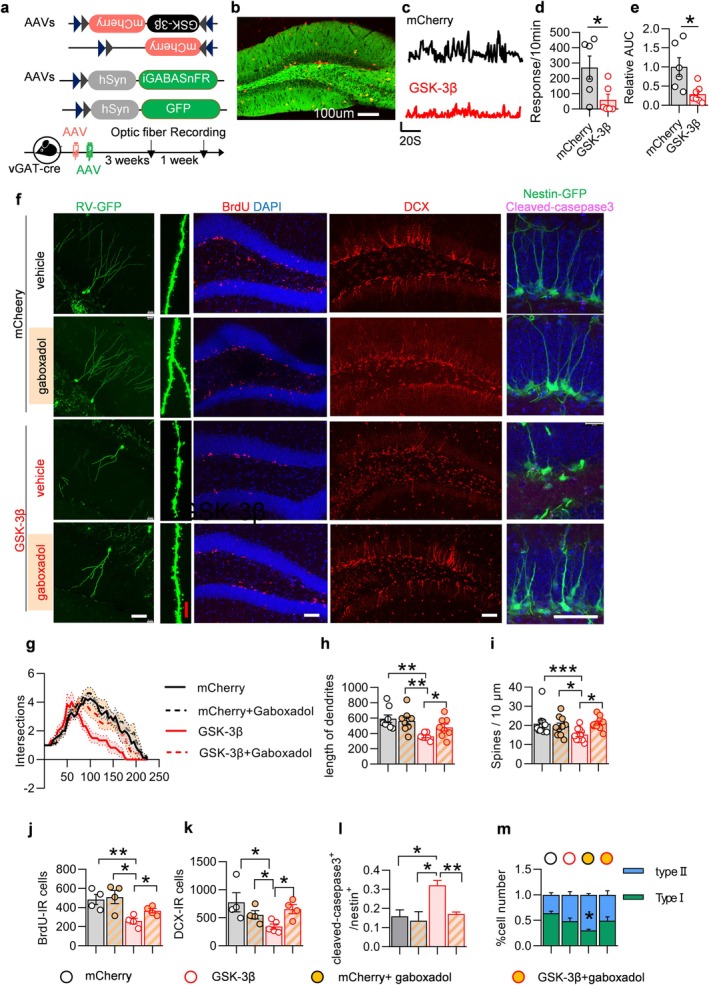
Interneuron-selective GSK-3β overexpression in another male-mouse cohort reduces proliferation-labeled cells and DCX-positive newborn neurons a month later. Tracked young neurons have shorter, less complex dendrites and lower spine density. An interneuron change affects developing cells.
Source: Liu F et al. · Aging cell · CC BY
Original figure and English caption ↗
More activation does not mean more new neurons
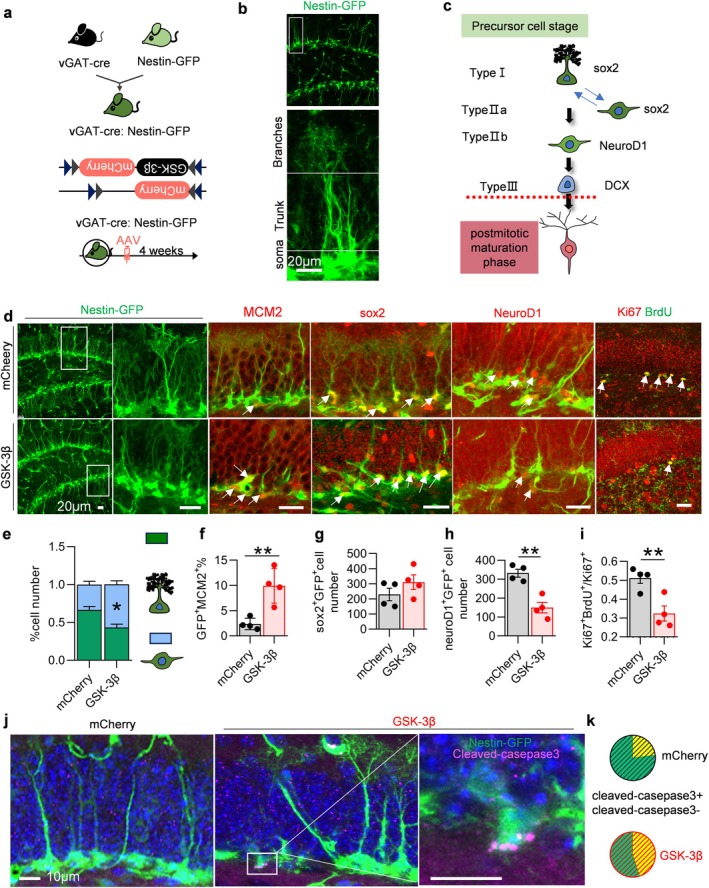
Stem-cell activation is one stage of neurogenesis. After GSK-3β overexpression, total Nestin-positive cell numbers do not significantly change, but radial-glia-like type I representation falls while type II intermediate precursors and MCM2 labeling increase.
Later differentiation does not keep pace. NeuroD1 labeling falls, fewer cells retain paired proliferation labels, and apoptosis labeling rises in type II cells. More cells reach an active stage yet fewer progress toward newborn neurons, bringing survival and maturation into focus.
Source: Liu F et al. · Aging cell · CC BY
Original figure and English caption ↗
More excitatory activity does not benefit young cells
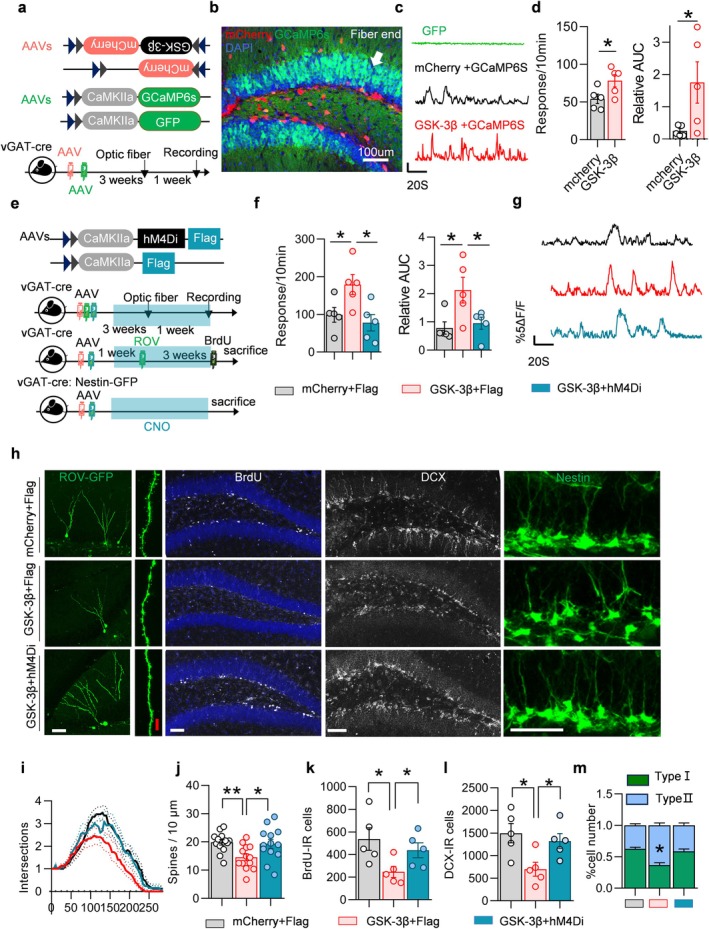
Interneurons use GABA to regulate neighboring cells. Following overexpression, dentate-gyrus excitatory-population calcium events and response area increase, placing circuit and developmental changes within the same niche.
Suppressing excitatory activity partly improves multiple neurogenesis measures: dendritic complexity and spine density recover, BrdU/DCX-labeled cells increase, and precursor proportions move toward controls. Excess circuit activity contributes to the altered developmental niche.
Source: Liu F et al. · Aging cell · CC BY
Original figure and English caption ↗
Reduced GABA signals point toward release
Local GABA-sensor responses weaken. GABA synthesis enzymes, intracellular GABA and several synthesis, transport and release-related protein levels do not fall in parallel. The difference shifts attention from availability toward effective transmission.
Proteomic and phosphoproteomic analyses identify altered phosphorylation associated with synaptic transmission, including calcium-channel and vesicle-release proteins. These changes provide molecular clues connecting the kinase with weakened GABA signaling and circuit disinhibition.
Source: Liu F et al. · Aging cell · CC BY
Original figure and English caption ↗
GABA receptor activation improves growth and context discrimination
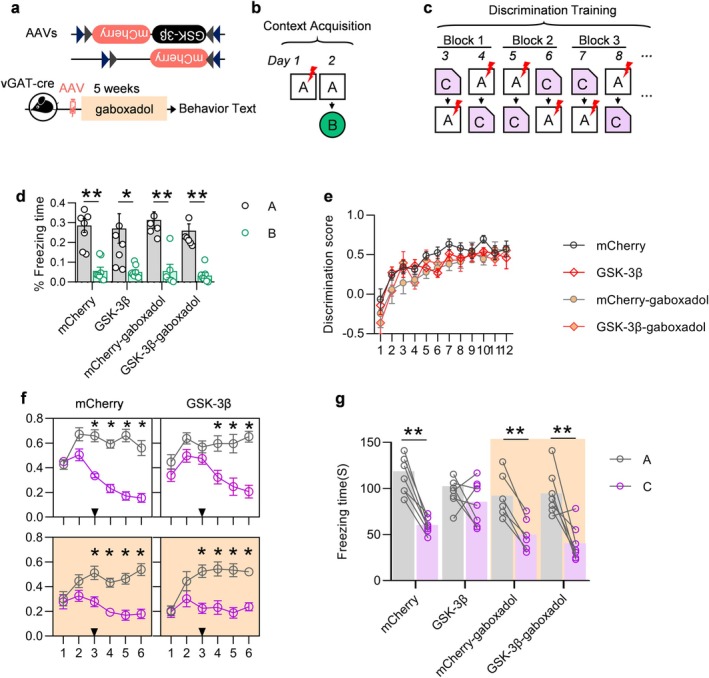
Gaboxadol, also called THIP, enhances GABA receptor signaling and improves newborn-neuron counts, dendritic length, complexity and spine density in the overexpression model. Precursor apoptosis and stage distributions also improve.
Behavioral differences center on similar contexts. Groups discriminate dissimilar environments, but overexpression mice learn more slowly which of two similar settings is paired with footshock. Gaboxadol improves discrimination, connecting cellular and circuit changes with finer contextual-memory processing.
Source: Liu F et al. · Aging cell · CC BY
Original figure and English caption ↗
Young neurons need a supportive neighborhood
The study describes consequences extending beyond a protein within one cell. Interneurons, excitatory neurons and precursors are linked: weaker GABA transmission accompanies stronger local activity and more precursor apoptosis. Two interventions improve parts of this sequence.
In these adult male-mouse experiments, neurogenesis depends on activation as well as survival and differentiation within an appropriate signaling environment. Connecting an Alzheimer’s-associated kinase with local inhibition and cellular development offers a specific route into studying memory changes.