Repeated grooming and digging involve different activity patterns
Without NLGN1, dorsal-striatal D2 cells become more excitable and mouse grooming and digging increase. The behaviors relate to different activity patterns, with PKC-associated changes contributing.
Grooming fur and moving bedding are part of ordinary mouse behavior. When these actions occur too often, researchers can ask why a behavior is repeatedly initiated. A 2024 Advanced Science study follows the autism-associated synaptic protein neuroligin 1, NLGN1, into the dorsal striatum. NLGN1 deficiency alters excitability in dopamine-D2-receptor-expressing medium spiny neurons, D2-MSNs, but grooming and digging are not simply two expressions of an identical activity pattern.
Reducing or deleting NLGN1 in dorsal-striatal D2-MSNs increases grooming and digging; suppressing the population reduces both. Activation paradigms and behavior-linked calcium signals reveal different temporal patterns, and PKC inhibition reduces the tested abnormalities.
Contents · 7 sections
Behaviors are initiated more often
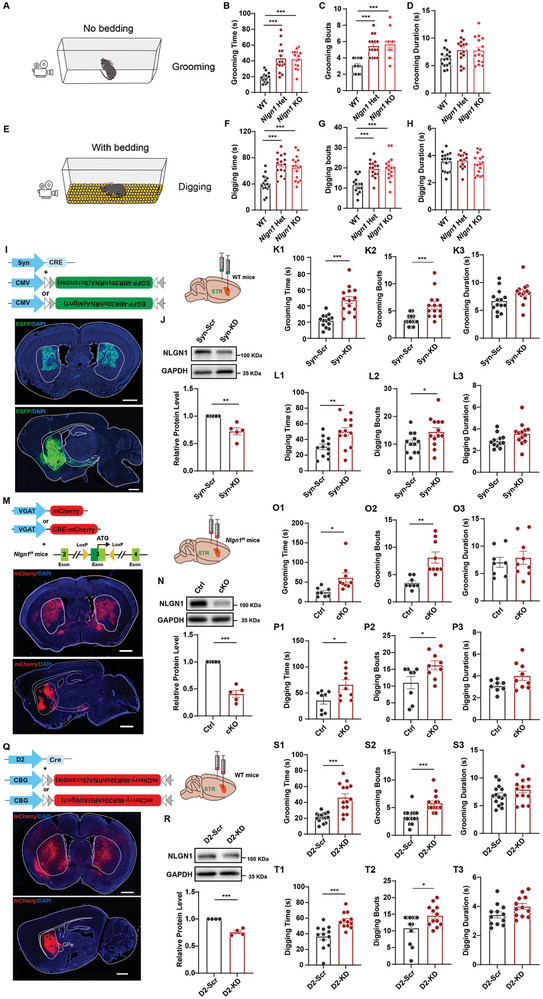
Nlgn1-deficient mice show increased total grooming and digging time and more bouts, with changes observed in both sexes. Reducing NLGN1 in selected brain regions reproduces similar changes in the striatum, linking a whole-animal genetic phenotype with a particular region.
The main striatal cells are inhibitory medium spiny neurons. Separating D1- and D2-receptor-marked populations shows that reducing NLGN1 in D2 cells increases both behaviors, whereas the corresponding D1 intervention does not significantly increase them. D2 denotes receptor expression rather than dopamine production, identifying a striatal population receiving modulatory signals.
Source: Lv D et al. · Advanced science (Weinheim, Baden-Wurttemberg, Germany) · CC BY
Original figure and English caption ↗
The dorsal D2 population stands out
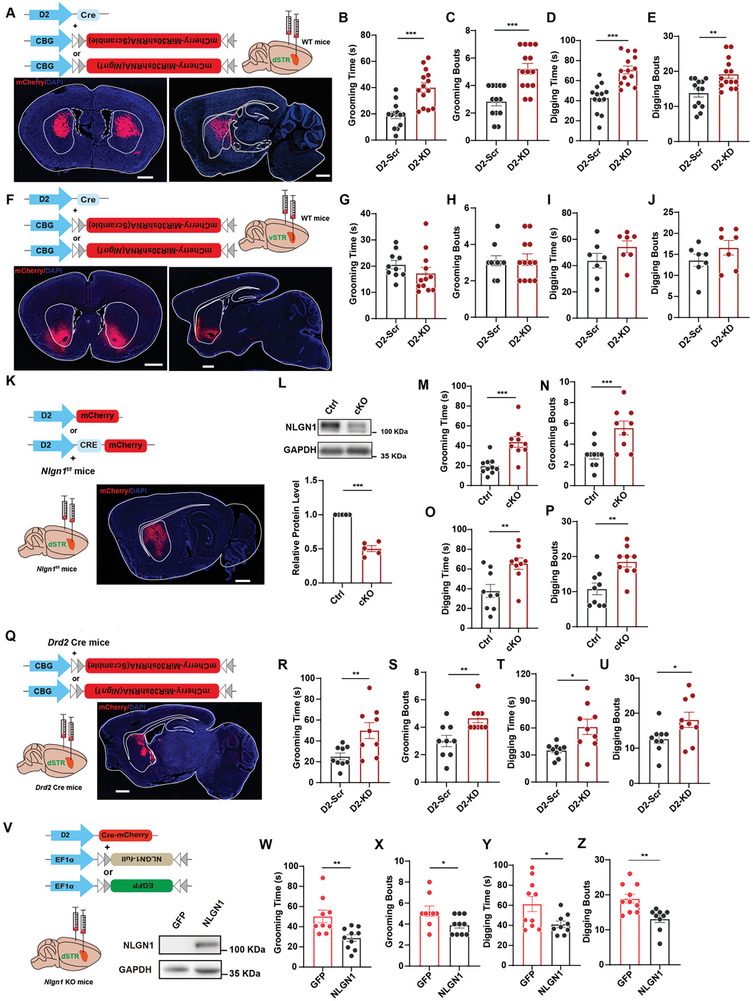
Reducing NLGN1 in dorsal-striatal D2 cells increases both behaviors, whereas the corresponding ventral-striatal intervention has no significant effect. Conditional deletion and knockdown in Drd2-Cre populations produce similar directions. D2 cells in different regions do not have identical roles in this protein-related regulation.
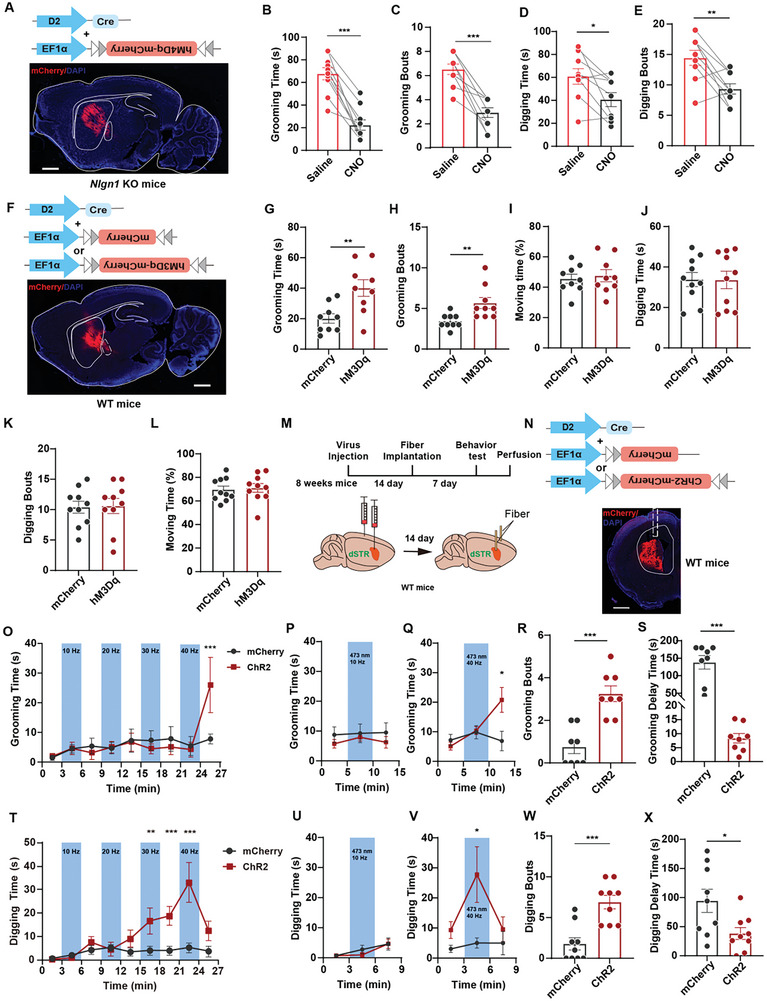
Reintroducing NLGN1 into dorsal D2 cells of adult deficient mice reduces excessive grooming and digging. In a separate D2-cell knockdown experiment, movement, open-field and three-chamber social measures do not change significantly, defining the particular behavioral scope of this localization.
Source: Lv D et al. · Advanced science (Weinheim, Baden-Wurttemberg, Germany) · CC BY
Original figure and English caption ↗
Greater excitability does not raise every measure
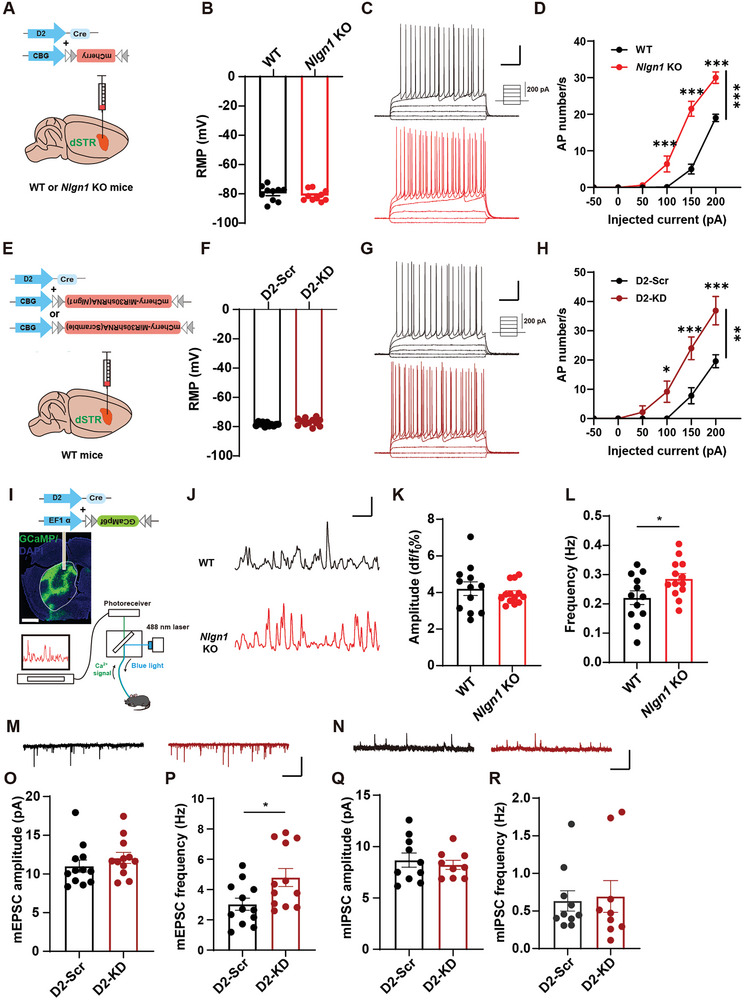
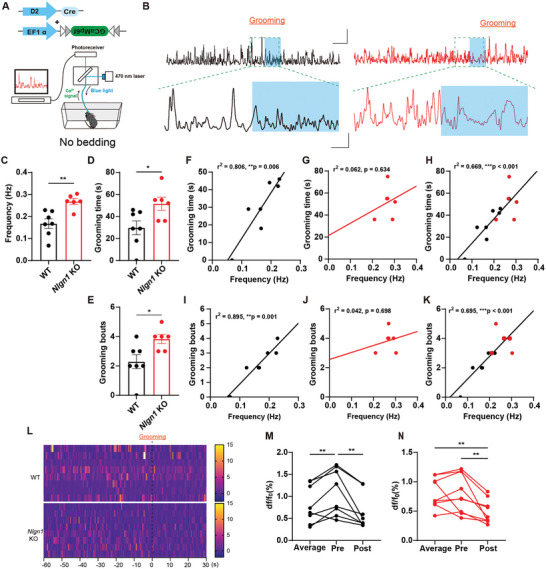
In slices, NLGN1-deficient D2 cells produce more action potentials under the same current injection, while resting potentials remain similar. In vivo calcium events occur more frequently without a significant amplitude increase. Responsiveness changes without every activity measure rising together.
After knockdown, miniature excitatory-current frequency increases, whereas its amplitude and miniature inhibitory-current frequency and amplitude remain nonsignificantly changed. Abnormal slice excitability persists after glutamate-receptor blockade; in vivo intervention also affects grooming and digging differently. Input changes alone leave a role for intracellular regulation.
Source: Lv D et al. · Advanced science (Weinheim, Baden-Wurttemberg, Germany) · CC BY
Original figure and English caption ↗
Activation affects grooming and digging differently
Suppressing dorsal D2 cells in deficient mice reduces the time and bout counts of both behaviors. Conversely, chemogenetic activation in normal mice increases grooming without significantly increasing digging. Movement time is also nonsignificantly changed under this activation condition.
Optical activation reveals a timing difference: higher-frequency activity does not increase grooming during stimulation, but grooming rises afterward. Digging can increase both during and after higher-frequency stimulation. Behavioral effects depend on how activity unfolds and when the action appears, beyond a simple increase in activity.
Source: Lv D et al. · Advanced science (Weinheim, Baden-Wurttemberg, Germany) · CC BY
Original figure and English caption ↗
Calcium signals change before grooming starts
During free behavior, D2 calcium-event frequency correlates positively with grooming time and bout counts in normal mice and in pooled analysis, but not significantly within the deficient group alone. With higher background activity, event frequency does not retain the same relationship with behavior.
Aligned to grooming onset, both groups show higher signals before than after the action begins. Pre-grooming signals also exceed the recording average in normal mice, but that comparison is nonsignificant in deficient mice. Together with post-stimulation grooming, this suggests a relationship between activation, subsequent decline and initiation.
Source: Lv D et al. · Advanced science (Weinheim, Baden-Wurttemberg, Germany) · CC BY
Original figure and English caption ↗
A different activity measure reveals the digging relationship
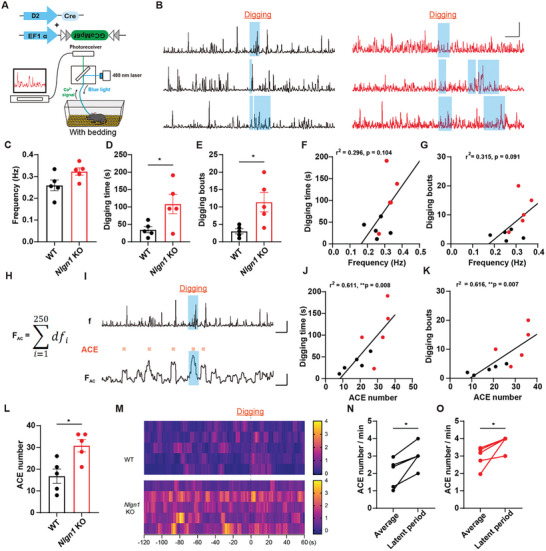
In a bedded environment, pooled correlations between calcium-event frequency and digging time or bout counts are nonsignificant. A cumulative measure integrating event signals instead shows positive correlations in normal mice and pooled analysis; the measure before digging also exceeds the recording average.
Grooming is associated with an activity transition around onset, while digging relates to prior accumulation. The actions share D2 cells but have different dynamic correlates. Cumulative analysis offers another view of the signal without independently establishing how a downstream circuit converts accumulation into action.
Source: Lv D et al. · Advanced science (Weinheim, Baden-Wurttemberg, Germany) · CC BY
Original figure and English caption ↗
PKC links protein deficiency with excitability changes
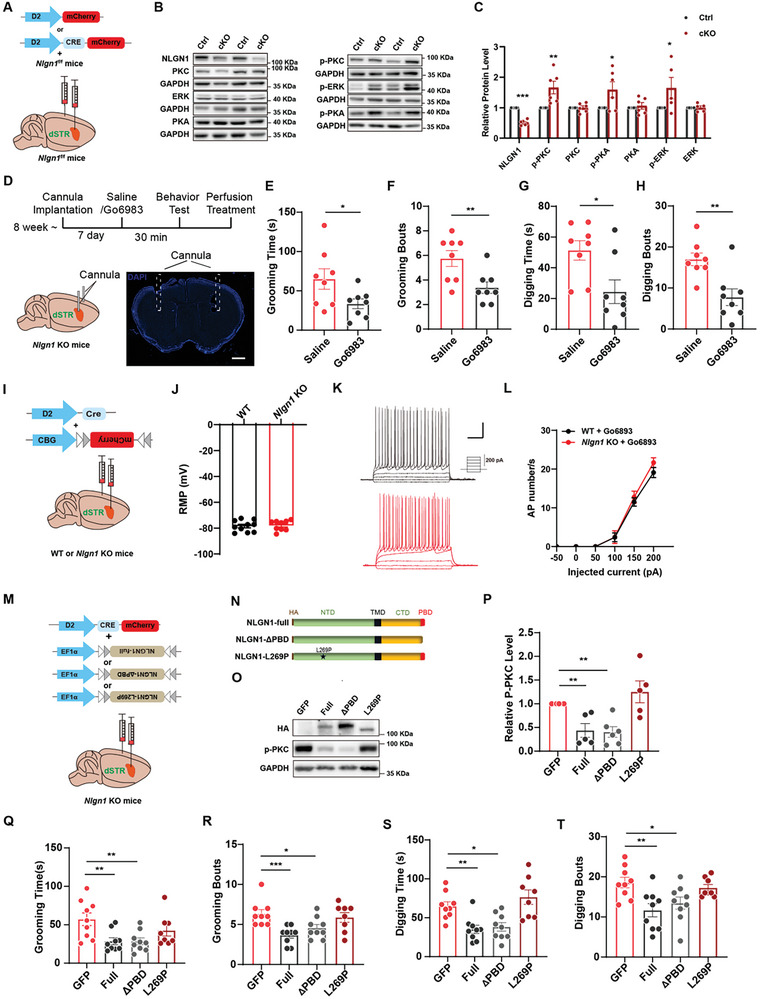
Single-nucleus analysis provides clues to intracellular signaling, and tissue assays show increased PKC, PKA and ERK phosphorylation markers. PKC inhibition reduces both behaviors in deficient mice and attenuates abnormal D2-cell firing differences. PKA inhibition has differing behavioral effects, while ERK inhibition does not reduce the tested excessive behaviors.
Re-expression of full-length NLGN1 or a version lacking its PDZ-binding domain reduces PKC-related labeling and excessive behavior, whereas the L269P variant does not produce the same effects. The study connects a synaptic protein, excitability and action timing: NLGN1-associated repeated behavior involves distinct dynamics in a shared cell population.
Source: Lv D et al. · Advanced science (Weinheim, Baden-Wurttemberg, Germany) · CC BY
Original figure and English caption ↗