Multiple exits in a seizure network: why does perirhinal cortex have broader effects than one projection?
A mouse study follows perirhinal cortex into several downstream targets, finding that seizure stage and chronic pathology change the roles of different outputs.

If one connection contributes to seizure propagation, is controlling it enough? A 2026 Nature Communications study starts with the perirhinal cortex, or PRh, projection to fasciola cinerea, or FC, then compares several outputs with the broader excitatory population. Regional suppression often has wider effects than one output, and individual routes change their contribution with seizure stage and chronic pathology. The differences outline a seizure network with multiple connections and state-dependent roles.
PRh excitatory populations influence seizures through distinct FC, infralimbic and lateral-entorhinal outputs. Broad suppression has wider effects, while FC-terminal degeneration accompanies weaker single-route effects in the chronic model.
Contents · 6 sections
Two inputs with different functional effects
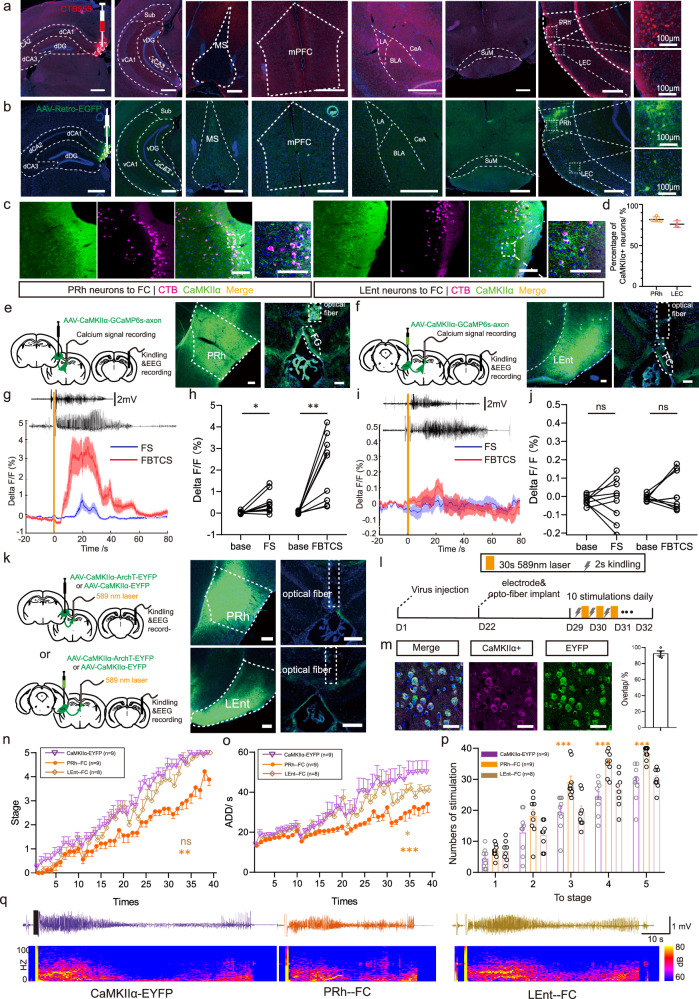
FC receives major excitatory inputs from PRh and lateral entorhinal cortex, or LEnt. During electrical kindling, PRh→FC calcium increased without a matching LEnt→FC change. Suppressing the first route slowed progression, while the second lacked comparable significant effects. Anatomically nearby input sources had different functions during seizures.
Activating either terminal population did not independently induce the measured seizures in naïve or fully kindled mice. Reducing an input could affect propagation, while increasing that segment alone did not initiate the whole event. The study therefore moved upstream to the broader PRh population and other outputs.
Source: Li Z et al. · Nature communications · CC BY-NC-ND
Original figure and English caption ↗
Broad modulation has stronger seizure effects
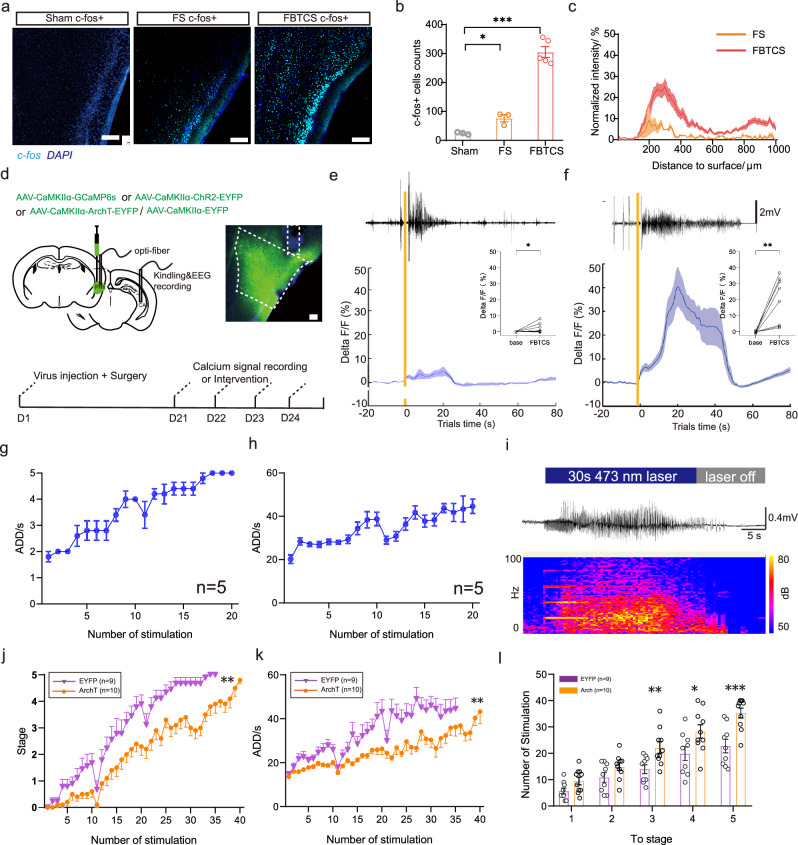
PRh excitatory cells were recruited during focal and focal-to-bilateral tonic–clonic seizures, more strongly in the latter. Broad activation induced discharges and behavioral seizures, with repeated stimulation progressing to more severe events. Suppression slowed kindling and shortened discharges. The difference from FC-terminal activation pointed toward participation by multiple outputs.
The work mainly focused on the labeled anterior PRh population. Placing its effects within its output map showed that regional modulation reaches several targets. Comparing connections in the same behavioral context could distinguish those influencing seizures from those recruited alongside broader network activity.
Source: Li Z et al. · Nature communications · CC BY-NC-ND
Original figure and English caption ↗
Activity rises across routes, but suppression effects differ
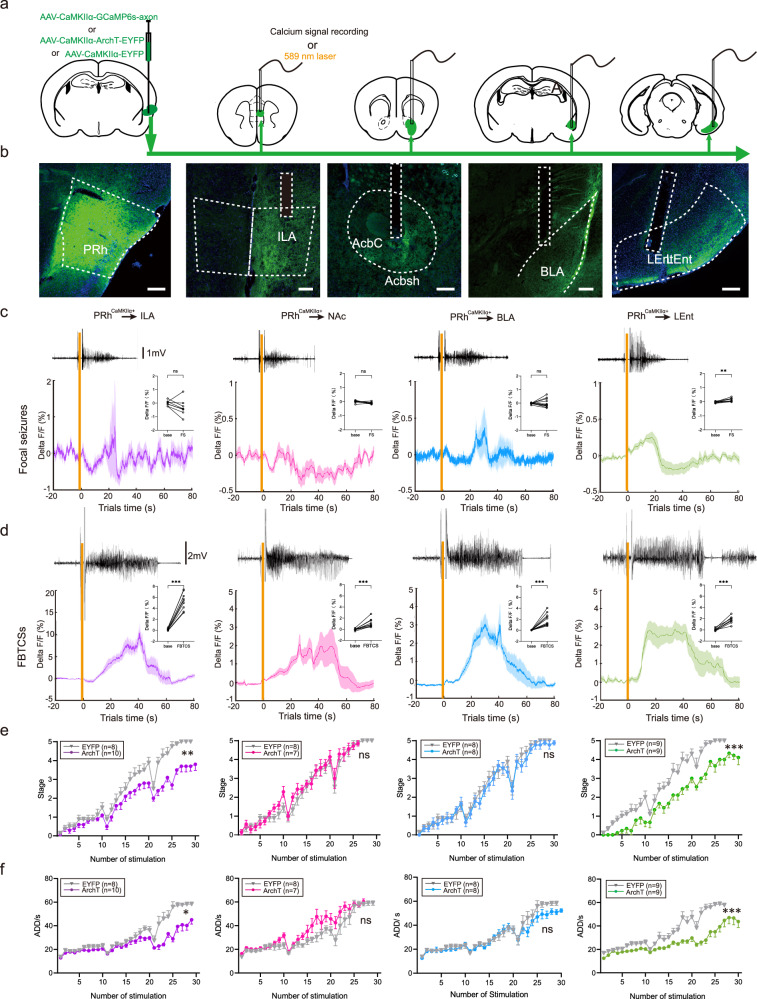
During more severe seizures, PRh terminal activity could increase in infralimbic cortex, or ILA, LEnt, BLA and NAc. LEnt suppression affected kindling more broadly, ILA mainly later, and BLA and NAc suppression lacked matching significant effects. Activity and function differed across these outputs.
Dual retrograde tracing showed limited overlap among target-defined populations, with different post-task activity labeling. One region therefore contained several populations with distinct destinations and stage-related effects. This distributed organization offered an explanation for broader regional influence.
Source: Li Z et al. · Nature communications · CC BY-NC-ND
Original figure and English caption ↗
Early propagation and established networks respond differently
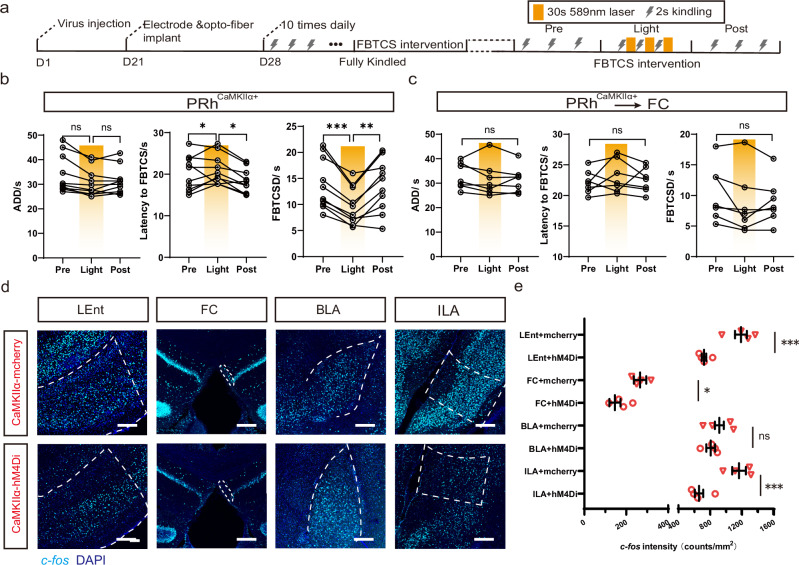
After full kindling, broad PRh suppression delayed bilateral seizures and shortened duration, while FC-only suppression did not show the same effect. ILA and LEnt modulation affected some outcomes. Lower stimulation made broad suppression more effective, showing the influence of seizure state and challenge strength.
The same FC route contributed to kindling progression but had limited effects on established seizures. Relative output contributions could change with repeated network recruitment. Comparing the developing and established states made this dynamic division clearer.
Source: Li Z et al. · Nature communications · CC BY-NC-ND
Original figure and English caption ↗
Terminal degeneration accompanies weaker single-route effects
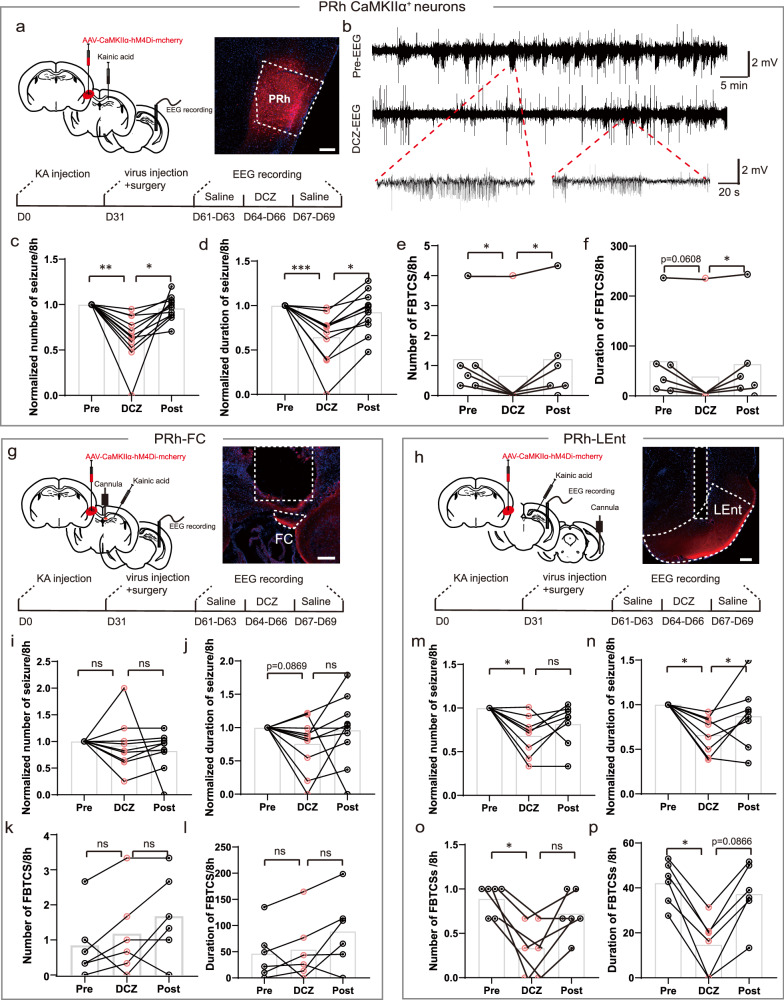
In chronic kainate mice, broad PRh suppression reduced spontaneous seizure frequency and duration, with weaker LEnt effects. FC-only modulation provided limited benefit in a minority, and bilateral seizure measures were not significant. PRh-origin FC terminals degenerated in roughly two-thirds of animals, accompanying weaker single-route function.
A route recruited during early kindling may have lost some terminals under chronic pathology. This structural context gives single-route results a temporal meaning: prior participation does not guarantee the same function later. Broad regional suppression remained effective chronically, directing attention to contributions from other preserved outputs.
Broad suppression partly improved object recognition but not object-location memory. Selective memory outcomes brought relationships between seizures and cognition into view. Wider output modulation affects more networks, making behavioral benefits and memory performance important to follow together.
Source: Li Z et al. · Nature communications · CC BY-NC-ND
Original figure and English caption ↗
A connection’s influence depends on stage and network context
PRh→FC contributes early, other outputs act at different stages, and chronic pathology includes terminal degeneration. Together, these findings frame seizure modulation as a network problem shaped by time and pathology. Broader regional effects align with a position capable of influencing multiple outputs.
The study used male mice, mainly in kindling with additional chronic kainate tests. The findings shift comparison toward which outputs remain involved under particular states. Viewing state and connectivity together provides specific evidence for understanding distributed seizure networks.