Morphine makes mice move more: tracing a cortical–zona-incerta circuit
A mouse study links the cingulate-to-intermediate-zona-incerta connection with high-dose morphine-induced hyperlocomotion, implicating delta-opioid receptors.
One drug can change movement, reward-related behavior and sensory responses without sending every effect through the same neural route. An Advanced Science study examines morphine-associated hyperlocomotion in mice, focusing on cingulate cortex (Cg) and the intermediate rostrocaudal division of zona incerta (ZIm). Reducing this circuit’s activity attenuates increased movement, while tested reward preference and analgesia measures do not similarly change. Effects that arise together can have separable neural organization.
Cg–ZIm activity supports hyperlocomotion under high-dose morphine. Reducing DOR in associated ZIm recipient populations weakens the motor response, and receptor blockade no longer produces a significant further reduction.
Contents · 6 sections
Hyperlocomotion is one part of the response
Opioids affect several behaviors. Increased distance traveled under morphine provides one readout of motor-related effects, while preference for an environment and responses to noxious stimuli address different questions. Investigating hyperlocomotion can clarify how drug effects are distributed across networks.
Behavioral observations use adult male mice. The study focuses on a connection between cingulate cortex, involved in higher-level regulation, and zona incerta, which integrates varied information and connects with motor-related nodes. Its central question is whether a cortical input influences movement under the drug condition.
Cortical input reaches intermediate zona incerta
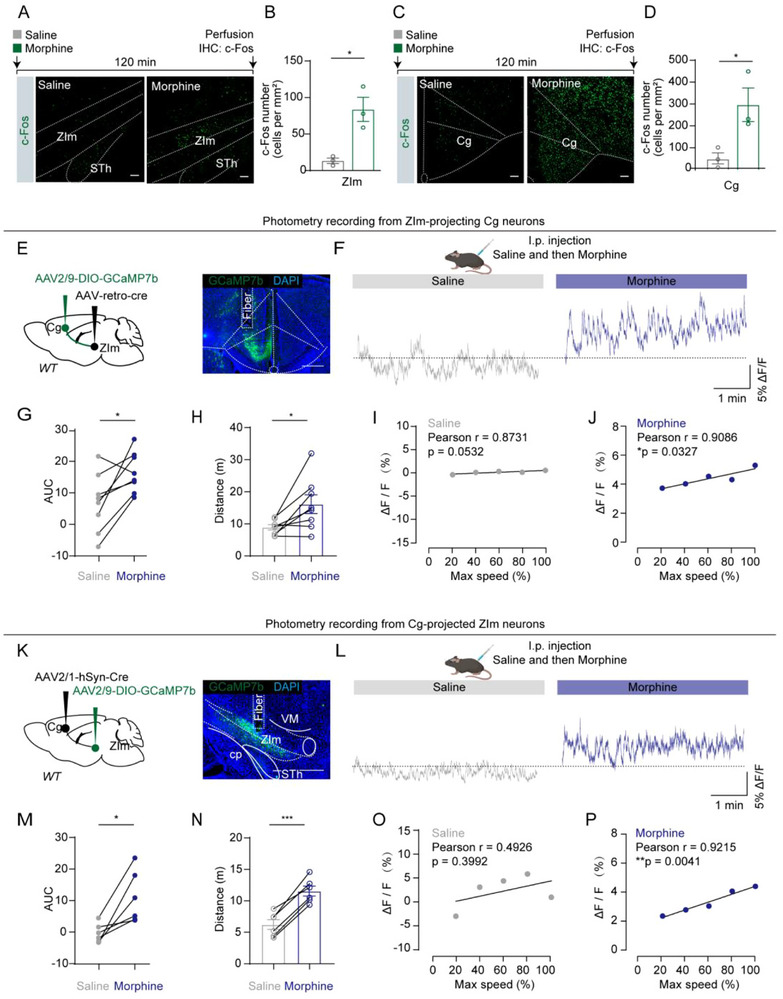
Tracing shows that terminals from excitatory Cg cells are concentrated in ZIm, with substantial connections to local inhibitory populations. ZIm is predominantly GABAergic, but the population receiving Cg input is heterogeneous. The composition of source and recipient populations sets the structural background.
Morphine increases activity-related labeling in both regions and calcium signals in ZIm-projecting Cg and associated ZIm recipient populations. Movement distance rises, with signals correlated with speed across the measured bins. The anatomical connection gains a drug-associated response, followed by tests of how changing activity affects movement.
Source: Li CY et al. · Advanced science (Weinheim, Baden-Wurttemberg, Germany) · CC BY
Original figure and English caption ↗
Reducing circuit activity attenuates hyperlocomotion
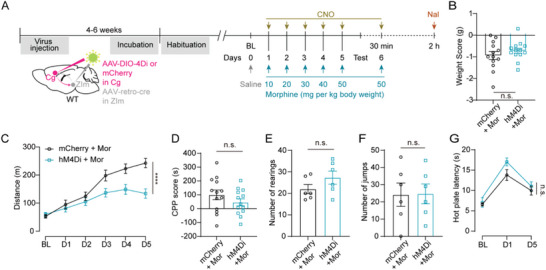
Reducing the activity of ZIm-projecting Cg cells attenuates high-dose morphine-induced movement, without a significant baseline locomotor change. The same inhibition has no significant effect at a lower dose. Circuit involvement therefore varies with the drug condition rather than remaining identical across exposure levels.
With repeated morphine exposure, inhibition again reduces hyperlocomotion, while body weight, conditioned place preference, tested withdrawal behaviors and hot-plate responses show no significant group differences. These parallel readouts clarify that motor-related effects can change while several other drug-associated responses remain similar.
Source: Li CY et al. · Advanced science (Weinheim, Baden-Wurttemberg, Germany) · CC BY
Original figure and English caption ↗
Increasing this activity can also drive movement
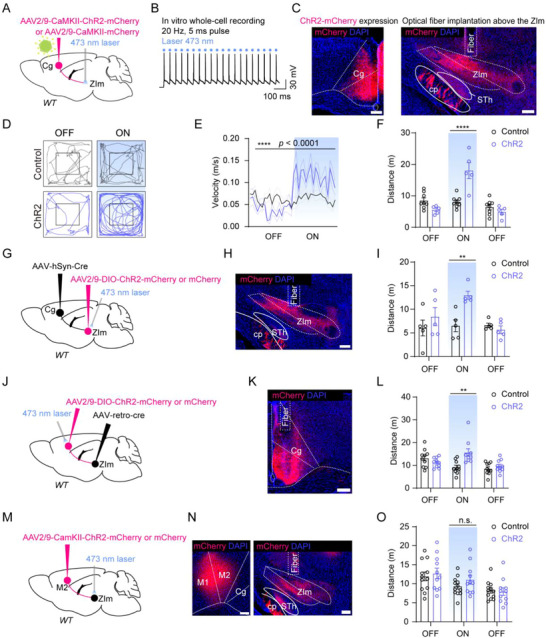
Without morphine, raising Cg terminal activity in ZIm increases speed and distance. Activating the source population or associated local recipient population produces similar effects. In a comparison with another cortical input, activating motor-cortex-associated terminals does not significantly change the measured distance.
Increased movement is not accompanied by significant changes in tested place preference, anxiety-related measures, marble burying or rotarod performance. Local populations differ too: Gad2-population activation does not change baseline movement, while inhibition of Gad2 or non-Gad2 populations under morphine attenuates hyperlocomotion. Population composition and current state therefore matter.
Source: Li CY et al. · Advanced science (Weinheim, Baden-Wurttemberg, Germany) · CC BY
Original figure and English caption ↗
Delta-opioid receptors contribute at higher doses
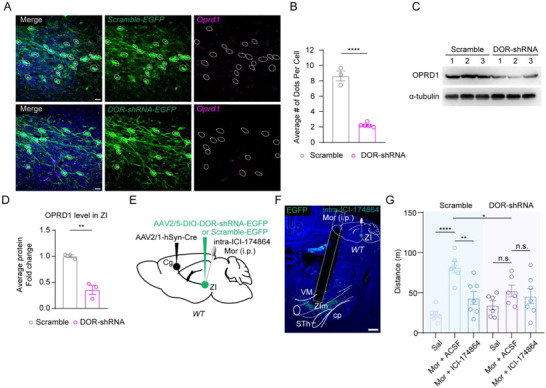
Associated ZIm recipient cells show delta-opioid receptor (DOR) labeling, also found in some morphine-activated cells. Local DOR blockade attenuates high-dose hyperlocomotion without a significant baseline movement difference. Lower-dose receptor comparisons instead implicate μ-opioid receptors, indicating condition-dependent receptor involvement.
Reducing DOR in Cg-associated ZIm recipient populations weakens the motor response to morphine, and DOR blockade no longer produces a significant further reduction. Receptor-expression changes and pharmacological findings converge within the associated population, connecting the receptor component to circuit function.
Source: Li CY et al. · Advanced science (Weinheim, Baden-Wurttemberg, Germany) · CC BY
Original figure and English caption ↗
Effects arising together can have distinct neural contributions
The study connects high-dose morphine’s motor effects with a cortical–zona-incerta network and receptor component. Reducing circuit activity makes mice move less, while tested reward preference, withdrawal behaviors and hot-plate responses remain similar. Drug effects can arise together while depending differently on neural circuits; hyperlocomotion is one part of the response.
ZIm cellular heterogeneity and dose differences show that network function is not a fixed label. Source input, local populations and receptors jointly shape the response in a particular state. The mouse study reveals separable neural organization for drug-associated behaviors, with movement itself representing only one component.