Astrocytes participate in contextual memory after seizures
A male-mouse study links subicular astrocyte calcium activity with contextual fear memory, implicating extracellular adenosine and A1 receptors.
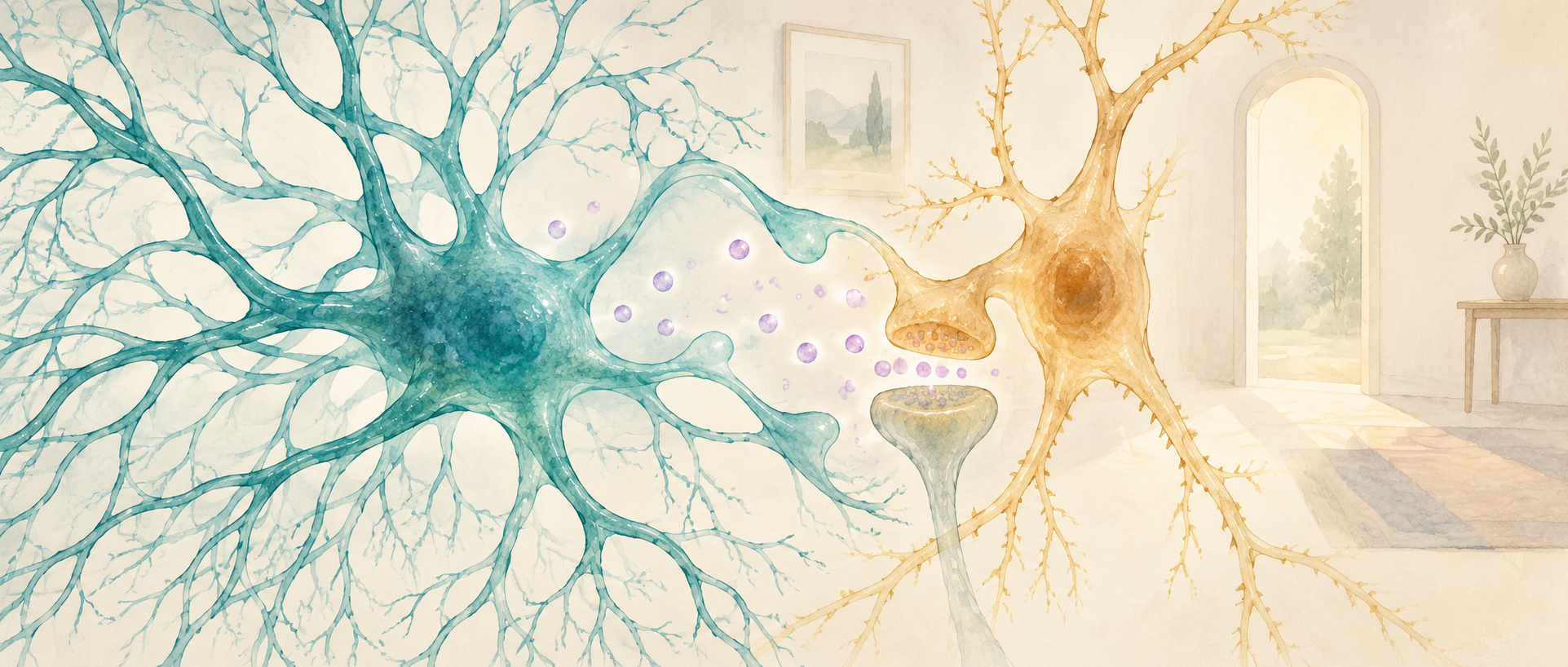
Will an animal remember an adverse experience when it returns to the same place? Contextual fear memory links an environment with an event and is commonly assessed through freezing on return. An Advanced Science study finds increased calcium activity in astrocytes of the subiculum, a hippocampal output region, in a seizure-associated model. Reducing astrocyte calcium signals restores subsequent contextual freezing, bringing neighboring glial cells into the memory-network story.
Increasing subicular astrocyte activity around the early learning period reduces later contextual freezing; recall-period activation does not have the same effect. Reducing astrocyte calcium activity or blocking local A1 receptors improves contextual readouts in the model.
Contents · 6 sections
The subiculum sends hippocampal information onward
The subiculum occupies an important hippocampal output position, connecting with cortical and subcortical regions and processing contextual information. Its astrocytes surround neurons and synapses and can influence nearby signaling through their own state. The study asks whether they contribute to memory changes when seizure-related activity affects this output region.
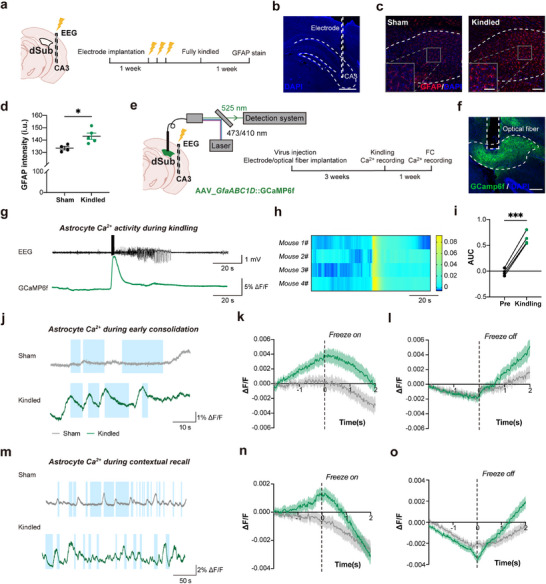
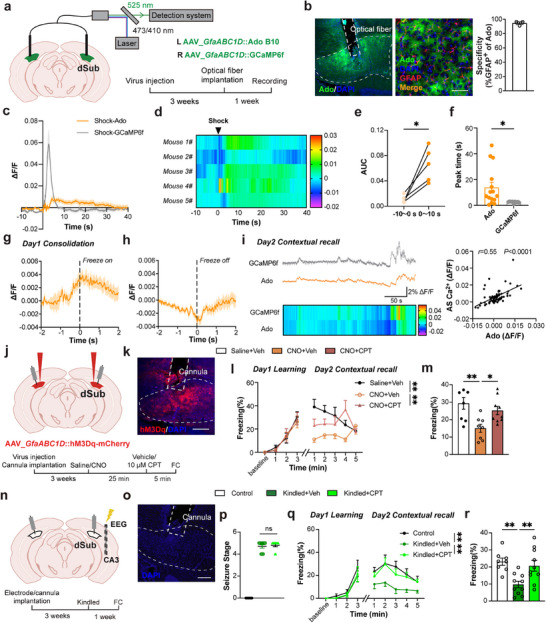
During normal learning, subicular astrocyte calcium signals respond to salient events, and spontaneous activity increases afterward, with dynamics related to transitions between movement and freezing. The glial response has a temporal structure, changing with experience and behavioral state rather than remaining a constant background.
Calcium responses are stronger in the seizure-associated model
In hippocampal kindling, seizures accompany strong subicular astrocyte calcium responses. During contextual learning and recall a week later, the model group still shows stronger calcium signals before freezing onset. A cellular-state link emerges between seizures and later behavior: network responses can differ after the electrical event has ended.
Learning-stage freezing is comparable, but later freezing on return to the original environment is lower. Changes in the cued task are less clear. The findings focus attention on contextual readouts and lead to a test of whether reducing glial calcium activity can alter the subsequent response.
Source: Shao Y et al. · Advanced science (Weinheim, Baden-Wurttemberg, Germany) · CC BY
Original figure and English caption ↗
Contextual performance rises without corresponding seizure changes
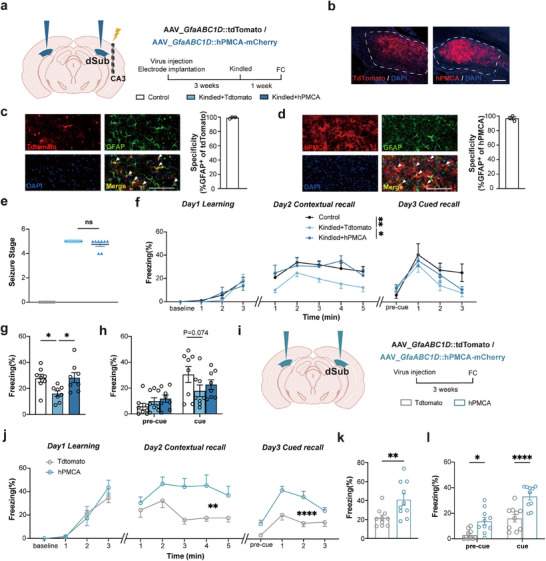
Reducing subicular astrocyte calcium activity raises contextual freezing in the model. Tested seizure severity and kindling progression do not significantly change, nor does learning-stage freezing. The contextual improvement occurs against comparable seizure-related measures, linking glial activity with regulation of the memory-related network.
In unkindled mice, the same calcium reduction increases contextual freezing and also raises pre-cue and cue-period freezing in another environment, suggesting possible fear generalization. The meaning of increased freezing therefore depends on the context in which it occurs as well as its magnitude.
Source: Shao Y et al. · Advanced science (Weinheim, Baden-Wurttemberg, Germany) · CC BY
Original figure and English caption ↗
The early learning period differs from recall
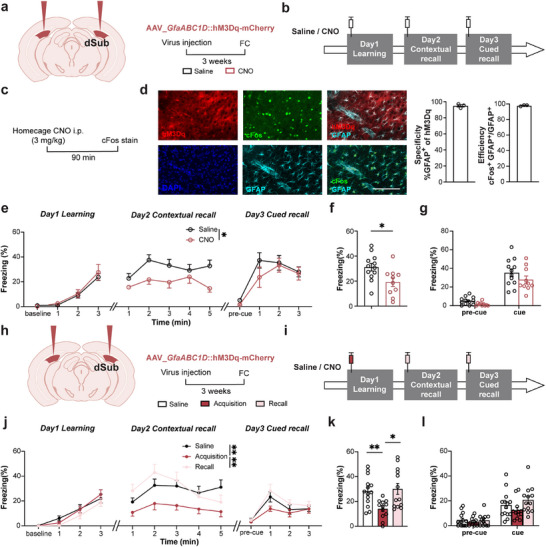
Increasing astrocyte Gq-associated activity lowers later contextual freezing, without significant changes in learning or cued memory. Movement, anxiety-related measures and tested seizure susceptibility also show no significant changes. Activating around the early learning period produces a similar contextual effect.
Activation confined to recall does not have the same contextual effect. Astrocyte state thus matters particularly around the early period in which an experience becomes a memory. A similar change in the same population can have different effects at different times, distinguishing formation-related state from later retrieval.
Source: Shao Y et al. · Advanced science (Weinheim, Baden-Wurttemberg, Germany) · CC BY
Original figure and English caption ↗
Extracellular adenosine links glial state with neuronal responses
With increased glial activity, local CaMKIIα-associated neuronal calcium responses around freezing transitions weaken, while responses to the salient event itself remain comparable. Separate sensing shows extracellular adenosine varying with experience and freezing state and correlating with astrocyte calcium activity. Glutamate does not show the same significant change.
Reducing glial calcium activity also diminishes associated extracellular adenosine responses. Local adenosine A1-receptor blockade attenuates contextual changes after astrocyte activation and improves contextual freezing in kindled mice. Calcium state, extracellular signal and receptor effects converge across observations, outlining an intercellular contribution to memory-related responses.
Source: Shao Y et al. · Advanced science (Weinheim, Baden-Wurttemberg, Germany) · CC BY
Original figure and English caption ↗
Memory networks include cells beside neurons
The male-mouse study places astrocytes within the mechanism of seizure-associated contextual memory. It reveals linked cellular and receptor effects, while the precise sources and release routes of extracellular adenosine remain to be resolved. Local glial state can influence neuronal responses and later behavioral expression in a remembered environment.
The clearest insight is that neurons do not act alone in memory. Neighboring glial activity, the surrounding chemical environment and the timing of a change jointly shape network responses, offering an intercellular perspective on contextual-memory changes after seizures.