Linking sights with sounds: CCK opens a window for plasticity
In mice, strengthening visual-to-auditory cortical inputs depends on activity pairing and CCK signaling. Entorhinal inputs also contribute to forming and recalling recent audiovisual associations.
A light on a doorbell can bring its sound to mind: everyday experience links information from different senses. How does such a relationship persist? A mouse study published in eLife on March 4, 2024 examines cooperation among visual cortex (VC), auditory cortex (AC) and entorhinal cortex (EC). Visual information can reach auditory cortex directly, but an anatomical connection does not automatically become stronger. CCK, a neuropeptide, works with activity pairing to enable plasticity and brings a third pathway into the account of audiovisual association.
CCK-positive entorhinal inputs, combined with paired activity, enable strengthening of visual-to-auditory cortical connections. Under tested conditions, potentiation occurred after five pairings with a 200-ms pre-to-post interval. The pathways also contribute to formation and retrieval of recent associative memory.
Contents · 6 sections
An existing connection needs additional conditions
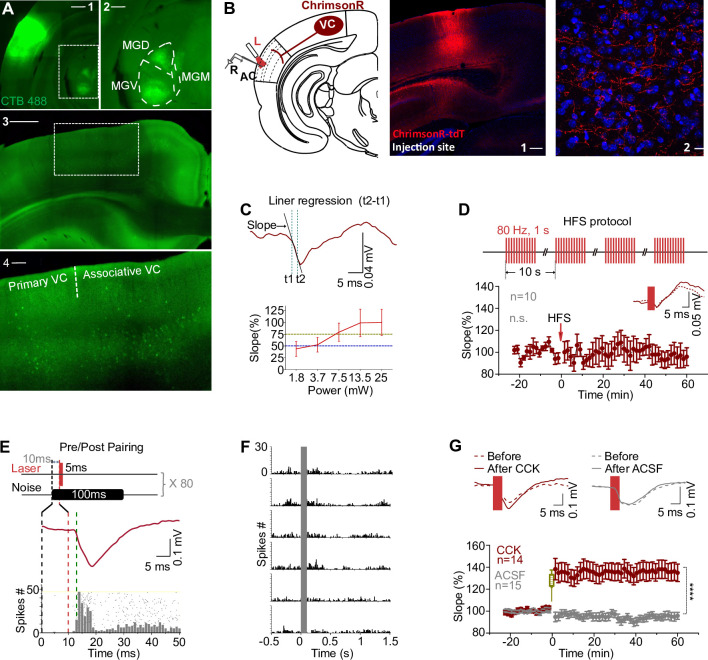
Auditory cortex receives direct visual cortical projections, providing a route for convergence. Strong activation of the visual input alone did not significantly induce long-term potentiation, nor did repeated pairing of that input with sound-evoked auditory cortical firing on its own.
With CCK present, activity pairing produced stronger visual-input responses that remained elevated during the subsequent hour of recording. CCK alone, or CCK combined with activation of only the input or receiving side, did not produce the same effect. Potentiation required these conditions together.
Source: Sun W et al. · eLife · CC BY
Original figure and English caption ↗
Entorhinal inputs enable another connection to strengthen
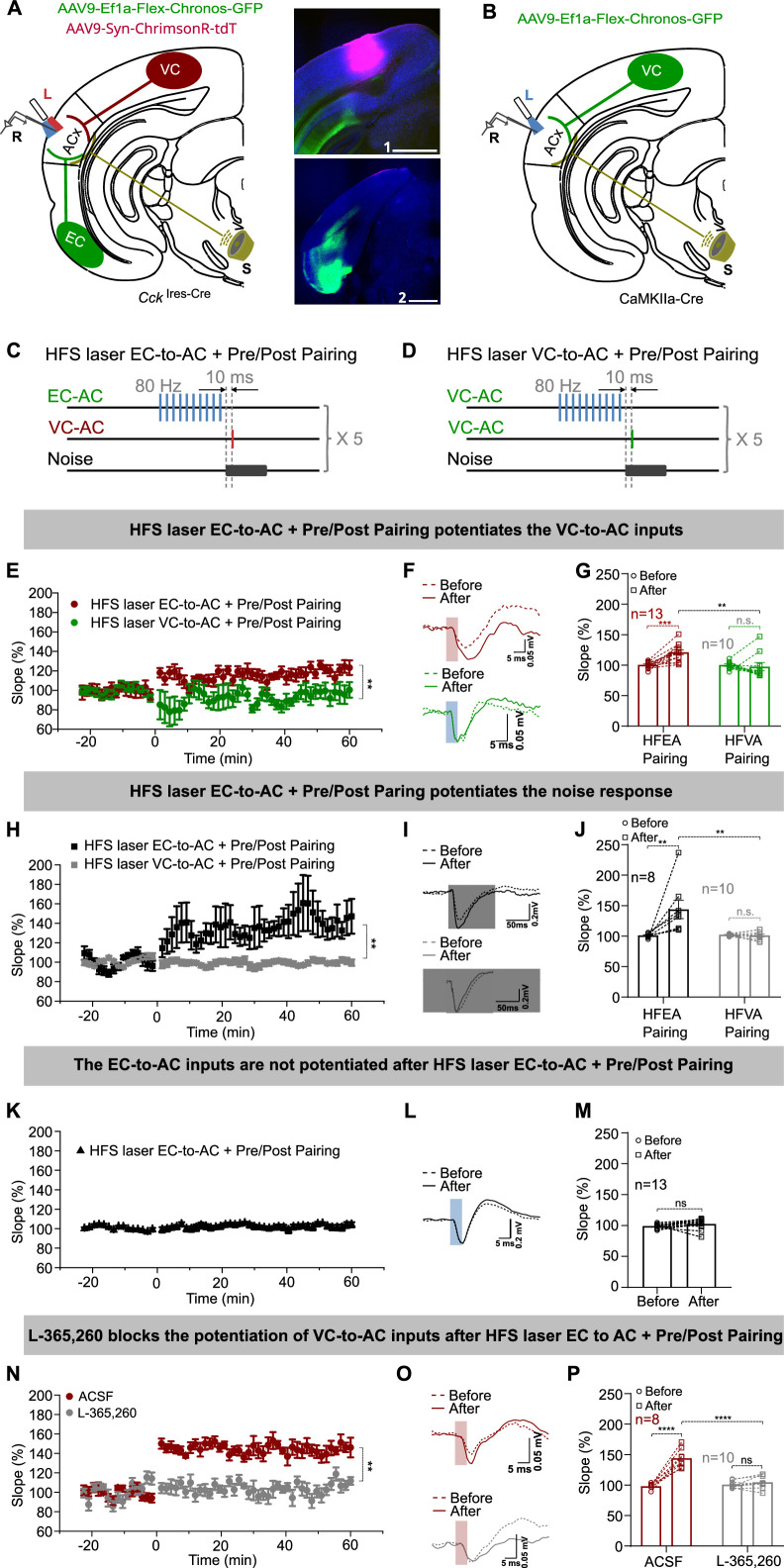
Endogenous inputs could provide the enabling signal. Recruitment of CCK-positive EC-to-AC projections before pairing visual input with recipient activity strengthened VC-to-AC responses. Strong stimulation of the visual pathway itself did not significantly produce this potentiation under the corresponding pairing conditions.
The entorhinal input itself did not significantly strengthen. Its recruitment enabled plasticity in another input, illustrating heterosynaptic plasticity. CCK sensor signals supported release in AC after entorhinal recruitment, and local CCK-B receptor blockade prevented visual-input potentiation.
Source: Sun W et al. · eLife · CC BY
Original figure and English caption ↗
Individual cells also show stronger input responses
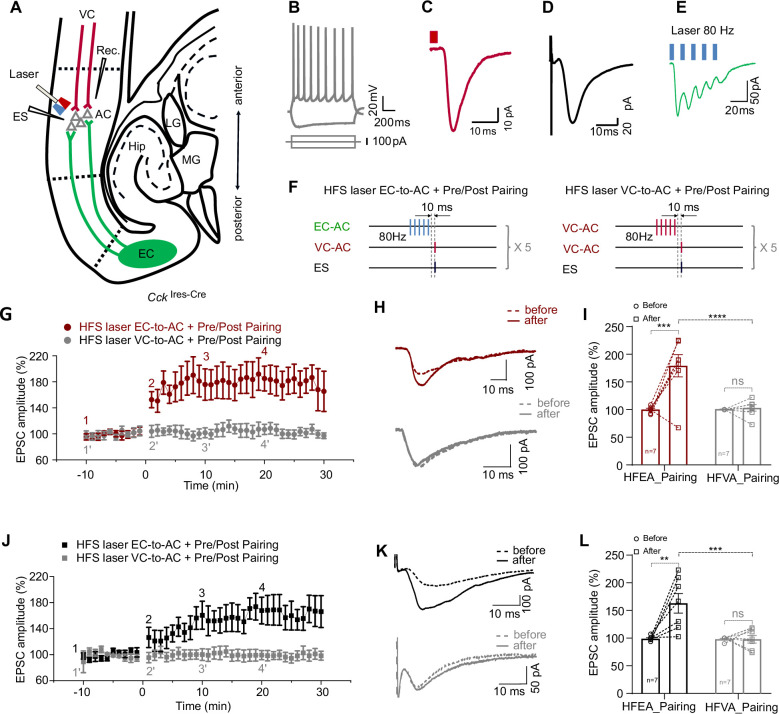
Recordings from individual auditory cortical pyramidal cells extended the evidence. Pairing activity after recruitment of CCK-positive entorhinal inputs increased visual-input excitatory synaptic currents, as well as electrically evoked currents. Replacing entorhinal recruitment with strong visual-pathway stimulation did not significantly produce the corresponding increases.
From in vivo field potentials to single-cell synaptic currents, the study found comparable directions across scales: a third input changed the conditions for plasticity. These findings give entorhinal-enabled potentiation a more specific cellular basis.
Source: Sun W et al. · eLife · CC BY
Original figure and English caption ↗
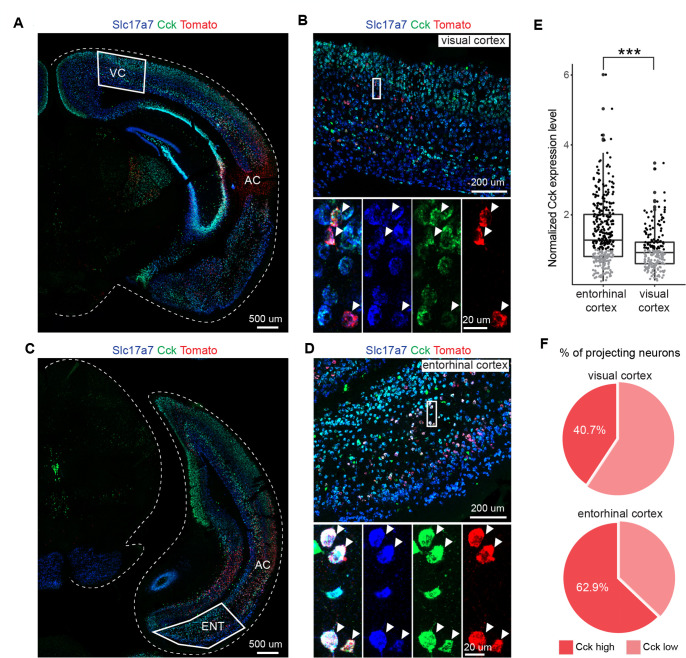
Inputs to the same cortex differ in Cck expression
Why do the two inputs differ? AC-projecting entorhinal cells had higher Cck transcript levels than corresponding visual cortical cells, with a larger proportion showing elevated expression. The comparison reveals molecular differences between inputs reaching the same recipient region.
Transcript differences complement release signals and receptor-blockade findings, supporting a contribution from entorhinal CCK inputs. These are CCK-bearing excitatory projections: their peptide signal can influence whether other connections strengthen, beyond carrying their own input.
Source: Sun W et al. · eLife · CC BY
Original figure and English caption ↗
Pairing can bridge a longer activity interval
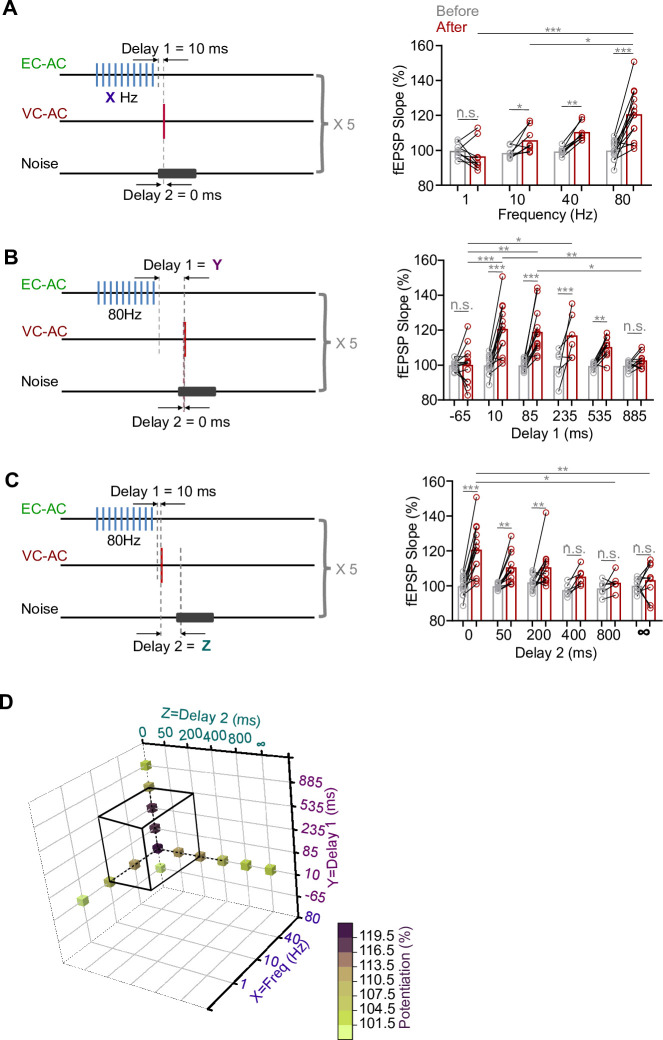
Recruitment pattern and activity timing influenced potentiation. Higher tested frequencies of entorhinal recruitment favored stronger responses, while a sufficiently long interval before pairing eliminated significant potentiation. The opportunity provided by peptide signaling thus depended on timing.
With entorhinal CCK inputs engaged, visual input arriving 200 ms before recipient firing still produced significant potentiation after five pairings. The tested 400- and 800-ms intervals did not significantly potentiate the input. This offers a clue to sensory association across longer intervals within the conditions examined.
Source: Sun W et al. · eLife · CC BY
Original figure and English caption ↗
Can a learned response to sound extend to a visual cue?
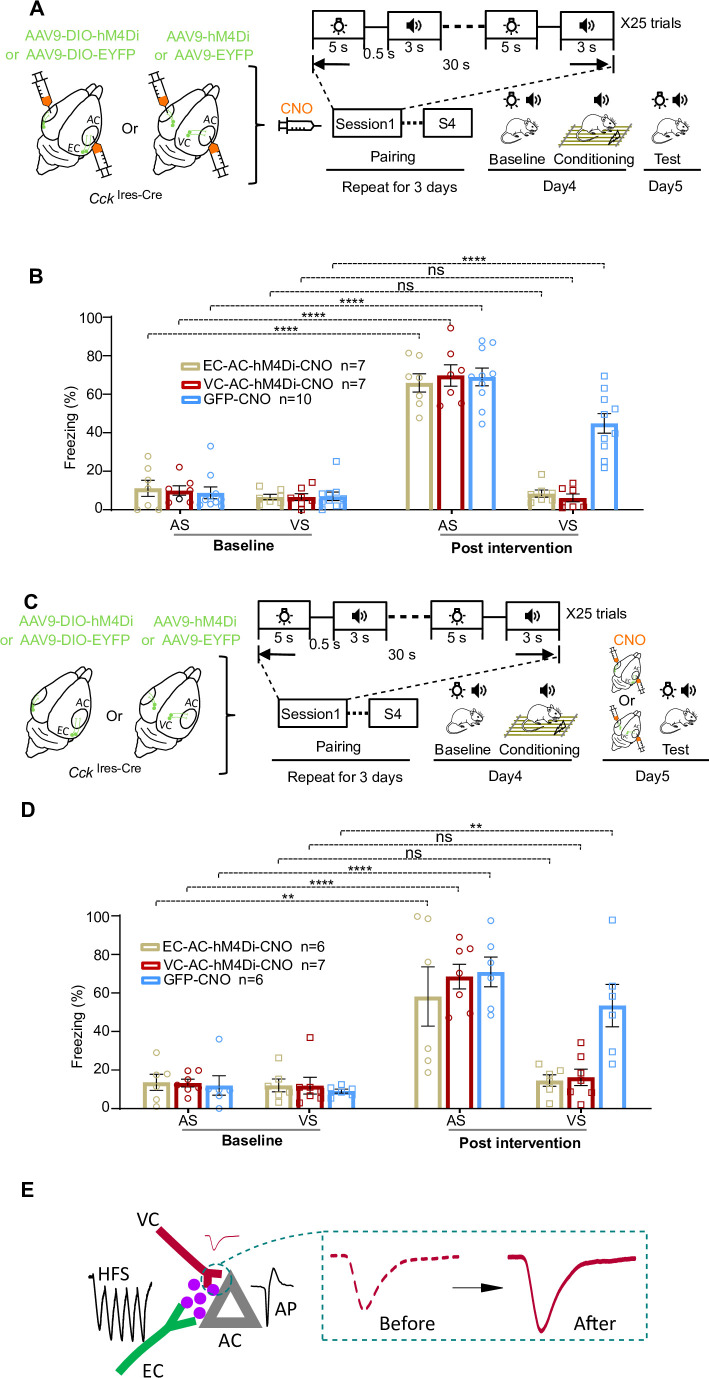
Mice first experienced paired visual and auditory cues, then learned an association between the sound and threat. A later visual cue alone elicited freezing under control conditions, reflecting the earlier audiovisual association. Inhibiting entorhinal CCK or VC-to-AC inputs during pairing prevented significant growth of visual-cue freezing, while the sound-related threat response still formed.
Inhibiting these inputs during the later test also affected visual-cue responses while preserving sound responses. The connections contribute to forming and retrieving recent associations. The evidence is from male mice; natural recruitment of entorhinal CCK inputs and corresponding mechanisms in other sensory associations remain open. Cross-modal learning reveals cooperation between local synaptic activity and peptide signals from another region.
Source: Sun W et al. · eLife · CC BY
Original figure and English caption ↗