Learning a threat association: a MeCP2 clue in accumbens interneurons
In male mice, loss of MeCP2 in cholinergic cells weakens fear-related learning measures. Accumbens interneuron activity and GABA-receptor changes offer a cellular explanation.
Learning that a sound or a place predicts danger involves more than the amygdala. A male-mouse study published in eLife on May 18, 2020 examined the small population of cholinergic interneurons in the nucleus accumbens. Loss of the transcriptional regulator MeCP2 in cholinergic cells weakened later responses to threat-associated cues. The work connected spontaneous firing, inhibitory inputs and α2-containing GABA receptors to ask how a local network contributes to learning.
Reduced accumbens cholinergic activity associated with MeCP2 loss accompanies weaker conditioned fear responses. Local MeCP2 restoration, increased activity or reduced α2-receptor expression improves behavioral measures.
Contents · 6 sections
Later cue responses weaken after MeCP2 loss
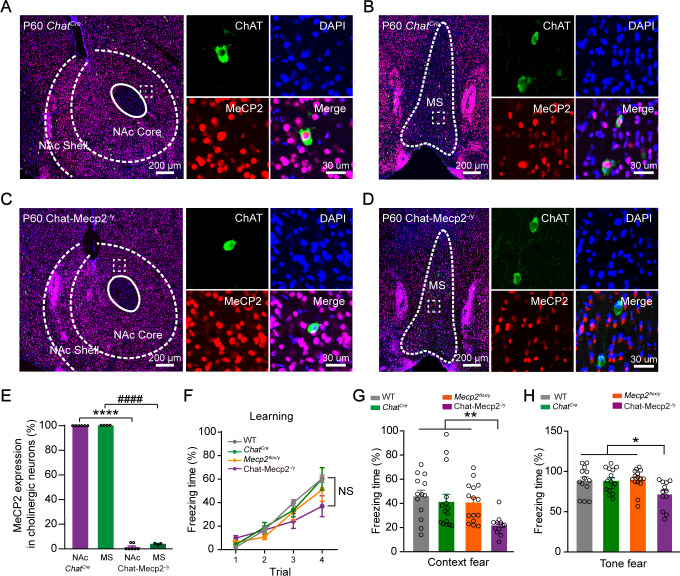
MeCP2 broadly regulates gene expression, and related mutations are associated with Rett syndrome. The study first removed Mecp2 from cholinergic cells and examined associations between a tone or context and an aversive event. This cell-class-specific model does not reproduce every feature of the human disorder.
Freezing increased during training across groups, while the main acquisition-curve comparison was not significant. At later context and tone tests, knockout mice froze less. This behavioral change implicates associative learning or later expression without establishing a complete absence of fear.
Source: Zhang Y et al. · eLife · CC BY
Original figure and English caption ↗
Restoring MeCP2 has different regional effects
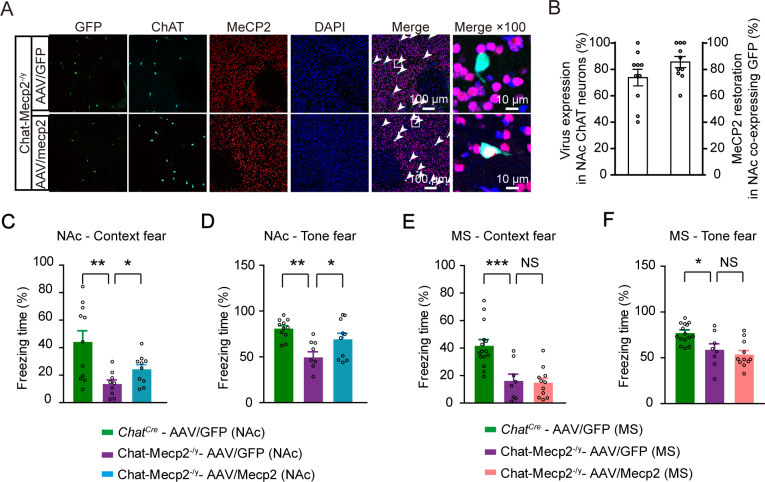
The initial deletion affected cholinergic cells across regions. Local restoration in accumbens cholinergic interneurons increased context- and tone-evoked freezing in knockout mice; corresponding restoration comparisons in the medial septum were not significant.
This identifies an accumbens contribution without excluding other regions. Restored responses did not reach control levels across every measure. Local MeCP2 can influence the knockout phenotype, motivating a closer look at interneuron state within the accumbens.
Source: Zhang Y et al. · eLife · CC BY
Original figure and English caption ↗
Reduced spontaneous firing accompanies stronger inhibitory input
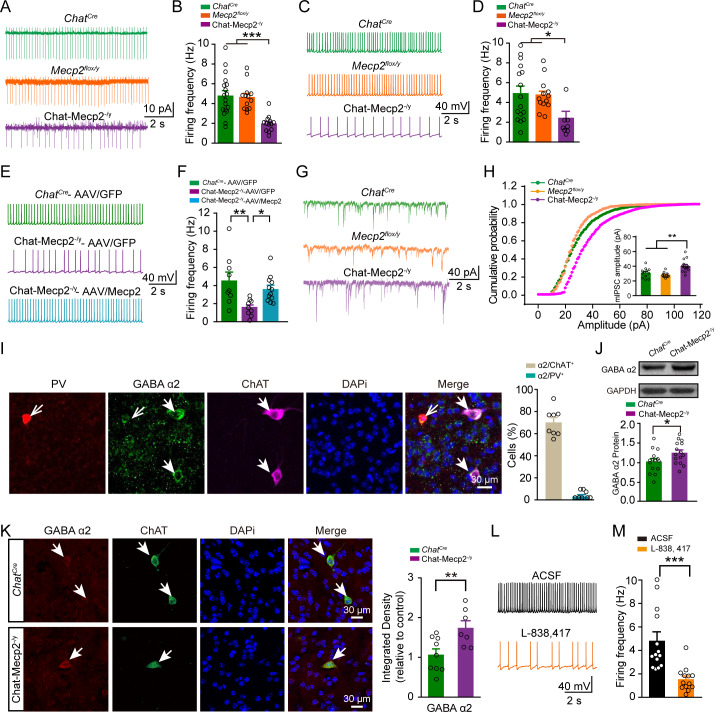
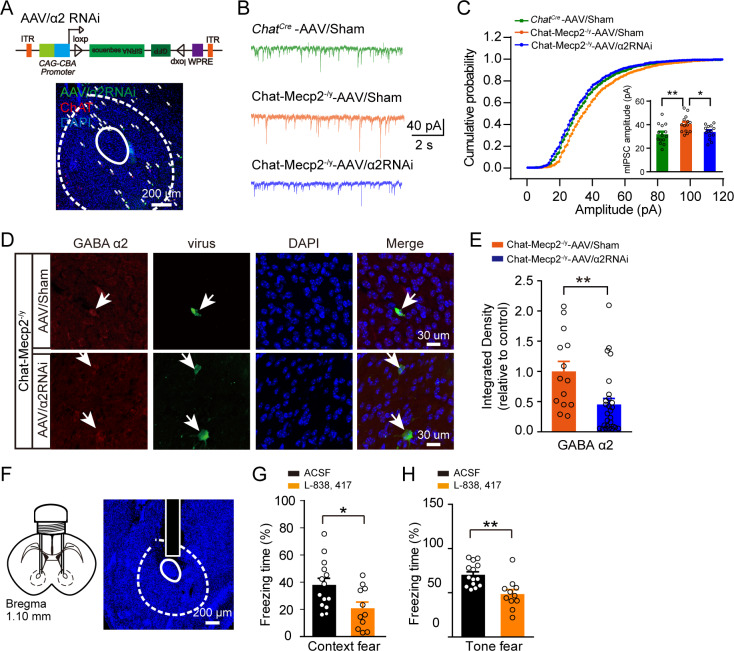
These interneurons normally fire spontaneously. In slices, knockout cells fired less frequently, and local MeCP2 restoration increased firing. Miniature inhibitory postsynaptic current amplitude increased without a significant frequency change, indicating stronger individual inhibitory current responses.
Expression associated with α2-containing GABA A receptors also increased. Tissue-level and cellular staining provide complementary evidence, but higher expression does not establish direct MeCP2 binding or regulation of the relevant gene. The intervening molecular steps remain unresolved.
Source: Zhang Y et al. · eLife · CC BY
Original figure and English caption ↗
Enhancing activity during learning improves later responses
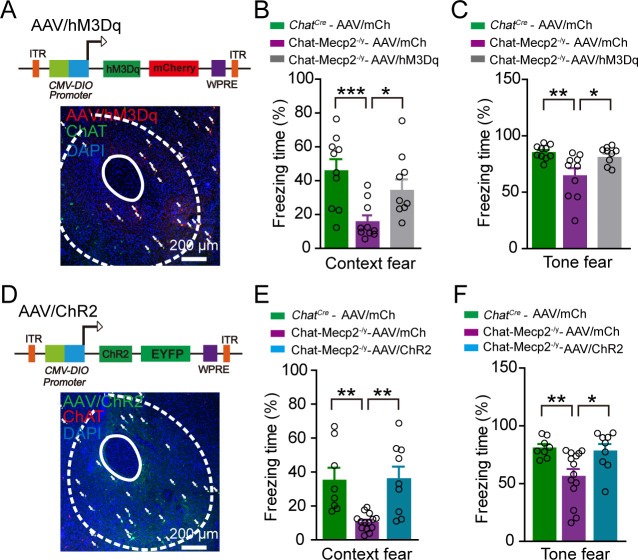
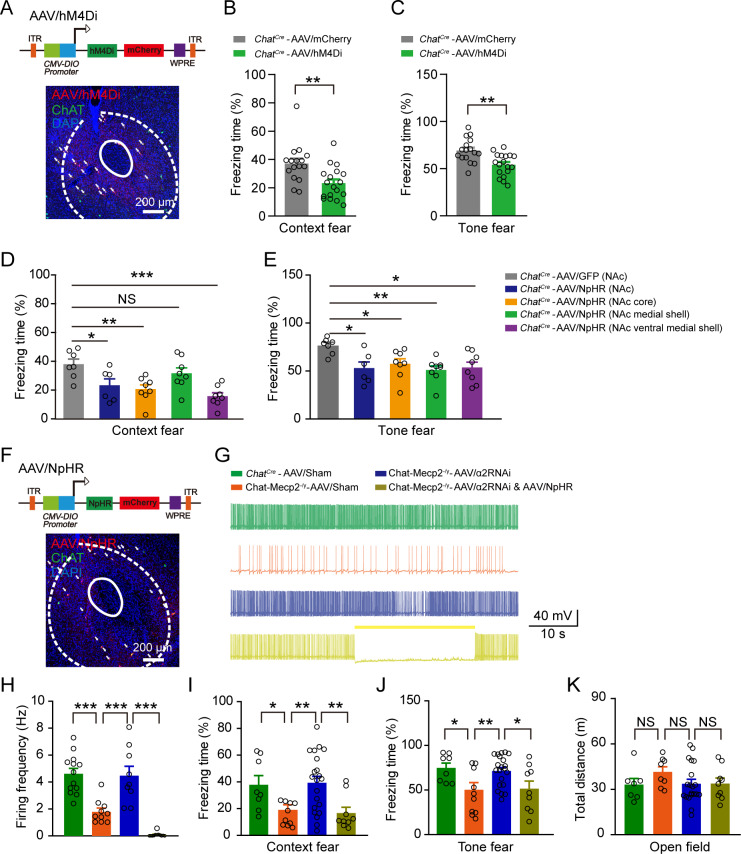
Increasing accumbens cholinergic activity during learning increased later context- and tone-evoked freezing in knockout mice, without repeating the acute manipulation at recall. Two activation approaches produced the same direction of later behavioral change.
The intervention occurred during learning, supporting a contribution to forming or consolidating associations rather than directly switching on fear during recall. Several corresponding final-training-trial comparisons were not significant, so effects differed across phases.
Source: Zhang Y et al. · eLife · CC BY
Original figure and English caption ↗
Reducing activity also weakens later responses
In control mice without the same deletion, reducing activity during learning decreased later context and tone freezing. Regional results differed, however: the medial-shell context-response comparison was not significant.
Reducing α2-related receptor expression in knockout mice improved firing and later freezing. Suppressing activity during learning on top of that intervention weakened the improvement. These combined comparisons connect receptor state, activity and behavior within the tested model and learning conditions.
Source: Zhang Y et al. · eLife · CC BY
Original figure and English caption ↗
How a molecular change can influence learning
Reducing α2-associated expression also lowered the abnormally large miniature inhibitory current amplitude, while the frequency comparison remained not significant. A separate local receptor-potentiation experiment reduced later freezing in controls. These findings connect MeCP2, inhibitory transmission and cholinergic activity across levels.
This small interneuron population may influence learning through local network regulation; effects on principal output neurons remain to be established. Findings in young adult males do not directly extend to females or establish Rett syndrome treatment efficacy. They provide a more specific cellular account of a gene-associated behavioral phenotype.
Source: Zhang Y et al. · eLife · CC BY
Original figure and English caption ↗