How thalamic circuits bring back a familiar companion
Sensory thalamic reticular nucleus contributes when mice recognize a familiar companion. A parietal–thalamic circuit and experience-tagged cells link recognition with recall that natural cues no longer readily elicit.
Can a mouse recognize a companion after time apart? A study published online in Neuron on May 2, 2024 examines the thalamic reticular nucleus, usually viewed as a gatekeeper of sensory information. Parvalbumin-related cells in its sensory sector (sTRN) contribute to familiar–novel discrimination within a pathway linking posterior parietal cortex to parafascicular thalamus. Reactivating cells tagged during a social experience also brings back discrimination a week later.
Excitatory PPC input acts through inhibitory sTRN cells to influence PF during social encoding and retrieval. Reactivating experience-tagged sTRN cells restores tested familiar–novel discrimination, and these cells have distinctive excitability, morphology and transcript profiles.
Contents · 7 sections
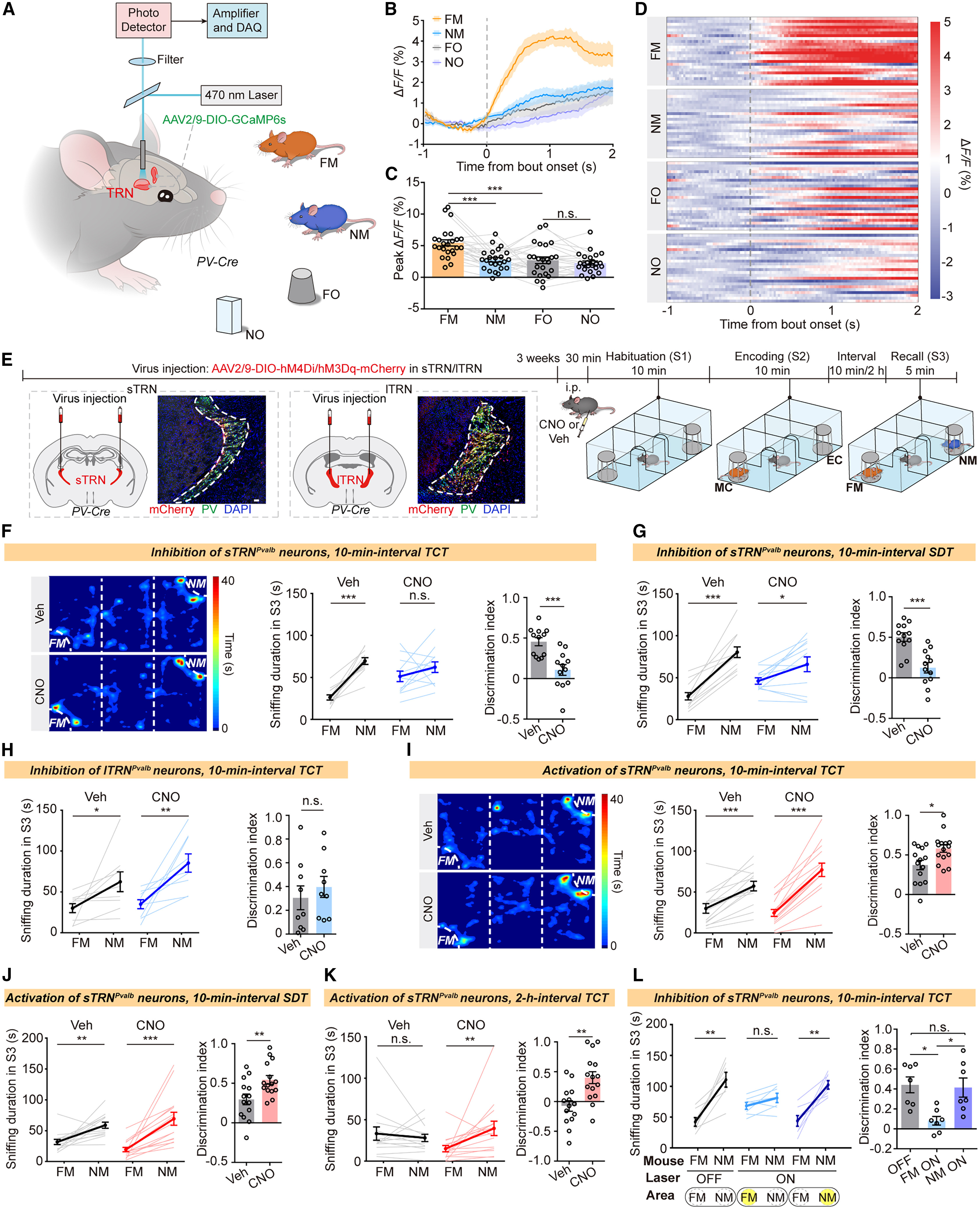
A familiar companion evokes stronger thalamic activity
TRN parvalbumin-related calcium responses are stronger for a familiar companion than a novel companion or familiar object, without the same familiar–novel object difference. Inhibiting sTRN cells reduces social discrimination, whereas limbic-TRN inhibition has no significant effect.
Activation improves discrimination, including after two hours. Inhibition during approach to the familiar companion reduces discrimination; inhibition near the novel one does not significantly change it. Basal sociability and object memory do not significantly change, tying the result to social familiarity.
Source: Feidi Wang et al. · Neuron · CC BY-NC-ND 4.0; © 2024 The Author(s). Published by Elsevier Inc.
Original figure and English caption ↗
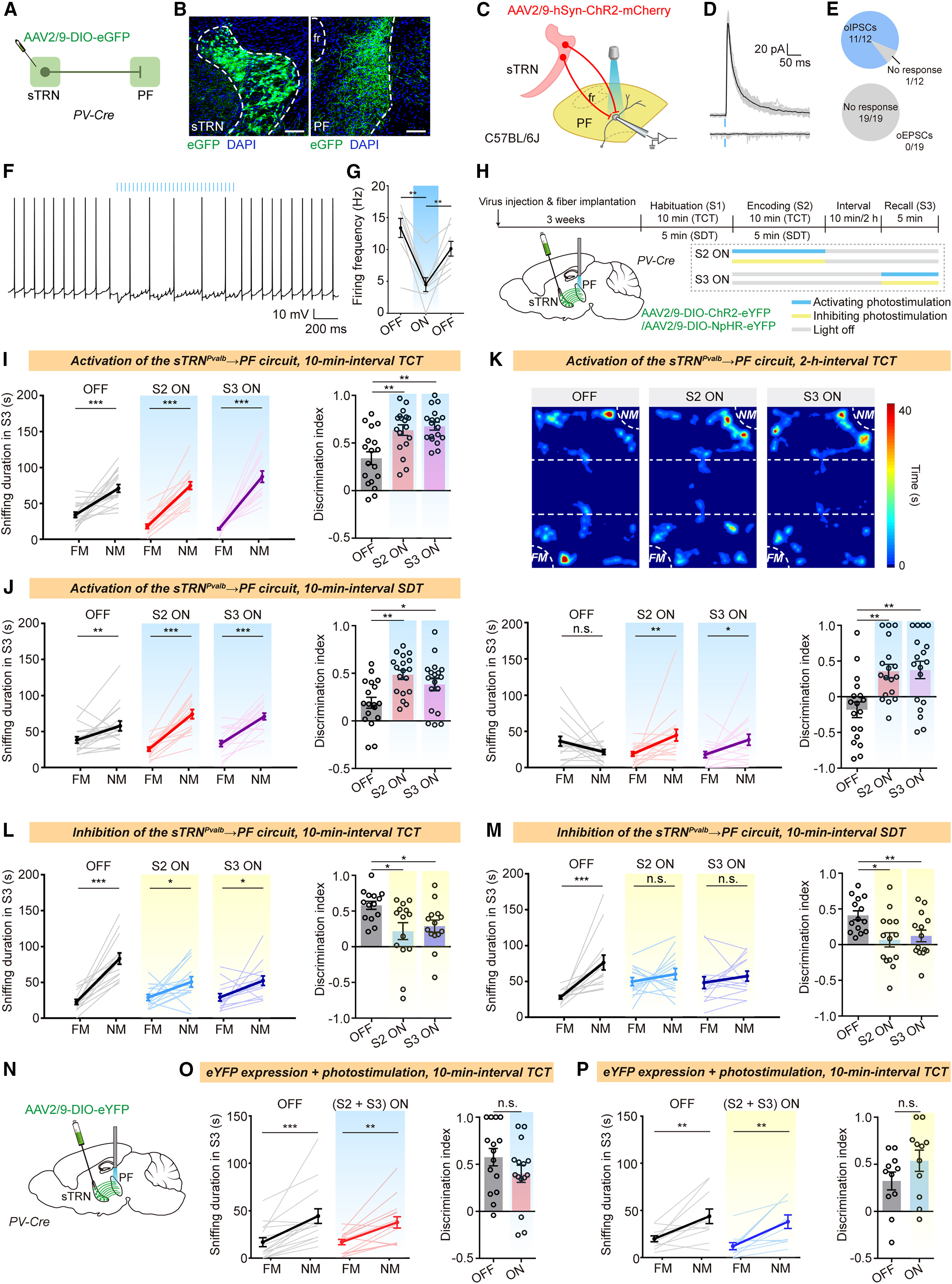
An inhibitory output supports memory performance
sTRN axons reach several thalamic regions, with dense input to parafascicular nucleus (PF). Terminal activation evokes inhibitory currents and reduces PF firing without evoked excitatory currents; supplementary evidence supports a direct GABAergic connection.
Enhancing the input during encoding or retrieval improves discrimination, while inhibition reduces it. Place preference, general sociability and object memory do not significantly change, linking this inhibitory signal to the use of particular information.
Source: Feidi Wang et al. · Neuron · CC BY-NC-ND 4.0; © 2024 The Author(s). Published by Elsevier Inc.
Original figure and English caption ↗
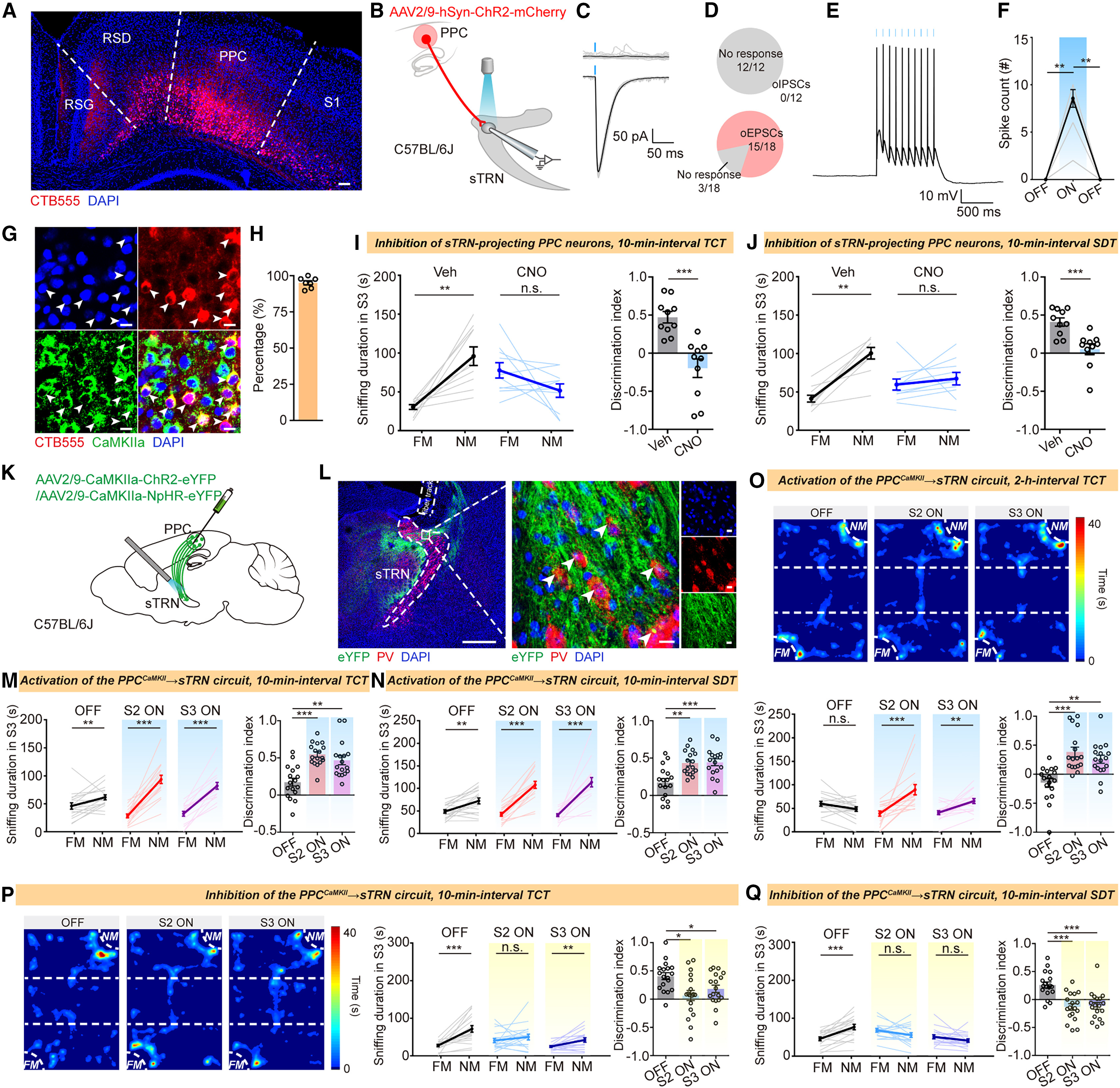
Posterior parietal cortex provides an upstream input
Tracing identifies dense sTRN-projecting cells in posterior parietal cortex (PPC), most bearing CaMKII-related labeling. Activating their axons evokes excitatory currents and increases sTRN firing, supplying an excitatory first leg before the inhibitory output.
Reducing PPC-to-sTRN input impairs discrimination, while enhancement improves encoding- and retrieval-phase performance and discrimination after two hours. A corticothalamic link associated with sensory integration thus enters the question of social familiarity.
Source: Feidi Wang et al. · Neuron · CC BY-NC-ND 4.0; © 2024 The Author(s). Published by Elsevier Inc.
Original figure and English caption ↗
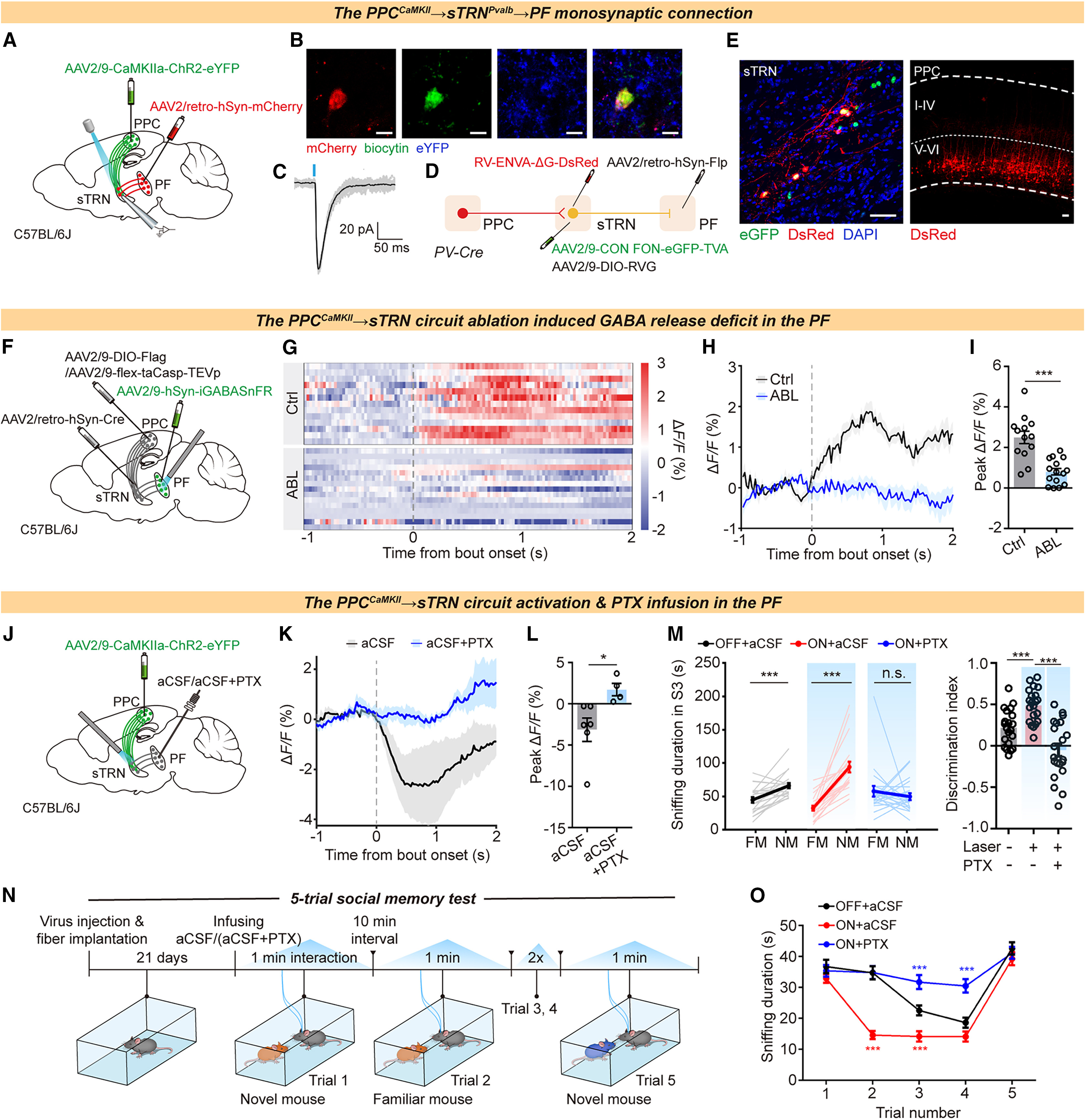
Excitation and inhibition form a connected pathway
PPC axons excite PF-projecting sTRN cells, and tracing supports the serial organization. Local PF GABA signals rise during social investigation and diminish after ablation of sTRN-projecting PPC cells, linking upstream activity with downstream inhibitory signaling.
After GABA-receptor-related transmission is blocked in PF, enhancing PPC-to-sTRN input no longer yields the earlier discrimination benefit, and habituation to repeated encounters is altered. The results connect cortical information with inhibitory gating of social memory.
Source: Feidi Wang et al. · Neuron · CC BY-NC-ND 4.0; © 2024 The Author(s). Published by Elsevier Inc.
Original figure and English caption ↗
Reactivating experience-related cells after a week
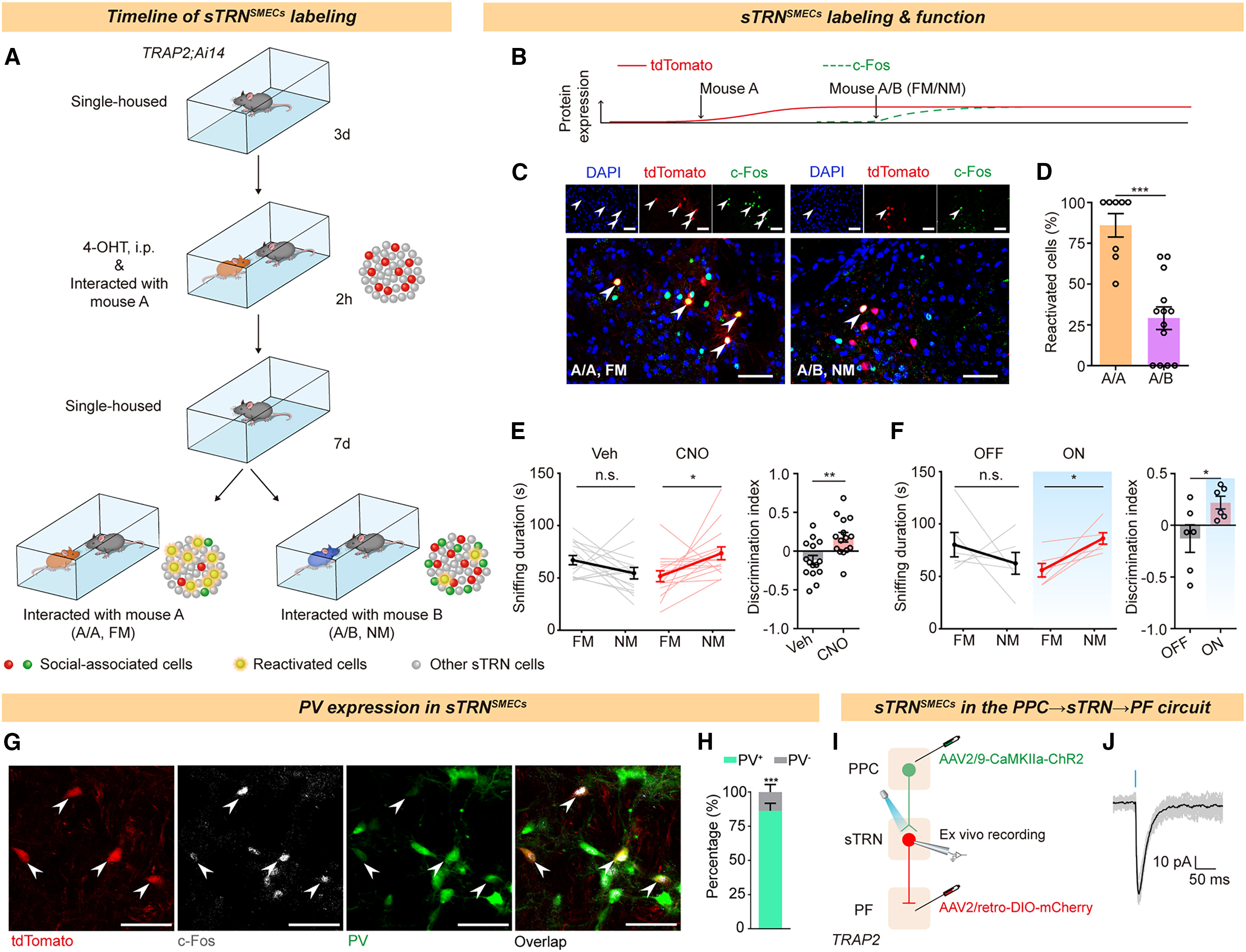
Cells active during an initial encounter are tagged in sTRN. A later encounter with the same mouse reactivates more of them than an encounter with another mouse. After a week apart, reactivation restores discrimination that natural cues no longer clearly elicit.
Most tagged cells bear PV labeling, and some receive PPC excitation while projecting to PF. This links the experience-related population with the circuit and suggests a distinction between difficult retrieval and complete loss of information.
Source: Feidi Wang et al. · Neuron · CC BY-NC-ND 4.0; © 2024 The Author(s). Published by Elsevier Inc.
Original figure and English caption ↗
Experience-tagged cells have distinct electrical and structural features
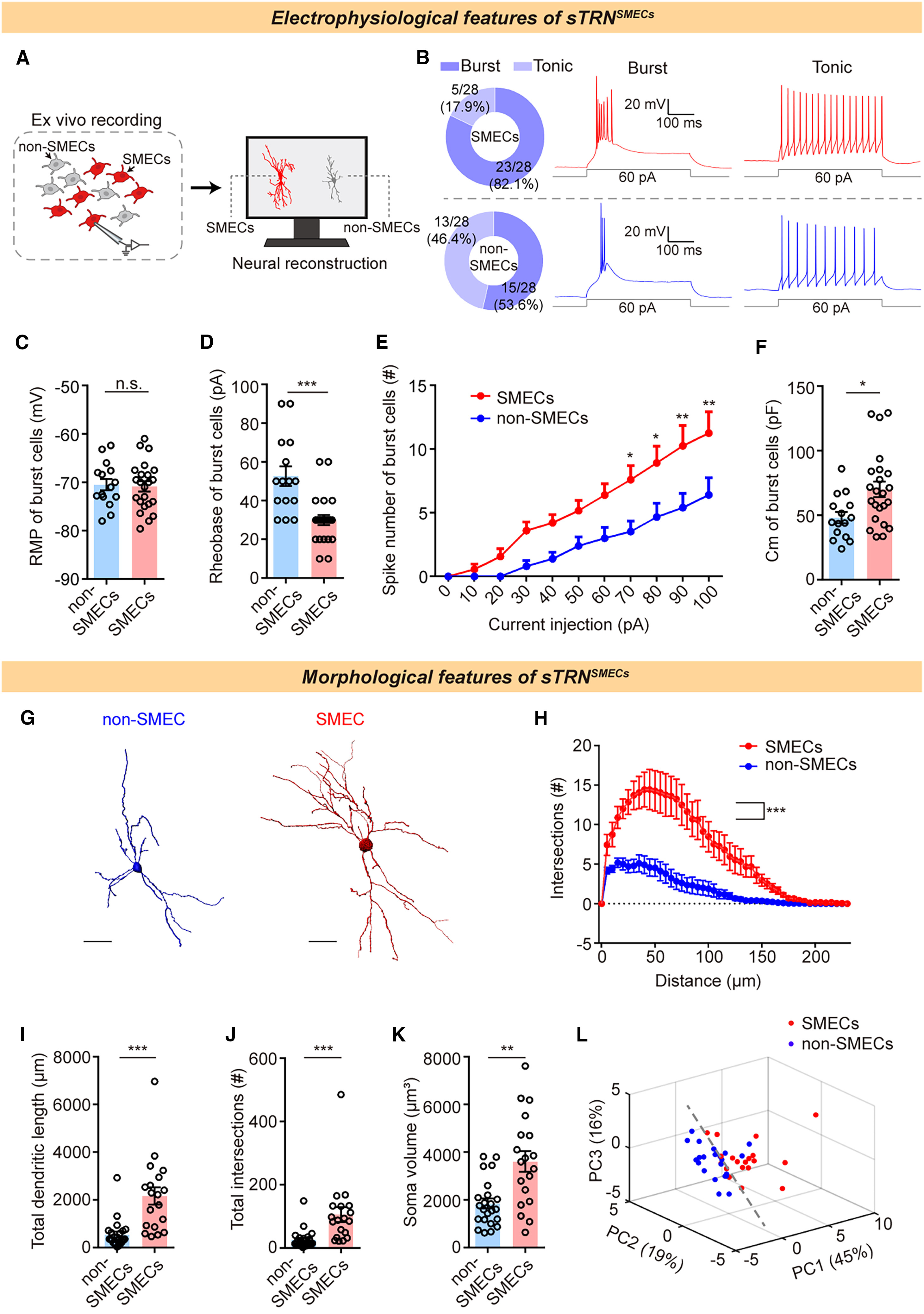
Tagged cells more often show burst firing. Within burst-firing cells, they have lower rheobase, more spikes and greater capacitance, but no significant resting-potential difference. Reconstructions reveal more complex, longer dendrites and larger somata.
Source: Feidi Wang et al. · Neuron · CC BY-NC-ND 4.0; © 2024 The Author(s). Published by Elsevier Inc.
Original figure and English caption ↗
Familiarity links molecules, cells and circuits
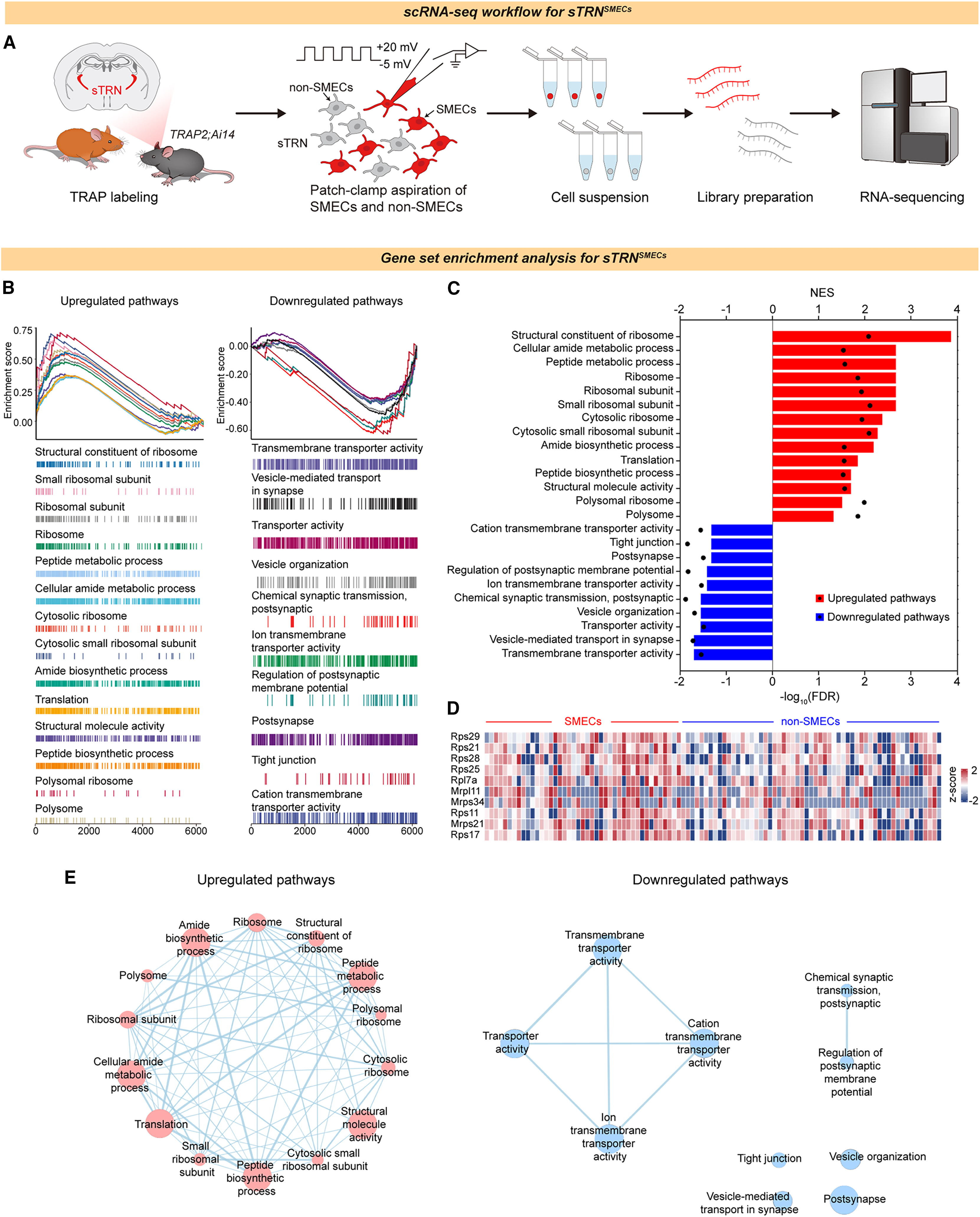
Tagged cells show enrichment of ribosome-, peptide-synthesis- and translation-related gene sets, suggesting greater engagement of protein-synthesis programs. These are transcript profiles; their causal role in maintaining memory remains to be tested.
Engram research has often focused on excitatory cells, with inhibitory cells considered regulators. These findings bring long-range inhibitory cells closer to experience-related traces, connecting the regulation of information flow with its potential retention.
Most experiments use male mice aged eight to thirteen weeks, with females included in selected sTRN-inhibition behavioral tests. The findings bring long-range inhibitory cells into the study of social-memory traces. Task arousal does not change significantly, while home-cage sleep and some whisker responses are affected, placing memory within this region’s broader functions.
Source: Feidi Wang et al. · Neuron · CC BY-NC-ND 4.0; © 2024 The Author(s). Published by Elsevier Inc.
Original figure and English caption ↗