How does an epileptic network develop? A stage-specific role for ventral subiculum–anterior thalamus
A male-mouse study finds that a hippocampal output can accelerate or slow epileptogenesis. The same modulation has little effect on established generalized seizures after full kindling.
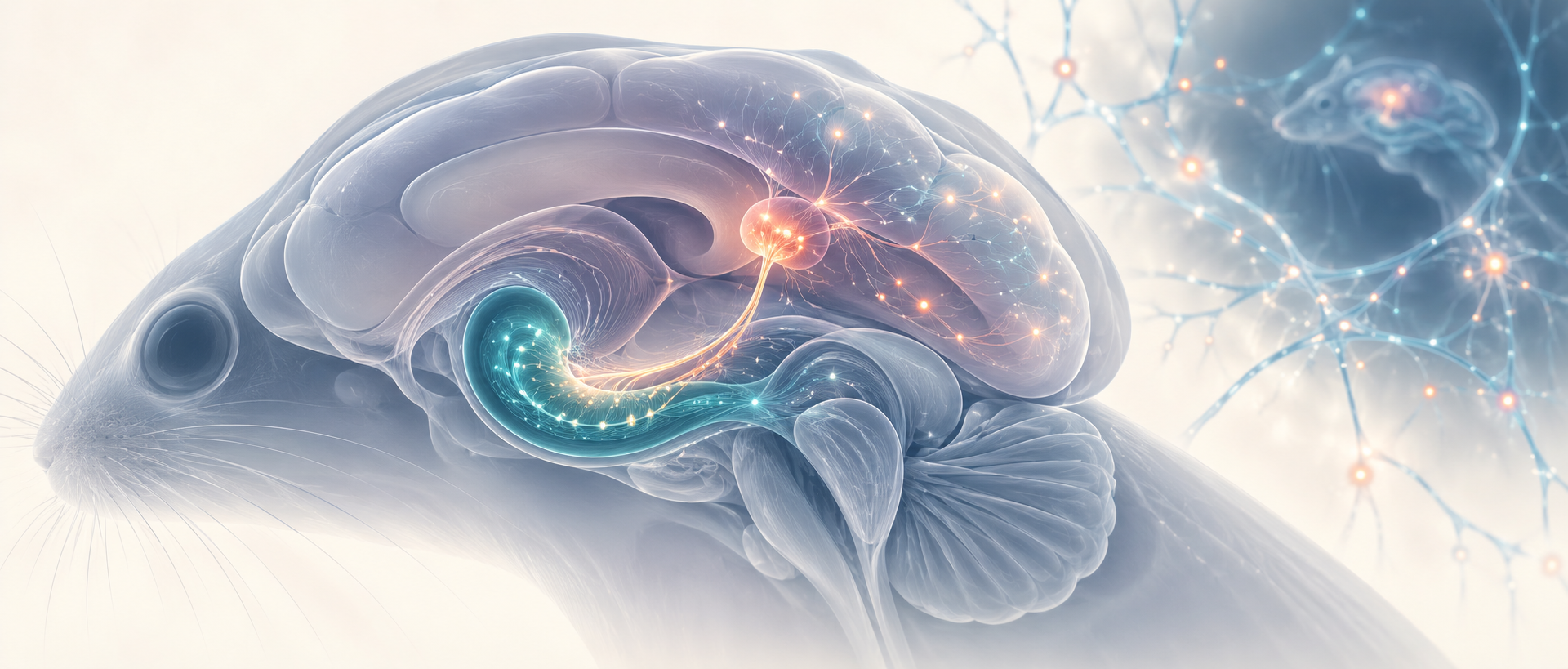
How does a seizure lead toward a network state more prone to further seizures? Following this development requires separating emerging changes from established events. A 2025 Communications Biology study focuses on ventral subiculum (vSub), a major hippocampal output. Its glutamatergic cells are active during kindling; enhancement accelerates progression and suppression slows it. Anterior thalamic nuclei (ATN) emerge as an important downstream route, with a distinctly stage-dependent role.
vSub glutamatergic cells and their ATN output bidirectionally affect kindling progression. Sustained suppression also delays the first recorded generalized seizure in a KA model, while established fully kindled seizures remain largely unchanged.
Contents · 6 sections
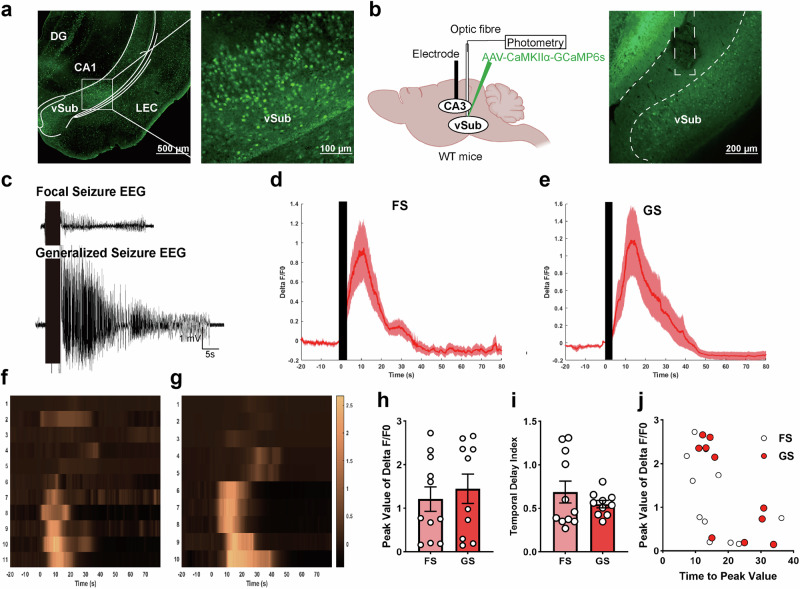
Subiculum is recruited in focal and generalized events
Kindling progresses from milder focal to generalized seizures. vSub glutamatergic calcium signals rose during both, with comparable peaks and relative timing rather than a simple increase with seizure stage. Tissue activity labeling more clearly exceeded controls after generalized events.
The subiculum distributes hippocampal information to cortical and subcortical regions, placing it along routes of abnormal activity spread. Recruitment during seizures could reflect either a driver or a consequence, motivating interventions to test whether changing its activity altered network development.
Source: Gong Y et al. · Communications biology · CC BY-NC-ND
Original figure and English caption ↗
Enhanced subicular activity advances kindling
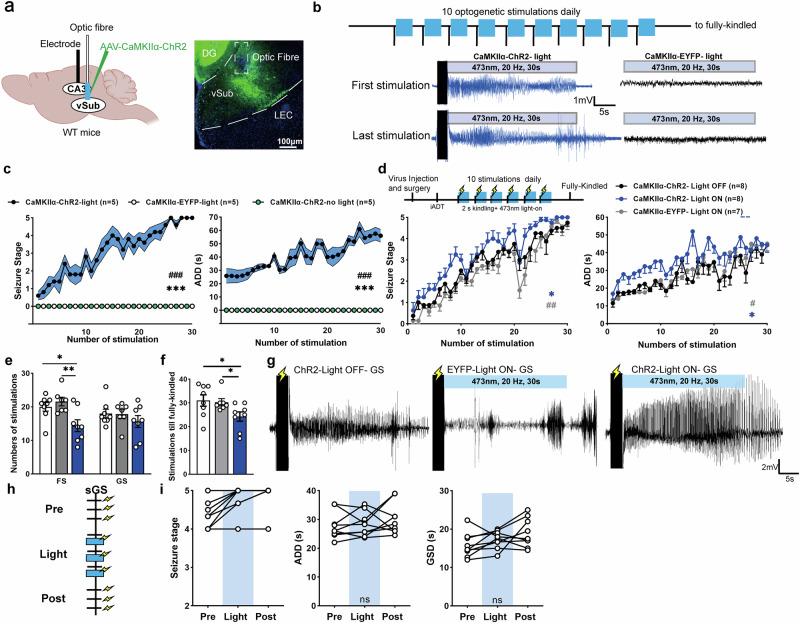
Repeated enhancement of vSub glutamatergic cells in initially unkindled animals produced progression from focal to more severe stages with longer afterdischarges. Enhancement during electrical hippocampal kindling also accelerated progression and reduced the stimulation needed for full kindling, supporting a driving contribution.
In fully kindled mice, further enhancement did not clearly change stage, afterdischarge duration or generalized-seizure duration. The same population had different roles during and after network development. A node affecting progression need not equally determine the expression of each established seizure.
Source: Gong Y et al. · Communications biology · CC BY-NC-ND
Original figure and English caption ↗
Suppression works chiefly during progression
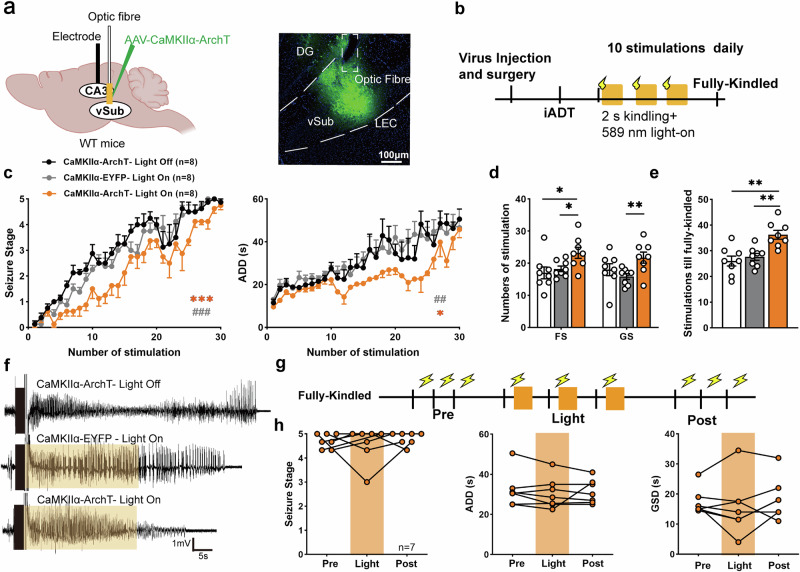
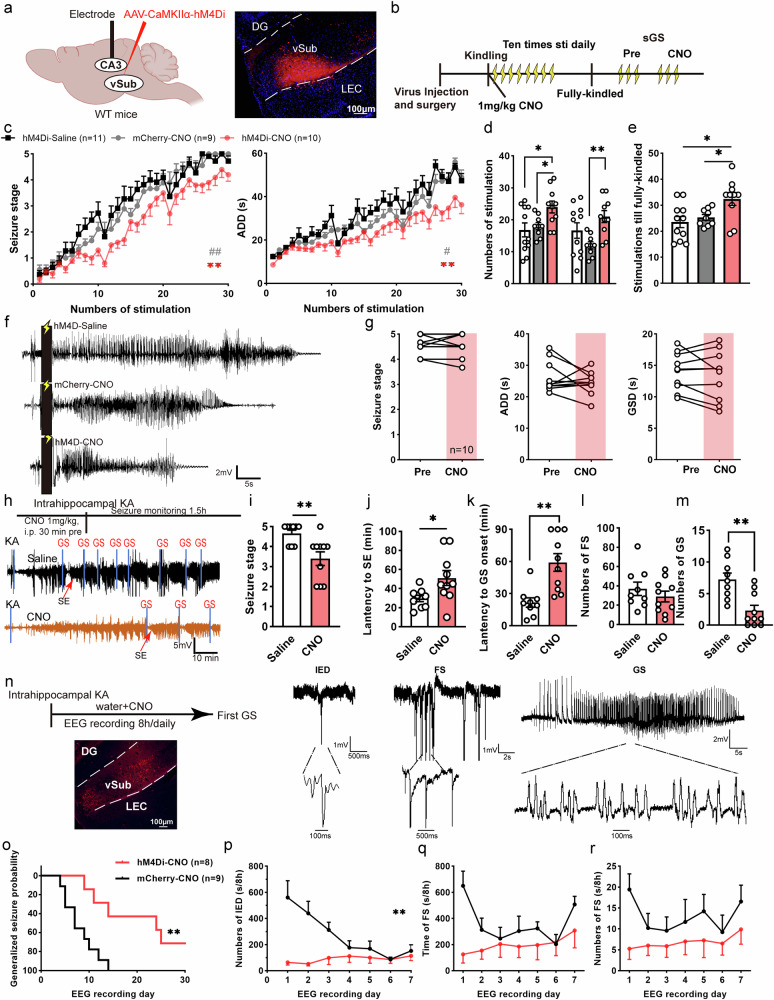
Suppressing vSub glutamatergic cells slowed kindling, shortened afterdischarges and prolonged the focal stage. Sustained cellular suppression produced changes in the same direction. Opposite manipulations converged on a contribution to progression rather than merely altering an instantaneous signal.
Suppression after full kindling likewise did not clearly reduce established generalized-seizure stage or duration. Progression effects alongside mature-stage stability defined a temporal role, showing that abnormal networks need not use the same nodes identically throughout their development.
Source: Gong Y et al. · Communications biology · CC BY-NC-ND
Original figure and English caption ↗
The first recorded generalized seizure occurs later
In the acute KA model, sustained suppression reduced the highest observed stage, delayed status epilepticus and the first generalized seizure, and reduced generalized-event counts. Focal-event counts remained broadly unchanged, concentrating the effect on severe-event emergence and frequency.
Daily EEG follow-up in the chronic KA model showed a longer interval to the first recorded generalized seizure and fewer interictal discharges during the first week, with comparable focal-event counts and duration. This extended the progression evidence beyond kindling to another network-development context.
Source: Gong Y et al. · Communications biology · CC BY-NC-ND
Original figure and English caption ↗
The anterior thalamic route differs from other outputs
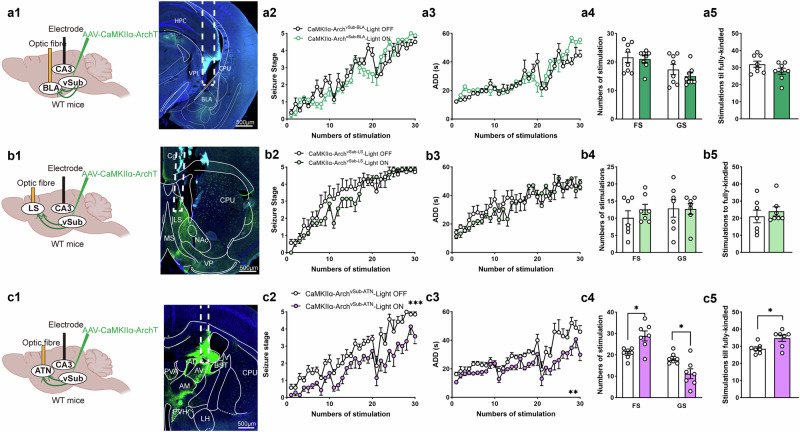
vSub projects to accumbens, bed nucleus, lateral septum, anterior thalamus and other sites. Comparing basolateral amygdala, lateral septum and ATN routes showed that ATN-terminal suppression slowed kindling and shortened afterdischarges, while the other two lacked equivalent effects.
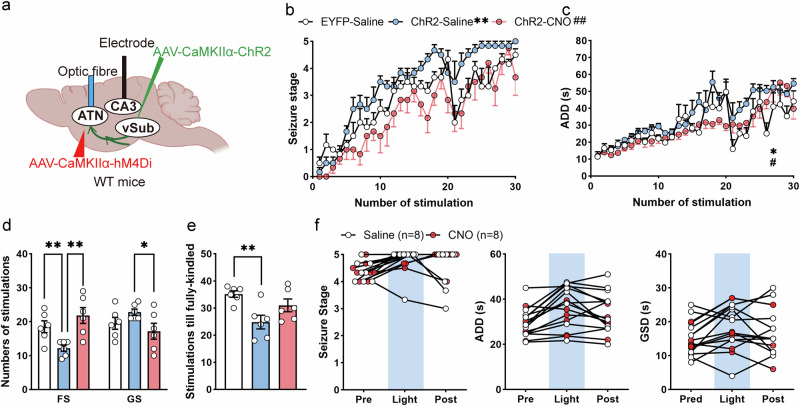
Enhancing vSub–ATN terminals accelerated stage and afterdischarge progression; simultaneous suppression of ATN glutamatergic cells reversed these effects. Joint upstream/downstream modulation supported a hippocampal–thalamic contribution, retaining the same stage specificity in fully kindled animals.
Source: Gong Y et al. · Communications biology · CC BY-NC-ND
Original figure and English caption ↗
Development has its own influential nodes
The study moves vSub from an active seizure-associated output to a functional contributor to network-development speed. ATN brings cooperation beyond hippocampus into view. Bidirectional and combined interventions show that epileptogenesis and established seizure expression can depend on different circuit contributions.
The evidence concerns adult male mice in kindling and KA models, with possible contributions from neighboring viral spread. It establishes stage-specific circuit effects in these models rather than human intervention outcomes. The central question is concrete: which outputs help an abnormal network develop, and which change their role afterward?
Source: Gong Y et al. · Communications biology · CC BY-NC-ND
Original figure and English caption ↗