How can a quiet sound soften a mouse’s startle?
In male Parkinson-like mice, tested movement remained comparable while a quiet sound lost some of its ability to soften a subsequent startle. An inferior-collicular–nigral connection helps explain this sensory filtering.
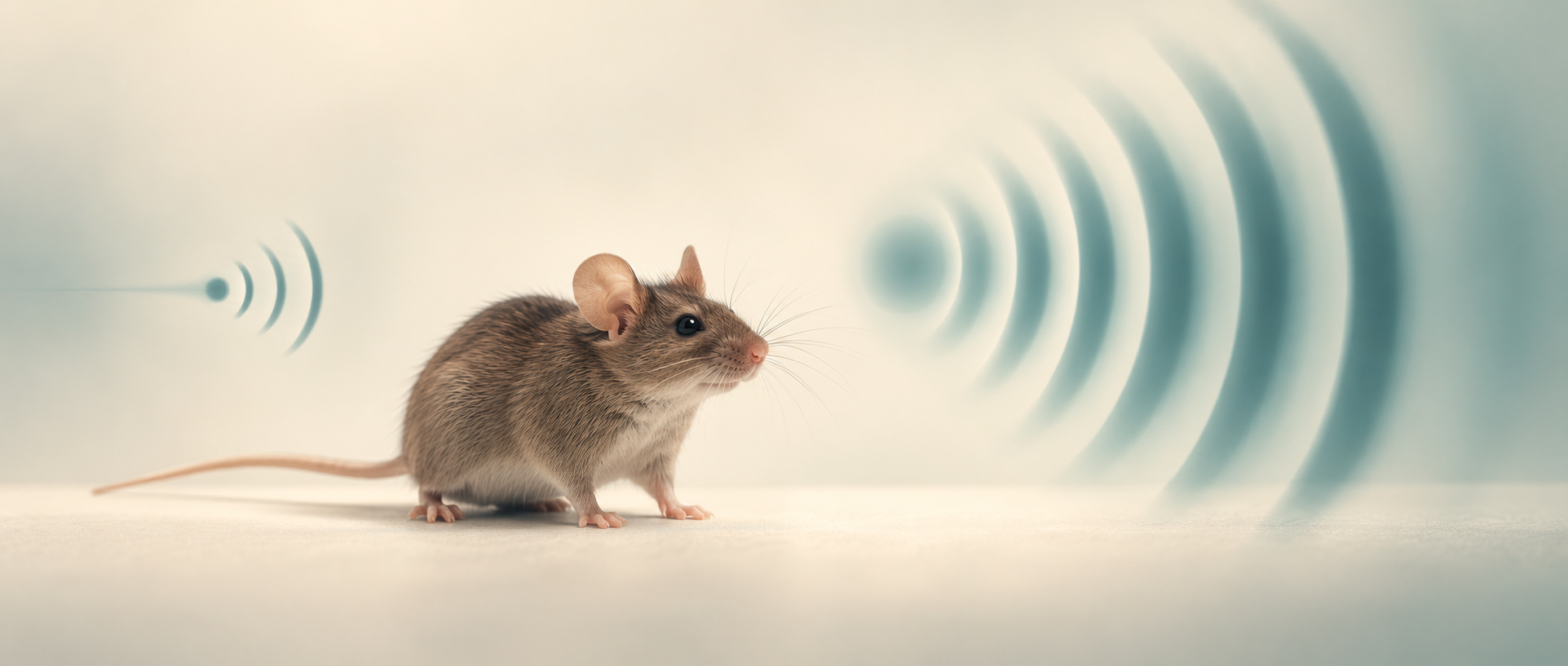
A sudden bang makes a mouse startle. When a quieter sound comes first, the same loud stimulus usually elicits a smaller jump—as though the nervous system had a brief chance to prepare. This is prepulse inhibition, or PPI. A 2026 npj Parkinson’s Disease study found weaker modulation in male MPTP mice even while grip, locomotion and basic-startle tests remained comparable with controls. Following auditory signals into the brain led the team to a connection between auditory midbrain and nigral dopamine cells.
Nigral cells associated with inferior-collicular input contribute to PPI: reducing their activity weakens gating in normal mice, while increasing it attenuates the deficit in MPTP mice.
Contents · 6 sections
The loud sound is unchanged; the quiet one matters
PPI concerns how much a weak preceding sound reduces the response to a stronger one. Sound still arrives and muscles can still contract, but the nervous system adjusts the response according to their sequence. Comparing a loud sound alone with the quiet–loud pair reveals this modulation.
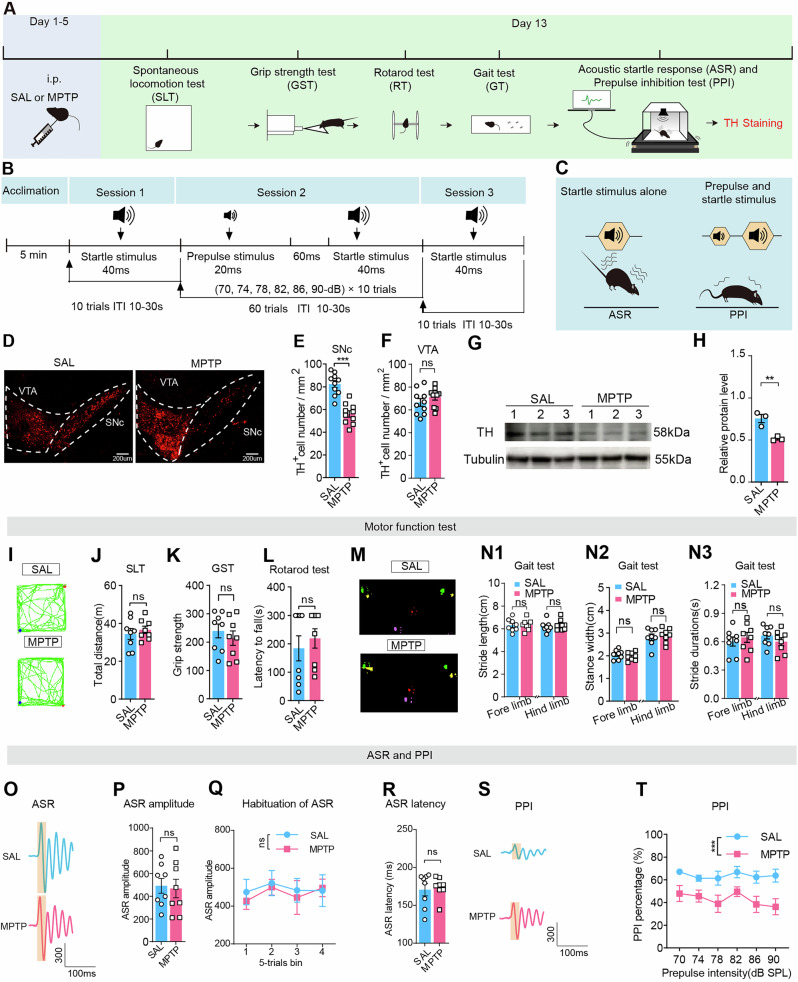
MPTP treatment reduced TH-positive cells in substantia nigra pars compacta, SNc. Locomotion, grip, rotarod and gait showed no significant group differences, as did the amplitude and latency of startle to a loud sound alone. The change appeared when sounds were paired: the weak sound became less effective at reducing startle, lowering PPI before differences emerged in these motor tests.
Source: Peng X et al. · NPJ Parkinson's disease · CC BY-NC-ND
Original figure and English caption ↗
Nigral cells also participate in auditory preparation
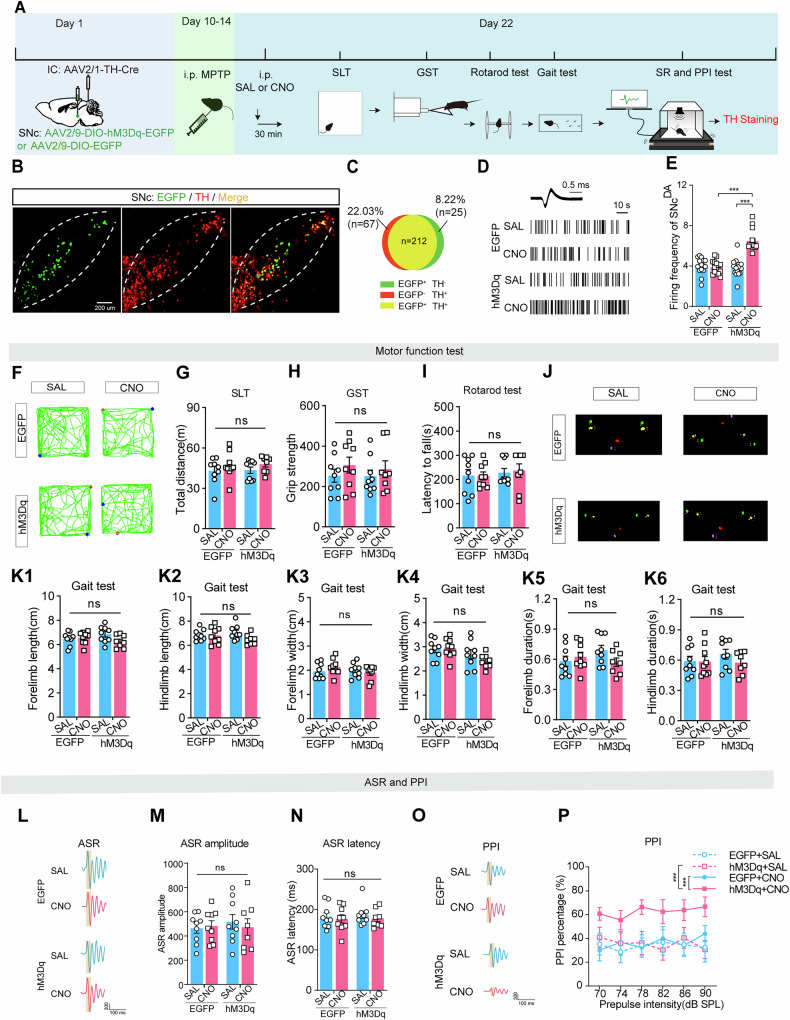
Nigral dopamine cells are often associated with movement. Here they entered a different setting: suppressing them in normal mice lowered PPI without corresponding significant changes in basic startle or tested movement. The loud sound could still startle the animals; the earlier quiet sound simply became less effective.
The opposite intervention produced a complementary result. Increasing this population’s activity in MPTP mice raised PPI while motor and basic-startle comparisons remained nonsignificant. These opposing effects linked nigral activity with sensory filtering and raised a more specific question: where does the auditory input arrive from?
Inferior colliculus connects an auditory network to SNc
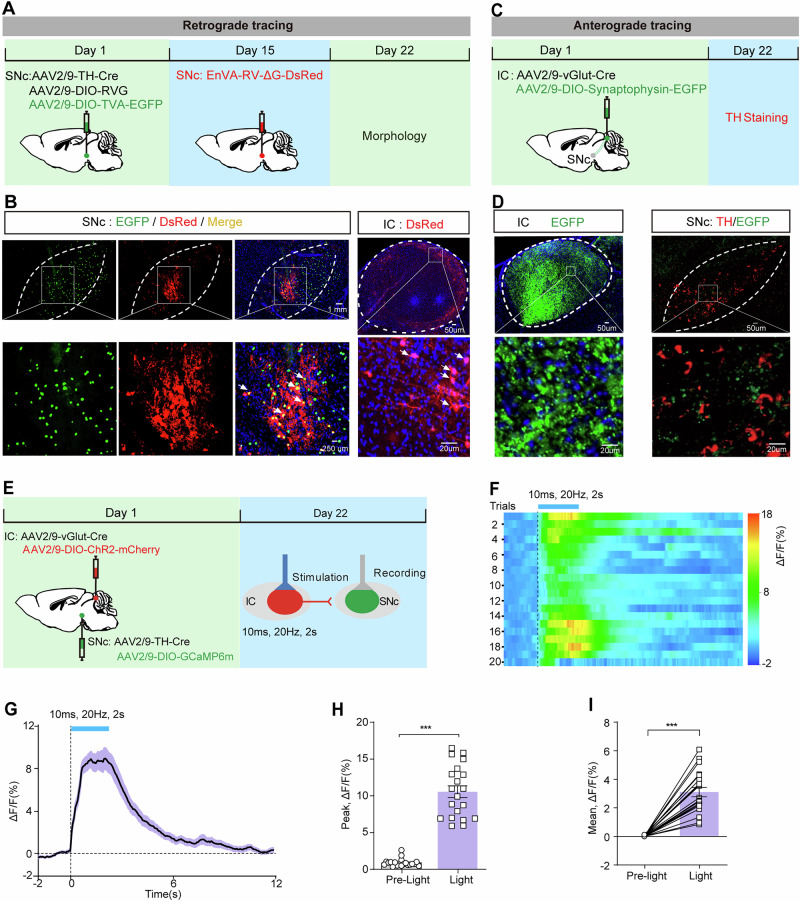
Tracing brought inferior colliculus, IC, into view. Glutamatergic cells in this auditory midbrain region showed direct anatomical connections with dopamine-associated SNc cells, alongside IC terminals in SNc. This supplies a connection between auditory processing and nigral cells that does not first require a cortical relay.
Stimulating the IC population increased SNc calcium signals, including peak and mean responses. Anatomical contact and downstream responsiveness pointed to a clear next question: do nigral cells associated with this input participate in the quiet sound’s modulation of startle?
Source: Peng X et al. · NPJ Parkinson's disease · CC BY-NC-ND
Original figure and English caption ↗
Input-associated cells can change PPI
The team then targeted SNc cells associated with IC input. Suppression lowered PPI in normal mice, whereas activation raised it in MPTP mice, with motor and basic-startle measures largely comparable. This joined the preceding observations: IC connects to SNc, and the input-associated population can alter prepulse modulation.
These cells form a relay: input arrives from auditory midbrain and output can influence other networks. Manipulating their somata tests the relay’s contribution, potentially engaging several outputs. The researchers next followed the nigral connections toward the brainstem.
Source: Peng X et al. · NPJ Parkinson's disease · CC BY-NC-ND
Original figure and English caption ↗
Brainstem activity changes when sounds are paired
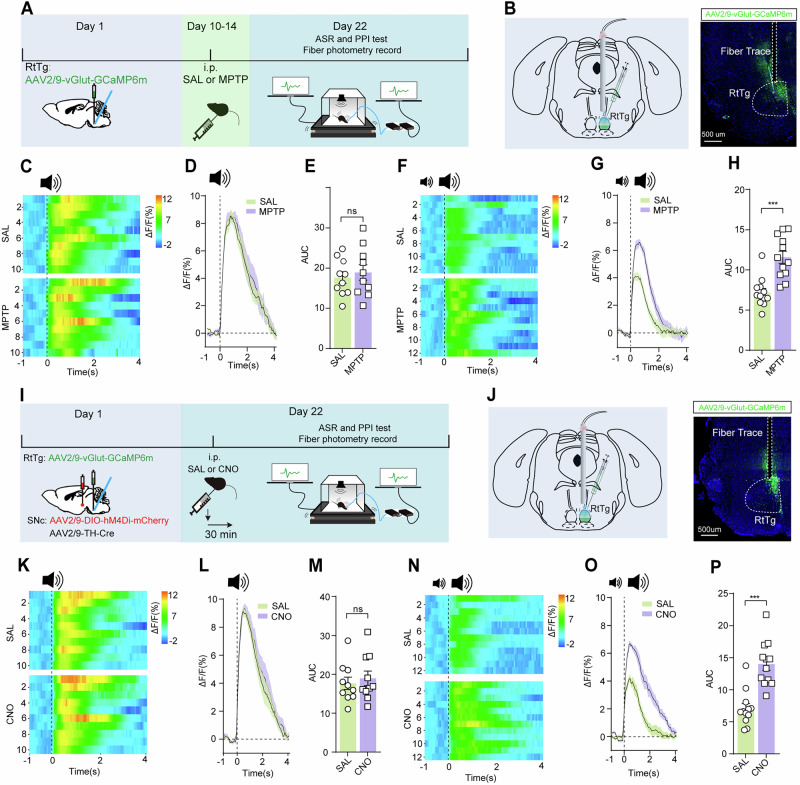
RtTg glutamatergic calcium responses showed no significant MPTP–control difference during startle to a loud sound alone, but were lower in MPTP mice during PPI. SNc inhibition produced a similar separation: comparable basic-startle responses and reduced activity under prepulse conditions.
Tracing found SNc terminals and RtTg-projecting cells in PPN. Suppressing PPN-projecting SNc cells also lowered PPI, linking auditory input, SNc and pontine networks. PPN contains several cell types; identifying the recipients that carry signals onward to RtTg remains an open part of this relay.
Source: Peng X et al. · NPJ Parkinson's disease · CC BY-NC-ND
Original figure and English caption ↗
What changes first may be the relationship between stimuli
The striking finding is that basic responses to a loud sound and tested movement remained comparable, while the influence of one sound on the next changed. Nigral involvement thus extends beyond movement speed to how the brain uses recently received information. The IC–SNc connection grounds this brief sensory filtering in identifiable cells and connections.
These findings describe gating in male MPTP mice. Human Parkinson’s disease develops over a longer course, and PPI can change in several disorders, so its clinical significance requires independent study. What this work establishes is a contribution from auditory input and cooperating nigral–brainstem networks to how a quiet sound softens startle.