Before digging becomes fragmented: early cortico-striatal decoupling in PD-like mice
Two regions remain active while their timing changes. A mouse study connects early digging-related misalignment with striatal D1R cells and dopamine modulation.
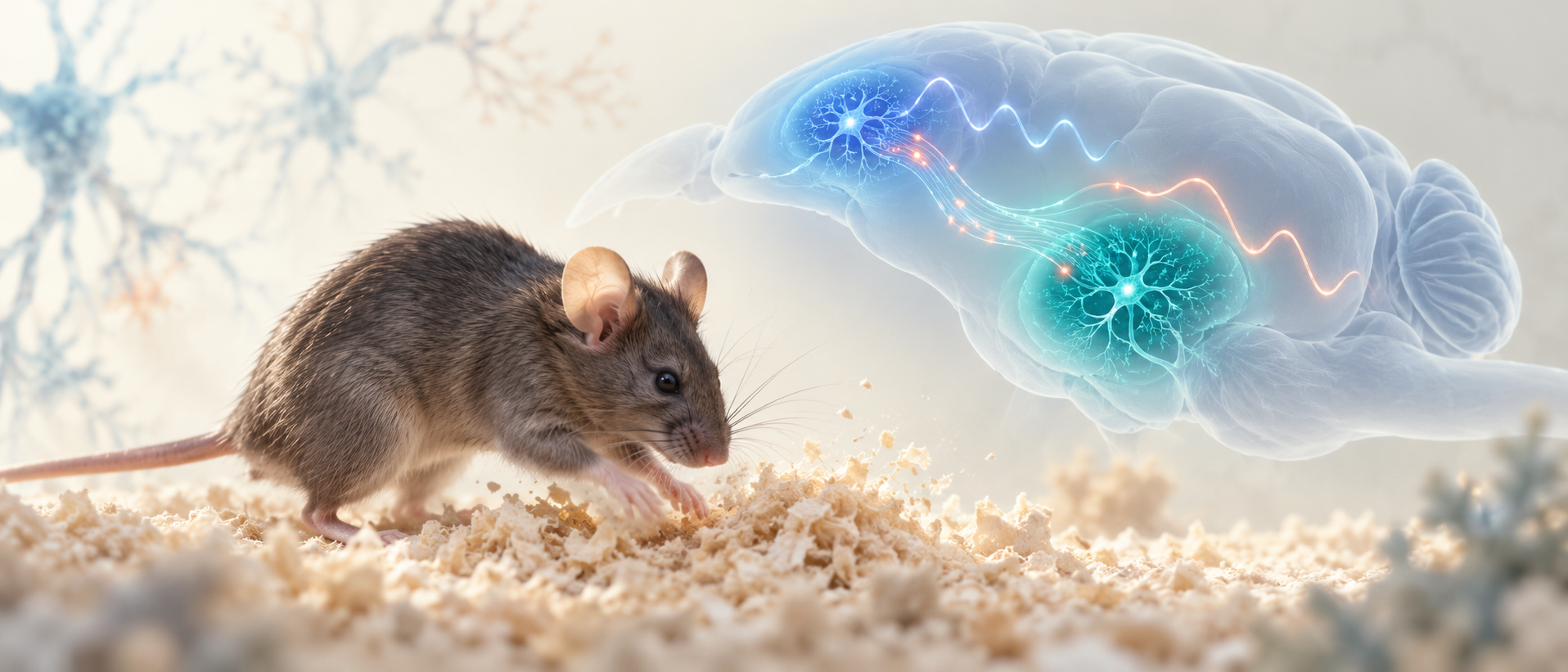
A mouse digs through bedding to retrieve buried food. Sustained, connected actions require cooperation between brain regions. An Advanced Science study published online in late 2025 follows primary motor cortex (M1) and dorsal striatum in an α-synuclein fibril (PFF) PD-like model. Their activity becomes misaligned before digging clearly shifts toward short, frequent bouts. The change favors one behavior and one cell class, placing early dysfunction in coordination rather than only overall activity.
Digging-related cortico-striatal decoupling appears two months after PFF, primarily involving D1R medium spiny neurons. Manipulating synchrony bidirectionally affects digging, and D1 receptor activation improves selected coordination and behavioral measures.
Contents · 6 sections
The same regions cooperate differently across actions
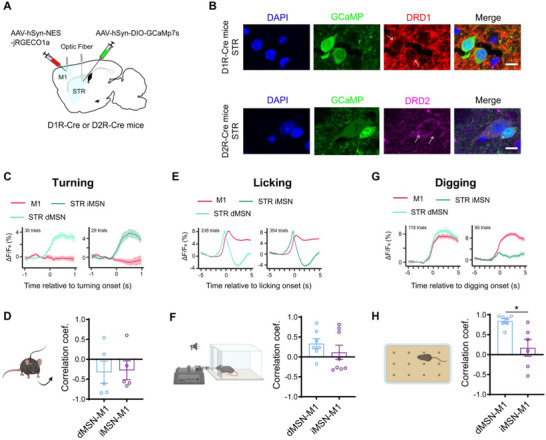
Simultaneous M1/striatal observation compared turning, licking and digging. Turning activated striatum with modest M1 suppression. Licking activated both with distinct time courses. Digging produced closely aligned sustained responses. Cooperation thus varied with the action rather than remaining a fixed regional property.
Cell identity sharpened the distinction. D1R- and D2R-expressing medium spiny neurons responded comparably during turning and licking, but D1R cells aligned more strongly with M1 during digging while D2R responses were weaker. Contributions depended on the behavior.
Source: Yao XR et al. · Advanced science (Weinheim, Baden-Wurttemberg, Germany) · CC BY
Original figure and English caption ↗
Pathology appears before clear motor decline
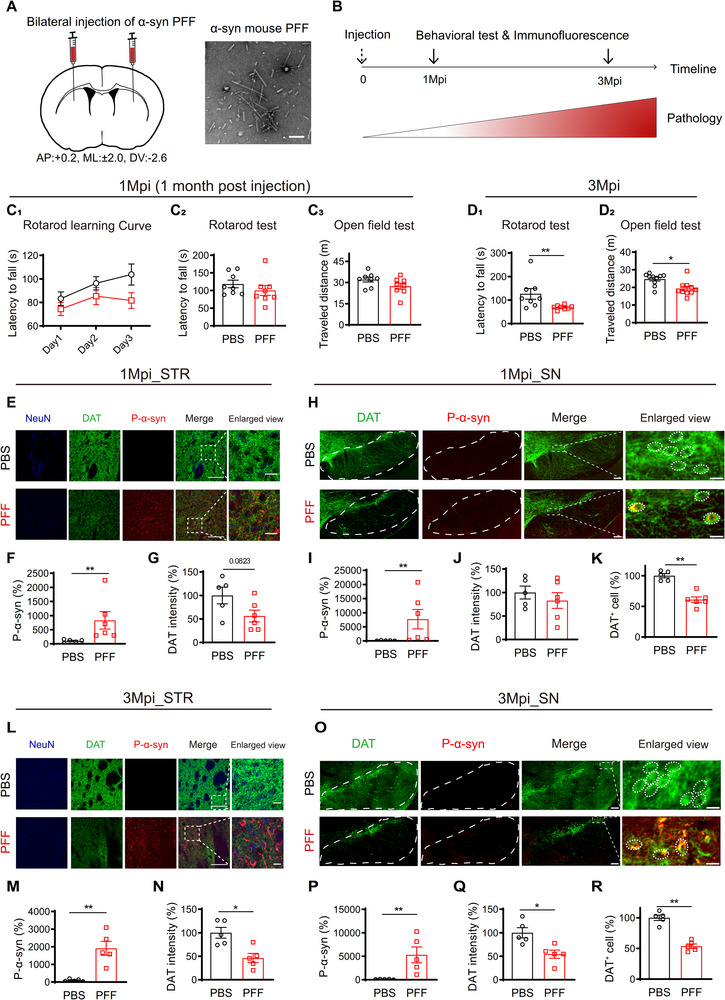
Phosphorylated α-synuclein increased in striatum and substantia nigra in the PFF model. At one month, rotarod performance and general locomotion remained broadly unchanged; by three months, rotarod latency and open-field distance declined clearly. Different pathology and behavior timelines created a window to examine earlier network changes.
Dopamine-transporter-related labeling also changed over time, indicating dopaminergic involvement. Reduced labeling can reflect diminished expression and cellular vulnerability as well as cell number. The progression shifted attention toward when motor regions first began to coordinate less effectively.
Source: Yao XR et al. · Advanced science (Weinheim, Baden-Wurttemberg, Germany) · CC BY
Original figure and English caption ↗
Amplitudes remain while timing changes first
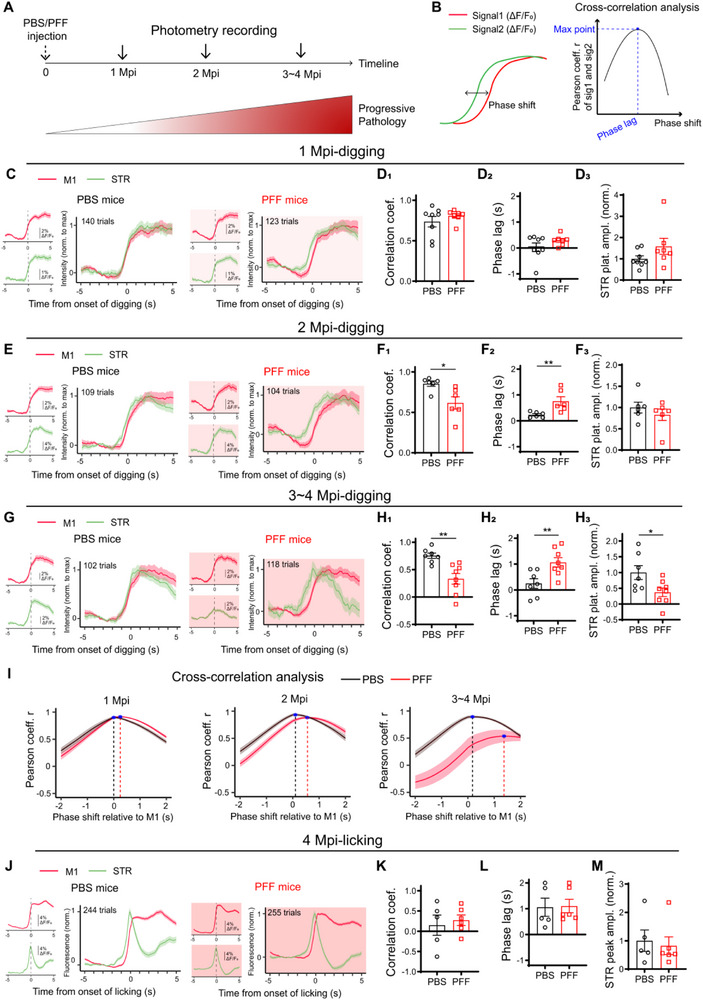
At one month, digging-related M1–striatal activity remained close to controls. By two months, correlation fell and temporal misalignment increased while overall cortical and striatal amplitudes remained comparable. At three to four months, decoupling worsened and striatal amplitude declined, making timing informative beyond signal strength.
Licking coordination remained broadly preserved even at four months. Digging later became shorter and more frequent, with lower retrieval success; lag and correlation related to these changes. The early dysfunction was thus specific to a behavior requiring sustained forelimb coordination rather than all actions failing together.
Source: Yao XR et al. · Advanced science (Weinheim, Baden-Wurttemberg, Germany) · CC BY
Original figure and English caption ↗
Misalignment causes difficulty; synchrony improves model performance
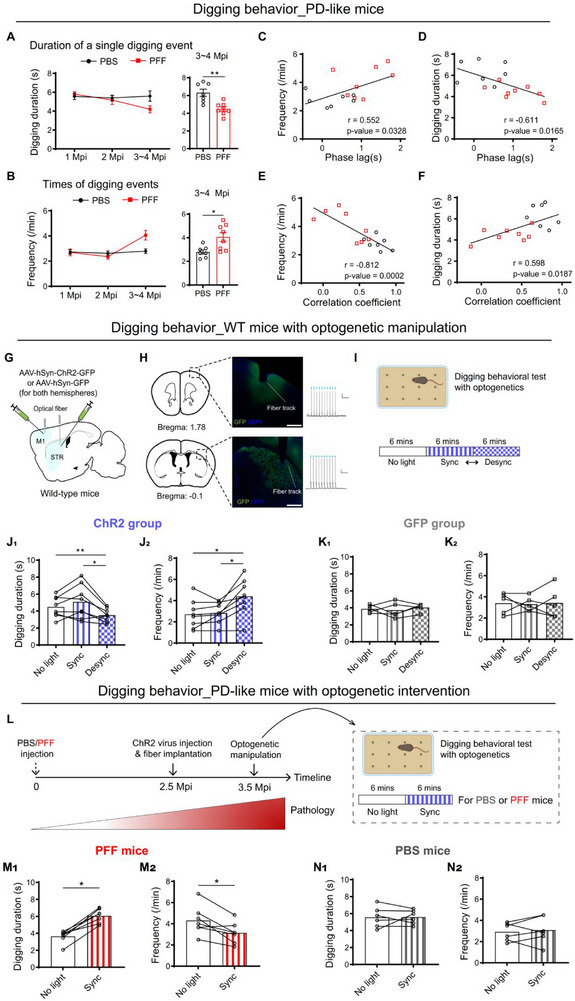
In controls, enhancing either region alone or both synchronously did not clearly alter digging. Desynchronized stimulation shortened bouts and increased frequency, resembling PFF fragmentation. Activity in both sites did not alone guarantee fluent action; their temporal cooperation mattered functionally.
Enhancing synchrony in PFF mice improved digging duration and frequency, without equivalent effects in controls. Bidirectional results connected observed decoupling with behavior. Synchrony influenced an existing coordination difficulty rather than generally improving normal performance.
Source: Yao XR et al. · Advanced science (Weinheim, Baden-Wurttemberg, Germany) · CC BY
Original figure and English caption ↗
Early changes concentrate in D1R cells
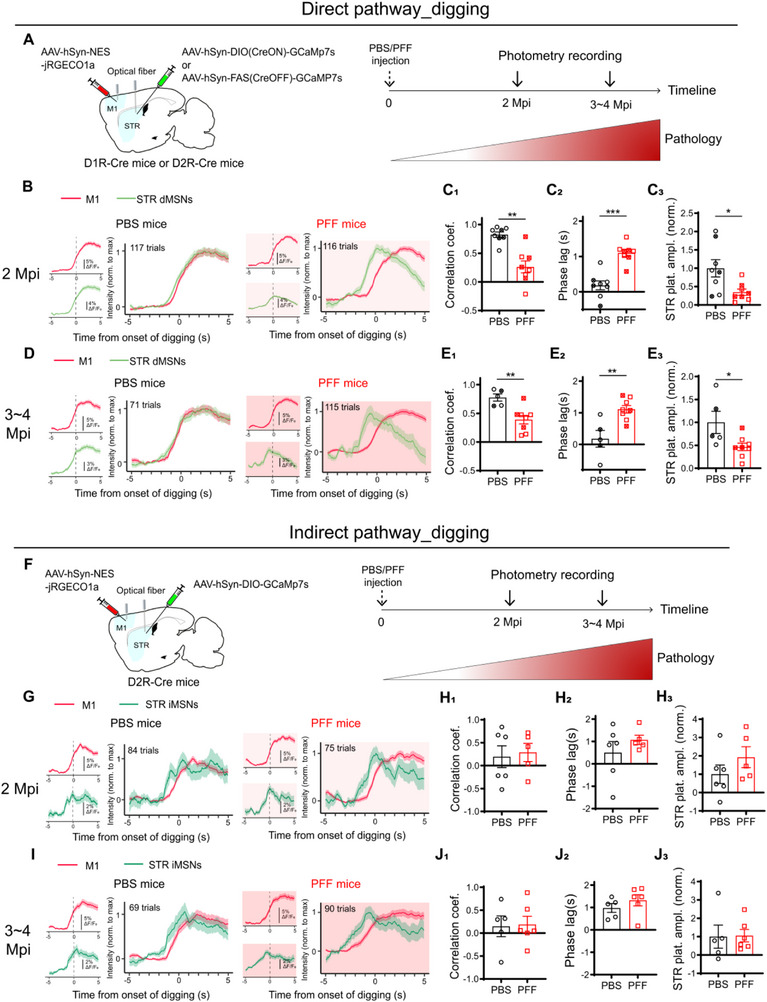
At two months, D1R medium spiny neurons already showed weaker coordination with M1 and reduced amplitudes. Corresponding D2R relationships remained more stable, and neither class showed matching licking changes. Behavior-specific analysis exposed differences hidden in overall signals.
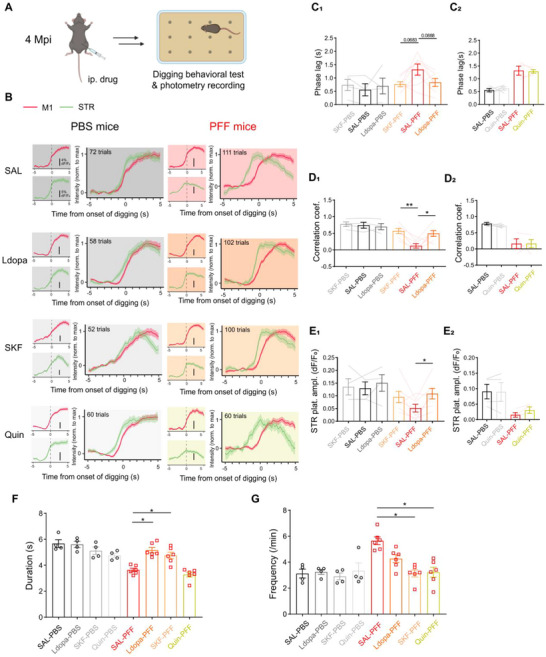
L-DOPA and a D1 agonist increased digging-related interregional correlation and improved selected digging measures. Phase lags trended shorter without clear changes in every comparison. D2 treatment lacked comparable restoration of coordination and sustained digging, showing measure- and pathway-dependent pharmacological effects.
Source: Yao XR et al. · Advanced science (Weinheim, Baden-Wurttemberg, Germany) · CC BY
Original figure and English caption ↗
Early dysfunction may hide within a particular action
Digging requires sustained forelimb organization, whereas licking has a different rhythmic and control context. More cortico-striatally dependent behavior may expose impaired cooperation earlier. Interneurons, cortical rhythms and dopamine need further dissection, but motor dysfunction here becomes a process with temporal and cellular specificity.
Core circuit recordings mainly concern male PFF-model mice, and calcium signals describe population timing rather than direct links between each cell pair. Human task validation remains needed. The concrete finding is that two regions can remain active while one action becomes fragmented as their coordination deteriorates.
Source: Yao XR et al. · Advanced science (Weinheim, Baden-Wurttemberg, Germany) · CC BY
Original figure and English caption ↗