A piece of the myelin-repair puzzle: potassium channels in precursor cells
In animal models of demyelination, 2-D08 enhances precursor-cell Kir4.1 currents, linking cellular maturation, myelin structure and motor performance.
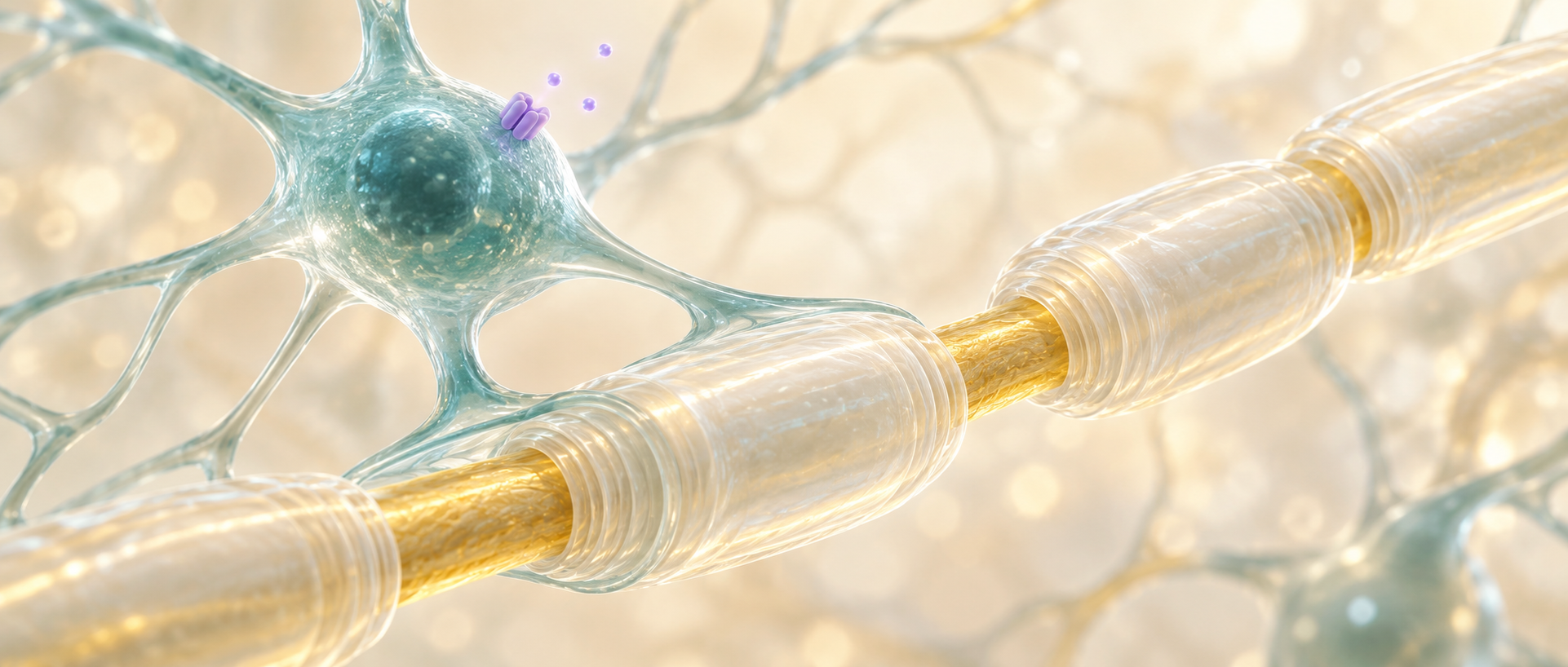
Myelin forms an insulating sheath around axons, supporting efficient neural transmission. Repair after damage requires not only new material but maturation of the cells that make the sheath. A study published on June 5, 2025 in Advanced Science focuses on the Kir4.1 potassium channel in oligodendrocyte precursor cells (OPCs). In demyelinated mice, impaired channel function accompanies repair deficits; the small molecule 2-D08 enhances channel activity and improves myelin structure and motor performance. The study also extends its observations to a very small marmoset cohort. Precursors may be present in demyelinated lesions without completing maturation. Enabling these cells to enter the myelin-producing stage is a central problem in repair.
OPC Kir4.1 supports recovery after demyelination. Associated effects of 2-D08 depend on this channel and accompany increased FYN phosphorylation and cellular maturation.
Contents · 7 sections
The precursor cell’s electrical state changes
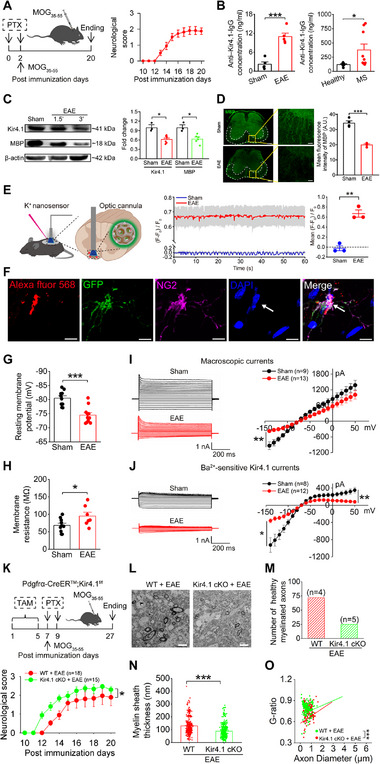
In mice with experimental autoimmune encephalomyelitis (EAE), spinal myelin decreases and extracellular potassium signals rise. OPCs, which replenish oligodendrocytes, also change: Kir4.1 currents decline in the ventral lesion region, alongside altered membrane electrical properties.
Removing Kir4.1 from OPCs further worsens disease manifestations and myelin structure. The examined astrocytes show no equivalent change in channel activity, and astrocytic Kir4.1 removal does not further worsen the corresponding motor deficits. The contributions of different glial cell classes begin to separate. In healthy adult mice, loss of this precursor channel does not clearly change basic behavior or mature-cell abundance; the disease state reveals a stronger dependence on it.
Source: Liu M et al. · Advanced science (Weinheim, Baden-Wurttemberg, Germany) · CC BY
Original figure and English caption ↗
2-D08 enhances precursor-cell channel currents
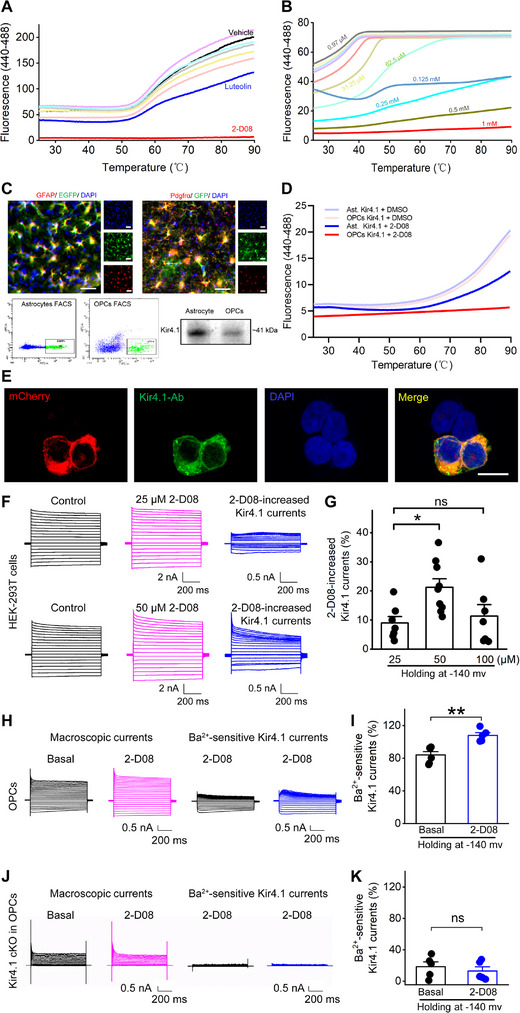
If channel impairment hinders recovery, could enhancing it make a difference? Screening and current recordings identify the small molecule 2-D08. Protein experiments support an interaction with Kir4.1, and it increases associated currents in channel-expressing cells and OPCs.
OPCs lacking Kir4.1 no longer show this current increase. Astrocytes also show no corresponding current change under the tested conditions, and related protein expression remains broadly unchanged in mature oligodendrocytes. The findings focus attention on precursors that retain differentiation potential.
Source: Liu M et al. · Advanced science (Weinheim, Baden-Wurttemberg, Germany) · CC BY
Original figure and English caption ↗
Improved electrical properties accompany better axonal wrapping
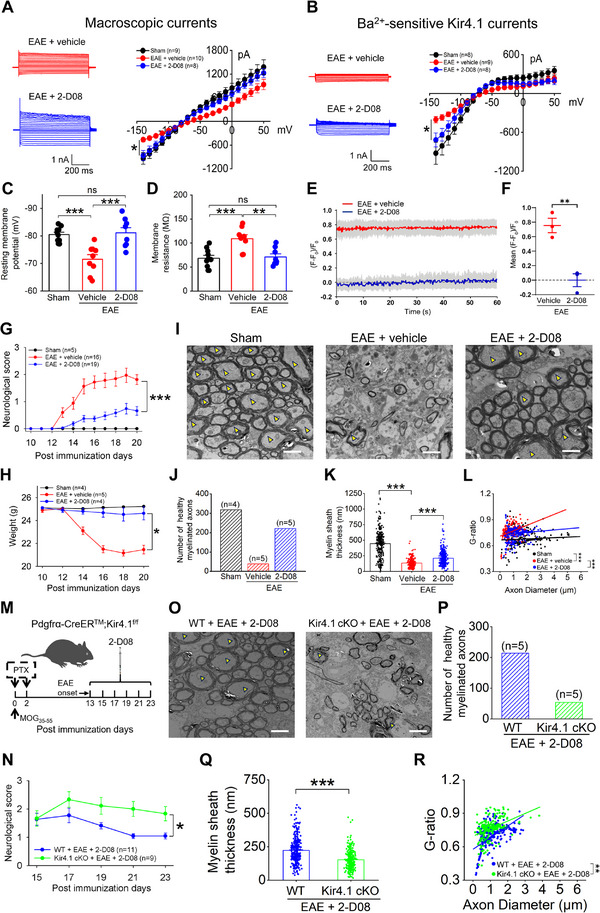
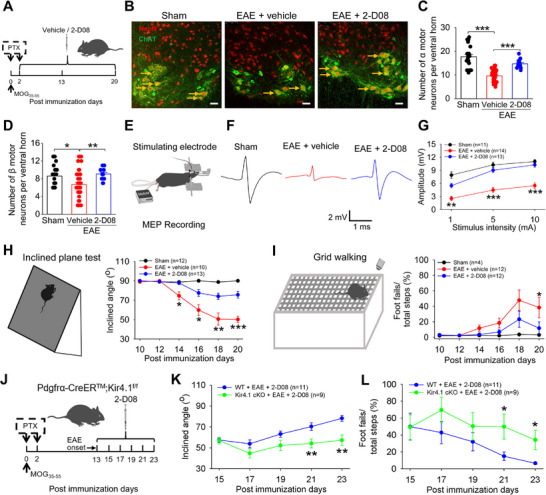
In one mouse series where intervention begins before disease onset, 2-D08 improves OPC currents and membrane properties while reducing elevated extracellular potassium signals. Electron microscopy shows more axons with substantial myelin, greater sheath thickness overall and improvement in the axon-to-sheath diameter ratio.
A separate series initiated after onset shows that mice lacking OPC Kir4.1 retain impaired recovery despite receiving the same intervention. Increased repair is also observed in a focal-demyelination model, extending the findings to a different injury context.
Source: Liu M et al. · Advanced science (Weinheim, Baden-Wurttemberg, Germany) · CC BY
Original figure and English caption ↗
Fewer missteps and improved conduction responses
Do structural changes correspond to motor performance? In the early-intervention series, spinal motor-neuron counts and motor-evoked-potential amplitudes improve. Mice maintain posture better on an inclined plane and make fewer hindlimb placement errors while walking on a grid.
In the channel-deficient comparison initiated after onset, these motor improvements are weakened. Findings at the levels of cellular channels, axonal wrapping and animal movement converge, supporting a relationship between OPC state and functional recovery after injury.
Source: Liu M et al. · Advanced science (Weinheim, Baden-Wurttemberg, Germany) · CC BY
Original figure and English caption ↗
The channel connects to FYN-associated signaling
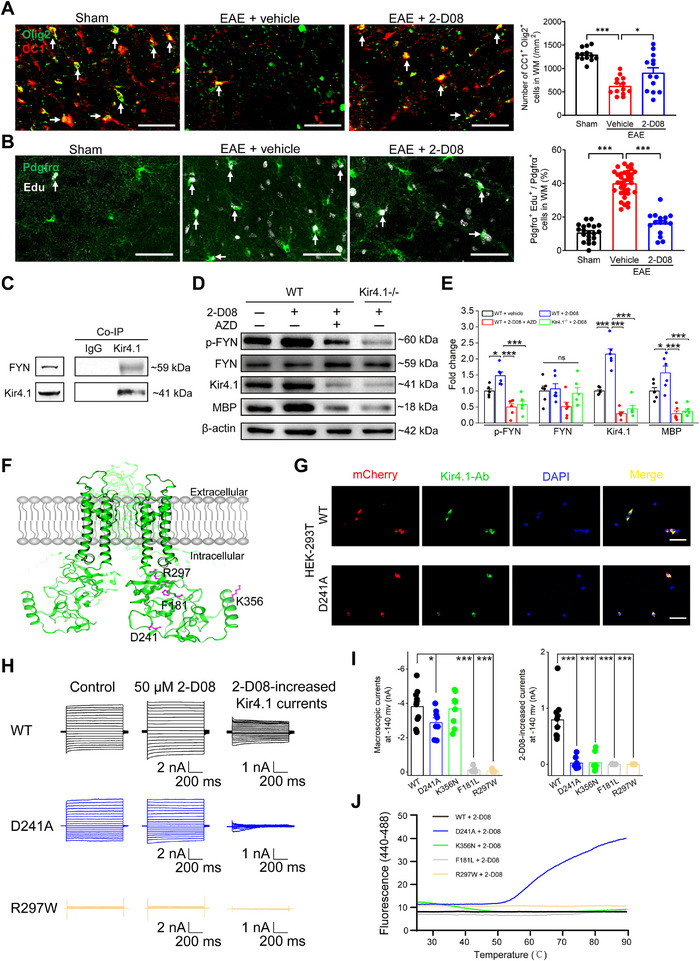
Mature oligodendrocytes make myelin. In mice receiving 2-D08, their abundance increases while proliferating OPCs decrease relative to untreated model mice. This pattern fits progression toward maturation rather than simply accumulation of more precursors.
Protein experiments connect Kir4.1 with the kinase FYN. 2-D08 increases FYN phosphorylation and the myelin-associated protein MBP while total FYN remains broadly unchanged. Kir4.1 loss or inhibition of associated kinase activity eliminates these changes, linking a membrane channel to intracellular differentiation signaling. Although 2-D08 is also studied as an inhibitor of SUMO modification, separately changing the SUMO pathway does not produce the same differentiation effect here, focusing attention on the channel–kinase connection.
Source: Liu M et al. · Advanced science (Weinheim, Baden-Wurttemberg, Germany) · CC BY
Original figure and English caption ↗
Similar motor improvements accompany different myelin changes
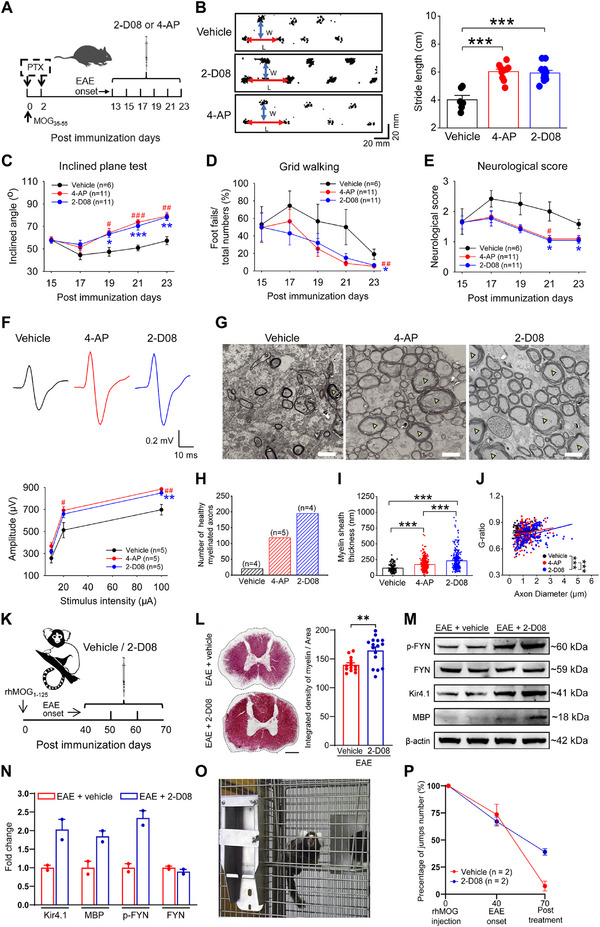
In a mouse series initiated after disease onset, the study compares 2-D08 with 4-AP. Both groups improve in stride length, motor tasks and evoked potentials, with some broadly similar motor outcomes. Sheath thickness and related ratio measures indicate stronger structural recovery in the 2-D08 group.
Improved movement can arise through different cellular actions. Examining function alongside sheath structure makes it possible to ask whether better performance is accompanied by restoration of axonal wrapping.
A small marmoset cohort shows similar tissue changes
In an EAE marmoset experiment with two animals per group, intervention begins after symptoms appear. Animals receiving 2-D08 show improvements in spinal myelin staining, MBP and FYN phosphorylation in the same direction as the mouse results, while retaining more cage-jumping activity.
This is a very small cross-species observation. Mechanistic results in adult male mice, together with preliminary data from male and female marmosets, place OPC potassium channels at the center of the repair question. Larger cohorts will determine how reproducibly this relationship holds.
Source: Liu M et al. · Advanced science (Weinheim, Baden-Wurttemberg, Germany) · CC BY
Original figure and English caption ↗