Why stress-related neural responses differ in female and male mice
In a defined acute-stress setting, adult female mice show more persistent local CRF-cell responses. Changing later activity or CRFR1 expression alters subsequent avoidance.
Do female and male mice develop different behavioral consequences after the same stress? A study published in Science Advances on May 10, 2024 examines the CRF network in oval bed nucleus of the stria terminalis, or ovBNST. The difference involves not only whether cells activate, but how long they respond: female local calcium responses persist longer during stress, while male responses subside earlier. This timing difference links peptide signals, cellular activity and exposed-space avoidance on the following day.
In the tested acute-stress condition, female ovBNST CRF-cell activity persists longer. Altering later activity during stress or changing CRFR1 expression in these cells changes subsequent avoidance.
Contents · 7 sections
Behavioral differences depend on stress duration
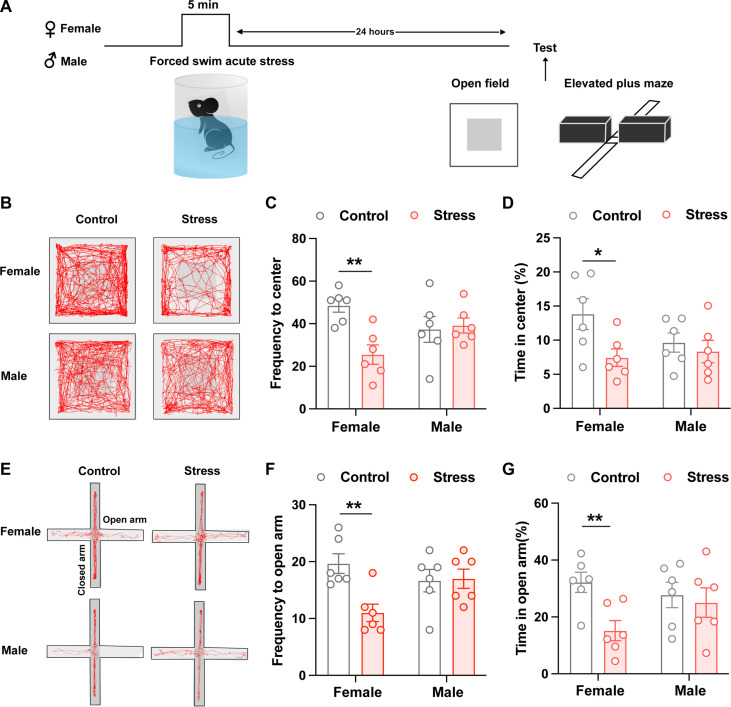
The team compares acute swim stress of different durations. With shorter exposure, neither sex subsequently shows significantly increased avoidance. At the intermediate duration, female center and open-arm time decrease without matching significant male changes. With longer stress, both sexes show avoidance, defining a particular window for the difference.
Behavior is measured the next day rather than only during swimming. The compared female estrous-stage groups do not significantly differ. Within this defined paradigm, the study asks what allows the same stress to produce subsequent avoidance earlier in females.
Source: Zhang N et al. · Science advances · CC BY-NC
Original figure and English caption ↗
An upstream input contributes without the same sex difference
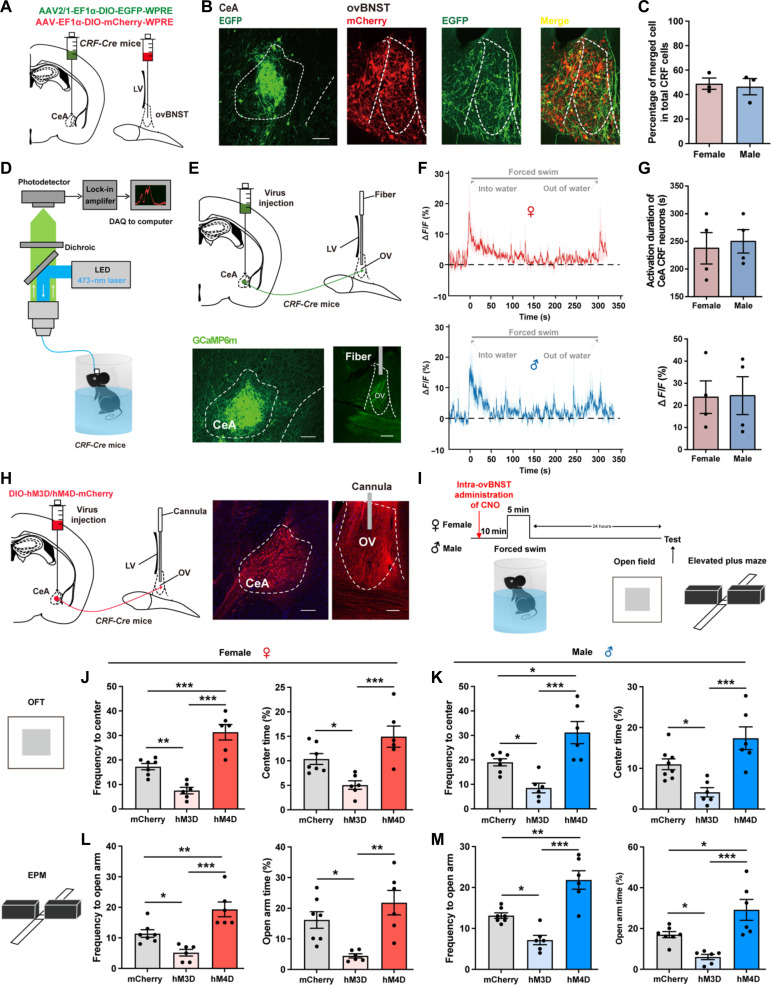
CeA CRF cells send input to ovBNST. Similar fractions of local CRF cells are anatomically linked to this input in both sexes, and terminal-calcium response duration and peak do not significantly differ during stress. This upstream candidate does not show the same distinction.
Increasing or decreasing this input affects subsequent exploration in both sexes. CeA contributes to the stress response, while explaining the sex difference requires examining local circuitry. Shared input can have different consequences in networks with differing states.
Source: Zhang N et al. · Science advances · CC BY-NC
Original figure and English caption ↗
The local peptide signal gains a second response
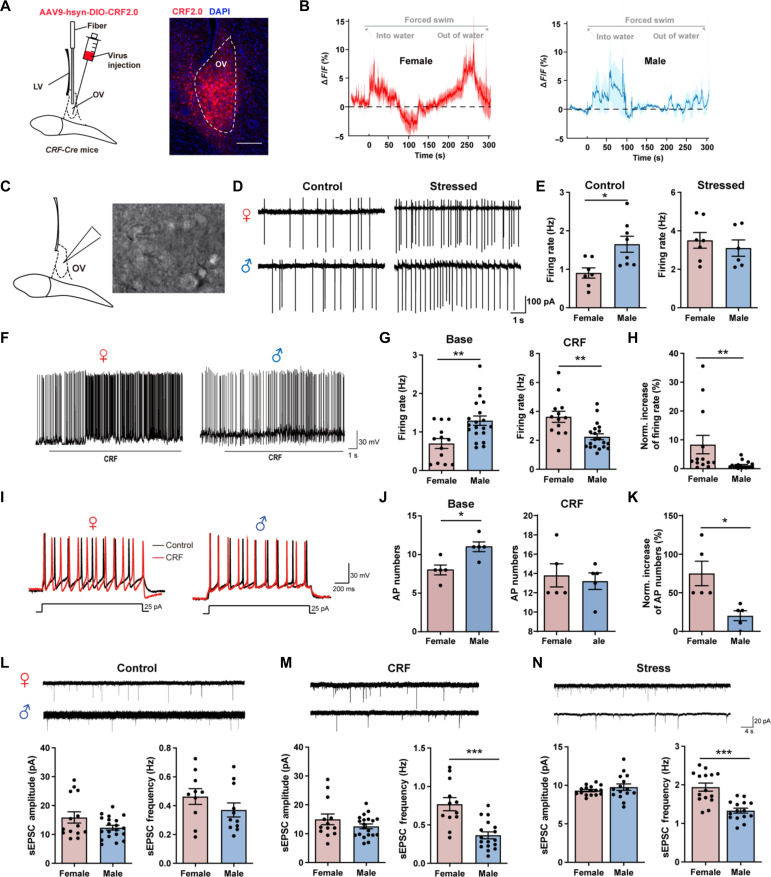
Direct observation of ovBNST CRF signals reveals a different picture. Both sexes respond early, but females show another prominent later response without a matching male peak. Local extracellular peptide and upstream terminal calcium display different temporal structures.
Local CRF could arise from other afferents or ovBNST cells themselves. Slice recordings show lower baseline spontaneous firing in female CRF cells; after stress, firing increases in both sexes to similar levels. A larger increase need not start from a higher baseline.
Applied CRF produces a larger firing increase in female cells. Excitatory-current frequency is higher than in males without a significant amplitude difference. Cellular activity, input events and peptide signals together direct attention to how ovBNST responds locally.
Source: Zhang N et al. · Science advances · CC BY-NC
Original figure and English caption ↗
Persistence matters alongside peak size
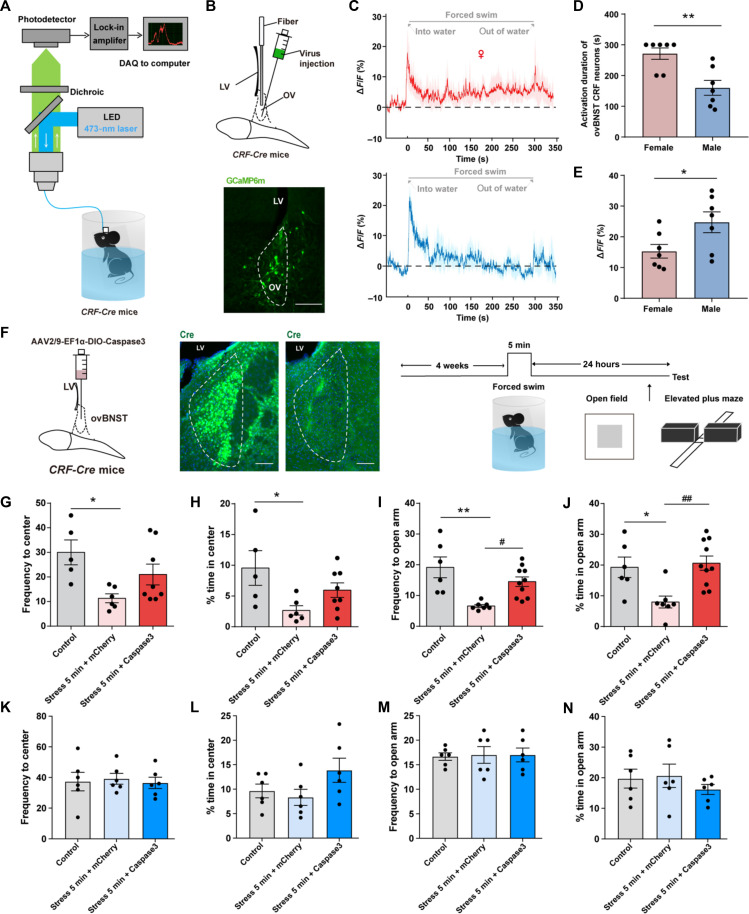
In vivo, female ovBNST CRF-cell responses persist through the intermediate stress episode, while male responses subside earlier. Male peaks are actually higher, so the comparison depends on temporal structure as well as maximum size.
Ablating this population improves female post-stress open-arm measures, without significant corresponding center-measure improvement. Males initially lack pronounced avoidance in this condition and show no significant change after ablation. Behavioral effects are scoped to particular tasks and stress conditions.
Source: Zhang N et al. · Science advances · CC BY-NC
Original figure and English caption ↗
Changing later stress activity alters next-day exploration
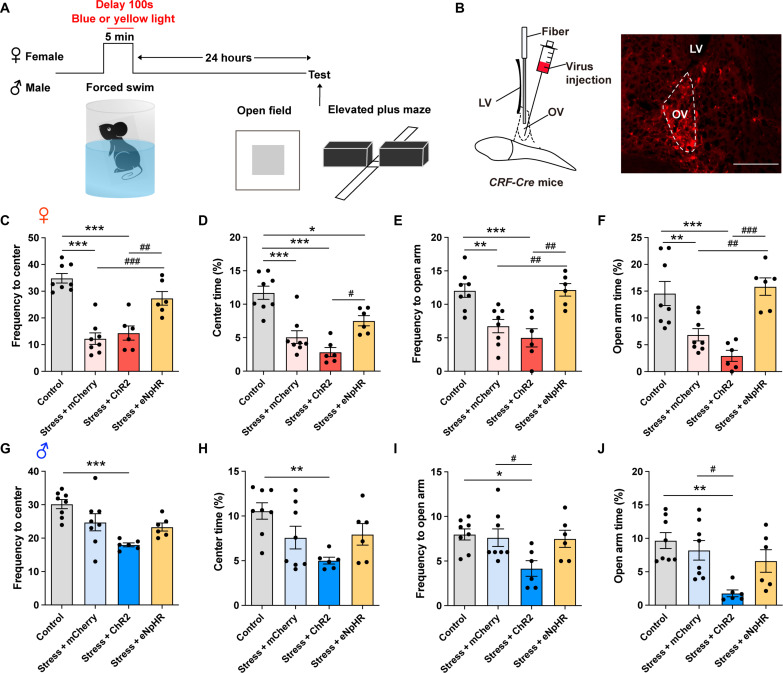
The team targets the later phase when activity trajectories diverge. Reducing female CRF-cell activity during that phase increases subsequent exposed-area exploration. Extending male activity promotes avoidance. The response’s persistence can therefore influence later choices under the same stress condition.
The timeline becomes a testable causal component. Intervention occurs during stress and behavior is assessed the next day, examining formation of subsequent avoidance. Cellular activity contributes to how a stress episode translates into later exploration.
Source: Zhang N et al. · Science advances · CC BY-NC
Original figure and English caption ↗
The receptor shapes how cells receive CRF
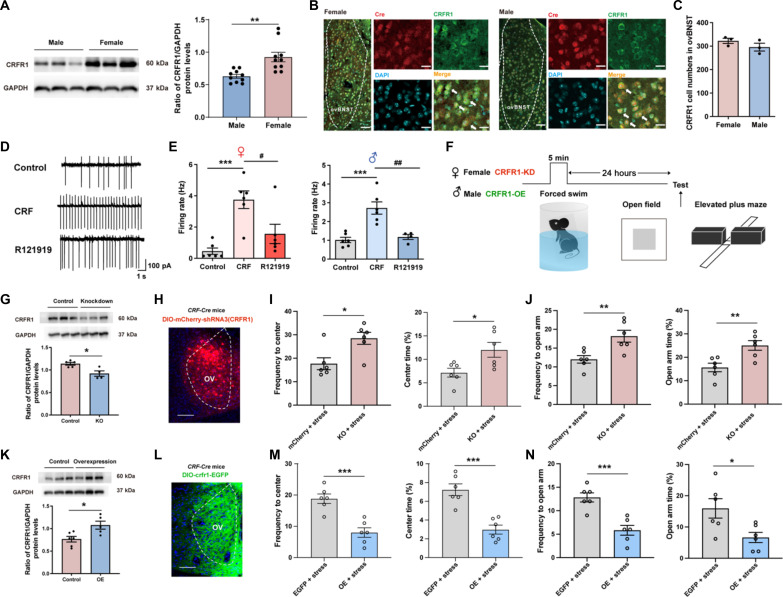
Before stress, female ovBNST tissue has higher CRFR1 protein levels without a significant sex difference in receptor-positive cell counts. CRF cells in both sexes carry CRFR1 labeling, and antagonism reduces applied-CRF firing enhancement in both. Expression and cellular responsiveness become linked.
Reducing CRFR1 specifically in female CRF cells increases next-day exposed-space exploration; increasing it in male CRF cells reduces exploration. The receptor participates in translating stress signals into cellular and behavioral consequences.
Source: Zhang N et al. · Science advances · CC BY-NC
Original figure and English caption ↗
Shared signals meet different local responses
This adult female and male mouse study develops a temporal account: similar upstream input can coexist with differing local peptide signals, receptor conditions and response persistence. Longer stress produces avoidance in both sexes, while the intermediate window reveals how sustained local activity contributes to their difference.
Cell number, receptor levels and activity timing give stress responses several interacting layers. Similar findings across the tested female cycle stages leave questions about developmental hormones, other input sources and broader stress contexts. The present account concerns the local CRF network in this defined model.