Caution or exploration? Two amygdala pathways work together
Two amygdala–BNST pathways exert opposing effects in male mice, with inhibitory networks and environmental cues contributing to their coordination.
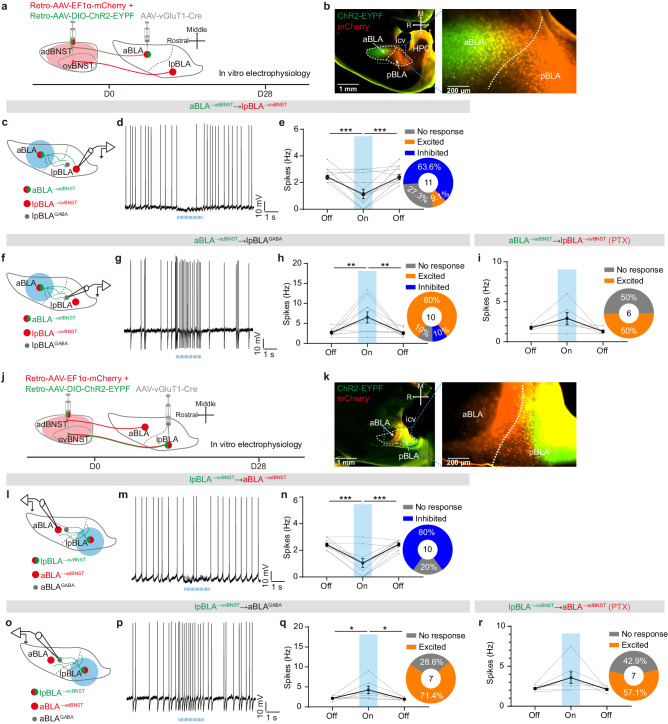
In unfamiliar surroundings, animals balance caution with exploration. How can vigilance change with context rather than remain persistently high? A study published in Nature Communications on April 24, 2024 examines dense connections between the basolateral amygdala (BLA) and bed nucleus of the stria terminalis (BNST). In male mice, neighboring pathways produce opposite behavioral changes and interact at both their origin and destination, revealing a basis for context-dependent anxiety-like responses.
Anterior BLA inputs primarily reach adBNST and promote exploration when activated. Lateral posterior BLA inputs primarily reach ovBNST and increase avoidance through adBNST inhibition. Their responses to open–closed arm transitions have opposite directions.
Contents · 8 sections
Neighboring origins reach different destinations
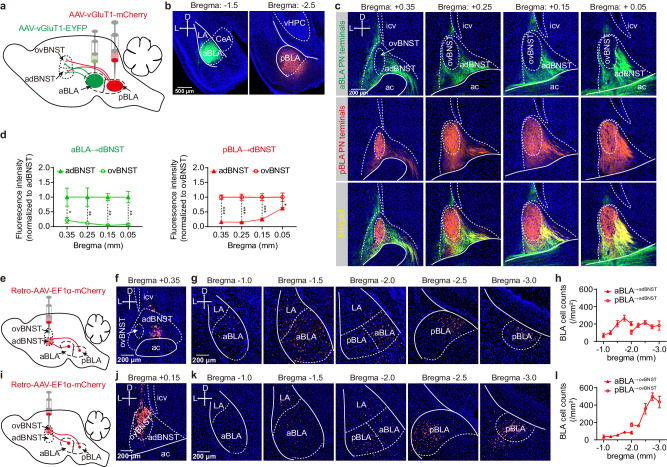
Dorsal BNST contains anterodorsal adBNST and oval ovBNST. Anterior BLA axons concentrate almost exclusively in adBNST, whereas posterior BLA axons are denser in ovBNST while also reaching adBNST. The broad projection therefore contains distinct routes.
Tracing back from the recipients placed adBNST-projecting cells in both anterior and posterior BLA, while ovBNST-projecting cells were concentrated posteriorly. This finer map provides an anatomical basis for examining opposing functions.
Source: Han RW et al. · Nature communications · CC BY
Original figure and English caption ↗
Excitatory inputs produce opposite net effects
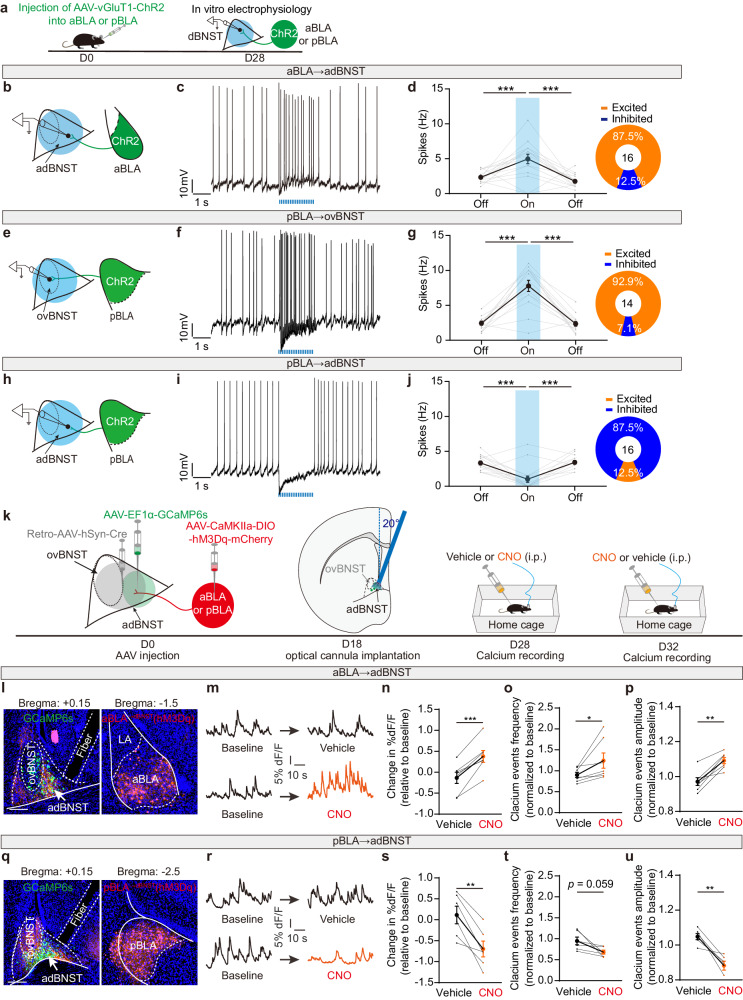
Activating anterior BLA inputs increased adBNST firing. Activating posterior inputs excited ovBNST cells but reduced adBNST firing. Both inputs are glutamatergic, yet the receiving network produces different net responses.
In vivo recordings showed the same direction: recruitment of anterior projecting cells increased adBNST calcium activity, whereas recruitment of posterior projecting cells decreased it. The anatomical difference thus extends to population activity.
Source: Han RW et al. · Nature communications · CC BY
Original figure and English caption ↗
An intervening circuit turns excitation into a brake
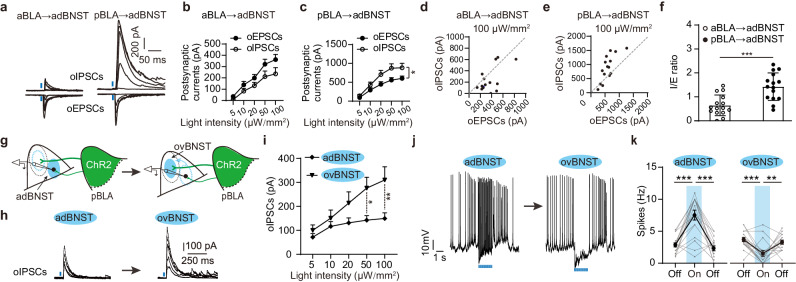
The inhibitory ovBNST-to-adBNST connection provides a key explanation. Posterior BLA inputs generated a higher inhibitory-to-excitatory current ratio, with stronger inhibition recruited through ovBNST than through the local adBNST network alone.
Selective activation of posterior BLA terminals in adBNST increased adBNST firing, whereas activation in ovBNST reduced it. Inputs from the same broad upstream region can therefore have opposite net effects through different recipients.
Source: Han RW et al. · Nature communications · CC BY
Original figure and English caption ↗
More exploration or greater avoidance?
The circuit differences also appeared in behavior. Anterior BLA-to-dorsal BNST activation increased open-field center time and open-arm exploration in the elevated plus maze, whereas posterior activation changed these measures in the opposite direction. Corresponding pathway inhibition produced opposite effects.
Neither activation significantly changed total open-field distance. The effects centered on approaching or avoiding exposed areas rather than changing overall locomotion. Local glutamate-receptor blockade in BNST abolished the behavioral effects of both projections, supporting a contribution from their direct inputs within this recipient region.
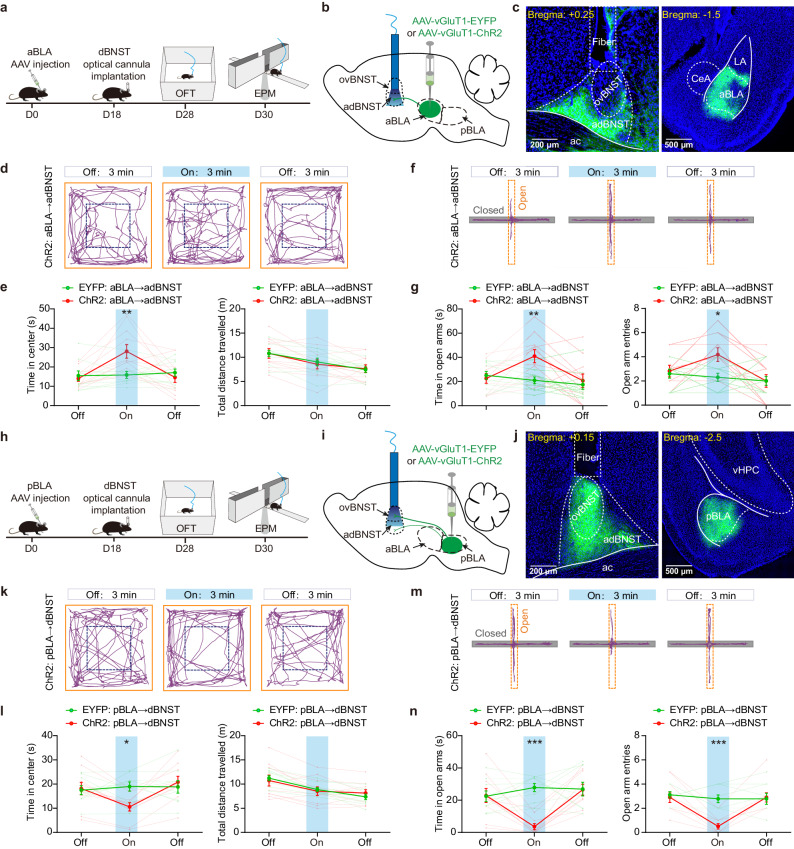
Source: Han RW et al. · Nature communications · CC BY
Original figure and English caption ↗
The destination helps determine the behavioral effect
Posterior BLA is itself functionally heterogeneous. More medial cells primarily project to adBNST, while more lateral cells primarily project to ovBNST. Activating the former promoted open-area exploration; activating the latter increased avoidance.
Activation of the broad posterior BLA-to-dorsal BNST projection can consequently differ from activation of an individual branch. Origin, destination and local processing together help explain behavioral regulation.
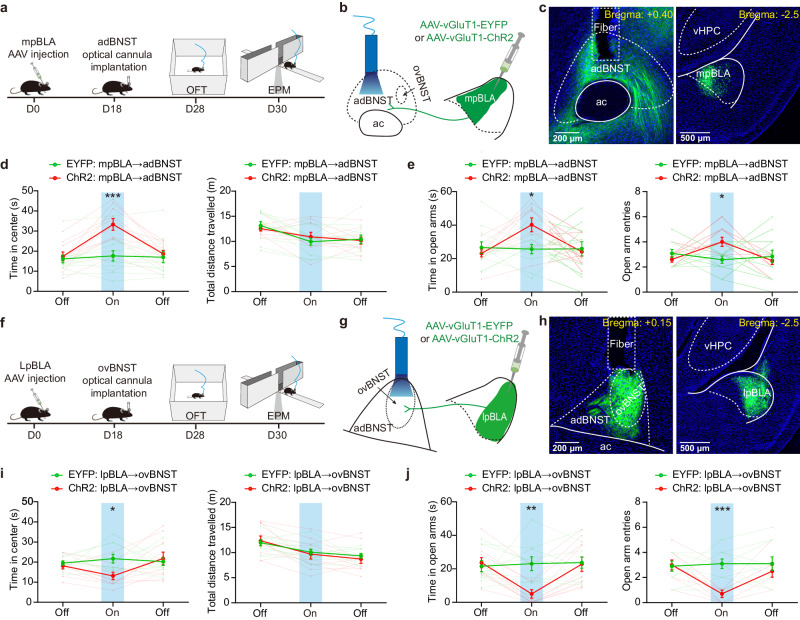
Source: Han RW et al. · Nature communications · CC BY
Original figure and English caption ↗
The pathways change direction at an exposed boundary
When mice moved from a closed to an open maze arm, anterior BLA-to-adBNST terminal activity decreased and lateral posterior BLA-to-ovBNST activity increased. Returning to a closed arm reversed the respective responses. Opposing population changes were aligned with environmental transitions.
Opposing responses aligned to open–closed transitions connect context with circuit activity and place the interventions alongside natural exploration. Separate experiments monitored recipient-region activity and behavior together: anterior-pathway recruitment increased adBNST activity and exploration, whereas lateral posterior-pathway recruitment reduced adBNST activity and increased avoidance.
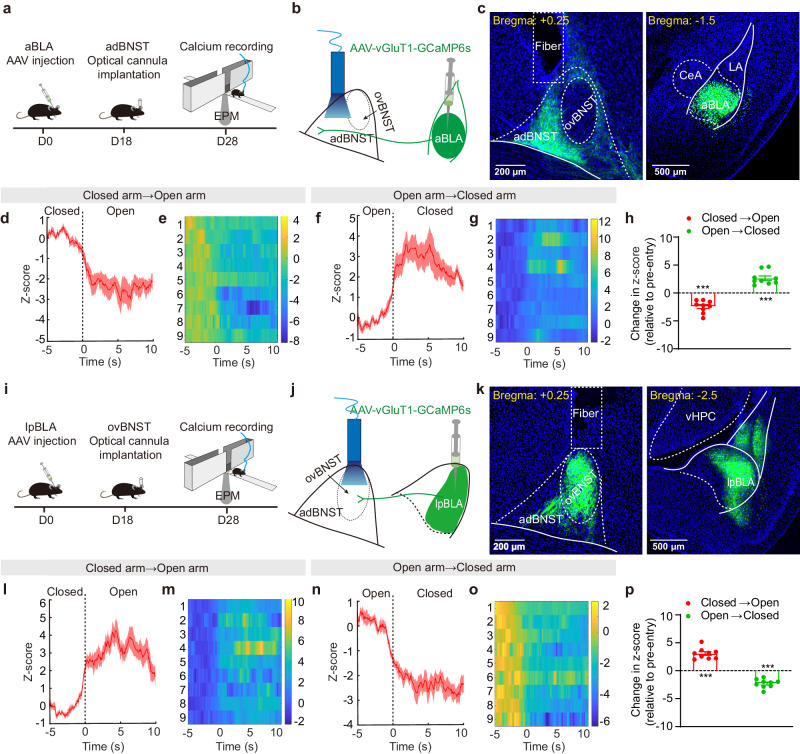
Source: Han RW et al. · Nature communications · CC BY
Original figure and English caption ↗
Local cells mediate reciprocal inhibition
Within BLA, activating anterior projecting cells suppressed lateral posterior projecting cells, and activation in the reverse direction also produced inhibition. Local inhibitory cells were recruited, and blocking GABA signaling abolished the reciprocal suppression.
The populations also differed in their upstream input proportions, including auditory, insular, ventral hippocampal and entorhinal regions. Distinct information sources and reciprocal local inhibition provide possible organizational bases for the opposing responses.
Source: Han RW et al. · Nature communications · CC BY
Original figure and English caption ↗
Several interacting connections shape the response
The study places promotion of exploration and increased avoidance within one circuit framework. Local inhibition at the origin, feedforward inhibition at the destination and different upstream information may together contribute to context-dependent regulation. The authors propose a coordination model for these functionally opposing pathways.
The evidence concerns cellular activity and exploratory behavior in male mice. The roles of distinct BNST cell types and corresponding functions in females remain open. Changing vigilance involves interactions among specific connections, revealing several levels of regulation within this network.
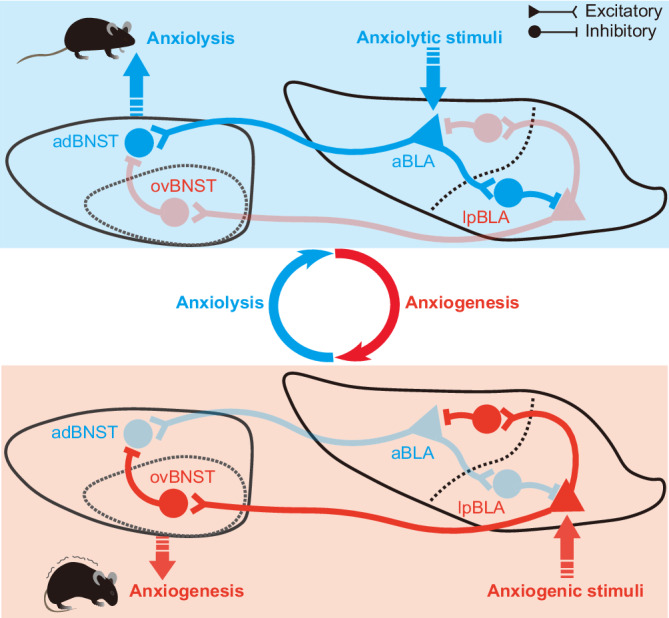
Source: Han RW et al. · Nature communications · CC BY
Original figure and English caption ↗