Why does returning to a stress-associated place increase activity?
Ventral hippocampal input and paraventricular thalamic PAC1 signaling contribute to context-related activity in male mice without generalized hyperactivity elsewhere.
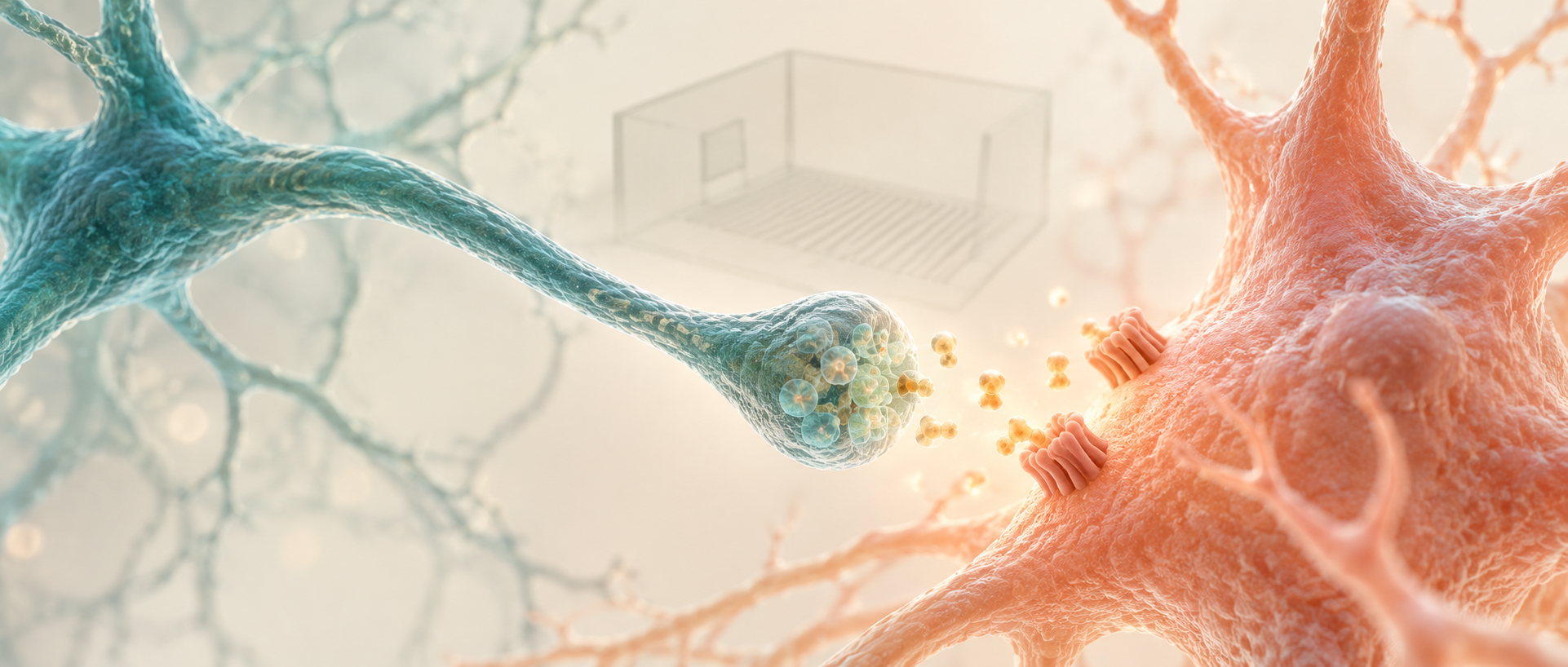
The same mouse can respond differently in different boxes. After repeated stress, it moves more in the stress-associated setting, without the same change elsewhere. How does a place become a trigger for an earlier experience? A Translational Psychiatry study compares two settings, follows ventral hippocampal input to paraventricular thalamus, or PVT, and examines PAC1 receptor signaling and thalamic excitability. Context becomes part of the explanation rather than merely the testing background.
Inhibiting PVT-projecting hippocampal cells during stress reduces later context-related activity increases. Inhibiting hippocampal-recipient PVT cells or locally blocking PAC1 also changes broader stress-related measures.
Contents · 7 sections
The activity change appears in one setting
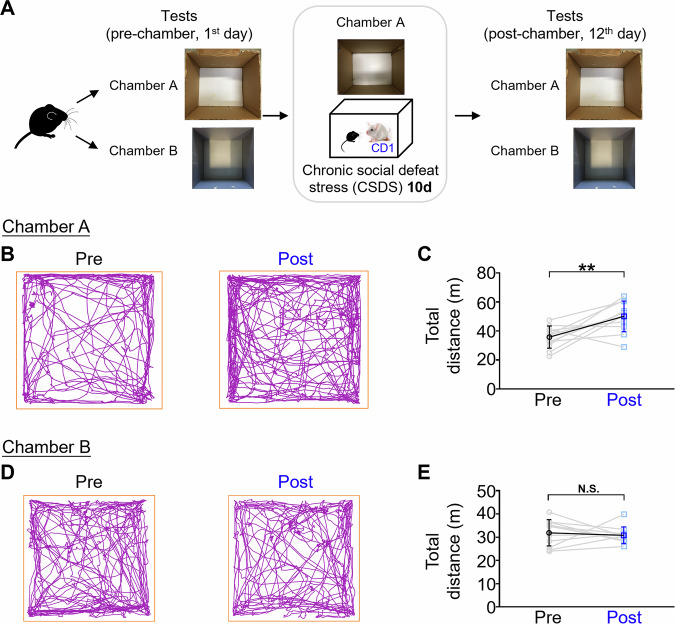
After ten days of chronic social defeat, male mice move farther in the original stress box but not significantly farther in a box of different material and dimensions. Context-related activity and open-arm avoidance persist for three weeks. Increased movement is associated with the prior setting rather than appearing everywhere.
Social and opposite-sex contact preferences decline and acoustic startle increases, while sucrose preference and forced-swim immobility show no corresponding abnormality. The distinct measures focus attention on the contextual difference: which neural activity changes the response to a familiar place?
Source: Cao Z et al. · Translational psychiatry · CC BY-NC-ND
Original figure and English caption ↗
Repeated PVT activation can be paired with context
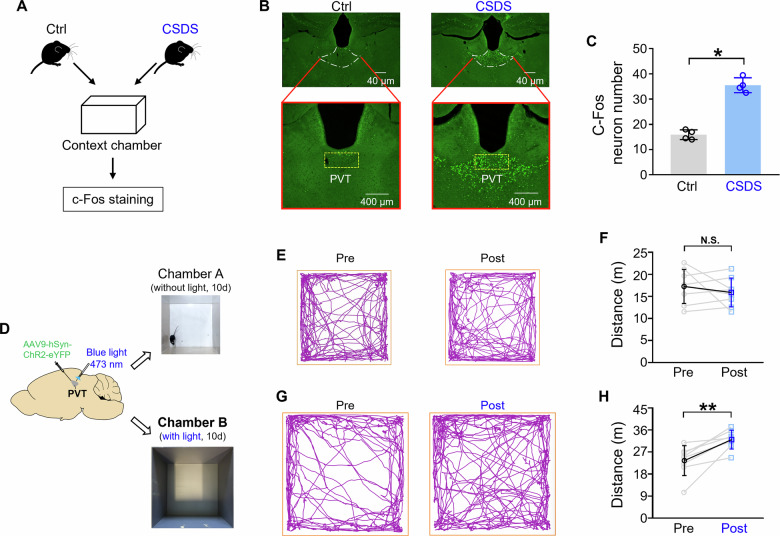
Reentry into the stress-associated setting increases PVT c-Fos. Researchers pair multiday PVT photostimulation with one box in mice without social defeat. Later activity increases in the paired setting, without significant changes in the other box.
Repeated stimulation also changes some avoidance, social and startle measures, while tested depression-related measures remain nonsignificant. Repeated thalamic activity paired with context produces a partly similar behavioral pattern, altering the later response to the setting rather than merely increasing movement during a test.
Source: Cao Z et al. · Translational psychiatry · CC BY-NC-ND
Original figure and English caption ↗
A direct route for context-related input
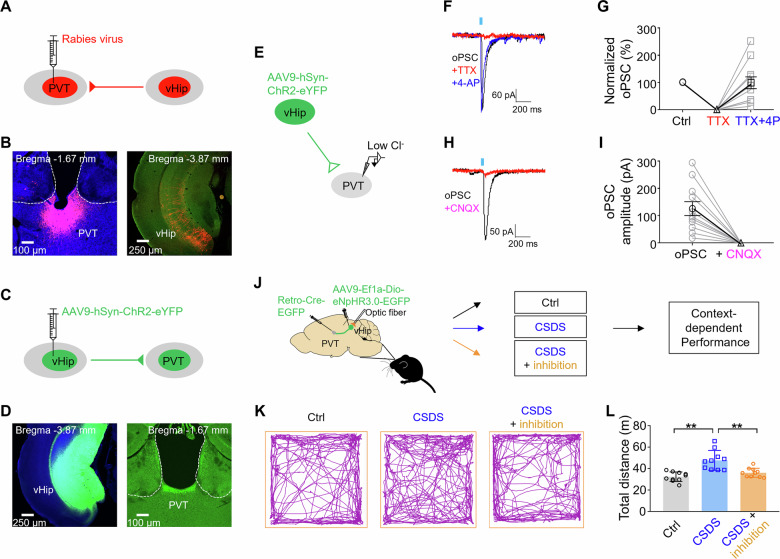
Bidirectional tracing connects vHip with PVT. Hippocampal-terminal stimulation evokes excitatory currents with pharmacological evidence for direct glutamatergic connectivity. Hippocampal activity has a defined route into this thalamic node.
After stress, miniature excitatory-current frequency rises without a significant amplitude change; miniature inhibitory currents remain unchanged, while evoked firing increases. The cells receive more frequent excitatory events and generate stronger output, motivating functional intervention.
Source: Cao Z et al. · Translational psychiatry · CC BY-NC-ND
Original figure and English caption ↗
Upstream and recipient cells differ in behavioral scope
Inhibiting PVT-projecting hippocampal cells during defeat reduces later context-related activity increases, while avoidance, reduced social and opposite-sex preferences, and enhanced startle remain. The upstream population has a prominent contextual contribution without explaining every measure.
Inhibiting hippocampal-recipient PVT cells reduces contextual activity and broader behavioral changes. Upstream and recipient manipulations have different scopes and outcomes, highlighting PVT as a convergence point within a wider network.
Heat and simulated threat engage the recipient population
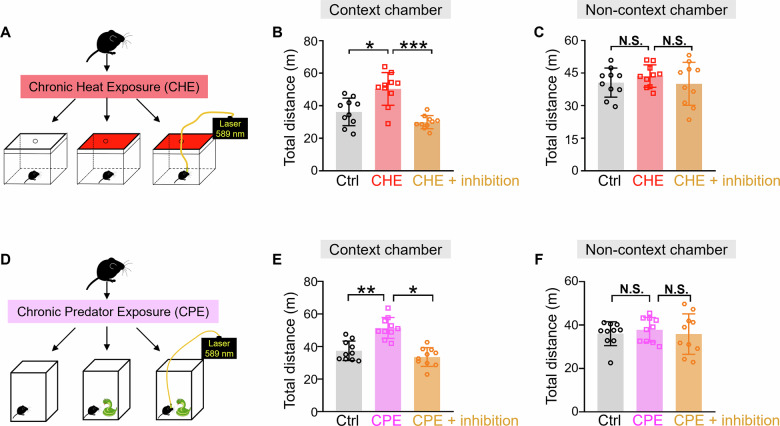
The study also examines repeated heat exposure and simulated predatory threat from a remote-controlled robotic snake. Recipient-cell inhibition attenuates stress-context activity increases in both, without significant unrelated-box changes, and improves several other measures. Context selectivity extends beyond social defeat.
Source: Cao Z et al. · Translational psychiatry · CC BY-NC-ND
Original figure and English caption ↗
PAC1 changes the thalamic cell state
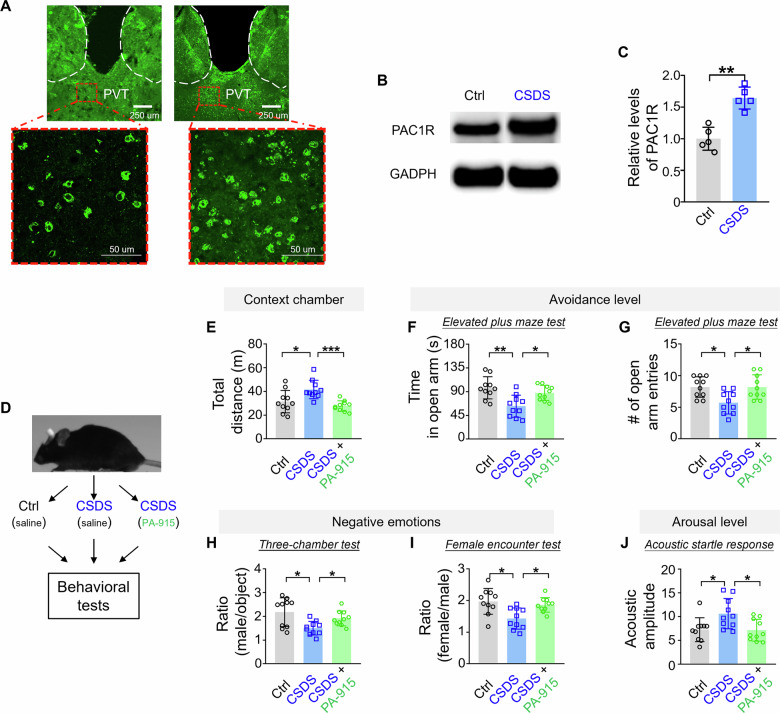
Stress increases PVT PAC1 immunoreactivity and protein levels. In slices, antagonism hyperpolarizes cells and reduces firing, while agonism produces opposite effects. The neuropeptide receptor system can tune responsiveness and provides a molecular correlate of stress-related excitability.
Local PVT PA-915 during defeat reduces later contextual activity and improves open-arm, social-preference and startle measures. Intervention during repeated experience implicates PAC1 signaling in the development of these changes.
Source: Cao Z et al. · Translational psychiatry · CC BY-NC-ND
Original figure and English caption ↗
An associated setting changes the response on return
In adult male mice, context-related input reaches a thalamic system whose state changes with stress. Hippocampal input, PVT activity and PAC1 modulation contribute to responses on returning to the stress setting. Increased movement gains meaning when place and prior experience are considered together.