Why does living with a stressed partner change behavior? From odor to prefrontal dopamine
Attractive breath, aversive urine and phase-dependent dopamine changes reveal how mice respond to sensory cues from defeated partners.
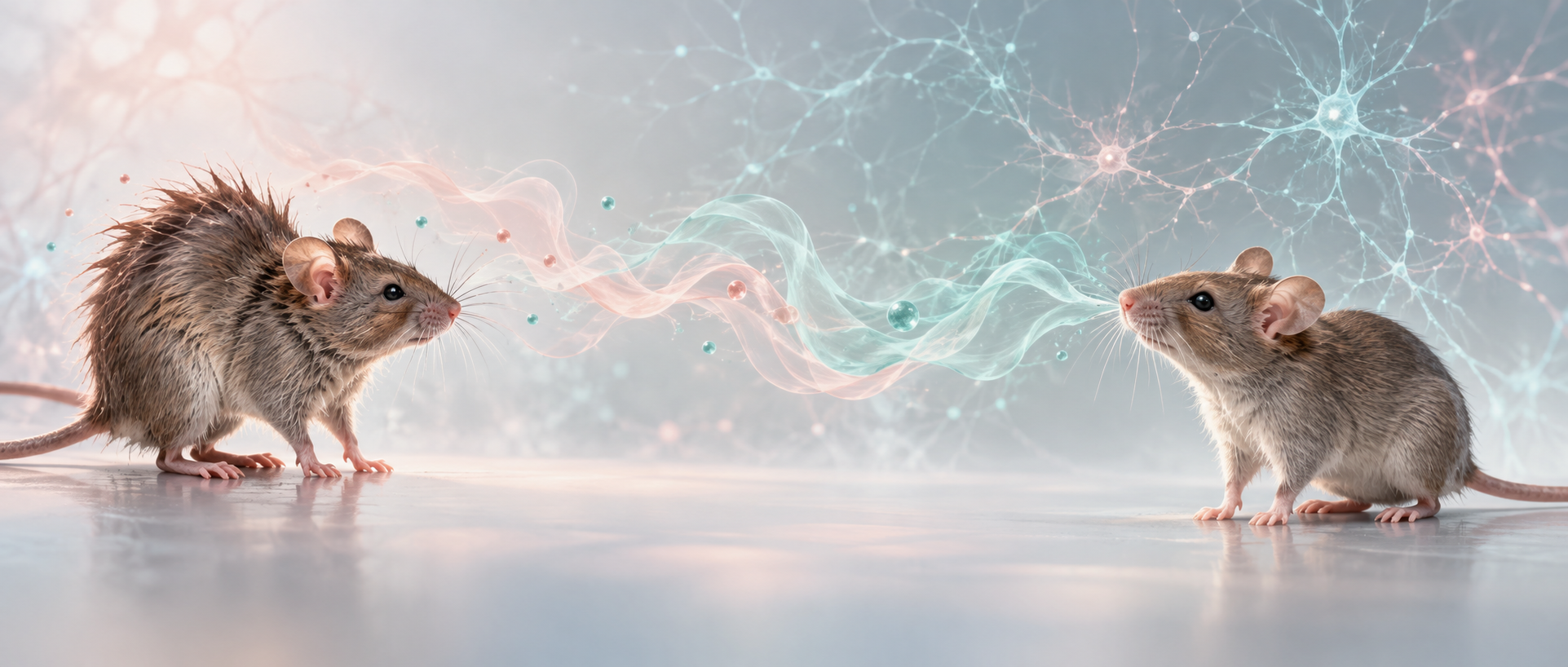
Animals living with a stressed partner may change their behavior too. Which cues come from witnessing an event, and which arise during subsequent interaction? A 2026 Nature Communications study follows mice that were not directly attacked as they live with defeated partners. It starts with a striking sensory difference: breath from the same defeated partner promotes approach, while urine elicits avoidance. Following two olfactory routes and prefrontal–midbrain connections, the researchers identify dopamine and its transporter, DAT, in behavioral modulation at different stages.
Distinct olfactory routes contribute to approach and avoidance toward defeated-partner cues. Prefrontal dopamine rises during interaction but falls after repeated cohabitation, and DAT modulation changes the associated behavioral trajectories.
Contents · 6 sections
Behavioral changes emerge through living together
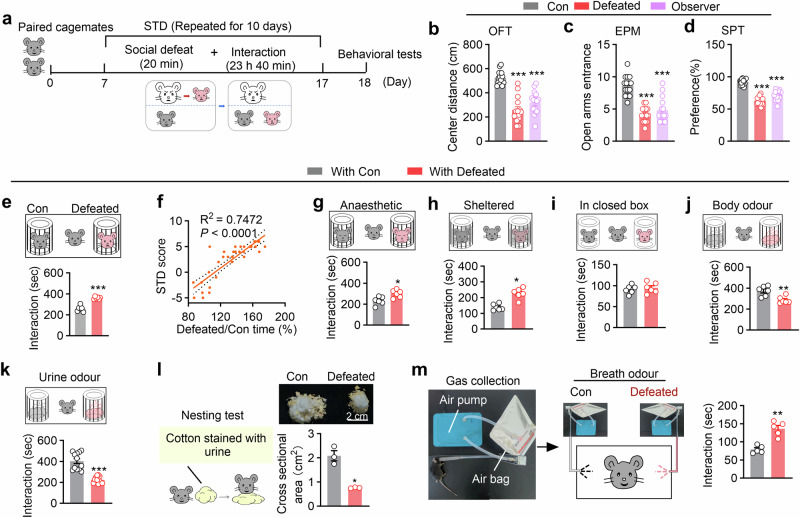
Observer mice witnessed partners’ social defeat without direct attack and subsequently lived with them. After ten days, changes appeared in exploration, reward preference, immobility and interaction. Cohabitation alone also produced related outcomes, whereas witnessing alone did not produce equivalent significant changes. Overt aggression during cohabitation was not observed.
The comparison directed attention to sensory and interaction cues during daily cohabitation. Initial approach preference toward defeated partners also correlated with later outcomes. Which inputs accompany approach, and how the brain processes them, became the next questions connecting partner state with observer behavior.
Source: Zhang K et al. · Nature communications · CC BY-NC-ND
Original figure and English caption ↗
Breath attracts while urine repels
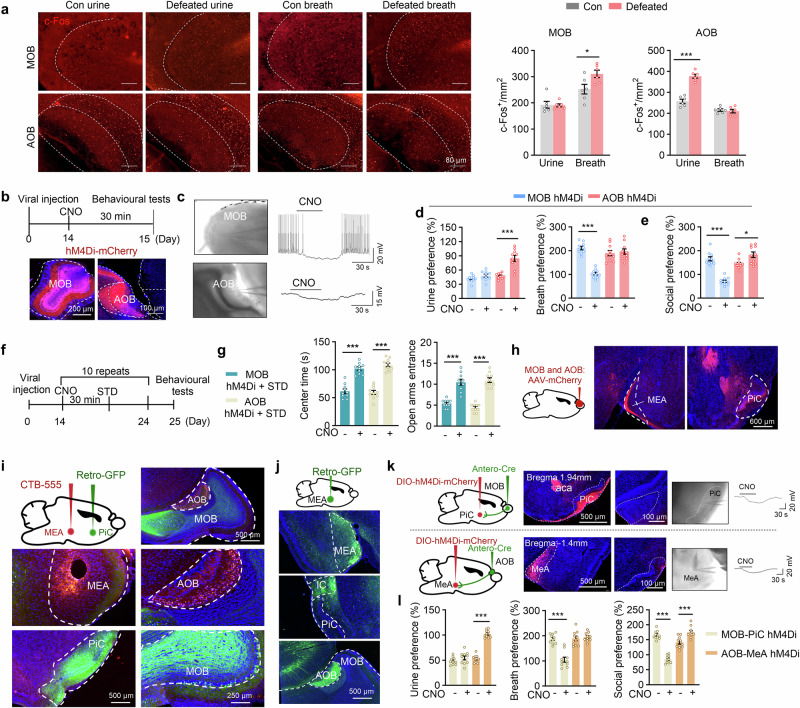
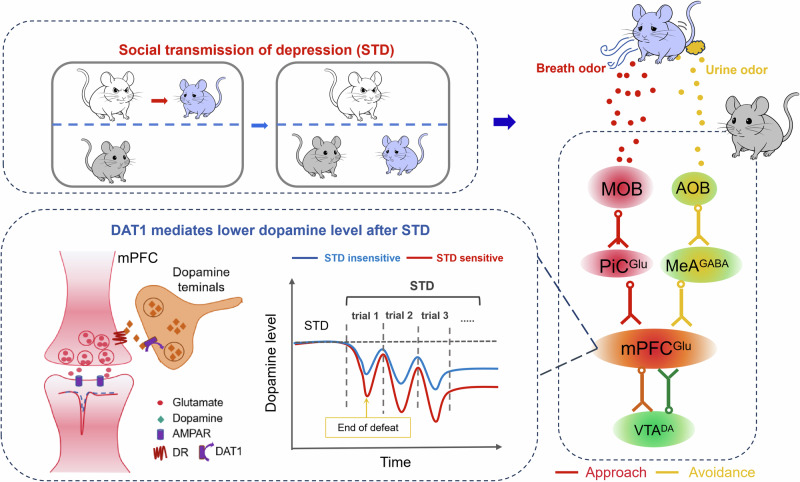
Urine and some body odors from defeated partners elicited avoidance, whereas breath promoted approach. The main olfactory bulb–piriform cortex, or MOB–PiC, route favored breath-related approach, while the accessory olfactory bulb–medial amygdala, or AOB–MeA, route contributed to urine-related avoidance. Modulation of the routes revealed different functions, showing that one partner can supply opposing sensory drives.
Breath profiling identified altered compounds, some attractive and others aversive under the tested conditions. Combinations of odor cues made approach and avoidance a process requiring integration. The study therefore followed how the routes converge at a higher level.
Source: Zhang K et al. · Nature communications · CC BY-NC-ND
Original figure and English caption ↗
Different inputs relate to different interaction phases
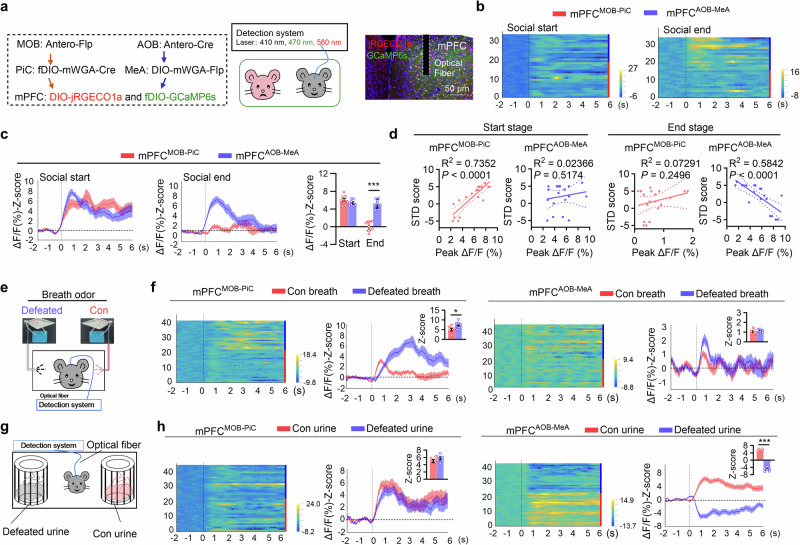
Both olfactory routes converge on medial prefrontal cortex, or mPFC. Dual-color calcium recordings showed MOB–PiC-associated cells recruited mainly at interaction onset, whereas AOB–MeA-associated cells were active at both onset and ending. Their activity related oppositely to final phenotype scores, and pathway inhibition attenuated observer outcomes.
The timing of approach and departure was thus related to different input populations. Prefrontal cortex emerged as an integration site, where partner odors did not uniformly drive behavior but arrived through distinct routes associated with event phases and the organization of interaction timing.
Source: Zhang K et al. · Nature communications · CC BY-NC-ND
Original figure and English caption ↗
Higher during interaction, lower after repeated exposure
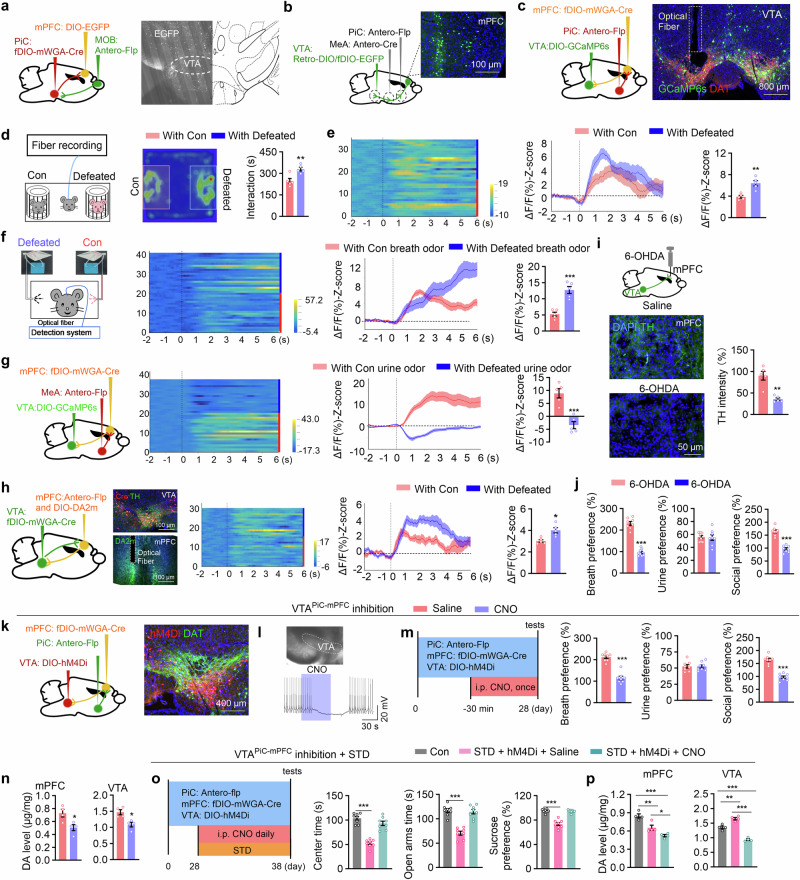
Relevant prefrontal cells project to the ventral tegmental area, or VTA. Midbrain activity and mPFC dopamine signals increased during interaction. Reducing prefrontal dopamine terminals or suppressing the relevant prefrontal–VTA route reduced breath and partner preference and attenuated observer outcomes, linking odor-guided approach with dopamine-related circuitry.
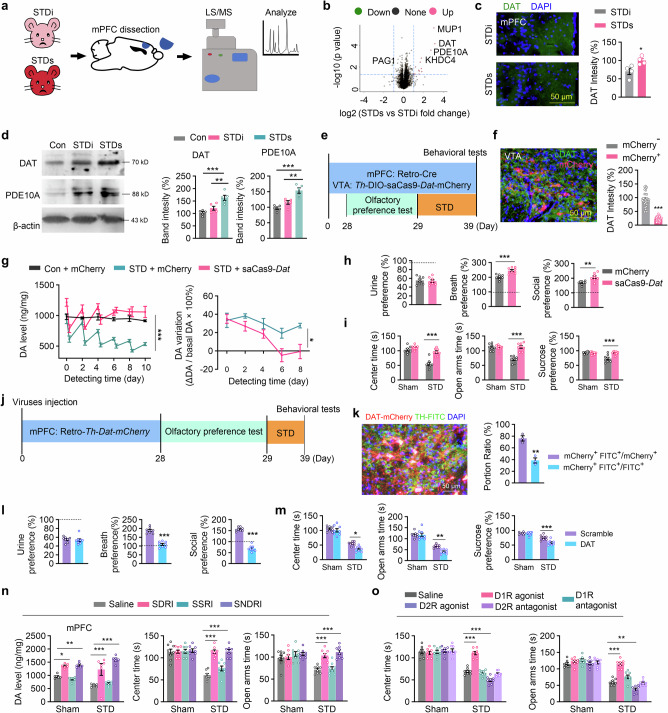
After ten days of cohabitation, susceptible animals had lower prefrontal tissue dopamine and higher DAT. Rapid responses during interaction and tissue levels after repeated exposure described changes on different timescales. Dopamine’s contribution therefore involved both short-term approach and longer-term state changes.
Source: Zhang K et al. · Nature communications · CC BY-NC-ND
Original figure and English caption ↗
Stronger approach can accompany a milder final phenotype
Reducing DAT in mPFC-projecting VTA cells increased prefrontal dopamine and slowed its decline during repeated exposure. Approach preference became stronger while the final phenotype was attenuated. Increasing DAT produced effects in the opposite direction. Initial approach and longer-term outcomes therefore had a nonlinear relationship shaped in part by transmitter clearance.
Pharmacological comparisons after exposure offered additional clues. DAT and multi-transmitter reuptake inhibitors improved related behavior, whereas fluoxetine did not significantly improve it under the tested conditions. A D1 agonist had an effect, while the tested D2 agonist did not show the same outcome. These differences brought further details of prefrontal dopamine regulation into view.
Source: Zhang K et al. · Nature communications · CC BY-NC-ND
Original figure and English caption ↗
Sensory input and transmitter clearance shape behavioral trajectories
From attractive breath and aversive urine through prefrontal inputs and midbrain connections to DAT changes, the study brings several phases into one picture. Partner state influences interaction through sensory cues, while the observer’s own transmitter regulation relates to longer-term outcomes. Cohabitation-related change emerges as an interplay of approach, avoidance and state adjustment.
The picture leaves specific directions for further work: changes beyond DAT, coordination of signals across phases, and trajectories under other sensory conditions. Following short-term interactions and longer-term states continuously will help clarify these relationships.
Source: Zhang K et al. · Nature communications · CC BY-NC-ND
Original figure and English caption ↗