Why does half an hour with a partner reduce drug seeking?
A male-rat study finds different populations recruited by social reward and drug seeking, with reciprocal local inhibition linking one reward to the other behavior.
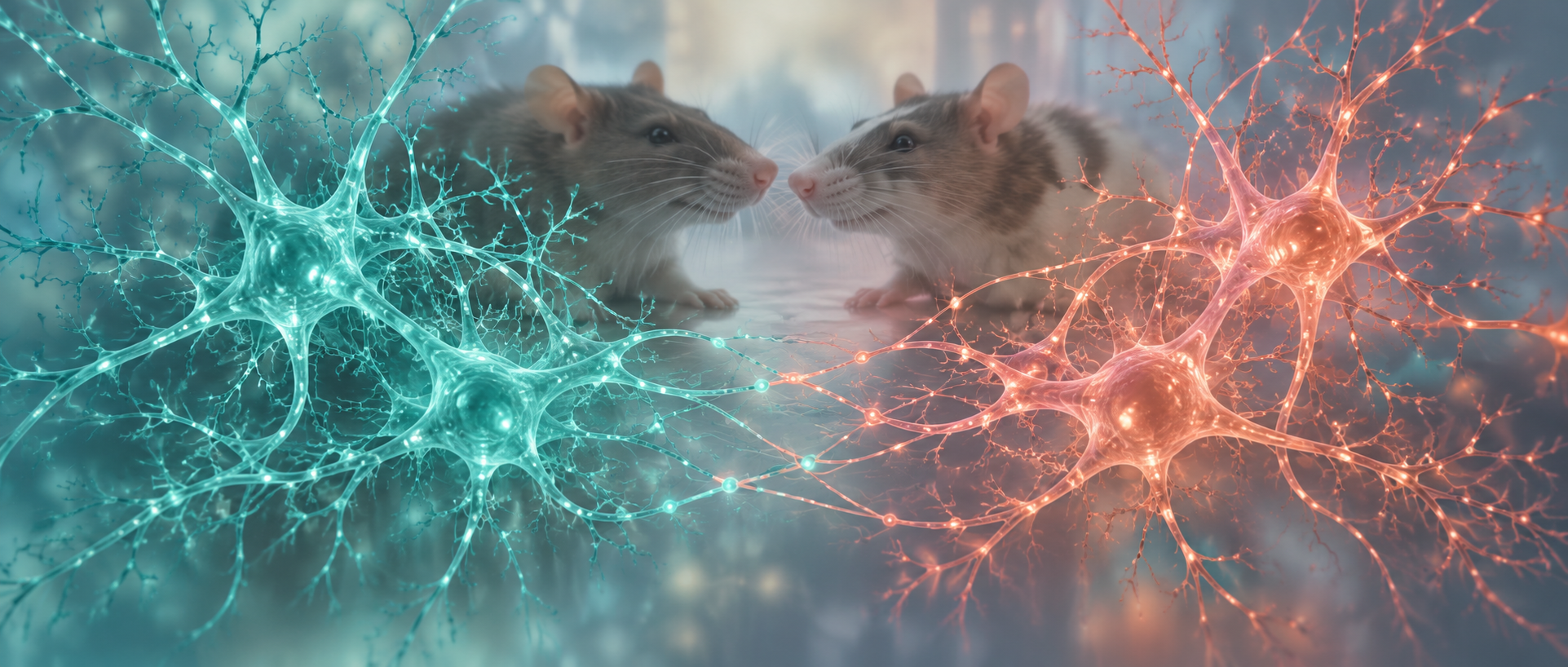
Why can drug cues become less compelling after interaction with a partner? A 2026 Nature Communications study compares social reward with drug seeking in the VTA of male rats. Dopamine cells appear active in both situations, but single-cell observations identify largely different ensembles. The populations also have inhibitory connections: cells recruited by natural reward can reduce seeking-associated responses. Cellular specialization within the reward system thus offers an explanation for the short-term influence of partner interaction.
Social-associated VTA dopamine ensembles reduce cue-induced drug seeking and reciprocally inhibit seeking ensembles through GABA-related transmission. DRN-input modulation can mimic or weaken this short-term effect.
Contents · 6 sections
Responses to drug cues decrease
After self-administration, extinction and recovery, rats responded through the active hole to drug-associated cues. Thirty minutes with drug-naïve juvenile partners reduced cocaine- and heroin-associated active responding, with similar inactive responses. Toys and anesthetized partners did not have the same effect, highlighting active partner interaction.
The interaction also supported place preference and operant social reward, indicating rewarding properties. The test measured cue-induced seeking without delivering drugs. Natural reward could change responses to learned drug cues, prompting investigation of interactions within the brain.
Similar population increases arise from different cells
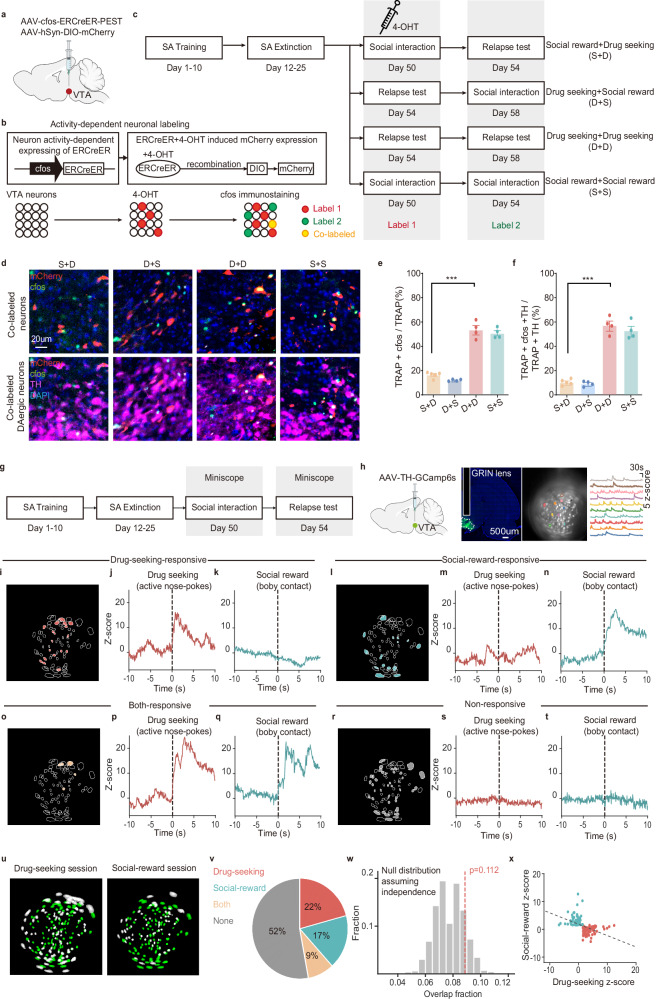
Bulk VTA dopamine calcium and NAc dopamine increased during both interaction and seeking, and seeking responses weakened after interaction. Same-field single-cell imaging and dual activity labeling found largely different responders with some overlap. The populations were not spatially segregated, placing functional distinctions within the same region.
Repeated stimuli across days recruited corresponding cells, and ensemble differences persisted when social and drug rewards were both assessed operantly. Moving from bulk recordings into single cells gave the same overall dopamine increase different compositions. Which cells were active became central to understanding the behaviors.
Source: Zheng W et al. · Nature communications · CC BY
Original figure and English caption ↗
Dopamine populations also have GABA-related inhibition
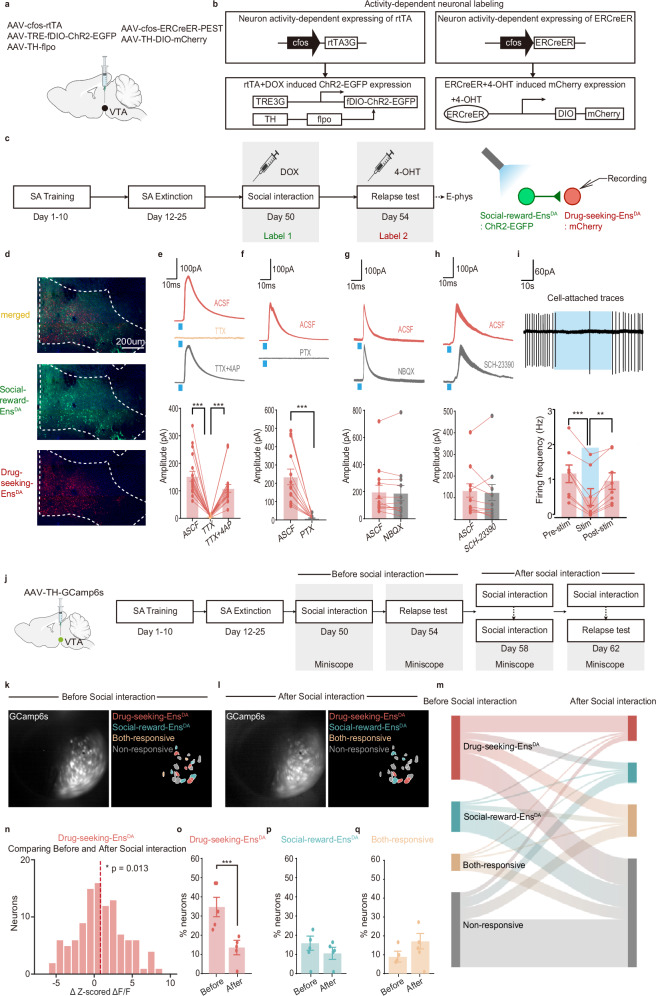
Social-ensemble stimulation produced GABA-receptor-sensitive inhibitory currents in seeking cells, with electrophysiological comparisons supporting monosynaptic connectivity. Reverse tests were similar. Firing decreased in recipient subsets, while random dopamine activation rarely produced the same currents, indicating ensemble-selective inhibition.
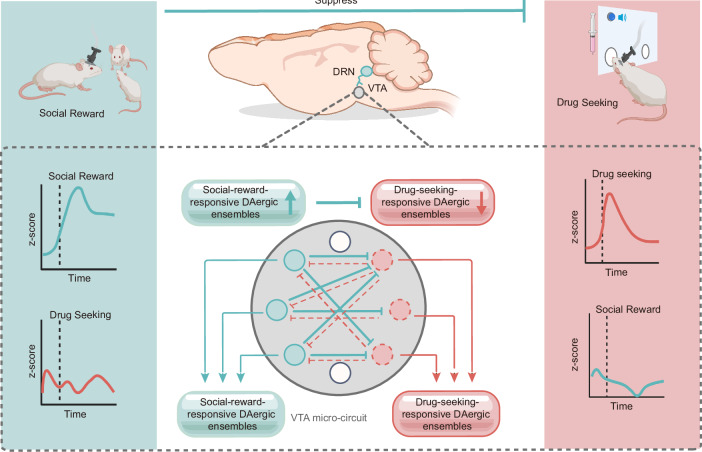
ALDH1a1 labeling and pharmacology supported GABA co-release-related communication. Reciprocal inhibition gave competition a local functional meaning: recruitment of one population could reduce responses in the other. Dopamine identity thus included diverse communication and behavioral functions.
Source: Zheng W et al. · Nature communications · CC BY
Original figure and English caption ↗
Social-ensemble activity influences seeking
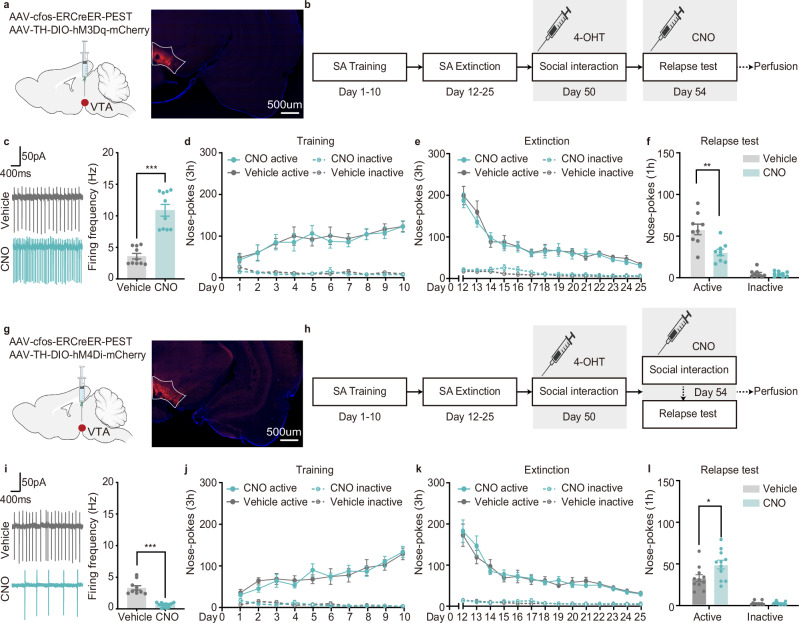
Reactivating VTA cells labeled during social reward reduced active cocaine-cue responding, whereas random dopamine activation did not. Suppression during interaction weakened the subsequent improvement. The two directions linked the defined ensemble with reduced seeking.
Prior seeking also reduced the proportion of later social responders without matching changes in individual response amplitude. Recruitment changed rather than every cell weakening proportionally. These population changes and local reciprocal inhibition together outlined competition between the behaviors.
Source: Zheng W et al. · Nature communications · CC BY
Original figure and English caption ↗
DRN-related input connects with social reward ensembles
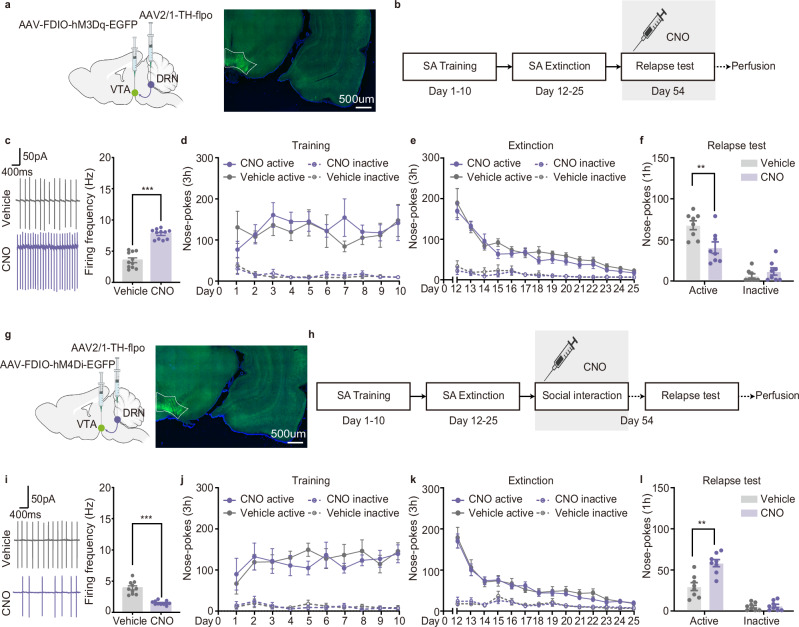
Input proportions differed, with more DRN-related input to social ensembles. Activating DRN-recipient VTA dopamine cells reduced cocaine and heroin seeking; suppression during interaction weakened improvement, while VP- and VS-associated controls lacked the same effect. Input identity again aligned with functional differences.
Upstream input, inhibition within VTA and NAc dopamine changes connected several observable sites of social-reward influence. Specific downstream recipients still need localization. The input selectivity already revealed finer organization within one reward region.
Source: Zheng W et al. · Nature communications · CC BY
Original figure and English caption ↗
The effect of one interaction fades with time
The behavioral improvement after one interaction disappeared by twenty-four hours, as did attenuation of seeking-associated calcium and dopamine. Longer-term social housing had separate effects. With the drug-naïve juvenile partners used here, a brief encounter produced a brief window of influence: competition between reward-related populations did not become permanently fixed after interaction.
The same VTA region responds to partners and drug cues, yet one set of cells does not handle every reward. Socially recruited cells can temporarily reduce responses in seeking ensembles through local inhibition. These male-rat findings give a cellular account of how one reward alters drug seeking, revealing specialization within a dopamine system whose populations influence one another as context changes.
Source: Zheng W et al. · Nature communications · CC BY
Original figure and English caption ↗